Download Subtitles for Nick Land's Fanged Noumena Lecture 3
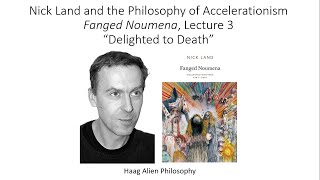
Nick Land Fanged Noumena Lecture 3 Delighted to Death
Haag Alien Philosophy
SRT - Most compatible format for video players (VLC, media players, video editors)
VTT - Web Video Text Tracks for HTML5 video and browsers
TXT - Plain text with timestamps for easy reading and editing
Scroll to view all subtitles
I'd like to continue the series of
videos on the philosophy of
accelerationism by resuming the reader's
guide over Nick Lan's Fang Nomina. In
this video, we will examine the third
essay within this book, Delighted to
Death. So, Nick Lan begins the essay by
quoting a passage from Thinking Against
Oneself, which claimed that the true
source of the most profound discoveries
is not at all the stereotypical image of
the kind of pacifist reflection
typically associated with like Eastern
spirituality as rather a certain violent
excess of intensity. In fact, he cites
nothing short of the example of even
finding God himself as something which
is not accomplished through peacefully
descending into our most intimate
depths. Rather by pushing or perhaps one
might even say through accelerating to
the exterior limit of our fever to the
precise point where our rage colliding
with his a shock results. Likewise, he
warns us that the author of any given
text does not actually exert total
control over his work in a
one-directional path of subject
dominating object. For there is no work
in fact that does not return against its
author. The poem always crushes the poet
etc. He therefore quotes Lasu's proverb
that the intense life is contrary to the
tow in order to contrast this peaceful
cliche of self-discovery with the thirst
for annihilating ecstasy that has
actually possessed the western world.
This emphasis on pushing towards the
violent yet productive intensity at the
limit rather than maintain the peaceful
reflection of contemplating a set of
pregiven contents actually does fit
quite well with Nick Land's own
insistence that accelerationism is all
about accelerating capital. Not because
we like capital, but rather in order to
push it to the point of reaching a
certain singularity where its own laws
are suspended rather than perfected. He
notes in another short explanation of
the topic that any illusion of stability
really is just the negative feedback of
something like a metaphorical thermostat
which provides a certain
territorialization to use a delusing
quad term to try to keep a system in the
same state. Accelerationism of course is
all about the exact opposite. It's about
the dterritorialization
or the selfreinforcing flight or escape
associated with positive feedback. He
says himself, "As the circuit is
incrementally closed or intensified, it
exhibits ever greater autonomy. It
becomes more tightly autoproductive,
which is of course what positive
feedback already means because it
appeals to nothing beyond itself. It is
inherently nihilistic. It has no
conceivable meaning beyond
self-amplification itself. It grows
simply in order to grow. Mankind is
perhaps its temporary host, but
certainly not its master. its only
purpose really is itself. Accelerate the
process therefore means with regard to
this nihilism, do more of it. Because as
Nick Land says himself, there is no
distinction to be made between the
destruction of capitalism and its
intensification.
One must be very careful therefore to
contrast what is described here with all
of the well-known pseudo attempts to go
beyond capitalism which don't actually
really do that such as the Marxist ideal
that communism will actually be more
capitalist than capitalism is itself is
because of the triple meaning of
negation within dialectic negation is in
a certain sense going beyond but also
preserving and it's also elevating an
earlier dialectical phase through
sublimating it into a new notion of
sorts really not that different from
Hegel's idea that art simply becomes
religion when it gets its own themes
regarding the absolute right and
religion simply becomes philosophy when
it finally gets its own themes regarding
the absolute right. The point of
socialism is not so much to suspend the
laws of capital as to perfect them by
elevating them to a higher form which uh
keeps the productive potential inherent
within industrialism but removes the
problem of social inequality by
progressing beyond the primitive social
relation of the owner of the means of
production and the underpaid worker by
finding a more efficient way to
distribute all of those goods. Nick Lan
himself noted in another essay that left
acceleration already appears to have
deconstructed itself back into the
traditional um notion of socialist
politics and the accelerationist torch
has already passed to a new generation
of brilliant young thinkers who are
advancing an unconditional
accelerationism. One must also contrast
uh accelerationism therefore with
Jacquil's revelation that any attempt to
progress beyond capitalism through the
pathway of technology is simply another
example of one technique replacing
another through fixing its predecessors
technical flaws. It will certainly
devalue the latter as so obviously
inferior as to no longer be an option.
But that is only because it is now
obsolete qua technology. This is
actually, by the way, the best
structural description of the SJW
movement and really leftism in general
today because it's only interested in
improving the social technology of
collectivization so that it allows fewer
and fewer deviations from an absurdly
strict norm over how everyone should be
and blotss out what little remaining
freedom modern technology had not yet
eliminated. This sort of singularity
which you don't have within communism or
within technique but you do have within
accelerationism can only really be
understood through recalling how delu's
understood intensities and qualitative
leaps in general. Often we are inhibited
from understanding these through
mistakenly smuggling in metaphors from
unrelated quantitative and extensive
ideas. For example, cutting a 5-ft
segment of rope in half is a
quantitative change of an extensive
thing. Changing from 50° F to 100° F is
an intensive shift in a qualitative
leap. Quite fittingly, Doo also included
accelerating from a low speed to a high
speed as another example of an intensive
leap which cannot be understood through
spatial metaphors.
Whereas for the dialectical thinker,
overcoming capitalism means evolving it
to some higher form where it is actually
embodied more unproatically. For the
Duzian accelerationist, overcoming
capital would not preserve and
incorporate it into some higher notion.
It would actually just explode it.
Likewise, we return to the essay itself
where Lan um then abruptly shifts to
discussing Kant of all people. By noting
the biographical religious fact that
Kant's background is a pietist
Protestant led him to differ from his
predecessors within western philosophy
by consciously trying to subsume the
exercise of reason under a similar type
of austerity. Critical philosophy for
all of its admitted complexity is at the
end of the day actually just Kant's
attempt to resist the seductions of the
horror of reason. Too few people realize
for example that the real reason why
Kant never wrote the same sort of system
of pure reason which was attempted in
fiction's visa or Hegel's science of
logic was not because he had no interest
in doing so. It was actually just that
he repressed this desire in a properly
religious sense. Lan therefore noted
that it was not the medieval Catholic
scholastics, but rather the
enlightenment Protestant thinker Kant
himself who tasted the fierce delights
of martyrdom most intensely within the
history of philosophy. It's no
coincidence, in fact, that Kant's third
critique of judgment appeared in 1790,
the same year in which the French
Revolution had reached critical mass in
terms of brutal and grotesque violence.
Not coincidentally, this was also about
the same time in which we can observe
the same insatiable fury expressed
linguistically in the uniquely
disturbing writings of the Marque Assad.
The greatest irony, however, is that
Kant rejected the excessive violence of
the French Revolution simply because its
restrained and utilitarian secularism
failed to quench his own thirst for
extinction, says Nicoland himself. Those
who find this to be a contradiction must
recall that Kant was above all the first
philosopher of intolerable pleasure. He
warned in his 1798 anthropology, for
example, that pain must always precede
pleasure, lest one suffer a rapid death
from delight. Paradoxically, uninhibited
pleasure would not satisfy one totally,
but would rather destroy the subject.
suffering provides the emergency break
to ironically preserve the subject by
never allowing it to enjoy so much that
it explodes.
This suspension of desire is however not
at all a means of letting it go to waste
but rather of capitalizing it as such.
Land cites Kant's own words to hold work
dear. Refuse your self-satisfaction not
in order to renounce it but rather to
hold it as much as possible in prospect.
For doing this will secure you a capital
of contentment independent of the
accidents of natural law. The irony
therefore is that the Lutheran aesthetic
restraint inherent in Kant's philosophy
is precisely what intensifies the
discipline and self-denial necessary to
capital accumulation even while
seemingly being the exact antithesis of
the materialist logic of capitalism.
However, even economic metaphors really
cannot fully capture the true
renunciation inherent in Kant's
commitment to pitist austerity within
the intellectual realm. For that, only
religious martyrdom as such will
suffice. Lamb does indeed go on to quote
a variety of heographical accounts of
martyrs from the premodern era only to
conclude that by the enlightenment
martyrdom itself had basically evolved
into something which required a more
systematic form one which would be
independent of the kind of historical
accidents characteristic of ancient and
medieval accounts of saints who died for
the cause of Christianity centuries ago.
This sort of systematic martyrdom of
course simply becomes the enlightenment
motif of the sublime. The sublime is the
experience in which the self finds the
highest level of enjoyment simply in the
intuition of its own self-splitting.
While it is obvious that this sort of
self-splitting does occur for Kant in
the third critique, the properly
philosophical problem becomes how to
explain this through understanding the
relation between sensibility which is of
course the finite or animal part of the
subject and reason which is of course
the transcendental or moral part. This
is the part which deals with the
universal formal law. In the second
critique, in his exploration of the
topic, he concluded that there is so
vast a gulf between these two that they
must be treated as separate worlds.
Ironically, therefore, even Kant himself
noted that the only possible resolution
hinges upon the concept of violence.
More specifically, the way in which
human nature cannot be properly oriented
towards the good except through the
violence which reason exercises over
sensibility. Because the imagination,
one might be reminded, is the
pre-rational faculty which processes the
raw material of sensibility and then
schematizes it into the protoconcepts
which can actually be subsumed under the
concepts of the understanding to result
in the kind of discursive experience
which we otherwise take for granted. The
object of this devastating violence
exercised in experiences of the sublime
is therefore none other than the
imagination itself which is the true
martyr of modernity rather than any one
Catholic saint. One might recall that in
Nick Lan's 1988 essay K capital and the
prohibition of incest he described a
certain structural isomorphism between
capital and Kant's model of experience.
In both cases, a disavowed interaction
with otherness which is dominated by an
abstract form of exchange which is
already given in advance. In capital,
this is money. In content phenomenology,
this is the universal structure of
experience. In both cases, still
generates a problematic surplus. Land
differs from German idealists for
example by thinking of this tension in
terms of dterritorialization and
reterritorialization rather than through
the dialectical resolution of
contradictions. But by the essay
delighted to death, we find that reason
attacks the imagination simply because
exchange requires a purification of this
lower animality within the subject in
favor of a purely rational transaction.
Because reason exerts a certain violence
over sensibility in order to accustom it
to the discipline of this sort of
inhibited synthesis. The sublime simply
formally thematizes the split between
animality and reason as such properly
understood. Therefore, the sublime
simply is the paradoxical experience of
the impossibility of experience. It
reveals that the self exceeds intuition
only through a certain failure of the
intuition itself.
One must ask, however, whether Kant was
right to subsume the sublime under the
more general heading of aesthetic
judgment. Given this fact, a materialist
rereading of Kant performed by Nick Lan,
of course, reverses a certain ordering.
Here, the sublime actually precedes the
aesthetic judgment for the same reason
that repression precedes its
justification. The sublime is found to
be generative rather than revelatory in
relation to reason, says land himself.
Whereas for K this rational discipline
precedes the traumatic excess of the
sublime aesthetic. For land as a
materialist it's really the other way
around. This animality is the
precondition for the construction of
beauty and reason as such. The under
acknowledged emphasis on violence is
also visible in the way that Kant
subcategorizes the sublime into its
mathematical and dynamical types
precisely according to what type of
violence is inflicted on the imagination
in each case. The imagination is the
object of violence also because it is
transcendental and hence philosophically
accessible in contrast with the violence
itself which is unaccountable within
such parameters. If we recall that the
mathematical sublime is the intuition of
magnitude which causes a certain
collapse of intuition which is somehow
pleasurable and the dynamical sublime is
the intuition of power within nature
which causes a certain collapse of
intuition which is also pleasurable. You
find that by celebrating the human
animals insignificance in the
mathematical and its vulnerability in
the dynamic, we find echoes of
theological motifs of the same which are
far from accidental. With the
mathematical sublime in particular, time
is crucial because a very large object
could with enough time ideally be
schematized in its entirety and
therefore robbed of its sublime
character. Khan himself noted in the
third critique a certain irony which had
been written into one traveler's account
of visiting the pyramids in Egypt in
person. This traveler noted that you can
neither be too close nor too far from
them to really get the experience. For
if they're too far off in the distance,
they will fail to appear as sublime
because your imagination will have no
trouble at all representing them in
their entirety as three tiny triangles
on the horizon. It is only if we
subjectively feel our own inadequacy
that the sublime can appear as such.
Interestingly, the most sublime,
therefore, is crude unliving nature,
says Kant, rather than any work of art
or any living creature. In fact,
likewise, what the sublime really
amounts to is a certain sudden collapse
of time, says Nick Lan, with the
corresponding compression of sensation
into a totally devastating intensity. In
a properly delusian sense, the
mathematical sublime is all about a
certain intensive singularity which is
not simply redundant of an ordered
series of preceding phases built up
within time, but is rather something of
a point of explosion in which time
itself is basically suspended and is
therefore not simply a concatenation of
many smaller versions of the same sort
of experience.
Likewise, Kant is not actually
celebrating the victory of angelic
reason over animal sensibility as his
readers usually assume, but is actually
doing the exact opposite. He notes that
reason's construction requires the
demolition of imagination through a
certain natural intelligence or animal
cunning. It is precisely the
imagination's freedom to act without
permission from judicial power which
must be demolished in order to
subordinate man's freedom to the
universal law. Which is not
coincidentally why the second critique
is all about reason while the third is
all about judgment. Reason is that which
can evaluate the categorical imperative
in terms of a purely formal universality
which is uncontaminated by any
pathological motivation to for example
feel bodily pleasure rather than act
ethically as such. He noted in the
second critique that the problem with
the pursuit of subjective experiences of
pleasure, which are of course
pathological, is that the only question
you ask with regard to them is how much
pleasure am I getting and how long will
it last. He compares this to gold. No
one really cares where it came from
since possessing it will feel about the
same regardless of whether its origin
was good or not, whether it was
ethically justified or not. Fortunately,
Kant noted that there is a way to
determine the will which bypasses the
sense path altogether. Reason determines
immediately without any need to pause
and provide a representation even of a
desired feeling. This alone can qualify
it as lawgiving in this higher sense
which Nick Land is also interested in.
Reason deals with desire but a higher
faculty of it rather than the lower
pathologically determined kind we
usually associate with the term.
Crucially therefore reason as practical
determines the will by the mere
universal form of a practical rule
without presupposing any feeling or
actually any empirical condition
whatsoever. Kant noted in the second
critique that if a law really is
objective, one can trust that it will
hold the same determining ground of the
will in all cases and for all rational
beings. It must have objective necessity
on strictly op priori grounds and must
be cognizable opriori by reason without
any experience mixed in. He notes in the
third theorem of the second critique.
Therefore, if one subtracts everything
material from law, all that remains is
the form which of course can only be
represented by reason because it is not
an object of the senses. To return to
Nick Lan's essay, he notes that although
such reason should have the highest
power over the subject as described in
such terms, because it is defined as
totally super sensible, it is actually
defined merely negatively. Morality also
is defined totally negatively in this
system as the total powerlessness of the
kind of animality which must be
repressed in order for it to function.
Len therefore noted that there can be no
categorical imperative without first
negatively defeating animality which of
course requires a certain excess of
violence without which the former would
make no sense at all. Not
coincidentally, therefore, Kant also
describes the delights of the sublime as
negative pleasure because this is where
morality comes the closest to actually
making contact with itself. Yet, isn't
reason just the pathological lunge
towards death which halts itself from
being delighted to death through such
repression which allows it to rediscover
itself in its own sublimation into the
thanotropic frenzy of Jason.
Full transcript without timestamps
I'd like to continue the series of videos on the philosophy of accelerationism by resuming the reader's guide over Nick Lan's Fang Nomina. In this video, we will examine the third essay within this book, Delighted to Death. So, Nick Lan begins the essay by quoting a passage from Thinking Against Oneself, which claimed that the true source of the most profound discoveries is not at all the stereotypical image of the kind of pacifist reflection typically associated with like Eastern spirituality as rather a certain violent excess of intensity. In fact, he cites nothing short of the example of even finding God himself as something which is not accomplished through peacefully descending into our most intimate depths. Rather by pushing or perhaps one might even say through accelerating to the exterior limit of our fever to the precise point where our rage colliding with his a shock results. Likewise, he warns us that the author of any given text does not actually exert total control over his work in a one-directional path of subject dominating object. For there is no work in fact that does not return against its author. The poem always crushes the poet etc. He therefore quotes Lasu's proverb that the intense life is contrary to the tow in order to contrast this peaceful cliche of self-discovery with the thirst for annihilating ecstasy that has actually possessed the western world. This emphasis on pushing towards the violent yet productive intensity at the limit rather than maintain the peaceful reflection of contemplating a set of pregiven contents actually does fit quite well with Nick Land's own insistence that accelerationism is all about accelerating capital. Not because we like capital, but rather in order to push it to the point of reaching a certain singularity where its own laws are suspended rather than perfected. He notes in another short explanation of the topic that any illusion of stability really is just the negative feedback of something like a metaphorical thermostat which provides a certain territorialization to use a delusing quad term to try to keep a system in the same state. Accelerationism of course is all about the exact opposite. It's about the dterritorialization or the selfreinforcing flight or escape associated with positive feedback. He says himself, "As the circuit is incrementally closed or intensified, it exhibits ever greater autonomy. It becomes more tightly autoproductive, which is of course what positive feedback already means because it appeals to nothing beyond itself. It is inherently nihilistic. It has no conceivable meaning beyond self-amplification itself. It grows simply in order to grow. Mankind is perhaps its temporary host, but certainly not its master. its only purpose really is itself. Accelerate the process therefore means with regard to this nihilism, do more of it. Because as Nick Land says himself, there is no distinction to be made between the destruction of capitalism and its intensification. One must be very careful therefore to contrast what is described here with all of the well-known pseudo attempts to go beyond capitalism which don't actually really do that such as the Marxist ideal that communism will actually be more capitalist than capitalism is itself is because of the triple meaning of negation within dialectic negation is in a certain sense going beyond but also preserving and it's also elevating an earlier dialectical phase through sublimating it into a new notion of sorts really not that different from Hegel's idea that art simply becomes religion when it gets its own themes regarding the absolute right and religion simply becomes philosophy when it finally gets its own themes regarding the absolute right. The point of socialism is not so much to suspend the laws of capital as to perfect them by elevating them to a higher form which uh keeps the productive potential inherent within industrialism but removes the problem of social inequality by progressing beyond the primitive social relation of the owner of the means of production and the underpaid worker by finding a more efficient way to distribute all of those goods. Nick Lan himself noted in another essay that left acceleration already appears to have deconstructed itself back into the traditional um notion of socialist politics and the accelerationist torch has already passed to a new generation of brilliant young thinkers who are advancing an unconditional accelerationism. One must also contrast uh accelerationism therefore with Jacquil's revelation that any attempt to progress beyond capitalism through the pathway of technology is simply another example of one technique replacing another through fixing its predecessors technical flaws. It will certainly devalue the latter as so obviously inferior as to no longer be an option. But that is only because it is now obsolete qua technology. This is actually, by the way, the best structural description of the SJW movement and really leftism in general today because it's only interested in improving the social technology of collectivization so that it allows fewer and fewer deviations from an absurdly strict norm over how everyone should be and blotss out what little remaining freedom modern technology had not yet eliminated. This sort of singularity which you don't have within communism or within technique but you do have within accelerationism can only really be understood through recalling how delu's understood intensities and qualitative leaps in general. Often we are inhibited from understanding these through mistakenly smuggling in metaphors from unrelated quantitative and extensive ideas. For example, cutting a 5-ft segment of rope in half is a quantitative change of an extensive thing. Changing from 50° F to 100° F is an intensive shift in a qualitative leap. Quite fittingly, Doo also included accelerating from a low speed to a high speed as another example of an intensive leap which cannot be understood through spatial metaphors. Whereas for the dialectical thinker, overcoming capitalism means evolving it to some higher form where it is actually embodied more unproatically. For the Duzian accelerationist, overcoming capital would not preserve and incorporate it into some higher notion. It would actually just explode it. Likewise, we return to the essay itself where Lan um then abruptly shifts to discussing Kant of all people. By noting the biographical religious fact that Kant's background is a pietist Protestant led him to differ from his predecessors within western philosophy by consciously trying to subsume the exercise of reason under a similar type of austerity. Critical philosophy for all of its admitted complexity is at the end of the day actually just Kant's attempt to resist the seductions of the horror of reason. Too few people realize for example that the real reason why Kant never wrote the same sort of system of pure reason which was attempted in fiction's visa or Hegel's science of logic was not because he had no interest in doing so. It was actually just that he repressed this desire in a properly religious sense. Lan therefore noted that it was not the medieval Catholic scholastics, but rather the enlightenment Protestant thinker Kant himself who tasted the fierce delights of martyrdom most intensely within the history of philosophy. It's no coincidence, in fact, that Kant's third critique of judgment appeared in 1790, the same year in which the French Revolution had reached critical mass in terms of brutal and grotesque violence. Not coincidentally, this was also about the same time in which we can observe the same insatiable fury expressed linguistically in the uniquely disturbing writings of the Marque Assad. The greatest irony, however, is that Kant rejected the excessive violence of the French Revolution simply because its restrained and utilitarian secularism failed to quench his own thirst for extinction, says Nicoland himself. Those who find this to be a contradiction must recall that Kant was above all the first philosopher of intolerable pleasure. He warned in his 1798 anthropology, for example, that pain must always precede pleasure, lest one suffer a rapid death from delight. Paradoxically, uninhibited pleasure would not satisfy one totally, but would rather destroy the subject. suffering provides the emergency break to ironically preserve the subject by never allowing it to enjoy so much that it explodes. This suspension of desire is however not at all a means of letting it go to waste but rather of capitalizing it as such. Land cites Kant's own words to hold work dear. Refuse your self-satisfaction not in order to renounce it but rather to hold it as much as possible in prospect. For doing this will secure you a capital of contentment independent of the accidents of natural law. The irony therefore is that the Lutheran aesthetic restraint inherent in Kant's philosophy is precisely what intensifies the discipline and self-denial necessary to capital accumulation even while seemingly being the exact antithesis of the materialist logic of capitalism. However, even economic metaphors really cannot fully capture the true renunciation inherent in Kant's commitment to pitist austerity within the intellectual realm. For that, only religious martyrdom as such will suffice. Lamb does indeed go on to quote a variety of heographical accounts of martyrs from the premodern era only to conclude that by the enlightenment martyrdom itself had basically evolved into something which required a more systematic form one which would be independent of the kind of historical accidents characteristic of ancient and medieval accounts of saints who died for the cause of Christianity centuries ago. This sort of systematic martyrdom of course simply becomes the enlightenment motif of the sublime. The sublime is the experience in which the self finds the highest level of enjoyment simply in the intuition of its own self-splitting. While it is obvious that this sort of self-splitting does occur for Kant in the third critique, the properly philosophical problem becomes how to explain this through understanding the relation between sensibility which is of course the finite or animal part of the subject and reason which is of course the transcendental or moral part. This is the part which deals with the universal formal law. In the second critique, in his exploration of the topic, he concluded that there is so vast a gulf between these two that they must be treated as separate worlds. Ironically, therefore, even Kant himself noted that the only possible resolution hinges upon the concept of violence. More specifically, the way in which human nature cannot be properly oriented towards the good except through the violence which reason exercises over sensibility. Because the imagination, one might be reminded, is the pre-rational faculty which processes the raw material of sensibility and then schematizes it into the protoconcepts which can actually be subsumed under the concepts of the understanding to result in the kind of discursive experience which we otherwise take for granted. The object of this devastating violence exercised in experiences of the sublime is therefore none other than the imagination itself which is the true martyr of modernity rather than any one Catholic saint. One might recall that in Nick Lan's 1988 essay K capital and the prohibition of incest he described a certain structural isomorphism between capital and Kant's model of experience. In both cases, a disavowed interaction with otherness which is dominated by an abstract form of exchange which is already given in advance. In capital, this is money. In content phenomenology, this is the universal structure of experience. In both cases, still generates a problematic surplus. Land differs from German idealists for example by thinking of this tension in terms of dterritorialization and reterritorialization rather than through the dialectical resolution of contradictions. But by the essay delighted to death, we find that reason attacks the imagination simply because exchange requires a purification of this lower animality within the subject in favor of a purely rational transaction. Because reason exerts a certain violence over sensibility in order to accustom it to the discipline of this sort of inhibited synthesis. The sublime simply formally thematizes the split between animality and reason as such properly understood. Therefore, the sublime simply is the paradoxical experience of the impossibility of experience. It reveals that the self exceeds intuition only through a certain failure of the intuition itself. One must ask, however, whether Kant was right to subsume the sublime under the more general heading of aesthetic judgment. Given this fact, a materialist rereading of Kant performed by Nick Lan, of course, reverses a certain ordering. Here, the sublime actually precedes the aesthetic judgment for the same reason that repression precedes its justification. The sublime is found to be generative rather than revelatory in relation to reason, says land himself. Whereas for K this rational discipline precedes the traumatic excess of the sublime aesthetic. For land as a materialist it's really the other way around. This animality is the precondition for the construction of beauty and reason as such. The under acknowledged emphasis on violence is also visible in the way that Kant subcategorizes the sublime into its mathematical and dynamical types precisely according to what type of violence is inflicted on the imagination in each case. The imagination is the object of violence also because it is transcendental and hence philosophically accessible in contrast with the violence itself which is unaccountable within such parameters. If we recall that the mathematical sublime is the intuition of magnitude which causes a certain collapse of intuition which is somehow pleasurable and the dynamical sublime is the intuition of power within nature which causes a certain collapse of intuition which is also pleasurable. You find that by celebrating the human animals insignificance in the mathematical and its vulnerability in the dynamic, we find echoes of theological motifs of the same which are far from accidental. With the mathematical sublime in particular, time is crucial because a very large object could with enough time ideally be schematized in its entirety and therefore robbed of its sublime character. Khan himself noted in the third critique a certain irony which had been written into one traveler's account of visiting the pyramids in Egypt in person. This traveler noted that you can neither be too close nor too far from them to really get the experience. For if they're too far off in the distance, they will fail to appear as sublime because your imagination will have no trouble at all representing them in their entirety as three tiny triangles on the horizon. It is only if we subjectively feel our own inadequacy that the sublime can appear as such. Interestingly, the most sublime, therefore, is crude unliving nature, says Kant, rather than any work of art or any living creature. In fact, likewise, what the sublime really amounts to is a certain sudden collapse of time, says Nick Lan, with the corresponding compression of sensation into a totally devastating intensity. In a properly delusian sense, the mathematical sublime is all about a certain intensive singularity which is not simply redundant of an ordered series of preceding phases built up within time, but is rather something of a point of explosion in which time itself is basically suspended and is therefore not simply a concatenation of many smaller versions of the same sort of experience. Likewise, Kant is not actually celebrating the victory of angelic reason over animal sensibility as his readers usually assume, but is actually doing the exact opposite. He notes that reason's construction requires the demolition of imagination through a certain natural intelligence or animal cunning. It is precisely the imagination's freedom to act without permission from judicial power which must be demolished in order to subordinate man's freedom to the universal law. Which is not coincidentally why the second critique is all about reason while the third is all about judgment. Reason is that which can evaluate the categorical imperative in terms of a purely formal universality which is uncontaminated by any pathological motivation to for example feel bodily pleasure rather than act ethically as such. He noted in the second critique that the problem with the pursuit of subjective experiences of pleasure, which are of course pathological, is that the only question you ask with regard to them is how much pleasure am I getting and how long will it last. He compares this to gold. No one really cares where it came from since possessing it will feel about the same regardless of whether its origin was good or not, whether it was ethically justified or not. Fortunately, Kant noted that there is a way to determine the will which bypasses the sense path altogether. Reason determines immediately without any need to pause and provide a representation even of a desired feeling. This alone can qualify it as lawgiving in this higher sense which Nick Land is also interested in. Reason deals with desire but a higher faculty of it rather than the lower pathologically determined kind we usually associate with the term. Crucially therefore reason as practical determines the will by the mere universal form of a practical rule without presupposing any feeling or actually any empirical condition whatsoever. Kant noted in the second critique that if a law really is objective, one can trust that it will hold the same determining ground of the will in all cases and for all rational beings. It must have objective necessity on strictly op priori grounds and must be cognizable opriori by reason without any experience mixed in. He notes in the third theorem of the second critique. Therefore, if one subtracts everything material from law, all that remains is the form which of course can only be represented by reason because it is not an object of the senses. To return to Nick Lan's essay, he notes that although such reason should have the highest power over the subject as described in such terms, because it is defined as totally super sensible, it is actually defined merely negatively. Morality also is defined totally negatively in this system as the total powerlessness of the kind of animality which must be repressed in order for it to function. Len therefore noted that there can be no categorical imperative without first negatively defeating animality which of course requires a certain excess of violence without which the former would make no sense at all. Not coincidentally, therefore, Kant also describes the delights of the sublime as negative pleasure because this is where morality comes the closest to actually making contact with itself. Yet, isn't reason just the pathological lunge towards death which halts itself from being delighted to death through such repression which allows it to rediscover itself in its own sublimation into the thanotropic frenzy of Jason.
Keep this transcript
Save it to LunaNotes and it becomes a real note in your library — editable, searchable, and ready to turn into flashcards or a diagram. Free to start.
Save to LunaNotesOr download subtitles for another video.
These subtitles were extracted using the Free YouTube subtitle downloader by LunaNotes.
Related videos
Download Subtitles for Nick Land's Fanged Noumena Lecture 2
Access accurate subtitles for Nick Land's 'Fanged Noumena Lecture 2: Narcissism and Dispersion' to enhance your understanding and engagement. Download captions to follow complex ideas effortlessly and improve your learning experience.
Download Subtitles for Nick Land Explained Fanged Noumena 8
Easily download subtitles for the video "Nick Land Explained Fanged Noumena 8 Making It With Death" to enhance your understanding and accessibility. Subtitles help you follow complex ideas and improve comprehension, especially for in-depth philosophical content.

Download Subtitles for Altered States: AI, Occult & Kabbalah
Enhance your understanding of the Altered States video featuring Tucker Carlson as it explores AI, the occult, Kabbalah, and Nick Land. Download accurate subtitles to follow complex ideas clearly and engage more deeply with the content. Perfect for learners and enthusiasts seeking detailed insights with accessible captions.

Download Subtitles for Jeffrey Dahmer - Dr. Judith Becker PT3 Audio
Enhance your understanding of the Jeffrey Dahmer - Dr. Judith Becker PT3 audio with accurate subtitles. Downloading these captions makes it easier to follow the remastered content and ensures you don't miss any important details. Ideal for educational use, accessibility, and improved comprehension.
Download Subtitles for Health Care Data Analytics Lecture B
Access accurate and easily downloadable subtitles for the Health Care Data Analytics Unit 6 lecture on Machine Learning and Natural Language Processing. Enhance your learning experience with clear captions that help you understand complex topics and improve retention.
Most viewed

Untertitel für 'Nicos Weg' Deutsch lernen A1 Film herunterladen
Laden Sie die Untertitel für den gesamten Film 'Nicos Weg' herunter, um Ihr Deutschlernen auf A1 Niveau zu unterstützen. Untertitel helfen Ihnen, Wortschatz und Aussprache besser zu verstehen und verbessern das Hörverständnis effektiv.

ดาวน์โหลดซับไตเติ้ล DMD LAND 3 The Final Land Day 1
ดาวน์โหลดซับไตเติ้ลสำหรับวิดีโอ DMD LAND 3 The Final Land Day 1 เพื่อช่วยให้เข้าใจเนื้อหาได้ง่ายขึ้น และเพิ่มความสะดวกในการติดตามทุกช่วงเวลา เหมาะสำหรับผู้ชมที่ต้องการความชัดเจนและเข้าถึงข้อมูลอย่างครบถ้วน

Subtítulos para TIPOS DE APEGO | 6 DE COPAS Episodio 56
Descarga los subtítulos para el episodio 56 de la tercera temporada de 6 DE COPAS, centrado en los tipos de apego. Mejora tu comprensión y disfruta del contenido en detalle con nuestros subtítulos precisos y accesibles.
Download Subtitles for Harvard CS50 2026 Computer Science Course
Enhance your learning experience with downloadable subtitles for the Harvard CS50 2026 full computer science course. Easily follow along with lectures, improve comprehension, and access the content offline anytime. Perfect for students and enthusiasts aiming to master computer science concepts.

Descarga Subtítulos para NARCISISMO | 6 DE COPAS - Episodio 63
Accede fácilmente a los subtítulos del episodio 63 de '6 DE COPAS', centrado en el narcisismo. Descargar estos subtítulos te ayudará a entender mejor el contenido y mejorar la experiencia de visualización.
Found this transcript useful?
Take it with you. One click puts it in your own LunaNotes library.
Save to LunaNotes