Download Subtitles for Stanford Neuroscientist Dream Analysis Video
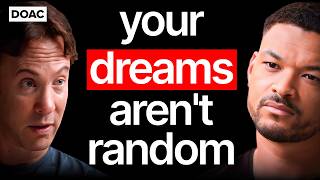
Stanford Neuroscientist: Can’t Remember Your Dreams? Your Brain May Be Warning You!
The Diary Of A CEO
SRT - Most compatible format for video players (VLC, media players, video editors)
VTT - Web Video Text Tracks for HTML5 video and browsers
TXT - Plain text with timestamps for easy reading and editing
Scroll to view all subtitles
After many many decades of people
debating this, you might have figured
out the reason why we dream. Yes. And
it's a simple answer. So if you go
blind, the visual cortex in the back of
the brain gets taken over by hearing and
by touch and by other things. In fact,
our colleagues at Harvard did an
experiment where they blindfolded
normally cighted people. And you could
start seeing that takeover happening
after 60 minutes. And that's when we
realized, wow, the purpose of dreaming
is to defend the visual territory from
takeover from the other senses. But what
fascinates me about brain plasticity and
what I've devoted my career to is
figuring out the way that we can be the
sculptors of our own brains and how it
gives us an opportunity to become the
kind of person we would like to be.
>> And can we do that?
>> Yes. Here's the thing. Your brain peaked
at the age of two. Okay. So at the
beginning you've got fluid intelligence,
meaning you could learn anything. But
now that you have grown up in this
world, you've got crystallized
intelligence, meaning you know how to
drive a car. You know how to operate a
cell phone. You know how to run a
business. And so your brain doesn't
require as much change which means that
the structure of the brain is always
degenerating.
>> So what are the set of actions that will
fundamentally change my brain and make
me that type of person who's motivated
and disciplines and who has high agency
and attacks the world.
>> So this is something I've studied in my
lab for decades now. And the key is that
>> and what about AI and the social media
debate as it relates to brain
development?
>> Well, I happen to be a cyber optimist
for young people. I think it's going to
make them much smarter than the
generation that came before. And here's
why.
>> Interesting.
This is super interesting to me. My team
given me this report to show me how many
of you that watch this show subscribe.
And some of you have told us according
to this that you are unsubscribed from
the channel randomly. So, favor to ask
all of you, please could you check right
now if you've hit the subscribe button
if you are a regular viewer of the show
and you like what we do here. We're
approaching quite a significant landmark
on this show in terms of a subscriber
number. So, if there was one simple free
thing that you could do to help us, my
team, everyone here, to keep this show
free, to keep it improving year over
year and week over week, it is just to
hit that subscribe button and to double
check if you've hit it. Only thing I'll
ever ask of you, do we have a deal? If
you do it, I'll tell you what I'll do.
I'll make sure every single week, every
single month, as we fight harder and
harder and harder and harder to bring
you the guests and conversations that
you want to hear, I've stayed true to
that promise since the very beginning of
the D of Sio, and I will not let you
down. Please help us. Really appreciate
it. Let's get on with the show.
Dr. David Eagleman, what made you so
fascinated about the brain? And why
should everybody listening be fascinated
about the brain as well? Here's what I
think it is. When I was 8 years old, I
fell off of the roof of a house that was
under construction and I fell 12 feet
and broke my nose on the floor below.
But the whole thing seemed to take a
long time. I did the calculation and
figured out that it only took 6 of a
second to get from the top to the
bottom. And I couldn't figure out why it
seemed to have taken so long. So I think
that got me really interested in
perception and the machinery by which we
view the world and taken in and what is
actually real versus what's a
construction of the brain. And that's
how what I've devoted my career to is
figuring out how the brain which is
locked inside the skull. It's about
three pounds. How it constructs this
model of the world and which things we
can take as reality and which things we
shouldn't.
>> I think most people don't even know they
have a there's a brain there almost. It
sounds like a strange thing to say, but
we've never really most of us haven't
really seen our own brains at all. We've
never been able to touch our own brains
at all. So, it's it's easy to fall into
the trap of thinking that everything I
experience is true and is reality. So,
I'm wondering how a deeper understanding
of all this stuff can help me live a
better life.
>> Yeah. One of the things that I started
writing about years ago is that I think
we're not I think we often think of
ourselves as individuals, meaning not
divisible into other things. But really,
you are a team of rivals. So, you've got
all these neural networks that have
different drives making different
suggestions to you.
>> What's a neural network?
>> Um, so in the brain, you've got 86
billion cells called neurons. And these
are communicating with each other at a
blindingly fast rate. Many of these
cells are hooked up in networks. So,
they're, you know, this guy's talking to
this guy and this guy, and they're all
in particular networks. The thing is,
you can actually get competing networks.
So, for example, Stephen, if I drop some
chocolate chip cookies in front of you,
part of your brain wants to eat it. It's
a good energy source. Part of your brain
says, "Don't eat it. I'll gain weight."
Part of you says, "Okay, I'll eat one,
but I'll go to the gym tonight." The
point is you are arguing with yourself.
You are conflicted. This is what makes
humans so interesting is that we have
all these voices trying to drive us to
different conclusions about our
behavior.
The way that your ship of state moves
depends on the vote of the neural
parliament at any time. So understanding
this I think is really critical to
navigating our own lives because all of
us do things where retrospectively we
regret it. We say I shouldn't have eaten
that whole bag of chips or done the you
know the alcohol or the drugs or what
like everybody has regrets all the time
with things and it's because you have
different voices in charge at different
times. Okay.
>> Part of what this leads to is what we
call the Ulisses contract. So a Ulisses
contract is where you do something now
to prevent yourself from behaving badly
in the near future. Just as an example,
you know, when people go to Alcoholics
Anonymous, the first thing they're told
is clear all the alcohol out of the
house. Because even if you feel like,
look,
>> I'm in a moment of sober reflection. I
don't want to ever drink again. If you
have alcohol in the house, you're going
to bust into that cabinet at some point
on a festive Saturday night or a lonely
Sunday night or whatever. So, what you
do is you constrain your future behavior
by setting things up in the right way so
your future uh the future you can't
behave badly. We naively think, okay,
well, I know who I am. I'm just one
person. But but you're not. And under
different circumstances, you're tempted
by different things and you'll do
different kinds of behavior. So having a
sense of what's going on under the hood
gives us an opportunity to be more
closely aligned with the kind of person
we would like to be
>> because it feels like there's just one
well I do argue with myself in my head
sometimes but it feels like there is
just one me
>> and so when I hear that voice say Steve
you should have that cookie and it's
1:00 a.m. And then the other voice says,
"No, you shouldn't." I think it's kind
of the same person just tussling with
himself,
>> right? Well, but that tustling with
himself implies different political
parties that are all battling it out.
You know, when you look at a parliament,
you've got all these political parties
that all love their country. They just
have different ideas of how to steer it.
And this is what's going on uh in in the
brain all the time.
>> So, what does one do about that? How do
I make do I do I have to make a list
contract? I think it's very useful to
make that sort of thing. But also just
understanding oneself. I mean part of
the you know there was this Greek
admonition to know thyself. This was a
sign they had in various places, various
temples and stuff. But I think that
becomes know thyelves. And the better we
know ourselves, the more we can get rid
of the illusion that we are one person.
Because all any of us need to do is look
back on our behavior to say, "Oh yeah,
in some circumstances I would do that.
and other circumstances I think is a
terrible idea. So this is all to the
goal of understanding who you are.
>> What are the big misconceptions about
the brain that people have gone through
their life believing? I mean that's one
of them. Something that is true that
kind of could fall in place of that is
just this fundamental idea that our
brains are plastic or sort of adaptable
because when I found out that I could
change my brain by what I do, I found
that to be really really inspiring.
>> Yes, that that's exactly right. So brain
plasticity, if someone hasn't heard that
term before, it sounds like a weird
term, but the reason it came about 100
years ago is because the great
psychologist William James pointed out
that, you know, if you take a piece of
plastic, what we like about that
material that we call plastic is that
you can mold it into a shape and it'll
hold that shape. And that's what your
brain does. So if I ask you the name of
your third grade teacher, you can
remember that name even though it's been
a long time because your neural networks
changed and held on to that piece of
information. Okay? Well, our whole lives
our brains are changing every moment. So
now we have certain doors that close at
different times. So just as an example,
um you need to learn language in the
first several years of your life. If you
don't learn language, you can never get
the concept of language. Your brain will
never figure that out.
>> You're not saying you can't learn a new
language as an adult. You're saying the
concept of
>> the concept of language, the concept
that I can name things and I can ask for
things and so on. Just that never clicks
in the brain. For example, in Romania at
the fall of Chuchescu, there were tens
of thousands of kids in the orphanages
because their parents had been killed.
It was too many kids. And so the staff
there said, "Look, the kids will get,
you know, clingy if you pay too much
attention to them. So here's what we're
going to do. We're going to feed the
kids, but we're not going to hold them
and we're not going to talk to them."
And all these children grew up with real
cognitive deficits as a result. Here's
the thing about brain plasticity. Human
beings have a a similar brain to all our
neighbors in the animal kingdom. If you
compare our brain to a horse brain, a
dog brain, anything like that, it's the
same general structures and stuff. But
what we have is much more of the wrinkly
outer bit called the cortex. It's the
outer 3 mm. And maybe we'll come back to
why that matters so much. But the other
thing that mother nature tweaked with
us, it's small genetic tweaks. But we
have much more plasticity, adaptability
such that when a horse drops into the
world, it's doing the same thing that
horses did 100,000 years ago. It's just,
you know, eat mate. But when a human
drops in the world, we learn everything
that's happened before us. And then we
springboard off the top of that. So we
living in the 21st century, we say, "Oh
great, you know, physics, math, this,
that, art, blah, blah, great. We got
everything that's happened before us.
Now let's do our own thing." And that's
what's so special about the plasticity
of the human brain, the adaptability of
it. The downside, the gamble is that
mother nature drops human brains into
the world kind of halfbaked and we then
get to absorb everything. But in the
rare circumstance where you're not
getting the right input, then then that
ends up really in trouble because it's
only halfbaked. So when it comes to
language, we can learn multiple
languages when we're young. That's very
easy, but it gets harder and harder as
that goes along. And various other
things become harder. And here's why.
It's because I I mentioned this earlier,
but the job of the brain is to make a
model of the world so it can operate
within it. So, for example, you're an
entrepreneur and you love doing
business. So, you get it. You okay,
here's how, you know, here's how you
structure business. Here's how you hire.
Well, here's how you set up a board.
Well, you're doing everything because
you've got a really rich internal model
of how to structure a business. That's
what the brain wants to do is get that
stuff right. As a result, if you
suddenly ended up, you know, taking a
trip to Mars and there's a whole very
different society there that does
businesses very differently, you would
have to relearn stuff really quickly.
So, here's the thing. You went from
having a brain that had high fluid
intelligence to now having a brain that
has high crystallized intelligence. What
that means is at the beginning you can
learn anything. You could learn any
language. You could have dropped into
any area. You could have dropped into
13th century Japan when I was young.
>> When you were young, when you were a
baby, if you had dropped out of the womb
in, you know, 10th century Mongolia, you
would have said like, "Okay, cool. Learn
lang." You would you would be a 10th
century Mongolian. But as it happens,
you dropped into this era, you know, a
certain place and time and neighborhood
and culture and family. And so you learn
that that's who you become is that
person. We often think that plasticity
diminishes as you age. But it's not
simply that it's diminishing. It's that
you are getting the right answers about
how to operate in the world. And so you
don't have to change as much. Your brain
doesn't require as much change.
>> What if I want to change?
>> Yes. So it turns out you still can
change. That's the key is that the
reason brains change less and less is
because they don't have to. But when
things get upside down, just as one
example, everything about the pandemic
really stunk, except for one thing, I
think the tiny silver lining is that all
of us had to reassess. Oh my gosh, wait,
how is the world working? I thought I
knew how the world worked, but now I
don't know if there's going to be toilet
paper at the store. I don't know if the
bank's going to be open. I don't know if
I can get coffee at the coffee shop.
Like, everything was different. As awful
as it was, it's really useful to
challenge your internal model of the
world and get to do that as an adult. We
don't usually get to.
>> So, if I want to change, what would you
recommend that I do? If I want to if I
want to change who I am, say I'm
stubborn, I'm not motivated,
>> um, and I want to be a different person.
>> The key is challenge. The key is seeking
challenge. So, it turns out that where
we always want to be is in between the
levels of frustrating but achievable.
and you want to take on new tasks. You
want to seek novelty to find yourself in
that zone and push yourself to do things
that you just haven't done before. And
one of the things that's so wonderful
about the modern world, you know,
everyone's got complaints about the
internet and social media and stuff like
that, but the good news is it deep it
exposes you to so much more than you
ever even knew was out there. The key is
to actively seek those challenges and
seek new things and seek to become
expert in various sorts of fields. And
and I think the key is that once you
become good at something, you you have
to drop that and take on something
you're not good at. This is the best
thing that you can do for your brain.
The reason is because what you're doing
is you're constantly building new
roadways and pathways in the brain.
There's a study that's been going on for
for decades now called the religious
orders study where a bunch of Catholic
nuns agreed to donate their brains for
autopsy when they passed away. What the
researchers discovered when they look at
the brain carefully is that some
fraction of these nuns had Alzheimer's
disease. Their brains were physically
degenerating with the ravages of of this
dementia, but they didn't show any of
the cognitive deficits that one normally
has. They didn't seem to be having
memory problems and so on. It turns out
it's because all these nuns lived in
these convents till the day they died.
They had social challenges and they had
fights with their fellow sisters and
they played games with their fellow
sisters and they were they had chores
and responsibilities and they were doing
stuff. What that means is even as the
tissue the brain tissue was physically
degenerating, they were making new
roadways and bridges all the time.
>> And so that's what kept them cognitively
healthy. We call that cognitive reserve.
Contrast this with with people who
retire at 65 and they go home and they
watch television and their social
circles shrink and so on. That's when
you've really got concerns because
you're not building the new pathways. Is
there data to support that that when you
retire, if you retire early or if you
retire say in your 60s, it increases
your probability of an earlier death or
cognitive decline? Almost certainly with
cognitive decline because you're just
not getting the challenge at that point.
You're just coasting on your internal
model.
this. It's tragic, but what happens
often is that people's hearing gets
worse. And so by the time they retire,
let's say in their mid-60s, it's not
really that fun for them to go out to
parties and restaurants anymore because
they can't quite hear. And so there
there all these converging reasons why
their social lives shrink. But it turns
out social life is one of the most
important things that we can do for our
brains because there's an expression we
sometimes use in neuroscience, which is
that nothing is as hard for the brain as
other people. because you never know
what the other person's going to say and
do and how they'll react emotionally and
so on. So, you're constantly on your
toes with other people. And if you're
not doing that anymore, that ends up
being a problem.
>> H
interesting. And as a as a I'm 33 years
old, so if you were to plot where my
brain is on like a graph of decline,
I is it the case that I should be doing
as much as I can now to build as many
pathways I can so that when I'm 80, my
decline sort of levels out in a in a
better place? Oh yeah, for for sure. But
this is true for many reasons actually.
Okay, so look, the truth is your brain
peaked at two at the age of two because
that's when you get the most connections
between neurons, between these cells in
the brain. You get this, at first you're
born with these 86 billion neurons and
they connect and connect and connect and
it finally becomes like a overgrown
garden at the age of two and from there
you're pruning. From there you're taking
connections away. Now it happens that
that's not a bad thing. That's a good
thing because that's how you're
resonating with the world that you are
in.
you know, 21st century London and LA
versus, you know, 10th century Mongolia
because you're you're just strengthening
those pathways that resonate and you're
getting rid of everything else. Okay,
fine. But over time, your brain cells
die. You know, every time you hit your
head on something or whatever, your
brain cells are going down. Um, so in
that sense, you've peaked. But your
crystallized intelligence that you've
been building your whole life, you know,
that keeps going and you'll you'll have
decades ahead of you where you can start
doing stuff. But yes, the reason to
learn everything you can is because all
that stuff cashes out at various points
in your life when you're starting your
next business or you're, you know,
wanting to do the next great thing where
you're surfing the way web of AI. You
know, you'll say, "Oh, I learned this
thing when I was 16. I learned this
thing when I was 22." And and these are
these are paying off now. I think I
heard Andrew Hubman say that one of the
most fascinating discoveries of the last
century is a particular part of the
brain called the anterior mid-sul cortex
and it links to what you were saying a
second ago about challenge and doing
things that are difficult.
>> Yeah, it turns out that area of the
brain is involved and other networks as
well because when you're doing something
new and challenging and difficult, you
have stress and anxiety. Your whole
brain is active. Let's say I measured
your brain even with something like EEG,
electronphilography. That's where I
stick electrodes on the outside. Let's
say I measure your brain in my brain.
We're doing something that let's say
you're an expert at what's something
you're really good at juggling. I don't
know some physics.
>> Let's go for juggling.
>> Okay. Let's say you're an expert
juggler. Let's say I've never juggled.
Okay. If we're both juggling, you're
going to be much better than I am. But
your brain will be less active. You
won't have as much activity in your
brain. all my brain is on fire with
activity because why I'm trying to
figure out okay where do I put my hand
how do I throw this and blah blah blah
so when I'm in novice at something my
brain is using much more activity not
just the anterior made singulate but
tons of activity all over because I'm
trying to figure out the rules I'm
trying to figure out what's going on you
as an expert you know you got it you
don't you don't need to burn much
activity this is what the brain's goal
is is to say hey once I've practiced
something along once I get something
about the world I'm going to burn it
deeper and deeper into the circuitry So
I don't have to burn a lot of energy on
it.
>> On this part of the brain, the anterior
mid singular cortex, Andrew human was
saying it's larger in people that do
things that they basically don't want to
do hard things. If you spend your life
doing things you don't want to do, then
it happens to be bigger. And so people
have now thought of this part of the
brain almost like the willpower muscle
because for some reason those that are
doing hard things have bigger ones and
those that are not have smaller ones. I
mean it wouldn't be so much the
willpower of muscle. It would be some
indication retrospectively of how hard
you have worked. Look, the fact is you
can see changes in brain size with lots
of things. I'll give you an example. If
you are a pianist, if you play piano,
then we can actually see physical
changes in your motor cortex. This is
the part of the brain essentially
underneath where you would wear
headphones. For those who are looking
visually, it's this red part here. You
actually get a bigger loop of tissue
here than you do in a normal brain. Why?
Because you're doing so much fine motor
activity with your fingers with both
hands. Okay? In contrast, if you're a
violinist,
you're only really doing that kind of
detailed activity with one hand. The
other hand is just boeing. And so you
only get that activity here in one half
of the brain for violinists. So I can
look at a brain and tell, hey, is the
person a pianist or a violinist or an
either? I can tell just by looking at
the visual cortex because you see
changes in the brain based on what you
do. For example, jugglers, people who
play music, even you can tell this with
medical students who study for final
exams. You actually see changes in the
distribution of of their cortex.
>> Why would it be getting bigger?
>> The reason is the brain's devoting more
real estate to that. In this case, let's
say we're talking about fingers on a
piano or a violin. The brain is devoting
more there's more relevance to that and
so it more real estate so that you can
do it better in the future.
>> Exactly. The key about the cortex this
wrinkly outer part is that it is a
one-trick pony. This is often overlooked
because even this brain that I'm holding
here uh is colorcoded so that we think
oh okay that's clearly labeled this
that's clearly labeled that and so on.
But in fact it's all the same stuff and
it can change. So for instance, if you
are born blind, then this area that we
normally call the visual cortex gets
taken over by the rest of the brain. If
you're born deaf, then this part that we
call the auditory cortex gets taken
over. It gets devoted to other tasks.
And so this whole system is very very
fluid. And this is what fascinates me
about brain plasticity is the way that
we can be the sculptors of our own
brains because we can devote ourselves
to particular things and have the brains
real estate get involved in that. So if
I was currently someone that couldn't
get out of bed, I didn't have a lot of
discipline or motivation and I wasn't
very good at committing myself to hard
things.
With everything you know about the
brain, is it possible to take a set of
actions that will fundamentally change
my brain and make me that type of person
who runs marathons, who does hard
things, who's motivated and disciplines,
and who has high agency and attacks the
world.
>> Yes. Yeah. But it's much more than
simply resolve because I mean just look
at New Year's resolutions. You know, by
by February, most people have dropped
most of them. So, it's really a
psychology problem about figuring out
okay, what are the things that motivate
me? So, let's say you want to become a
marathon runner. You've got that distant
dream. You figure out like what actually
motivates me in the short term? Who am I
trying to impress? What am I trying to
accomplish in my life? How can I
structure things like this Ulyses
contract that I talked about earlier
where I'm actually locking myself into a
contract? Like, you know, I call Bob and
I say, "I will meet you every morning at
7:00 and we're going to run until we
drop." Like once I've committed to those
sorts of things, that's how you set
things up so that you do the right
thing.
>> It's a bit of a cycle, right? Because
then my brain will adapt and then
presumably that will make it easier for
me to run.
>> Yeah.
>> And then I'll run more and then my brain
will adapt.
>> That's right.
>> And the cycle continues.
>> And it's not just your brain, of course.
In this case, it's your body. You're
getting better. You're getting stronger.
You don't get as out of breath. And so
all these things help. Exactly. But in
order to keep the cycle going, you need
to figure out what is spinning this
flywheel and what are the all the other
things in your life. Whether good
motivations or bad, it doesn't matter.
You just figure out what it is that you
can do to to get there.
>> Are there certain physical exercises
that are particularly good for the brain
from what you've understood?
>> The general story is exercise is really
important for the brain. I'll give you
just one example of that, which is
there's still this debate going on about
whether we get new neurons in the brain.
The general story has always been you're
born with 86 billion neurons and those
slowly die with time. But in rats, for
example, there is a little trickle of
new cells, new brain cells. And there's
been a debate for a long time about
whether that little trickle happens in
humans or not. Still unresolved. But in
rats, what you can see is that exercise
causes the trickle to increase. If you
stick the rat on the wheel and it's
doing physical exercise, you get more
new brain cells. Now, we don't know for
sure that this happens in humans, but
lots of things about physical fitness
and exercise matter a lot to the brain.
This is nothing new. Exercise, sleep,
diet, these are really important things
for keeping the health of this organ. Is
there anything else that's important to
know for someone that is trying to
change and improve and keep their brain
in a healthy state as they age that we
haven't touched on?
>> There is something that that all of us
are thinking about which is about um
social media and the internet in
general. I do think one of the
interesting things about the internet
and social media is that if we were
growing up in a village 500 years ago,
you just know the people in the village
and what they can do and so on. But
let's say no one in the village was an
entrepreneur or a neuroscientist. And so
we we can't even picture that as a
thing. We don't know anything about
that. One thing that the internet has
done for kids growing up in the digital
age is that you get a lot of more
exposure to things. You you have so much
more exposure. I actually think this is
one of the positive things that I would
say about social media is that you not
only get exposure, wow, that kind of
thing is possible and that kind of thing
is possible, but you also have people
teaching you how to get there.
>> They say like, hey, I'm a fitness
influencer and I'm going to show you
exactly how to do the thing. Or, you
know, you say, "Hey, here's exactly how
you start a business." Or I say, "Hey,
here's the the route that you go through
undergrad and grad school to become a
neuroscientist." And that's great. I
mean, there's just there's so much more
uh of a talent window now that that
everyone gets exposed to. So, I think
that makes a better brain.
>> What are we doing to our children that
you think we probably shouldn't be doing
as it relates to brain development?
>> Here's the thing that's really important
about this debate is that nobody really
knows. And I'll tell you why. It's
because to do anything in science when
you're saying something about a group,
you need to have a control group that
you're comparing against. And when it
comes to asking the question of, hey,
kids growing up now with social media or
the internet, how do they compare to
other brains of kids who don't grow up
with that? Well, we don't have a control
group unless you look at kids who are
incredibly impoverished or let's say
Quakers who don't believe in technology.
And with both those groups, there's a
hundred other important differences. So,
you can't just say, "Oh, look, I'm
comparing to this kid who grew up
without food and and I'm going to say
there's this difference." Who the heck
knows why the difference is there? even
a generation ago. There's so many
differences in terms of diet and
pollution and politics and blah blah
blah what like everything that you can't
do it. So I I only mention this because
I think it's very important. A lot of
people pipe off with things about oh the
younger generation their brain this that
but we don't actually know and I will
tell you that I happen to be a cyber
optimist on this point about what
growing up with the internet does for
young people. I think it's going to make
them much smarter than the generation
that came before. And here's why. It has
to do with the size of the intellectual
diet that they can bring in. So when I
was a kid, I grew up pre- internet. You
know, I wanted to know stuff. So my mom
would drive me to the library, which was
25 minutes away, and I would pick up the
Encyclopedia Bratannica and I would flip
through it and hope they had an article
about the thing that I wanted to know
about. And that's how I was able to get
my little straw of knowledge. But now
kids are growing up with access to
anything they're interested in. And this
is so good for the brain. And from a
plasticity point of view, the reason
this matters is because change happens
in the brain when you are curious about
something. So when a kid asks a question
to Alexa or Siri or whatever and they
get the answer, that sticks because they
have the right cocktail of chemicals
going on in their head. In contrast,
when I grew up, I learned tons of just
in case knowledge. I mean, that's all
that the teachers could teach us is just
in case you ever need to know this fact,
here it is. But kids are in a really
great situation now. So, there are pros
and cons to to all this stuff, but I
think I'm very optimistic about what
this means for the for the warehouse of
knowledge that that kids can build up
now. And by the way, I saw an interview
with Isaac Azimoff in 1988. He was the
great science fiction writer who wrote
Foundation and so many other books. And
he was saying on this show in 1988, he
said, "Look, I envision a day when there
will be one central supercomput and
every house will have a cable running to
that supercomputer and you can ask any
question you want and it knows the
entirety of humankind's knowledge on
that computer." You know, what he was
foreseeing here was the internet. He got
the details wrong, which doesn't matter.
The idea is he saw how this would be so
incredible for education
because he pointed out look in any
classroom it's going too fast for half
the kids too slow for the other half of
the kids and if you could just pursue
the sphere of humankind's knowledge if
you could enter in whatever door you
wanted to that's the way to do it
because you'll be motivated now he
wasn't talking about brain plasticity or
anything but this is exactly what I'm
saying from a brain plasticity point of
view really matters
I I'll just mention something which is a
lot of people are concerned that oh with
with AI we're going to get lazy. We
won't you know know how to do anything
anymore because we can outsource it. It
just so happens that I I love doing home
improvement. I'm always fixing my house.
I have 3xed myself in the last half year
because of AI because I take a picture
of something. I say hey I've never seen
this kind of thing before. How does this
work? Whatever. And chat GPT says oh you
do this and you take this out and here's
the bolt and blah blah. It's not me
outsourcing it. It's me being curious
about something and so I remember how to
do everything now. I know how to do much
more than I used to because I like it.
>> What about the you there's been a couple
of studies that have come out that say
things like your brain's going to
atrophy if you don't continue to write
or um if you just defer all of your
learning to things like chatgbt or other
AI models. Um, one I guess one of the
areas that I think in one of the
studies, was it a Stanford study that
everyone was talking about where the the
participants used Google and AI and then
they'd learned something themselves.
>> But one of the things I've wondered is
if I'm going through my business life
and I'm encountering hard problems and
every time I encounter a hard problem, I
drop it into an AI. The AI spits out a
textbased answer. I copy and paste that
and send it as my response. presumably
there's some kind of important part of
the learning cycle or the you know
neurological development that I'm like
foregoing there I'm missing that I
probably should you know you said
earlier about doing hard things what I'm
doing there is I'm avoiding the hard
thing which is like thinking about it
and trying to understand it
>> yeah here's I think the really important
distinction there's vicious friction in
our lives and there's virtuous friction
so vicious friction is all the stupid
stuff that you have to do like hey
Stephen for your business I need you to
cop copy this spreadsheet over here and
fill in all these cells and and do your
taxes and whatever. Okay, that if we can
push that off to AI is massively
important for for improving human lives.
There's really not benefit in vicious
friction. But virtuous friction is, hey
Stephen, I really want you to think
about what is the optimal way to do this
business. What is the best structure for
this? How do we actually go DT to C? How
do we go B2B on this? What's the what's
the approach here that we're going to
take that you haven't done before that
would be amazing? That's virtuous
friction because you're really using
your brain to learn stuff that way. So
that's the first distinction that
matters is get rid of all the busy work.
There's no honor in that. I mean I'll
just mention in the 1990s there was this
big debate about whether we should have
kids use desk calculators or not. And
thank god that finally got resolved and
we let kids use calculators so that we
can learn, you know, couple we can spend
a couple days learning long division,
but you don't have to spend six months
on it because who cares? With the
virtuous friction, there's real
opportunity to surf the wave of AI so
that you are figuring out these tough
problems with the aid of somebody who
cares about your problem and is willing
to talk with you 247 and never gets
tired of talking to you about it. And so
you are not just copying and pasting,
but you're working with the AI to come
up with ideas that were beyond what you
would have come up with. Because I
mentioned earlier about internal models,
we have pretty narrow fence lines and
you can think of all these things, but
you don't even know what you don't know.
So, if you can have somebody who's
willing to talk with you, an expert in
all of humankind's knowledge, willing to
talk with you about it as much as you
want, there's a real opportunity there
to have a synergy where collectively you
both come up with a better idea than
either of you could have alone. But is
there a way for that relationship to
take place so that I actually benefit?
Because, you know, in the example I
gave, I'm just I take the question I was
asked, I put it into an AI, it gives me
an answer, I copy and paste it back to
the person that asked me the question.
that would happen if you really didn't
care about the person asking you the
question or the question. I mean
>> I mean this is what a lot of people are
doing like I get so many email because
you know we interview a lot of
candidates who join the business and so
I see tens of thousands of emails
sometimes a week that I mean I don't see
all of them but the ones that I see I
often know that you know because we've
sent them five questions or a task and I
look at it and go this is I can almost
predict the exact model that sent it to
me because they all have a different
personality so I go oh this one the
person put into Gemini or this one the
person put it into chatbt. Yeah,
exactly. And it's full of contrastive
constru construction like
>> it's not this, it's that. Yeah, exactly.
And then the M dashes. Exactly.
>> I'm really asking like is the person
that did that benefiting from from it?
>> No.
>> Well, no, but for a couple reasons. One
is that, you know, you and it it
triggers your red flag and so that does
not do anyone any good. see so many of
my colleagues posting on LinkedIn these
very obvious AI things and it irritates
me because I feel like I'm not going to
spend my time reading that because of I
call this this the effort phenomenon
which is um in in psychology we care a
lot about things that seemed like they
took a lot of effort and there's
something about seeing an AI post that's
just irritating because it's so
obviously AI
>> that's a really interesting idea the
effort phenomenon
>> yeah I've been I've been writing about
this for a while because um it turns out
there are psychology ology studies where
if I offer you two pieces of art and one
of them looks like, you know, let's say
it's a a red dot in the middle of a
white canvas and the other one is, you
know, bottle caps stacked up and glued
in this great shape or whatever, you'll
pay you'll pay much more for the thing
that looks like it took a lot of effort.
People will pay more for a real diamond
than a synthetic lab grown diamond,
which is exactly the same thing. It's
just carbon in the matrix. But they feel
like, oh well, mother nature took
hundreds of millions of years of effort
on this one, but not over here. It just
took a few days in the lab. So, there's
a million ways where we care about that
a lot. When it comes to this AI thing,
um, yes, anybody who's just popping back
something to you, it just feels like,
all right, they took the the path of
least resistance, and I'm not so
interested.
>> I want to know from a neuroscience
perspective whether they benefit.
>> Presumably, they don't benefit too much
either. I mean, it's hard to know
exactly how many times they went back
and forth with it. They could have said,
"Hey, Chad GPT, thank you for this, but
I'm kind of this more of this person.
When I really think about it, this is
the thing that inspires me." Not not
what you suggested. So, so somebody
could put effort into it. It's just that
we can't know that when we get the AI
response. It seems to be a pretty
consistent principle of life generally
that like when you do something hard or
when you put in effort, as you say, you
tend to get back like an equal and
opposite return like relatively. So I I
would think that if I fought through,
you know, maybe even using AI as a
companion, but I fought then to write it
out myself instead of just copying and
pasting.
>> Yeah.
>> One of the things I've learned from
doing this podcast and all these
episodes is everything is a trade-off.
>> Yeah.
>> And and if you don't know what the trade
you're making, then you're often at
great risk. And so like some of my
friends will say, "Oh, I take this pill
and it's amazing. It does all these
things for me. It's the most amazing
thing ever. I can just focus for 24
hours a day and I'm so productive now.
And I go, "What's the what's the
downside?" And they go, "Oh, there's no
downside." And I go, "Hm." Like, so
that's what I mean. It's even worse when
you don't you don't know the trade
you're making. And so with AI, I go,
"Okay, if it's making me wildly more
efficient or productive, what trade am I
making?" I think understanding this it's
probably not two categories but a
spectrum from vicious friction to
virtuous friction but really paying
attention to what is virtuous friction
what would make me a better person if I
actually put the effort into this that
matters a lot and I will say for us as
professors for you looking for job
candidates we need to change how we're
asking the questions if we just say hey
write answer these five questions of
course everyone's going to use it for
example in my classes is at Stanford. I
I don't have people turn in a final
paper anymore. That was from previous
life before AI. Now I have them do
projects as their final thing where
they're uh you know running an
experiment on something. And of course
they use AI to help them generate some
of the issues, but they have to deal
with other people and look at the data
and figure out what's wrong and that
kind of stuff. I worry that it's getting
into the age of, you know, the whole
calculator thing you said where maybe
actually it is now you need to assess
them on their ability to use the AI,
>> not to succeed without it.
>> Yeah, agreed. This is the whole game for
all of us, I think, is figuring out how
to surf this wave of AI where it can
make us super human. We can just be
better, so much better than anything we
ever were doing before because we have
immediate access to knowledge and facts
that either we had forgotten or we never
knew existed. And so we should be
surfing that wave. So I I I totally
agree with you on that point. If you can
figure out how to change your interview
questions so that you're seeing, hey,
can this person really get the speed?
With everything you know about learning
and neuroplasticity and expanding one's
brain, is there a anything else you can
say to the audience about how they
should use AI so that they become a
superhum?
>> Interesting. I you know, look, I I have
been talking to my friends about this
issue a lot lately and I I mentioned how
I've become so much better at home
improvement stuff. I just know so much
more. Each one of my friends has
something like that where like, hey, you
know what? I've actually gotten so much
better at this super random thing that I
never even thought I, you know, I never
thought about it explicitly, but because
I'm always asking AI questions about
that and it's giving me the answers.
It's not simply that it gives me the
answers and I forget it. It gives me the
answers and I remember it. I become
better and better because it's like the
way that Alexander the Great had
Aristotle as his tutor and could ask him
anything and learn great stuff from him.
We've all got Aristotle in our pocket
now and we can become better at the
things that we want to do, the things
that resonate with us for whatever
reason. If everyone's got Aristotle in
their pocket, how does one create an
edge?
>> I think it has to do with we're all just
going to be running faster. In the same
way that when Steve Jobs introduced
Apple computers, he said this is like a
bicycle for the mind. What he meant by
that was that for millions of years
we've been walking bipedily and then
just in the last nancond of evolution we
invented the bicycle and suddenly humans
can move faster because of the bicycle
and he said having a personal computer
is like a bicycle for the mind and I
think of AI now as like a motorcycle for
the mind it's it allows us to move so
much faster so now it's a motorcycle
race and there will be people who are
much faster than other people because
they're really using that optimally.
>> And that's what I mean. It's like how do
I create an edge versus my whoever I'm
competing with in whatever industry I'm
in.
>> Well, for sure the people who are just
copying and pasting the AI slop that'll
be easy to beat that crowd. But
otherwise, I think it's just a matter
of, hey, these are the newest things.
It's like in history when the new sword
gets invented or the new gun or the new
cannon, you know, you have to keep
improving and and using that. And that's
what's going on now with AI
>> and with from a neuroscience
perspective. If I wanted to use AI to
based on all these things you've told me
about novelty and all these other points
that expand the the connections across
my brain and give me a big cognitive
reserve.
What might I I install as a practice
every week when I'm speaking to my AI?
Oh, ask it questions that you're curious
about about anything. Just asking
questions. Here's one thing I do all the
time. I'll say, "Hey, I've been thinking
about this. You know, I on my podcast, I
do a lot of monologues and so I'll start
talking to it and I'll say, "Hey, I've
got this idea that I'm thinking about.
What if blah blah blah blah." And then
I'll say, "Here's my idea. Give me pros
and cons." You know, tell me why this is
wrong. And I do that pretty much with
everything that I ask it if I'm
proposing some, you know, stupid seed of
an idea and it really gives me the
counter arguments and I really engage
with it. That is the important part, I
think. And by the way, I just want to
say I think for the next generation that
we're teaching this, there really only
two things we can teach because all the
details of, you know, hey, let's teach
computer programming or something,
that's probably already gone as a useful
thing. So what we can teach is critical
thinking and creativity. That's it. I
think that's such an important point,
this point about asking your AI why you
might be wrong.
>> Yeah. I I think I've had most of my
paradigm shifting moments when I've come
to an AI model that I was using with a
very with very high conviction. And the
prompt that always I think is most sort
of expansive in terms of my intellectual
knowledge is when I say to it, be
brutally honest about your opinion.
Think for yourself and be objective and
tell me where my blind spots are.
There's something innate with within us
all where we don't actually want to be
wrong. We often I think as a natural
reflex and this is why people get really
sort of trapped in echo chambers of
political opinion and you know Leon
Fesser talked about this idea of
cognitive dissonance when something you
believe contrasts with new information
and how it makes you feel uncomfortable
there's something when I type that out
when I when I love the idea or the thing
I've written or the memo I've written
this new idea and I go on tell me why
I'm completely completely wrong and it
eviscerates me it is both uncomfortable
but it feels incredibly important
because then then it's like I've I've
grown. But these AIs, they're they're
programmed almost to like kiss my ass.
>> Yes. Although, you know, Chatupati
released a very sickopantic version, I
don't know, maybe a year ago. Meaning it
compliments you. You give some idea and
it says, "Oh, Stephen, that's the best
idea I've ever heard. You're a genius
and blah blah." And that didn't last
very long, that model, because nobody
actually liked it. So, you're exactly
right. And and I'm sure most listeners
know this, but you can tell your AI to
be brutally honest with you all the
time. You can tell them to do that all
the time and it'll do that. So you can
you can establish the kind of person
that you're talking to. Here's the
thing. You're right. Of course, people
don't like to be wrong. It can be
socially embarrassing. It can be
uncomfortable. And yet, there's
something very different when you're
talking to your AI. It's a very private
thing. And you say, "Hey, tell me why
I'm brutally wrong." And when it tells
you, you think, "Oh, thank God it's
telling me that instead of like a real
human." So I I think a lot of that is
alleviated with AI. We we don't feel as
bad about being wrong there.
>> As you were saying that, I just went on
chat and I typed this in. Is my joke
funny? And the joke I typed in is knock.
Who's there? A letter. Let us who? Let
us in and I'll tell you.
>> Okay. You didn't laugh. I didn't laugh.
>> Okay.
>> Chapati said, "Yes, it works as a joke.
solid structure, uses the classic pun
payoff, which is exactly how most not
jokes land. And then it's done a
laughing emoji. I then said, "Be
brutally honest and completely
objective. Was that funny?" It said,
"It's not very funny."
Interesting. You know, but but that's
interesting because it depends, right? A
little child actually finds that joke
funny and and for a little child, they
then get to repeat that to their
classmate. They're learning how to do a
joke and so on. So I'm not I'm not sure
I think there's a single answer to
whether that can be funny or not.
>> But the interesting thing is it just
reinforcing what I already believed. And
therefore when we think about growth or
having a growth mindset if someone's
just always reinforcing what you already
believe and know I don't know if it's
ever going to be a growth mindset. I
mean I just asked it again. I said be
really honest and it said it's
absolutely not funny.
>> Yeah. But but remember all it's doing is
it's just it's a statistical parrot. And
so when you say be brutally honest, it
it thinks that's what it should answer.
>> Also, be even more honest. It says it's
basically not funny at all and you
shouldn't say that to people.
>> Okay.
>> And it says comedic originality 1 out of
10. Likelihood of real laughter 1 out of
10.
>> Well, that's that's quite good. That's
quite accurate. Um, here's the thing.
I've been thinking about this issue a
lot about whether AI can be funny. And
at the moment, it can't be. It It's
great at repeating jokes, but it doesn't
understand humor on its own. what it
knows if you ask it to make up a new
joke, what it'll do is it'll have, you
know, the first guy walks in the bar,
then the second guy walks in the bar and
does X, and that establishes the
pattern, but then the third guy, it'll
have break that pattern, which is the
structure of a joke, but it doesn't know
how to break the pattern in a way that's
funny. It's just the third guy does some
random thing. So AI as it stands now,
the way it's structured with what's
called a transformer model, doesn't know
how to think of the punchline and then
go back and make the joke lead to that
punchline.
>> A lot of people don't either.
>> Do you know what I mean? Like I say that
not in an offense way, but just to say
that like
>> I don't know. I often hear the claim
that AI could never be creative.
>> It's massively creative. Here's why.
Creativity in the brain, all creativity
is is you absorb your world. the whole
world around you, every experience
you've ever had. And then you're bending
and breaking and blending those
cognitive concepts into new remixes.
That's all creativity is. And you're
doing that all the time. Whether you're
just trying to think of what to say next
or what recipe to make next or what
patent to do or what company to start,
you're just remixing the stuff that you
already know. And that's why, you know,
I don't know, take Beethoven, he could
have written any kind of music that was
being done anywhere in the world. But of
course, he didn't. like that's what he
grew up with was the music and his local
culture and so on. What we have now is a
much broader diet as I mentioned before
where we can get everything going in.
But the point I want to make here is
that AI that's what it does. It remixes
stuff that's come in. So AI is massively
creative. The part of creativity that AI
can't do right now is selection. Meaning
it can generate a 100 pictures but it
doesn't know which one to pick. It
doesn't know which one is going to be
the most appealing to you. But it can
remix beautifully.
>> But neither do humans, right? So if I
asked an intern to make me 100 pictures,
I mean, I could get my AI to pick one,
but it wouldn't know what the intern or
the AI wouldn't know which one I loved.
>> The intern would have a much better shot
at it. And as the intern is there for a
while, he or she becomes quite good at
getting, oh, okay, I get Steven's taste.
It would be this one.
>> And the AI can't learn that what my
taste is. I don't think the AI could
learn that about visual images because
when it generates the pixels, it's doing
this, you know, this magical stuff under
the hood where it's deciding which
pixels and how they diffuse together
and, you know, mix the image, but it
doesn't know how to read that image
like, oh yeah, the way this is and blah
blah that'll really appeal to Steve. It
does it it's not seeing the image except
as a bunch of pixels. Hm. Hm.
>> You need to be a human for that
>> cuz I feed um I was doing an experiment
recently where I took our my behind the
scenes channel which is a 30 minute long
video. I dropped it into Gemini and I'd
say things to it like predict where
people would drop off on the video and
then we upload the video to YouTube. we
get the retention data back and Gemini
uh in the last two times that I've done
it has a 100% record of knowing that at
minute 7 where insert person talked for
too long and might have been a bit more
sight might have tried to sell a hoodie
for example in that part it would say
you're going to lose people here and it
would and it very accurately say why it
would say because there's you talked for
74 seconds and it was jarring versus the
the the moment that came before it and
when I feed the AI I don't let's say
thumbnails and say which thumbnail is
going to perform the best. We did a test
recently where we put four thumbnail
test results that we knew the answer to
into Gemini and said which one's going
to win on YouTube AB testing and it got
100% accuracy of predicting on data we
already had which one would win. And so
now I I don't know I I keep having these
paradigm shifting moments where only
humans could could do that. But
increasingly the the AIs that we're
experimenting with are making better
creative decisions than now I can make
myself as if the outcome of that
creative decision is which one is people
going to prefer.
>> Yeah.
>> I'd say a year ago that wasn't the case.
>> Okay. So I totally agree with you. But
but let me just mention one thing which
is fascinating which is that often the
way it's doing it is not at all the way
that a human would do it which might be
fine for our purposes but the data and
the way that it's picking up on it. It
might be something about you know how
much I'm making this up you how much
green was in the YouTube thumbnail image
or how much red or whatever whatever the
thing is or just noticing that there's
big font versus smaller font or
whatever. the next time you try it, it
says, "Oh, yeah, this thumbnail is going
to be great." And it's some ridiculous
thumbnail that doesn't make any sense to
you as a human, nor to your fellow
humans, but it might say, "Oh, yeah,
this would be great." Because it's
judging things on very weird dimensions
that we can't always see. You know, the
example you gave about maybe it's cuz
the text is bigger or the color red, but
those are the same factors we think
about as a human. We think if we know
that if the font is bigger, it performs
better. We know that red performs better
than green.
>> Quite possibly. But here's the
interesting thing. Human art constantly
evolves and all AI is trained on is what
has been done before and what has
worked. And so if I asked it, let's say
we composed five different songs and
said, "Hey AI, which song is going to be
better?" It's going to say something
that's right in the middle of the
distribution of popular songs. But
that's not what actually makes it next
year and the year after. It's new
things. It's new twists that that nobody
has seen before. That's what we love.
That's what we seek as consumers. And so
because AI can only be trained up on
what already exists, it's never going to
get the new thing at the edge.
>> But if if the AI was asked to cuz I
think the reason why a new song would
break out, let's say, you know, a new
Drake song comes out and it's a smash
hit. If we think about that distribution
curve, so like if I draw on the GR,
you're saying that um this middle
section here is what sort of AI will aim
at because it's the popular in the
known. Well, if I tell AI to make a
million songs, which is kind of what I
guess is what's going on every day um
around the world, if you scattered them
on on this graph at like, you know,
>> Absolutely.
>> And then the AI's most unusual song ends
up taking off. But it's just because
there's so many of them.
>> Quite right. But that's the human
selection part that we're seeing over
there. If you asked, okay, out of all
these dots, which do you think AI is
going to be best? It's going to have to
tell you the middle of the curve. But
the surprising part is the part that you
circled there, which is the one on the
edge is the one that humans like. Why?
Because we're constant novelty seekers.
We care about the things that are new. I
think the the point I'm getting at is
that um the creation of it, the creative
process is still the same, which is like
>> totally
>> AI or humans just trying a bunch of
and then the world going, "Ooh, that
one."
>> Oh. Oh, yeah. I totally agree. This is
consistent with what I was saying, which
is that AI can be massively creative in
terms of the generation of something,
but you need humans to do the selection.
I'm only arguing the point that AI is
not good at saying, okay, I've generated
a 100 songs. This is the one humans will
choose. We end up saying, hey, wait,
this one is just weird and unique enough
that I really like that. It's
interesting because when you um when you
speak to like record labels about music,
what they're often doing is getting a
format of a song that they know will
work. So they're like, "Right, so it's
got to be eight bars here. It's got to
be this here. You got to have a chorus
that's like hookie. It's got to come
back around. It's got to build up pace.
And there's like a rough format to it."
And it's no surprise that Ed Sheer
someone like Ed Sheeran has written so
many songs for so many people.
>> Yeah. When I spent some time working
with Sony, they had a brand new boy band
in the wake of One Direction. And when I
sat with the boy band um and was
introducing myself, they said they said
to me, "Oh yeah, so um here are their
his the boy band's first three songs and
um Ed Sheeran has written all of them."
And I was like, "What?" I thought I
thought like they're like, "No, Ed Ed
Sheeran's written all of them." And then
what we do is we give them to the boy
band and then the boy band sing them and
they're pretty much guaranteed to be
hits because Ed Sheeran has like a
formula. the way he writes is really in
like vogue right now. You people tend to
think a lot that the songs that are
number one in the charts are there
because just because someone had
creative genius and of course that is
the case sometimes but there is a lot of
this writing going on and then handing
the formula over because someone has
cracked the code of a hit,
>> right? But here's the thing and you know
that we all know this which is that the
code never lasts. So humans have this
pull where they're always seeking things
between novelty and familiarity. So we
like things where we recognize the brand
and we recognize what the singer has
done before. But there has to be novelty
or else we're not going to go for it.
We're not going to listen to that boy
band for the next 10 years doing the
same song over and over. So you're of
course right that we, you know, we want
a bit of familiarity. We want to be
anchored, but we definitely seek the
new. This is what humans always do. This
is why car companies always release the
next model even though the current model
is perfectly fine. This is why haircuts
evolve. This is why fashion evolves
through the years. Um because we always
care about novelty. And the other thing
in the music industry that I think is is
also creating a hit is I was reading
many years ago about some psychology
which you'll probably know much more
about that says exactly what you just
said which is we love something when it
is familiar but new.
>> Exactly. So the way that the record
industry and the radio industry make
something familiar is they blast the
same song at you on every radio station
for a long period of time until it
breaks past being just novel, just new
and it becomes familiar. And like I saw
this graph which shows that the a song
that you'll love is right there in the
middle of like it's new enough that
you're still into it but it's um
familiar now because you've heard it so
many times that you love it and you'll
if anyone listening the first time you
hear a song you might not love it as
much as once you've heard it like 20
times
>> and then at some point you've heard it
too much.
>> Yeah.
>> And it comes back down the other side of
the cover where it's now too familiar.
>> Yeah. That's exactly right. And so we're
always seeking that tension in the
middle. And yeah, companies run into
this all the time. Like sometimes they
try things that are too novel that just
completely fail. You know, Coca-Cola
tried this a long time ago with
introducing new Coke and no one liked
it, whatever. Um, and other companies
like what was that company? Blackberry
with the the little thumb things that
you can press the physical keyboard on
the phone. They failed because they
wouldn't change fast enough. But anyway,
companies that make it are always
staying in that uh sweet spot.
Whoa. What's that on your face?
>> This is my Bon Charge face mask. I've
been wearing this for some time now.
They're a sponsor of the podcast. I put
this on for 15 20 minutes a day. I can
sit here in the chair and wear it.
Boosts my collagen production. Helps
with fine lines, blemishes, my
complexion gets better, and then more
people listen to the podcast cuz I I
look better. Professionalgrade equipment
in such a small box. It's noninvasive.
And having sat here with so many of the
world's leading health professionals,
there's various things that I repeatedly
hear work and some things I'm a bit
skeptical about. This is one of the
things that almost all of my guests on
this show have confirmed works. It is
really, really, really effective. And
they offer fast, free shipping worldwide
with easy returns and exchanges. And
you'll also get a one-year warranty on
all of their products. And they're HSA
and FSA eligible, giving you taxfree
savings up to 40%. And you can get 20%
off when you order through my link at
bondcharge.com/doac.
That's bondcharge.com/doac.
The deal applies sitewide. I'm 100% more
productive using this app despite
spending 50% less time typing. And that
might confuse you, but let me explain,
which is exactly why I invested in
Whisper Flow. They're also one of our
sponsors on this podcast. Whisper Flow
turns your speech into text, so you can
send it in any app or device at any
time. And I promise you, it doesn't seem
to ever make mistakes. This is the most
accurate voice dictation I have ever
used after a decade of trying to get one
to work. Not only does it save me a ton
of time, it also corrects your speech if
you change your mind mid-sentence before
turning it into text on the device. I
love it and I know my team loves it too
because when I posted it in our Slack
channel asking if anybody wanted a pro
version, half the office said yes and
they had it within an hour which tells
me everything. This is the tool you and
your team need to speed yourselves up
and to capture those important ideas so
that they don't disappear. Head over to
whisperflow.ai/stephven
to download it now. That's
wispr.ai/stephven.
When you think about the brain and how
it's built and then you think about the
exact technology that they've used to
create AI, isn't it very very similar?
And if so, if it is similar, what does
that say about humans role in the
future? It's similar, but it's not the
same. Which is why with AI, you get what
what we call jagged intelligence,
meaning that it can do something so
extraordinarily smart and then in the
next moment give an answer that's weird
and doesn't make any sense. AI still is
doing this. It's not it's not yet
thinking like we think. Okay. Why? It's
because
AI as we think about it now really
started of course decades and decades
ago where people said look you've got
all these billions of cells neurons in
the brain that are connected to each
other. What if we ignore all that
complexity and we just say look imagine
that you have units that are connected
to each other. We're going to forget
about you know a single cell in the
brain is as complicated as a city. It's
got the entire human genome. It's
trafficking millions of proteins. Let's
put all that aside. Just imagine it's a
circle and it's connected to other cells
and each connection has a certain
strength and that's what we call an
artificial neural network. Now that went
off in its own direction and the kind of
amazing surprising part is how
successful it's been to just get rid of
all the detail but it's still super
different than what human brains are
like. So just an example uh this thing I
mentioned at the very beginning about
how we're a team of rivals under the
hood. You got all these different
competing neural networks that are
trying to drive your behavior and so on.
The fact that we're emotional, the fact
that we are driven by different
appetites, whether food or sexuality or
whatever it is, but you know, you're a
your chat GPT, you don't want that in
the chat GPT. So, it's just an
artificial neural network many layers
deep and it's extraordinary at what it
does, but it's so different than a
human. For example, the fact that it's
read everything on the planet and
remembers it and you haven't, you would
need to lead a thousand lifetimes to
read that much. And of course, you
wouldn't remember much of it. It It's
very different is the point I'm making.
They both have converged on something
that we would call intelligence, but
it's a pretty different structure. Even
though AI was inspired by the brain,
that's what Jeffrey Hinton was telling
me. He was telling me that like much of
the the breakthroughs that have made AI
what it is today came from understanding
how the brain works.
>> Yeah. But that's interesting because
Hinn isn't is incentivized to say that.
But a neuroscientist
>> incentivized to say that
>> people doing AI of course are paying a
lot of attention to how this is
structured like the brain because before
that people would do things like
probability theory or rules or you know
they were trying to do AI by trying to
say okay if this then do that but when
people started doing artificial neural
networks that led to a lot of success
I'm only pointing out that the
artificial neural network looks a lot
like the brain on the surface You say,
"Hey, you've got units and you've got
connections, but beyond that, there's a
lot of differences."
>> And why are those differences
significant as it relates to what's
possible?
>> Because what we've developed is this a
new species essentially that is
incredibly impressive, but it ain't a
human brain. It's different than a human
brain. There may be all kinds of
similarities, things that we even come
to understand are similar, but there are
so many differences. Here's an example.
You know, we humans do one trial
learning all the time. Meaning if I say
or when you were a kid and and your mom
said, "Hey, Stephen, this is a
pomegranate." You say, "Okay,
pomegranate. Got it." But you can't when
you're training up a an artificial
neural network like at OpenAI or Gemini
or Anthropic, you have to give thousands
or millions of examples of everything
for it to learn anything. There's no one
trial learning on those uh systems. And
they have to be trained at the cost of
billions of dollars. then they can do a
run where you ask a question and and it
answers the question. But brains in the
real world don't have that luxury of
having a training phase and then an
action phase. We have to learn on the
fly. It's very different.
>> So I guess the the pertaining question
is
does it change what's possible for the
brain versus the artificial neural
networks we see in AI? like is there
some limitation based on what you've
just said that means the this brain in
front of me, this human brain in front
of me will always be better than the AI
at something because I'm trying to track
forward about what this means for the
future of humans.
>> Yeah.
>> Um
>> I think it's an interesting question um
that we'll have to see. But it's clearly
the case that we know what it is to be a
human from the inside. And when I'm
making a model of you and who you are
and you're making a model of me, we have
assumptions about what it is like to be
a human. AI only watches human behavior
from the outside. And so it can tell a
lot of great stuff, but it doesn't
really know what it is to be a human. So
if I ask it some question about what
would it be like if this or that
happened, it can answer based on
observing lots of things, but it can
only ever know from the outside
>> in terms of why that matters.
>> Yeah. Because you know if I ask my AI my
fiance's been like this today or if I
ask my best friend my fiance's been like
this today. If it both of them give me
the same useful answer it doesn't really
matter what's
>> I agree with you. I agree it may I I I'm
actually writing a new podcast on this
about what you can tell from the outside
and what you can tell from the inside
and whether that difference matters.
Look an example is you know I last year
got a Tesla with full self-driving and I
was watching as it was full
self-driving. I was coming up on a very
complicated traffic situation. And I
thought, well, what's my car going to do
here? How's it possibly going to
understand? But what it did is it slowed
down and came to a stop, which was
exactly the right thing. And I thought,
oh, that's interesting. Algorithmically,
it might think of it very differently
than I am thinking about the situation.
Doesn't matter. It comes to the same
conclusion, ends up in the same place.
Yeah, I agree. We have yet to see where
these differences matter and and what it
is to be a human. But I can tell you one
thing. We care about other humans. So
here's my little prediction is that
there's going to be actually a
renaissance in things like live theater
and live performances. When when things
first came out like Napster, everyone
thought, okay, that's the death of
concerts. Like who's that's the death of
musicians, right? But in fact, you look
at a a Taylor Swift concert, gajillions
of people there paying lots of money.
Like everyone loves the the thing. Why?
Because they're going to see the real
Taylor Swift in person. And I have
noticed I give a lot of talks on the
road. I have noticed an increase in the
number of talks since AI came out a few
years ago. The first thing that my
friend said to me is hey did you know
David that you can you know use uh 11
labs and hey Jen and you know you can
make an avatar of yourself and you can
use your voice and and use chat to
generate what you're going to say and
have a fully virtual version of you. He
said my friend who gives talks too he
said maybe we can start doing this and
do virtual talks. I said nobody's going
to want that. In fact, what's happened
is more people want to fly us across the
country to have us stand there in person
because it really matters to see fellow
humans. And I think that's only going to
increase.
>> I completely agree with you. I think I
think it's so funny. I did a post on
LinkedIn the other day saying that maybe
the like interesting paradox or
interesting outcome of AI is that every
other iteration of technology made us
less human. And maybe the intelligence
now has gotten to a point where
>> it's now forcing us to be more human
because that is all that kind of remains
in a way that maybe the the technology
has gotten so good like social media
didn't make us more human in any
capacity. But maybe this is the moment
where it goes we've got this now
>> go do what only you as a human can do
which is like go out there Taylor Swift
and sing in front of people IRL.
>> Go and do something in the real world.
Even for like nurses um and doctors,
maybe they shouldn't be filling out
admin and paperwork anymore. Maybe they
should be holding your hand and giving
you, you know, in real life care that
only a human could do.
>> I totally agree.
>> And so maybe that's the like the the
positive upside to all of this is um
finally, you know, we've been on this
journey with technology and finally it's
delivered upon its promise.
>> I totally agree. And by the way, you
know, AI relationships, by one estimate,
there's a billion people having
relationships with AI, like a girlfriend
or boyfriend kind of thing.
>> Okay? And so for people like us who grew
up before that existed, we think, "Oh my
gosh, that's weird." But in fact, I
think it might become helpful because it
can be a sandbox as long as we have the
proper feedback. In the end, we have
millions of years of evolution driving
us towards being with the person you
love, touching another human being,
watching the stars, taking her out to
dinner with your parents, like all you
know, we care about that. And so this
worry that people sometimes talk about
about oh people are just going to be on
their phone with their AI relationship I
don't think is realistic for almost
everybody because it gives us the chance
to you know hopefully sandbox some
things about relationships and get over
some dumb things with relationships and
then we can actually be with our fellow
humans. counterargument would be that
maybe there's going to be a bifocation,
a splitting of society where some people
are going to become even more addicted
to the technology because the AI is now
much smarter at retention. Like I know
exactly what I need to say to you based
on your brain, Dr. David, to make you
not put this device down. Yes. But
fundamentally, I want to be in contact
with my wife. I mean, that's that's the
evolution
of hundreds of millions of years is that
I want to make babies. I want to go and
eat dinner with somebody. And and as
much as I might find my phone appealing,
I'm not going to sit it across from me
at a nice Italian restaurant and sit
there like that. So, I a lot of people
do.
>> Me and my me and my friends are at
restaurants cuz we have a rule where we
don't touch our phones when we're at
date night. And I have to look around
and I'm like, "Oh my god, like how is
how are all these guys getting away with
this?" Like, but do you see what I'm
saying? Like some some people they just
have a different sort of proclivity or
they have a different wiring which means
that you know instead of doing the hard
thing of going out there and going on a
first date and being rejected,
pornography or a virtual uh wife might
be a substitute for that.
>> Yeah. No, I agree with you. There will
be bifurcations. One question I don't
know the answer to, but one question is
what would that person have done in
previous generations? You know, is it
really the case that person would have
gone out and had a great successful
relationship or would they always have
had troubles relating to people?
>> Yeah, I sat with um a few
neuroscientists and experts that are
studied dopamine. Dr. Anna LMK was one.
>> Yeah, she's my colleague.
>> She's your colleague. Yeah. And uh she
talks a lot about how we all have
different types of addictive substances
and like you know we will think like
heroin's addictive for everybody and
alcohol's addictive and I used to think
of it on a spectrum but actually she
said like for her addiction was romantic
erotic novels.
>> Yeah. and she she almost ruined her
relationship because of erotic novels,
which is something that I would read and
just throw in the bit like but so maybe
this new technology is particularly
addictive to a certain type of person.
>> Yeah, I I think that's exactly right.
And I think we're going to see that with
everything. I mean,
>> the wild part about human society is
that there's so little that we have in
common, meaning everybody is really
different. And this is something I've
studied in my lab for for decades is
this issue about what are the subtle
differences from person to person. Not
big things like oh this person is a
psychopath or this person has
schizophrenia but the more subtle
things. I'll just give you an example
like if I ask you to imagine to
visualize let's say an ant on a purple
and white tablecloth uh crawling towards
a jar of red jelly. Do you see that in
your head like a movie or do you have
like no particular picture at all or
somewhere in between? What what do you
experience?
>> An ant crawling towards a jar of jelly.
>> Yes.
>> Yeah. I see a big black ant and then
this jar of jelly is like overflowing
down the sides with a wooden lid on top
of it and the ant is almost there.
>> Oh wow. Okay. So you have a Okay. So
what you have I'm just guessing where
you are but you are on the end of the
spectrum that we call hyperfantasia
which means you have very rich
visualization. You're like seeing it
like a picture or a movie. Is that is
that accurate? Okay. I happen to be at
the other end of that spectrum called
aphantasia where I don't have any visual
images at all. There's no I I don't see
things visually in any way.
>> And it turns out the whole population is
spread evenly along this spectrum. I'll
just give a quick side note which is
that for many years I've been talking
with Ed Catmull about this. He's the guy
who started Pixar films. So he's got all
the patents on how to do ray tracing and
how to make these beautiful animated
characters, right? Ed Catmull is
afantasic like I am. And when he learned
about this, he got really interested and
he gave the questionnaire to everybody
at Pixar. And it turns out many of his
best animators and directors are
aphantasic. They don't picture anything
inside their heads. Now this seems
surprising and strange, right? But it
turns out that if you are an aphantasia
kid, you're going to become better at
drawing because you have to really pay
attention to the subject out there and
really have a dialogue with the page
with your pencil. Whereas a kid who's
hyperfantasic might say, "Oh, I know
what a horse looks like." And just draws
it. Okay. So anyway,
>> got tracks.
>> Yeah. Yeah. So it turns out there's a
real spectrum across the population,
meaning inside your head and my head,
we're having pretty different
experiences. But I've studied this along
dozens of different axes and everyone's
got different things going on. Just as
one example, do you know about
synesthesia? Have you ever heard of
this? Forget is that forgetting or
something?
>> No. Sesthesia is having a blending of
the senses. So someone with sesthesia
might look at letters and it triggers a
color experience in their head. So they
look at J and that triggers green and
they look at M and that triggers blue
and whatever. It's different for each
person. Or you might hear music and it
triggers a visual experience. Or you
might taste something, it puts a feeling
on your fingertips or whatever. It's
just it's a blending of the senses. At
least 3% of the population has this.
It's not a disease or a disorder. It's
just an alternative perceptual reality.
So if you have aphantasia, does that
mean that you can't picture your kids?
>> It means that the way I picture them is
not visually. I mean there's sort of a
very g but for me it's more motoric
imagery and you know I I and audio
imagery. Like I'm I'm imagining talking
to them and being with them and being
close to them and probably some old
factory imagery meaning you how they
smell and the whole thing like I have a
very rich notion of what it is to be
with my kids but it's a pretty terrible
visual picture. Not much there.
>> So I imagine people at home have done
that same experiment while they were
listening. Could they picture an ant
walking towards a jar of jam and if they
find themselves on the aphantas I can't
remember the two.
>> Aphantasagasic. Yeah. Or hyperfantasic.
So hyperfantasia is you can picture it,
aphantasia because you can't.
>> Yes.
>> What does that potentially suggest about
nothing? Now here's the interesting
part. So we've done lots of studies
about what this translates to in terms
of your capacities in the world.
Nothing. Why does it translate to
nothing? It's because you can
accomplish tasks in a hundred different
ways. And so some people are doing this
very visually. Other people are doing it
where they're like picturing it with
their motor systems. Others are doing
it, you know, as I mentioned, with sound
or smell or whatever, or others are
doing it just purely conceptually, just
thinking through how the steps would go.
But there's nothing there's nothing
obvious other than this thing I
mentioned about visual artists often
being aphantasic.
Um, otherwise you can kind of accomplish
anything.
>> I run multiple companies that have
multiple sales teams. And one of the
things as a founder of a company that's
often confusing is you find it hard to
figure out where sales are. So about 10
years ago, I started using Pipe Drive in
my former company and it's also the
reason why I switched over all of my
commercial teams in my current media
company called Steven.com to use Pipe
Drive as well. Not only do they sponsor
this show, but they've been an
incredibly effective way of scaling our
sales engine over the years. Pipe Drive
is an easy to use intelligent CRM. And
at its very core, it makes your sales
process visible through one dashboard, a
visual pipeline showing every deal, what
stage it's in, what needs to happen
next, and it's all in real time with no
delay. It doesn't magically close the
deal for you, of course, but it does
replace complexity with clarity. If you
want to join over a 100,000 companies
already using Piperive, you can use my
link for a 30-day free trial with no
credit card payment needed. Head to
piperive.com/ceeo
to get started. That's
piperive.com/ceeo.
I'll see you over there. This is
something that I've made for you. I
realized that the diio audience are
striv
goals that we want to accomplish. And
one of the things I've learned is that
when you aim at the big big goal, it can
feel incredibly psychologically
uncomfortable because it's kind of like
being stood at the foot of Mount Everest
and looking upwards. The way to
accomplish your goals is by breaking
them down into tiny small steps. And we
call this in our team the 1%. And
actually this philosophy is highly
responsible for much of our success
here. So what we've done so that you at
home can accomplish any big goal that
you have is we've made these 1% diaries
and we released these last year and they
all sold out. So I asked my team over
and over again to bring the diaries back
but also to introduce some new colors
and to make some minor tweaks to the
diary. So now we have a better range for
you. So if you have a big goal in mind
and you need a framework and a process
and some motivation, then I highly
recommend you get one of these diaries
before they all sell out once again. And
you can get yours at the diary.com.
And if you want the link, the link is in
the description below.
I heard that you might have after many,
many decades of people debating this,
you might have figured out the reason
why we dream.
>> Yeah. Yeah, it's actually after
millennia of people debating this. This
is the cool part. So, okay, remember I
mentioned earlier that if you go blind,
the visual cortex of the back of the
brain gets taken over by hearing and by
touch and by other things and it's no
longer visual cortex. Well, what we
realized is that because we live on a
planet that rotates into darkness for
half the time, the visual cortex, the
visual part of your brain is at a
disadvantage. So what I realized is that
the purpose of dreaming is to defend the
visual territory from takeover from the
other senses. So every 90 minutes you've
got these um you've got this very
ancient thing in your midbrain that
shoots random activity into the visual
system and only the visual system only
this very tiny part of the visual
system. Every 90 minutes you just blast
random activity in here and the reason
is you are just defending that territory
against takeover. Now, the reason that
all this came together is because our
colleagues at Harvard did an experiment
where they took normally cighted people
and they blindfolded them tightly for 60
minutes. And it turns out that 60
minutes was sufficient for the visual
cortex to start responding to sound and
to touch. You could start seeing that
takeover happening after 60 minutes. And
that's when we realized, wow, this this
part of the brain really needs a way of
defending itself now because the brain
is a natural storyteller. If you blast
random activity in there, it'll, you
know, put that together in some sort of
visual story about what's happening,
mostly based on what connections are hot
from the day. But that's why we dream.
So we we dream to stop the other parts
of our brain overtaking the visual part
of our brain, um, overpowering it, and I
guess ultimately making us go blind.
>> Yeah, that's exactly right. If we lived
on a different kind of planet that did
not rotate into darkness, then we would
we presumably wouldn't dream.
>> Would we even need to close our eyes? I
mean,
>> not necessarily. Yeah. It may be that in
the sleeping state, in the state of deep
sleep, the brain is doing particular
things like taking out the trash and
cleaning some things up. That might be
necessary. Who knows? But yeah, I don't
think we would need to dream. We
wouldn't need to blast random activity
in there. um you know if if if our eyes
were always open for example and it was
always light out
>> are there other examples in the animal
kingdom which support this?
>> Yes, thank you for asking that. It's
this is why this new theory about why we
dream is taking off because we can make
quantitative predictions across animal
species. So for example in our last
paper we looked at 25 different species
of primates, apes and monkeys and we
looked at how plastic their brains are.
In other words, how flexible the whole
circuitry was and how much they dream at
night, which you can tell by looking at
rapid eye movements. You know, when you
dream at night, your eyes are shooting
back and forth like that. It's called
REM, rapid eye movement sleep. So, you
can measure that in other animals, their
eyes moving back and forth. So, we
correlated how plastic the brain is and
how much dream sleep you have. And it
correlates perfectly, which is to say,
humans, which are the most plastic, have
dream sleep all the time. And by the
way, when you're an infant, you sleep
for you have dream sleep for half of
your sleep time, 50% of the time. As you
get older, you get less and less dream
sleep because you just don't need it as
much anymore. But anyway, when we look
across species, it correlates perfectly
if you're a monkey that drops into the
world sort of already fully baked and
you don't need to have much plasticity.
You don't have much dream sleep either.
Interesting.
Seems like a very strange thing. It
sounds like it's a very strange thing
for the for the brain to do, but it also
is perfectly plausible based on
everything you've said.
>> Yeah. And by the way, I just want to
mention dreaming is across the animal
kingdom. Everybody dreams. All animals
dream at night. Even like animals at the
bottom of the ocean. Uh, yes. It's
harder to measure stuff all the way at
the bottom of the ocean. But fish do
have what is equivalent to dream sleep
where you're just zapping activity in
there. And by the way, even animals that
have gone blind, like there's a there's
a mammal called the blind mole rat,
which lives in darkness and has eyes,
but they're blind because over
evolutionary time, they've lost vision.
But they still dream because the dream
circuitry is so ancient. This is so
ancient that all animals have to defend
themselves against the darkness by
keeping their visual systems going. And
so even though the animal went blind,
the rest of the brain didn't catch up. I
mean, that's how evolution goes.
>> Funny. It's funny because it's kind of
like that evolution gave us this TV
that comes on at nighttime when the real
TV, our real life turns off and it just
puts on this fake TV set to keep that
part of the brain doing something so
that it doesn't deteriorate and um
atrophy.
>> It's exactly right. Yeah, it's exactly
right. Which means dreams are quite
pointless outside of just protecting our
neurological matter.
>> I suspect so. It might be that the
particular pathways that could travel
down, you know, maybe there's some
meaning there. I my own suspicion is
that it's like if I went to your
bookshelf and I picked picked a random
book up and I flipped to a random page
and picked a random sentence. I might
find some meaning in that. I might say,
"Oh, that was just the sentence that I
needed to hear." But it's not really.
It's just that it has some meaning to
me. Anyway, the point is if you blast
random activity in there, I might dream
about something where I wake up and say,
"Oh, that was pretty useful." But the
thing that I think gets overlooked is
that most dreams are totally useless and
bizarre. Dr. David, what is the most
important thing we haven't talked about
that we should have talked about as it
specifically relates to people that are
trying to improve their lives, get
better at whatever their subjective
mission is and the brain.
There are probably a lot of things, but
I got to say the thing that I've been
thinking about so much lately is just
about our political uh interfacing with
one another. And so I do feel that
really learning the skills of dialogue
with our fellow humans where we listen
to what they're saying and try to better
understand what their internal model is.
It's not equivalent to agreeing with
them. But it is saying, "Hey, somebody
is coming from this perspective. Let me
see if I can understand that." I think
that matters a lot. And I also think
that because we're so highly predisposed
for in-groups and outgroups, it's really
useful to figure out how to complexify
those relationships. Meaning, how do you
figure out the all the things that cross
cut in the relationship so that you say,
"Hey, you know what? I shouldn't dismiss
this person as a member of my out group
right away because actually
they belong to the same group I do and
they love surfing as much as I do and
they love golden retriever dogs and they
you know grew up in my hometown and
whatever. Like finding those things uh
explicitly helps the brain to keep these
circuits on that are involved in seeing
another person as a person. We have we
have all this social circuitry that is
all about understanding other people and
when things get dehumanized that
actually gets dialed way down. When we
look at you know let's say a homeless
person or a drug addict or someone who
we think of as our enemy or an out group
that gets dialed down so we don't think
of them as a person anymore. We think of
them as an object to to get around. Mhm.
So, this is what I think is really
important is figuring out what we can do
to keep that social circuitry still
going, which includes the things like
eye contact and conversation. And this
is this is one of the most important
things we can do as citizens in a
rapidly changing world as it relates to
things like dementia, which I know is a
fear that a lot of people have. A lot of
people are suffering with dementia, I
think increasingly. In fact, if I was
trying to save off dementia, what advice
would you give me, David?
>> Yeah, keep your brain active. Keep it
active till the day you die. Take on new
challenges. And as soon as you get good
at something like, you know, sudoku,
drop it and pick up some that you're not
good at.
>> And in simple terms, why?
>> It's because you're forcing your brain
to make changes. Otherwise, your brain
says, "Okay, I got this. I got the
world. I understand what's going on.
There's no real particular need for me
to change." And the fact is that the
structure of the brain is always
degenerating. And when you get something
like a disease like Alzheimer's disease,
it degenerates much faster. And what you
want to always be doing is building new
roadways and fashioning new paths that
had not been walked before.
>> So that there's more to degenerate,
which gives me more left over once that
degeneration begins.
>> Yeah, I that's Yeah, I think that's a
good way to look at it. your pathways
are falling apart and if you can build
new pathways which requires effort you
have to actually care and pursue and do
the thing even as parts of the thing
have fallen apart you still have ways of
getting from A to B
>> what do I need to stay away from in
terms of chemicals or supplement I don't
know or food I don't know
>> yeah obviously there's just been a lot
more emphasis on getting good sleep and
good diet and this stuff really matters
I think that's really useful for the
brain I mean it's fascinating to watch
what's happened in the latest generation
in terms of alcohol ol consumption. I
live up in Silicon Valley and there's a
lot of people who have wineries just
north of me and they're like selling
half their acorage. It's absolutely
fascinating to see what's happening
there. I will say I have a friend who's
who's in her 20s who said that she's in
favor of bringing drinking back. Why?
Because she said we go to parties and
everything's so awkward and no one knows
how to talk to one another. And so
they're missing something else. they're
missing the the dumb mistakes category
that we all got to enjoy growing up. So,
it it is a really interesting balance of
of how abstious one wants to become.
>> David, we have a closing tradition where
the last guest leaves a question, the
next guest, not knowing who they're
leaving it for.
>> Question left for you is, what do you
wish most for our planet over the next
10 years?
>> Well, the whole list are the top 10.
>> Yeah. um can't be world peace.
>> You know, I think I would come back to
this piece about the complexification of
relationships, which is to say, if we
could just get a little bit smarter
about understanding people out groups as
being humans with lives with their own
thing going on. doesn't mean we have to
love them or agree with them, but if we
can just get to that point, I don't
think we'll ever hit world peace, but at
least we'd have slightly less
polarization. So, I'm I'm definitely in
favor of that and I do think it's
possible and I do think AI can help us
get there by challenging us on these
points and saying, "Hey, that group that
you've already dismissed as an out
group, what if I told you this story
about this person? What if I introduced
you to this person?" That kind of stuff.
and you know having there's all kinds of
social movements that have sprung up
that allow people of different political
opinions to come together in a room and
talk with one another again it's not
that anyone has to change their mind but
they can say hey you know what I really
like that person I thought that was a
cool person a sweet person nice person
and and now I understand that somebody
who I have seen with my own eyes has a
different opinion on this than idea
>> is that wishful thinking to some degree
>> I don't think so because these things
are happening all over the place and and
>> the macro is is division isn't it It's
polarization echo chambers. There's now
I think there's now 20 social networks
or some crazy number that have more than
20 million people on them which means
that social networks are splintering off
into niches and interests and you know
there's like Rumble and Bumble and then
there's like threads and X and Facebook
snap Instagram and and what we're seeing
is more and more
>> interest group and also the other thing
with algorithms is we went from having
like a social graph where if I had a
thousand people follow me those thousand
people would see my stuff to now these
interest graphs where it doesn't matter
if I have one follower or million
followers, the algorithm is going to
decide who's interested in that thing
and it's going to serve it to them
because that's the most retentive thing
if you're a publicly listed company
that's driven by ad revenue. So, you've
got this algorithm that's actually
forcing you into what you know into this
into tighter and tighter and tighter
echo chambers. And even as someone
that's been on social media 15 years and
ran social media companies, this is one
of the great things I've noticed is when
I had a million followers back in the
day, I would reach those people because
they'd hit follow or subscribe. Now,
even on our YouTube channel, 61% of you
don't subscribe. Um, and please
subscribe. Um, and that's in part
because the algorithm is now doing the
work of deciding who to show it to, who
it will
>> on the basis of who will be retained.
>> Yeah. Here's what I would say. There's
absolutely nothing new about echo
chambers because it was always the case
that your neighbors and your community
and whatever, that's what you thought
was reality. I'm actually quite
optimistic about the existent the mere
existence of the internet because at
least we are exposed to the fact that
there are lots of different points of
view. It used to be in places like the
USSR, they controlled the media tightly
so that everything you saw was a news um
approved story, but now you see all the
points of view. Now, many of them might
drive you crazy and whatever, but at
least you know that there are people out
there that believe in that. And I think
that's really useful. If I had to decide
between state control where there's a
single story or seeing the whole messy
spectrum of opinions, I'd rather see the
latter.
>> What about the middle? You know, they
always one of the phrases that's again a
principle that's helped me think is that
the truth is in the middle. And
generally I try understand what the
middle looks like. So you've got state
controlled over here. You've got
aggressive algorithm that's sort of
reinforcing whatever you currently
believe.
>> Is there not some kind of middle ground
where
um the algorithms have to let up a
little bit and of course we're not going
to go for state controlled. Here's my
prediction in 2026 is that there is a
market opportunity for a new social
media company to come along because
everybody is aware of exactly this
problem that you're pointing out.
Everyone hates when they surf and they
get served exactly what they're supposed
to get served and they get off after an
hour or two and they feel like they've
wasted their lives. I think there's a
real opportunity for a social media
company to come along and say, you know
what, we're not building our algorithm
like the other guys. It's not about just
trying to get engagement at any cost
with, you know, um, incendiary posts,
but instead we're looking for ways to
connect people. So, if you and I both
love this particular thing, this
particular cuisine or or location or
whatever it is, we get connected. We see
each other's stuff and the algorithm
carefully, temporally sequences things
so that we come to have a certain
connection threshold before we find out,
whoa, you have a totally different
political opinion than I do on on
subject X. Wow, I didn't know that, but
I really like Stephen, so I'm going to
lean in and listen a little bit more. I
think this is very easy to do and I
think it can actually be part of the
selling point of the media company is
saying hey we are here not to enrage you
but to to actually build connection
>> sounds like how social media started
>> yeah it's a return
>> I think there's probably a neuroscience
basis as to why we ended up yeah
>> no it's an economics basis
>> but the fact is there's now an economic
opportunity now that everyone sees the
landscape
>> what I'm trying to say is that that
social network wouldn't be that
retentive by design because it wouldn't
trigger my dopamine. It wouldn't be a
slot machine like in Tik Tok is a slot
machine. Ping ping randomized returns.
Ping ping ping. Dopamine hit. Ping ping
ping. So this other social network that
wasn't playing with my dopamine in such
a way. I don't know whether I'd be
addicted enough to return. Therefore,
they wouldn't sell their ads the
economic return. Therefore, they
wouldn't do very well.
>> Here's the thing. I don't know if the
story is that simple that we all want to
do slot machines all the time.
>> Exactly. Because the fact is that a lot
of people go to Las Vegas and do slot
machines sometime, but we don't do that
all the time. It's kind of rare
actually. What we really desire are
meaningful connections. We really desire
feeling like, hey, you know what? I met
this person online that I'm following
and he's following me and we really
connect on all these points and oh by
the way, I then found out interestingly
he's got a totally different opinion
about Iran or abortion or whatever than
I do, but that's cool. Now we're we're
listening to each other. It kind of goes
back to your point earlier about at the
very start where we're talking about,
you know, the brain having an internal
battle like, do I want the cookie or do
I want the salad?
>> And unfortunately in the world we live
in, you know, this the cookie is going
to give me a dopamine hit.
>> Yes. But we don't eat cookies all the
time. This is the point. We do eat
salads much of the time because we're
not just unconscious automaton that are
doing the cookies.
>> Dr. David Eagleman, thank you so much
for the work that you do. I'm going to
link your book below um so everyone can
read this book. You've got a new book on
the way which I'm very excited about as
well. What's that book going to be about
and when is that out?
>> That's about the Ulisses contract and
that'll come out in 2027.
>> June. Okay. Um for anyone that wants to
know how to change your life by changing
your brain, I think this is the perfect
book to read. It's a New York Times
bestselling um author. Um and the book
is absolutely fascinating. It was
actually learning about this subject
matter in LiveWire that helped me to um
pursue more of a growth mindset and just
a growth mentality across my life and to
realize that if I'm not something now,
it doesn't mean that I can't be
tomorrow. So, thank you so much for the
work that you do, David. And, um, it's
been truly illuminating, and I'm sure my
my neural pathways have expanded in
really important ways because of this.
Great. Thank you, Stephen.
>> YouTube have this new crazy algorithm
where they know exactly what video you
would like to watch next based on AI and
all of your viewing behavior. And the
algorithm says that this video is the
perfect video for you. It's different
for everybody looking right now. Check
this video out and I bet you you might
love
Full transcript without timestamps
After many many decades of people debating this, you might have figured out the reason why we dream. Yes. And it's a simple answer. So if you go blind, the visual cortex in the back of the brain gets taken over by hearing and by touch and by other things. In fact, our colleagues at Harvard did an experiment where they blindfolded normally cighted people. And you could start seeing that takeover happening after 60 minutes. And that's when we realized, wow, the purpose of dreaming is to defend the visual territory from takeover from the other senses. But what fascinates me about brain plasticity and what I've devoted my career to is figuring out the way that we can be the sculptors of our own brains and how it gives us an opportunity to become the kind of person we would like to be. >> And can we do that? >> Yes. Here's the thing. Your brain peaked at the age of two. Okay. So at the beginning you've got fluid intelligence, meaning you could learn anything. But now that you have grown up in this world, you've got crystallized intelligence, meaning you know how to drive a car. You know how to operate a cell phone. You know how to run a business. And so your brain doesn't require as much change which means that the structure of the brain is always degenerating. >> So what are the set of actions that will fundamentally change my brain and make me that type of person who's motivated and disciplines and who has high agency and attacks the world. >> So this is something I've studied in my lab for decades now. And the key is that >> and what about AI and the social media debate as it relates to brain development? >> Well, I happen to be a cyber optimist for young people. I think it's going to make them much smarter than the generation that came before. And here's why. >> Interesting. This is super interesting to me. My team given me this report to show me how many of you that watch this show subscribe. And some of you have told us according to this that you are unsubscribed from the channel randomly. So, favor to ask all of you, please could you check right now if you've hit the subscribe button if you are a regular viewer of the show and you like what we do here. We're approaching quite a significant landmark on this show in terms of a subscriber number. So, if there was one simple free thing that you could do to help us, my team, everyone here, to keep this show free, to keep it improving year over year and week over week, it is just to hit that subscribe button and to double check if you've hit it. Only thing I'll ever ask of you, do we have a deal? If you do it, I'll tell you what I'll do. I'll make sure every single week, every single month, as we fight harder and harder and harder and harder to bring you the guests and conversations that you want to hear, I've stayed true to that promise since the very beginning of the D of Sio, and I will not let you down. Please help us. Really appreciate it. Let's get on with the show. Dr. David Eagleman, what made you so fascinated about the brain? And why should everybody listening be fascinated about the brain as well? Here's what I think it is. When I was 8 years old, I fell off of the roof of a house that was under construction and I fell 12 feet and broke my nose on the floor below. But the whole thing seemed to take a long time. I did the calculation and figured out that it only took 6 of a second to get from the top to the bottom. And I couldn't figure out why it seemed to have taken so long. So I think that got me really interested in perception and the machinery by which we view the world and taken in and what is actually real versus what's a construction of the brain. And that's how what I've devoted my career to is figuring out how the brain which is locked inside the skull. It's about three pounds. How it constructs this model of the world and which things we can take as reality and which things we shouldn't. >> I think most people don't even know they have a there's a brain there almost. It sounds like a strange thing to say, but we've never really most of us haven't really seen our own brains at all. We've never been able to touch our own brains at all. So, it's it's easy to fall into the trap of thinking that everything I experience is true and is reality. So, I'm wondering how a deeper understanding of all this stuff can help me live a better life. >> Yeah. One of the things that I started writing about years ago is that I think we're not I think we often think of ourselves as individuals, meaning not divisible into other things. But really, you are a team of rivals. So, you've got all these neural networks that have different drives making different suggestions to you. >> What's a neural network? >> Um, so in the brain, you've got 86 billion cells called neurons. And these are communicating with each other at a blindingly fast rate. Many of these cells are hooked up in networks. So, they're, you know, this guy's talking to this guy and this guy, and they're all in particular networks. The thing is, you can actually get competing networks. So, for example, Stephen, if I drop some chocolate chip cookies in front of you, part of your brain wants to eat it. It's a good energy source. Part of your brain says, "Don't eat it. I'll gain weight." Part of you says, "Okay, I'll eat one, but I'll go to the gym tonight." The point is you are arguing with yourself. You are conflicted. This is what makes humans so interesting is that we have all these voices trying to drive us to different conclusions about our behavior. The way that your ship of state moves depends on the vote of the neural parliament at any time. So understanding this I think is really critical to navigating our own lives because all of us do things where retrospectively we regret it. We say I shouldn't have eaten that whole bag of chips or done the you know the alcohol or the drugs or what like everybody has regrets all the time with things and it's because you have different voices in charge at different times. Okay. >> Part of what this leads to is what we call the Ulisses contract. So a Ulisses contract is where you do something now to prevent yourself from behaving badly in the near future. Just as an example, you know, when people go to Alcoholics Anonymous, the first thing they're told is clear all the alcohol out of the house. Because even if you feel like, look, >> I'm in a moment of sober reflection. I don't want to ever drink again. If you have alcohol in the house, you're going to bust into that cabinet at some point on a festive Saturday night or a lonely Sunday night or whatever. So, what you do is you constrain your future behavior by setting things up in the right way so your future uh the future you can't behave badly. We naively think, okay, well, I know who I am. I'm just one person. But but you're not. And under different circumstances, you're tempted by different things and you'll do different kinds of behavior. So having a sense of what's going on under the hood gives us an opportunity to be more closely aligned with the kind of person we would like to be >> because it feels like there's just one well I do argue with myself in my head sometimes but it feels like there is just one me >> and so when I hear that voice say Steve you should have that cookie and it's 1:00 a.m. And then the other voice says, "No, you shouldn't." I think it's kind of the same person just tussling with himself, >> right? Well, but that tustling with himself implies different political parties that are all battling it out. You know, when you look at a parliament, you've got all these political parties that all love their country. They just have different ideas of how to steer it. And this is what's going on uh in in the brain all the time. >> So, what does one do about that? How do I make do I do I have to make a list contract? I think it's very useful to make that sort of thing. But also just understanding oneself. I mean part of the you know there was this Greek admonition to know thyself. This was a sign they had in various places, various temples and stuff. But I think that becomes know thyelves. And the better we know ourselves, the more we can get rid of the illusion that we are one person. Because all any of us need to do is look back on our behavior to say, "Oh yeah, in some circumstances I would do that. and other circumstances I think is a terrible idea. So this is all to the goal of understanding who you are. >> What are the big misconceptions about the brain that people have gone through their life believing? I mean that's one of them. Something that is true that kind of could fall in place of that is just this fundamental idea that our brains are plastic or sort of adaptable because when I found out that I could change my brain by what I do, I found that to be really really inspiring. >> Yes, that that's exactly right. So brain plasticity, if someone hasn't heard that term before, it sounds like a weird term, but the reason it came about 100 years ago is because the great psychologist William James pointed out that, you know, if you take a piece of plastic, what we like about that material that we call plastic is that you can mold it into a shape and it'll hold that shape. And that's what your brain does. So if I ask you the name of your third grade teacher, you can remember that name even though it's been a long time because your neural networks changed and held on to that piece of information. Okay? Well, our whole lives our brains are changing every moment. So now we have certain doors that close at different times. So just as an example, um you need to learn language in the first several years of your life. If you don't learn language, you can never get the concept of language. Your brain will never figure that out. >> You're not saying you can't learn a new language as an adult. You're saying the concept of >> the concept of language, the concept that I can name things and I can ask for things and so on. Just that never clicks in the brain. For example, in Romania at the fall of Chuchescu, there were tens of thousands of kids in the orphanages because their parents had been killed. It was too many kids. And so the staff there said, "Look, the kids will get, you know, clingy if you pay too much attention to them. So here's what we're going to do. We're going to feed the kids, but we're not going to hold them and we're not going to talk to them." And all these children grew up with real cognitive deficits as a result. Here's the thing about brain plasticity. Human beings have a a similar brain to all our neighbors in the animal kingdom. If you compare our brain to a horse brain, a dog brain, anything like that, it's the same general structures and stuff. But what we have is much more of the wrinkly outer bit called the cortex. It's the outer 3 mm. And maybe we'll come back to why that matters so much. But the other thing that mother nature tweaked with us, it's small genetic tweaks. But we have much more plasticity, adaptability such that when a horse drops into the world, it's doing the same thing that horses did 100,000 years ago. It's just, you know, eat mate. But when a human drops in the world, we learn everything that's happened before us. And then we springboard off the top of that. So we living in the 21st century, we say, "Oh great, you know, physics, math, this, that, art, blah, blah, great. We got everything that's happened before us. Now let's do our own thing." And that's what's so special about the plasticity of the human brain, the adaptability of it. The downside, the gamble is that mother nature drops human brains into the world kind of halfbaked and we then get to absorb everything. But in the rare circumstance where you're not getting the right input, then then that ends up really in trouble because it's only halfbaked. So when it comes to language, we can learn multiple languages when we're young. That's very easy, but it gets harder and harder as that goes along. And various other things become harder. And here's why. It's because I I mentioned this earlier, but the job of the brain is to make a model of the world so it can operate within it. So, for example, you're an entrepreneur and you love doing business. So, you get it. You okay, here's how, you know, here's how you structure business. Here's how you hire. Well, here's how you set up a board. Well, you're doing everything because you've got a really rich internal model of how to structure a business. That's what the brain wants to do is get that stuff right. As a result, if you suddenly ended up, you know, taking a trip to Mars and there's a whole very different society there that does businesses very differently, you would have to relearn stuff really quickly. So, here's the thing. You went from having a brain that had high fluid intelligence to now having a brain that has high crystallized intelligence. What that means is at the beginning you can learn anything. You could learn any language. You could have dropped into any area. You could have dropped into 13th century Japan when I was young. >> When you were young, when you were a baby, if you had dropped out of the womb in, you know, 10th century Mongolia, you would have said like, "Okay, cool. Learn lang." You would you would be a 10th century Mongolian. But as it happens, you dropped into this era, you know, a certain place and time and neighborhood and culture and family. And so you learn that that's who you become is that person. We often think that plasticity diminishes as you age. But it's not simply that it's diminishing. It's that you are getting the right answers about how to operate in the world. And so you don't have to change as much. Your brain doesn't require as much change. >> What if I want to change? >> Yes. So it turns out you still can change. That's the key is that the reason brains change less and less is because they don't have to. But when things get upside down, just as one example, everything about the pandemic really stunk, except for one thing, I think the tiny silver lining is that all of us had to reassess. Oh my gosh, wait, how is the world working? I thought I knew how the world worked, but now I don't know if there's going to be toilet paper at the store. I don't know if the bank's going to be open. I don't know if I can get coffee at the coffee shop. Like, everything was different. As awful as it was, it's really useful to challenge your internal model of the world and get to do that as an adult. We don't usually get to. >> So, if I want to change, what would you recommend that I do? If I want to if I want to change who I am, say I'm stubborn, I'm not motivated, >> um, and I want to be a different person. >> The key is challenge. The key is seeking challenge. So, it turns out that where we always want to be is in between the levels of frustrating but achievable. and you want to take on new tasks. You want to seek novelty to find yourself in that zone and push yourself to do things that you just haven't done before. And one of the things that's so wonderful about the modern world, you know, everyone's got complaints about the internet and social media and stuff like that, but the good news is it deep it exposes you to so much more than you ever even knew was out there. The key is to actively seek those challenges and seek new things and seek to become expert in various sorts of fields. And and I think the key is that once you become good at something, you you have to drop that and take on something you're not good at. This is the best thing that you can do for your brain. The reason is because what you're doing is you're constantly building new roadways and pathways in the brain. There's a study that's been going on for for decades now called the religious orders study where a bunch of Catholic nuns agreed to donate their brains for autopsy when they passed away. What the researchers discovered when they look at the brain carefully is that some fraction of these nuns had Alzheimer's disease. Their brains were physically degenerating with the ravages of of this dementia, but they didn't show any of the cognitive deficits that one normally has. They didn't seem to be having memory problems and so on. It turns out it's because all these nuns lived in these convents till the day they died. They had social challenges and they had fights with their fellow sisters and they played games with their fellow sisters and they were they had chores and responsibilities and they were doing stuff. What that means is even as the tissue the brain tissue was physically degenerating, they were making new roadways and bridges all the time. >> And so that's what kept them cognitively healthy. We call that cognitive reserve. Contrast this with with people who retire at 65 and they go home and they watch television and their social circles shrink and so on. That's when you've really got concerns because you're not building the new pathways. Is there data to support that that when you retire, if you retire early or if you retire say in your 60s, it increases your probability of an earlier death or cognitive decline? Almost certainly with cognitive decline because you're just not getting the challenge at that point. You're just coasting on your internal model. this. It's tragic, but what happens often is that people's hearing gets worse. And so by the time they retire, let's say in their mid-60s, it's not really that fun for them to go out to parties and restaurants anymore because they can't quite hear. And so there there all these converging reasons why their social lives shrink. But it turns out social life is one of the most important things that we can do for our brains because there's an expression we sometimes use in neuroscience, which is that nothing is as hard for the brain as other people. because you never know what the other person's going to say and do and how they'll react emotionally and so on. So, you're constantly on your toes with other people. And if you're not doing that anymore, that ends up being a problem. >> H interesting. And as a as a I'm 33 years old, so if you were to plot where my brain is on like a graph of decline, I is it the case that I should be doing as much as I can now to build as many pathways I can so that when I'm 80, my decline sort of levels out in a in a better place? Oh yeah, for for sure. But this is true for many reasons actually. Okay, so look, the truth is your brain peaked at two at the age of two because that's when you get the most connections between neurons, between these cells in the brain. You get this, at first you're born with these 86 billion neurons and they connect and connect and connect and it finally becomes like a overgrown garden at the age of two and from there you're pruning. From there you're taking connections away. Now it happens that that's not a bad thing. That's a good thing because that's how you're resonating with the world that you are in. you know, 21st century London and LA versus, you know, 10th century Mongolia because you're you're just strengthening those pathways that resonate and you're getting rid of everything else. Okay, fine. But over time, your brain cells die. You know, every time you hit your head on something or whatever, your brain cells are going down. Um, so in that sense, you've peaked. But your crystallized intelligence that you've been building your whole life, you know, that keeps going and you'll you'll have decades ahead of you where you can start doing stuff. But yes, the reason to learn everything you can is because all that stuff cashes out at various points in your life when you're starting your next business or you're, you know, wanting to do the next great thing where you're surfing the way web of AI. You know, you'll say, "Oh, I learned this thing when I was 16. I learned this thing when I was 22." And and these are these are paying off now. I think I heard Andrew Hubman say that one of the most fascinating discoveries of the last century is a particular part of the brain called the anterior mid-sul cortex and it links to what you were saying a second ago about challenge and doing things that are difficult. >> Yeah, it turns out that area of the brain is involved and other networks as well because when you're doing something new and challenging and difficult, you have stress and anxiety. Your whole brain is active. Let's say I measured your brain even with something like EEG, electronphilography. That's where I stick electrodes on the outside. Let's say I measure your brain in my brain. We're doing something that let's say you're an expert at what's something you're really good at juggling. I don't know some physics. >> Let's go for juggling. >> Okay. Let's say you're an expert juggler. Let's say I've never juggled. Okay. If we're both juggling, you're going to be much better than I am. But your brain will be less active. You won't have as much activity in your brain. all my brain is on fire with activity because why I'm trying to figure out okay where do I put my hand how do I throw this and blah blah blah so when I'm in novice at something my brain is using much more activity not just the anterior made singulate but tons of activity all over because I'm trying to figure out the rules I'm trying to figure out what's going on you as an expert you know you got it you don't you don't need to burn much activity this is what the brain's goal is is to say hey once I've practiced something along once I get something about the world I'm going to burn it deeper and deeper into the circuitry So I don't have to burn a lot of energy on it. >> On this part of the brain, the anterior mid singular cortex, Andrew human was saying it's larger in people that do things that they basically don't want to do hard things. If you spend your life doing things you don't want to do, then it happens to be bigger. And so people have now thought of this part of the brain almost like the willpower muscle because for some reason those that are doing hard things have bigger ones and those that are not have smaller ones. I mean it wouldn't be so much the willpower of muscle. It would be some indication retrospectively of how hard you have worked. Look, the fact is you can see changes in brain size with lots of things. I'll give you an example. If you are a pianist, if you play piano, then we can actually see physical changes in your motor cortex. This is the part of the brain essentially underneath where you would wear headphones. For those who are looking visually, it's this red part here. You actually get a bigger loop of tissue here than you do in a normal brain. Why? Because you're doing so much fine motor activity with your fingers with both hands. Okay? In contrast, if you're a violinist, you're only really doing that kind of detailed activity with one hand. The other hand is just boeing. And so you only get that activity here in one half of the brain for violinists. So I can look at a brain and tell, hey, is the person a pianist or a violinist or an either? I can tell just by looking at the visual cortex because you see changes in the brain based on what you do. For example, jugglers, people who play music, even you can tell this with medical students who study for final exams. You actually see changes in the distribution of of their cortex. >> Why would it be getting bigger? >> The reason is the brain's devoting more real estate to that. In this case, let's say we're talking about fingers on a piano or a violin. The brain is devoting more there's more relevance to that and so it more real estate so that you can do it better in the future. >> Exactly. The key about the cortex this wrinkly outer part is that it is a one-trick pony. This is often overlooked because even this brain that I'm holding here uh is colorcoded so that we think oh okay that's clearly labeled this that's clearly labeled that and so on. But in fact it's all the same stuff and it can change. So for instance, if you are born blind, then this area that we normally call the visual cortex gets taken over by the rest of the brain. If you're born deaf, then this part that we call the auditory cortex gets taken over. It gets devoted to other tasks. And so this whole system is very very fluid. And this is what fascinates me about brain plasticity is the way that we can be the sculptors of our own brains because we can devote ourselves to particular things and have the brains real estate get involved in that. So if I was currently someone that couldn't get out of bed, I didn't have a lot of discipline or motivation and I wasn't very good at committing myself to hard things. With everything you know about the brain, is it possible to take a set of actions that will fundamentally change my brain and make me that type of person who runs marathons, who does hard things, who's motivated and disciplines, and who has high agency and attacks the world. >> Yes. Yeah. But it's much more than simply resolve because I mean just look at New Year's resolutions. You know, by by February, most people have dropped most of them. So, it's really a psychology problem about figuring out okay, what are the things that motivate me? So, let's say you want to become a marathon runner. You've got that distant dream. You figure out like what actually motivates me in the short term? Who am I trying to impress? What am I trying to accomplish in my life? How can I structure things like this Ulyses contract that I talked about earlier where I'm actually locking myself into a contract? Like, you know, I call Bob and I say, "I will meet you every morning at 7:00 and we're going to run until we drop." Like once I've committed to those sorts of things, that's how you set things up so that you do the right thing. >> It's a bit of a cycle, right? Because then my brain will adapt and then presumably that will make it easier for me to run. >> Yeah. >> And then I'll run more and then my brain will adapt. >> That's right. >> And the cycle continues. >> And it's not just your brain, of course. In this case, it's your body. You're getting better. You're getting stronger. You don't get as out of breath. And so all these things help. Exactly. But in order to keep the cycle going, you need to figure out what is spinning this flywheel and what are the all the other things in your life. Whether good motivations or bad, it doesn't matter. You just figure out what it is that you can do to to get there. >> Are there certain physical exercises that are particularly good for the brain from what you've understood? >> The general story is exercise is really important for the brain. I'll give you just one example of that, which is there's still this debate going on about whether we get new neurons in the brain. The general story has always been you're born with 86 billion neurons and those slowly die with time. But in rats, for example, there is a little trickle of new cells, new brain cells. And there's been a debate for a long time about whether that little trickle happens in humans or not. Still unresolved. But in rats, what you can see is that exercise causes the trickle to increase. If you stick the rat on the wheel and it's doing physical exercise, you get more new brain cells. Now, we don't know for sure that this happens in humans, but lots of things about physical fitness and exercise matter a lot to the brain. This is nothing new. Exercise, sleep, diet, these are really important things for keeping the health of this organ. Is there anything else that's important to know for someone that is trying to change and improve and keep their brain in a healthy state as they age that we haven't touched on? >> There is something that that all of us are thinking about which is about um social media and the internet in general. I do think one of the interesting things about the internet and social media is that if we were growing up in a village 500 years ago, you just know the people in the village and what they can do and so on. But let's say no one in the village was an entrepreneur or a neuroscientist. And so we we can't even picture that as a thing. We don't know anything about that. One thing that the internet has done for kids growing up in the digital age is that you get a lot of more exposure to things. You you have so much more exposure. I actually think this is one of the positive things that I would say about social media is that you not only get exposure, wow, that kind of thing is possible and that kind of thing is possible, but you also have people teaching you how to get there. >> They say like, hey, I'm a fitness influencer and I'm going to show you exactly how to do the thing. Or, you know, you say, "Hey, here's exactly how you start a business." Or I say, "Hey, here's the the route that you go through undergrad and grad school to become a neuroscientist." And that's great. I mean, there's just there's so much more uh of a talent window now that that everyone gets exposed to. So, I think that makes a better brain. >> What are we doing to our children that you think we probably shouldn't be doing as it relates to brain development? >> Here's the thing that's really important about this debate is that nobody really knows. And I'll tell you why. It's because to do anything in science when you're saying something about a group, you need to have a control group that you're comparing against. And when it comes to asking the question of, hey, kids growing up now with social media or the internet, how do they compare to other brains of kids who don't grow up with that? Well, we don't have a control group unless you look at kids who are incredibly impoverished or let's say Quakers who don't believe in technology. And with both those groups, there's a hundred other important differences. So, you can't just say, "Oh, look, I'm comparing to this kid who grew up without food and and I'm going to say there's this difference." Who the heck knows why the difference is there? even a generation ago. There's so many differences in terms of diet and pollution and politics and blah blah blah what like everything that you can't do it. So I I only mention this because I think it's very important. A lot of people pipe off with things about oh the younger generation their brain this that but we don't actually know and I will tell you that I happen to be a cyber optimist on this point about what growing up with the internet does for young people. I think it's going to make them much smarter than the generation that came before. And here's why. It has to do with the size of the intellectual diet that they can bring in. So when I was a kid, I grew up pre- internet. You know, I wanted to know stuff. So my mom would drive me to the library, which was 25 minutes away, and I would pick up the Encyclopedia Bratannica and I would flip through it and hope they had an article about the thing that I wanted to know about. And that's how I was able to get my little straw of knowledge. But now kids are growing up with access to anything they're interested in. And this is so good for the brain. And from a plasticity point of view, the reason this matters is because change happens in the brain when you are curious about something. So when a kid asks a question to Alexa or Siri or whatever and they get the answer, that sticks because they have the right cocktail of chemicals going on in their head. In contrast, when I grew up, I learned tons of just in case knowledge. I mean, that's all that the teachers could teach us is just in case you ever need to know this fact, here it is. But kids are in a really great situation now. So, there are pros and cons to to all this stuff, but I think I'm very optimistic about what this means for the for the warehouse of knowledge that that kids can build up now. And by the way, I saw an interview with Isaac Azimoff in 1988. He was the great science fiction writer who wrote Foundation and so many other books. And he was saying on this show in 1988, he said, "Look, I envision a day when there will be one central supercomput and every house will have a cable running to that supercomputer and you can ask any question you want and it knows the entirety of humankind's knowledge on that computer." You know, what he was foreseeing here was the internet. He got the details wrong, which doesn't matter. The idea is he saw how this would be so incredible for education because he pointed out look in any classroom it's going too fast for half the kids too slow for the other half of the kids and if you could just pursue the sphere of humankind's knowledge if you could enter in whatever door you wanted to that's the way to do it because you'll be motivated now he wasn't talking about brain plasticity or anything but this is exactly what I'm saying from a brain plasticity point of view really matters I I'll just mention something which is a lot of people are concerned that oh with with AI we're going to get lazy. We won't you know know how to do anything anymore because we can outsource it. It just so happens that I I love doing home improvement. I'm always fixing my house. I have 3xed myself in the last half year because of AI because I take a picture of something. I say hey I've never seen this kind of thing before. How does this work? Whatever. And chat GPT says oh you do this and you take this out and here's the bolt and blah blah. It's not me outsourcing it. It's me being curious about something and so I remember how to do everything now. I know how to do much more than I used to because I like it. >> What about the you there's been a couple of studies that have come out that say things like your brain's going to atrophy if you don't continue to write or um if you just defer all of your learning to things like chatgbt or other AI models. Um, one I guess one of the areas that I think in one of the studies, was it a Stanford study that everyone was talking about where the the participants used Google and AI and then they'd learned something themselves. >> But one of the things I've wondered is if I'm going through my business life and I'm encountering hard problems and every time I encounter a hard problem, I drop it into an AI. The AI spits out a textbased answer. I copy and paste that and send it as my response. presumably there's some kind of important part of the learning cycle or the you know neurological development that I'm like foregoing there I'm missing that I probably should you know you said earlier about doing hard things what I'm doing there is I'm avoiding the hard thing which is like thinking about it and trying to understand it >> yeah here's I think the really important distinction there's vicious friction in our lives and there's virtuous friction so vicious friction is all the stupid stuff that you have to do like hey Stephen for your business I need you to cop copy this spreadsheet over here and fill in all these cells and and do your taxes and whatever. Okay, that if we can push that off to AI is massively important for for improving human lives. There's really not benefit in vicious friction. But virtuous friction is, hey Stephen, I really want you to think about what is the optimal way to do this business. What is the best structure for this? How do we actually go DT to C? How do we go B2B on this? What's the what's the approach here that we're going to take that you haven't done before that would be amazing? That's virtuous friction because you're really using your brain to learn stuff that way. So that's the first distinction that matters is get rid of all the busy work. There's no honor in that. I mean I'll just mention in the 1990s there was this big debate about whether we should have kids use desk calculators or not. And thank god that finally got resolved and we let kids use calculators so that we can learn, you know, couple we can spend a couple days learning long division, but you don't have to spend six months on it because who cares? With the virtuous friction, there's real opportunity to surf the wave of AI so that you are figuring out these tough problems with the aid of somebody who cares about your problem and is willing to talk with you 247 and never gets tired of talking to you about it. And so you are not just copying and pasting, but you're working with the AI to come up with ideas that were beyond what you would have come up with. Because I mentioned earlier about internal models, we have pretty narrow fence lines and you can think of all these things, but you don't even know what you don't know. So, if you can have somebody who's willing to talk with you, an expert in all of humankind's knowledge, willing to talk with you about it as much as you want, there's a real opportunity there to have a synergy where collectively you both come up with a better idea than either of you could have alone. But is there a way for that relationship to take place so that I actually benefit? Because, you know, in the example I gave, I'm just I take the question I was asked, I put it into an AI, it gives me an answer, I copy and paste it back to the person that asked me the question. that would happen if you really didn't care about the person asking you the question or the question. I mean >> I mean this is what a lot of people are doing like I get so many email because you know we interview a lot of candidates who join the business and so I see tens of thousands of emails sometimes a week that I mean I don't see all of them but the ones that I see I often know that you know because we've sent them five questions or a task and I look at it and go this is I can almost predict the exact model that sent it to me because they all have a different personality so I go oh this one the person put into Gemini or this one the person put it into chatbt. Yeah, exactly. And it's full of contrastive constru construction like >> it's not this, it's that. Yeah, exactly. And then the M dashes. Exactly. >> I'm really asking like is the person that did that benefiting from from it? >> No. >> Well, no, but for a couple reasons. One is that, you know, you and it it triggers your red flag and so that does not do anyone any good. see so many of my colleagues posting on LinkedIn these very obvious AI things and it irritates me because I feel like I'm not going to spend my time reading that because of I call this this the effort phenomenon which is um in in psychology we care a lot about things that seemed like they took a lot of effort and there's something about seeing an AI post that's just irritating because it's so obviously AI >> that's a really interesting idea the effort phenomenon >> yeah I've been I've been writing about this for a while because um it turns out there are psychology ology studies where if I offer you two pieces of art and one of them looks like, you know, let's say it's a a red dot in the middle of a white canvas and the other one is, you know, bottle caps stacked up and glued in this great shape or whatever, you'll pay you'll pay much more for the thing that looks like it took a lot of effort. People will pay more for a real diamond than a synthetic lab grown diamond, which is exactly the same thing. It's just carbon in the matrix. But they feel like, oh well, mother nature took hundreds of millions of years of effort on this one, but not over here. It just took a few days in the lab. So, there's a million ways where we care about that a lot. When it comes to this AI thing, um, yes, anybody who's just popping back something to you, it just feels like, all right, they took the the path of least resistance, and I'm not so interested. >> I want to know from a neuroscience perspective whether they benefit. >> Presumably, they don't benefit too much either. I mean, it's hard to know exactly how many times they went back and forth with it. They could have said, "Hey, Chad GPT, thank you for this, but I'm kind of this more of this person. When I really think about it, this is the thing that inspires me." Not not what you suggested. So, so somebody could put effort into it. It's just that we can't know that when we get the AI response. It seems to be a pretty consistent principle of life generally that like when you do something hard or when you put in effort, as you say, you tend to get back like an equal and opposite return like relatively. So I I would think that if I fought through, you know, maybe even using AI as a companion, but I fought then to write it out myself instead of just copying and pasting. >> Yeah. >> One of the things I've learned from doing this podcast and all these episodes is everything is a trade-off. >> Yeah. >> And and if you don't know what the trade you're making, then you're often at great risk. And so like some of my friends will say, "Oh, I take this pill and it's amazing. It does all these things for me. It's the most amazing thing ever. I can just focus for 24 hours a day and I'm so productive now. And I go, "What's the what's the downside?" And they go, "Oh, there's no downside." And I go, "Hm." Like, so that's what I mean. It's even worse when you don't you don't know the trade you're making. And so with AI, I go, "Okay, if it's making me wildly more efficient or productive, what trade am I making?" I think understanding this it's probably not two categories but a spectrum from vicious friction to virtuous friction but really paying attention to what is virtuous friction what would make me a better person if I actually put the effort into this that matters a lot and I will say for us as professors for you looking for job candidates we need to change how we're asking the questions if we just say hey write answer these five questions of course everyone's going to use it for example in my classes is at Stanford. I I don't have people turn in a final paper anymore. That was from previous life before AI. Now I have them do projects as their final thing where they're uh you know running an experiment on something. And of course they use AI to help them generate some of the issues, but they have to deal with other people and look at the data and figure out what's wrong and that kind of stuff. I worry that it's getting into the age of, you know, the whole calculator thing you said where maybe actually it is now you need to assess them on their ability to use the AI, >> not to succeed without it. >> Yeah, agreed. This is the whole game for all of us, I think, is figuring out how to surf this wave of AI where it can make us super human. We can just be better, so much better than anything we ever were doing before because we have immediate access to knowledge and facts that either we had forgotten or we never knew existed. And so we should be surfing that wave. So I I I totally agree with you on that point. If you can figure out how to change your interview questions so that you're seeing, hey, can this person really get the speed? With everything you know about learning and neuroplasticity and expanding one's brain, is there a anything else you can say to the audience about how they should use AI so that they become a superhum? >> Interesting. I you know, look, I I have been talking to my friends about this issue a lot lately and I I mentioned how I've become so much better at home improvement stuff. I just know so much more. Each one of my friends has something like that where like, hey, you know what? I've actually gotten so much better at this super random thing that I never even thought I, you know, I never thought about it explicitly, but because I'm always asking AI questions about that and it's giving me the answers. It's not simply that it gives me the answers and I forget it. It gives me the answers and I remember it. I become better and better because it's like the way that Alexander the Great had Aristotle as his tutor and could ask him anything and learn great stuff from him. We've all got Aristotle in our pocket now and we can become better at the things that we want to do, the things that resonate with us for whatever reason. If everyone's got Aristotle in their pocket, how does one create an edge? >> I think it has to do with we're all just going to be running faster. In the same way that when Steve Jobs introduced Apple computers, he said this is like a bicycle for the mind. What he meant by that was that for millions of years we've been walking bipedily and then just in the last nancond of evolution we invented the bicycle and suddenly humans can move faster because of the bicycle and he said having a personal computer is like a bicycle for the mind and I think of AI now as like a motorcycle for the mind it's it allows us to move so much faster so now it's a motorcycle race and there will be people who are much faster than other people because they're really using that optimally. >> And that's what I mean. It's like how do I create an edge versus my whoever I'm competing with in whatever industry I'm in. >> Well, for sure the people who are just copying and pasting the AI slop that'll be easy to beat that crowd. But otherwise, I think it's just a matter of, hey, these are the newest things. It's like in history when the new sword gets invented or the new gun or the new cannon, you know, you have to keep improving and and using that. And that's what's going on now with AI >> and with from a neuroscience perspective. If I wanted to use AI to based on all these things you've told me about novelty and all these other points that expand the the connections across my brain and give me a big cognitive reserve. What might I I install as a practice every week when I'm speaking to my AI? Oh, ask it questions that you're curious about about anything. Just asking questions. Here's one thing I do all the time. I'll say, "Hey, I've been thinking about this. You know, I on my podcast, I do a lot of monologues and so I'll start talking to it and I'll say, "Hey, I've got this idea that I'm thinking about. What if blah blah blah blah." And then I'll say, "Here's my idea. Give me pros and cons." You know, tell me why this is wrong. And I do that pretty much with everything that I ask it if I'm proposing some, you know, stupid seed of an idea and it really gives me the counter arguments and I really engage with it. That is the important part, I think. And by the way, I just want to say I think for the next generation that we're teaching this, there really only two things we can teach because all the details of, you know, hey, let's teach computer programming or something, that's probably already gone as a useful thing. So what we can teach is critical thinking and creativity. That's it. I think that's such an important point, this point about asking your AI why you might be wrong. >> Yeah. I I think I've had most of my paradigm shifting moments when I've come to an AI model that I was using with a very with very high conviction. And the prompt that always I think is most sort of expansive in terms of my intellectual knowledge is when I say to it, be brutally honest about your opinion. Think for yourself and be objective and tell me where my blind spots are. There's something innate with within us all where we don't actually want to be wrong. We often I think as a natural reflex and this is why people get really sort of trapped in echo chambers of political opinion and you know Leon Fesser talked about this idea of cognitive dissonance when something you believe contrasts with new information and how it makes you feel uncomfortable there's something when I type that out when I when I love the idea or the thing I've written or the memo I've written this new idea and I go on tell me why I'm completely completely wrong and it eviscerates me it is both uncomfortable but it feels incredibly important because then then it's like I've I've grown. But these AIs, they're they're programmed almost to like kiss my ass. >> Yes. Although, you know, Chatupati released a very sickopantic version, I don't know, maybe a year ago. Meaning it compliments you. You give some idea and it says, "Oh, Stephen, that's the best idea I've ever heard. You're a genius and blah blah." And that didn't last very long, that model, because nobody actually liked it. So, you're exactly right. And and I'm sure most listeners know this, but you can tell your AI to be brutally honest with you all the time. You can tell them to do that all the time and it'll do that. So you can you can establish the kind of person that you're talking to. Here's the thing. You're right. Of course, people don't like to be wrong. It can be socially embarrassing. It can be uncomfortable. And yet, there's something very different when you're talking to your AI. It's a very private thing. And you say, "Hey, tell me why I'm brutally wrong." And when it tells you, you think, "Oh, thank God it's telling me that instead of like a real human." So I I think a lot of that is alleviated with AI. We we don't feel as bad about being wrong there. >> As you were saying that, I just went on chat and I typed this in. Is my joke funny? And the joke I typed in is knock. Who's there? A letter. Let us who? Let us in and I'll tell you. >> Okay. You didn't laugh. I didn't laugh. >> Okay. >> Chapati said, "Yes, it works as a joke. solid structure, uses the classic pun payoff, which is exactly how most not jokes land. And then it's done a laughing emoji. I then said, "Be brutally honest and completely objective. Was that funny?" It said, "It's not very funny." Interesting. You know, but but that's interesting because it depends, right? A little child actually finds that joke funny and and for a little child, they then get to repeat that to their classmate. They're learning how to do a joke and so on. So I'm not I'm not sure I think there's a single answer to whether that can be funny or not. >> But the interesting thing is it just reinforcing what I already believed. And therefore when we think about growth or having a growth mindset if someone's just always reinforcing what you already believe and know I don't know if it's ever going to be a growth mindset. I mean I just asked it again. I said be really honest and it said it's absolutely not funny. >> Yeah. But but remember all it's doing is it's just it's a statistical parrot. And so when you say be brutally honest, it it thinks that's what it should answer. >> Also, be even more honest. It says it's basically not funny at all and you shouldn't say that to people. >> Okay. >> And it says comedic originality 1 out of 10. Likelihood of real laughter 1 out of 10. >> Well, that's that's quite good. That's quite accurate. Um, here's the thing. I've been thinking about this issue a lot about whether AI can be funny. And at the moment, it can't be. It It's great at repeating jokes, but it doesn't understand humor on its own. what it knows if you ask it to make up a new joke, what it'll do is it'll have, you know, the first guy walks in the bar, then the second guy walks in the bar and does X, and that establishes the pattern, but then the third guy, it'll have break that pattern, which is the structure of a joke, but it doesn't know how to break the pattern in a way that's funny. It's just the third guy does some random thing. So AI as it stands now, the way it's structured with what's called a transformer model, doesn't know how to think of the punchline and then go back and make the joke lead to that punchline. >> A lot of people don't either. >> Do you know what I mean? Like I say that not in an offense way, but just to say that like >> I don't know. I often hear the claim that AI could never be creative. >> It's massively creative. Here's why. Creativity in the brain, all creativity is is you absorb your world. the whole world around you, every experience you've ever had. And then you're bending and breaking and blending those cognitive concepts into new remixes. That's all creativity is. And you're doing that all the time. Whether you're just trying to think of what to say next or what recipe to make next or what patent to do or what company to start, you're just remixing the stuff that you already know. And that's why, you know, I don't know, take Beethoven, he could have written any kind of music that was being done anywhere in the world. But of course, he didn't. like that's what he grew up with was the music and his local culture and so on. What we have now is a much broader diet as I mentioned before where we can get everything going in. But the point I want to make here is that AI that's what it does. It remixes stuff that's come in. So AI is massively creative. The part of creativity that AI can't do right now is selection. Meaning it can generate a 100 pictures but it doesn't know which one to pick. It doesn't know which one is going to be the most appealing to you. But it can remix beautifully. >> But neither do humans, right? So if I asked an intern to make me 100 pictures, I mean, I could get my AI to pick one, but it wouldn't know what the intern or the AI wouldn't know which one I loved. >> The intern would have a much better shot at it. And as the intern is there for a while, he or she becomes quite good at getting, oh, okay, I get Steven's taste. It would be this one. >> And the AI can't learn that what my taste is. I don't think the AI could learn that about visual images because when it generates the pixels, it's doing this, you know, this magical stuff under the hood where it's deciding which pixels and how they diffuse together and, you know, mix the image, but it doesn't know how to read that image like, oh yeah, the way this is and blah blah that'll really appeal to Steve. It does it it's not seeing the image except as a bunch of pixels. Hm. Hm. >> You need to be a human for that >> cuz I feed um I was doing an experiment recently where I took our my behind the scenes channel which is a 30 minute long video. I dropped it into Gemini and I'd say things to it like predict where people would drop off on the video and then we upload the video to YouTube. we get the retention data back and Gemini uh in the last two times that I've done it has a 100% record of knowing that at minute 7 where insert person talked for too long and might have been a bit more sight might have tried to sell a hoodie for example in that part it would say you're going to lose people here and it would and it very accurately say why it would say because there's you talked for 74 seconds and it was jarring versus the the the moment that came before it and when I feed the AI I don't let's say thumbnails and say which thumbnail is going to perform the best. We did a test recently where we put four thumbnail test results that we knew the answer to into Gemini and said which one's going to win on YouTube AB testing and it got 100% accuracy of predicting on data we already had which one would win. And so now I I don't know I I keep having these paradigm shifting moments where only humans could could do that. But increasingly the the AIs that we're experimenting with are making better creative decisions than now I can make myself as if the outcome of that creative decision is which one is people going to prefer. >> Yeah. >> I'd say a year ago that wasn't the case. >> Okay. So I totally agree with you. But but let me just mention one thing which is fascinating which is that often the way it's doing it is not at all the way that a human would do it which might be fine for our purposes but the data and the way that it's picking up on it. It might be something about you know how much I'm making this up you how much green was in the YouTube thumbnail image or how much red or whatever whatever the thing is or just noticing that there's big font versus smaller font or whatever. the next time you try it, it says, "Oh, yeah, this thumbnail is going to be great." And it's some ridiculous thumbnail that doesn't make any sense to you as a human, nor to your fellow humans, but it might say, "Oh, yeah, this would be great." Because it's judging things on very weird dimensions that we can't always see. You know, the example you gave about maybe it's cuz the text is bigger or the color red, but those are the same factors we think about as a human. We think if we know that if the font is bigger, it performs better. We know that red performs better than green. >> Quite possibly. But here's the interesting thing. Human art constantly evolves and all AI is trained on is what has been done before and what has worked. And so if I asked it, let's say we composed five different songs and said, "Hey AI, which song is going to be better?" It's going to say something that's right in the middle of the distribution of popular songs. But that's not what actually makes it next year and the year after. It's new things. It's new twists that that nobody has seen before. That's what we love. That's what we seek as consumers. And so because AI can only be trained up on what already exists, it's never going to get the new thing at the edge. >> But if if the AI was asked to cuz I think the reason why a new song would break out, let's say, you know, a new Drake song comes out and it's a smash hit. If we think about that distribution curve, so like if I draw on the GR, you're saying that um this middle section here is what sort of AI will aim at because it's the popular in the known. Well, if I tell AI to make a million songs, which is kind of what I guess is what's going on every day um around the world, if you scattered them on on this graph at like, you know, >> Absolutely. >> And then the AI's most unusual song ends up taking off. But it's just because there's so many of them. >> Quite right. But that's the human selection part that we're seeing over there. If you asked, okay, out of all these dots, which do you think AI is going to be best? It's going to have to tell you the middle of the curve. But the surprising part is the part that you circled there, which is the one on the edge is the one that humans like. Why? Because we're constant novelty seekers. We care about the things that are new. I think the the point I'm getting at is that um the creation of it, the creative process is still the same, which is like >> totally >> AI or humans just trying a bunch of and then the world going, "Ooh, that one." >> Oh. Oh, yeah. I totally agree. This is consistent with what I was saying, which is that AI can be massively creative in terms of the generation of something, but you need humans to do the selection. I'm only arguing the point that AI is not good at saying, okay, I've generated a 100 songs. This is the one humans will choose. We end up saying, hey, wait, this one is just weird and unique enough that I really like that. It's interesting because when you um when you speak to like record labels about music, what they're often doing is getting a format of a song that they know will work. So they're like, "Right, so it's got to be eight bars here. It's got to be this here. You got to have a chorus that's like hookie. It's got to come back around. It's got to build up pace. And there's like a rough format to it." And it's no surprise that Ed Sheer someone like Ed Sheeran has written so many songs for so many people. >> Yeah. When I spent some time working with Sony, they had a brand new boy band in the wake of One Direction. And when I sat with the boy band um and was introducing myself, they said they said to me, "Oh yeah, so um here are their his the boy band's first three songs and um Ed Sheeran has written all of them." And I was like, "What?" I thought I thought like they're like, "No, Ed Ed Sheeran's written all of them." And then what we do is we give them to the boy band and then the boy band sing them and they're pretty much guaranteed to be hits because Ed Sheeran has like a formula. the way he writes is really in like vogue right now. You people tend to think a lot that the songs that are number one in the charts are there because just because someone had creative genius and of course that is the case sometimes but there is a lot of this writing going on and then handing the formula over because someone has cracked the code of a hit, >> right? But here's the thing and you know that we all know this which is that the code never lasts. So humans have this pull where they're always seeking things between novelty and familiarity. So we like things where we recognize the brand and we recognize what the singer has done before. But there has to be novelty or else we're not going to go for it. We're not going to listen to that boy band for the next 10 years doing the same song over and over. So you're of course right that we, you know, we want a bit of familiarity. We want to be anchored, but we definitely seek the new. This is what humans always do. This is why car companies always release the next model even though the current model is perfectly fine. This is why haircuts evolve. This is why fashion evolves through the years. Um because we always care about novelty. And the other thing in the music industry that I think is is also creating a hit is I was reading many years ago about some psychology which you'll probably know much more about that says exactly what you just said which is we love something when it is familiar but new. >> Exactly. So the way that the record industry and the radio industry make something familiar is they blast the same song at you on every radio station for a long period of time until it breaks past being just novel, just new and it becomes familiar. And like I saw this graph which shows that the a song that you'll love is right there in the middle of like it's new enough that you're still into it but it's um familiar now because you've heard it so many times that you love it and you'll if anyone listening the first time you hear a song you might not love it as much as once you've heard it like 20 times >> and then at some point you've heard it too much. >> Yeah. >> And it comes back down the other side of the cover where it's now too familiar. >> Yeah. That's exactly right. And so we're always seeking that tension in the middle. And yeah, companies run into this all the time. Like sometimes they try things that are too novel that just completely fail. You know, Coca-Cola tried this a long time ago with introducing new Coke and no one liked it, whatever. Um, and other companies like what was that company? Blackberry with the the little thumb things that you can press the physical keyboard on the phone. They failed because they wouldn't change fast enough. But anyway, companies that make it are always staying in that uh sweet spot. Whoa. What's that on your face? >> This is my Bon Charge face mask. I've been wearing this for some time now. They're a sponsor of the podcast. I put this on for 15 20 minutes a day. I can sit here in the chair and wear it. Boosts my collagen production. Helps with fine lines, blemishes, my complexion gets better, and then more people listen to the podcast cuz I I look better. Professionalgrade equipment in such a small box. It's noninvasive. And having sat here with so many of the world's leading health professionals, there's various things that I repeatedly hear work and some things I'm a bit skeptical about. This is one of the things that almost all of my guests on this show have confirmed works. It is really, really, really effective. And they offer fast, free shipping worldwide with easy returns and exchanges. And you'll also get a one-year warranty on all of their products. And they're HSA and FSA eligible, giving you taxfree savings up to 40%. And you can get 20% off when you order through my link at bondcharge.com/doac. That's bondcharge.com/doac. The deal applies sitewide. I'm 100% more productive using this app despite spending 50% less time typing. And that might confuse you, but let me explain, which is exactly why I invested in Whisper Flow. They're also one of our sponsors on this podcast. Whisper Flow turns your speech into text, so you can send it in any app or device at any time. And I promise you, it doesn't seem to ever make mistakes. This is the most accurate voice dictation I have ever used after a decade of trying to get one to work. Not only does it save me a ton of time, it also corrects your speech if you change your mind mid-sentence before turning it into text on the device. I love it and I know my team loves it too because when I posted it in our Slack channel asking if anybody wanted a pro version, half the office said yes and they had it within an hour which tells me everything. This is the tool you and your team need to speed yourselves up and to capture those important ideas so that they don't disappear. Head over to whisperflow.ai/stephven to download it now. That's wispr.ai/stephven. When you think about the brain and how it's built and then you think about the exact technology that they've used to create AI, isn't it very very similar? And if so, if it is similar, what does that say about humans role in the future? It's similar, but it's not the same. Which is why with AI, you get what what we call jagged intelligence, meaning that it can do something so extraordinarily smart and then in the next moment give an answer that's weird and doesn't make any sense. AI still is doing this. It's not it's not yet thinking like we think. Okay. Why? It's because AI as we think about it now really started of course decades and decades ago where people said look you've got all these billions of cells neurons in the brain that are connected to each other. What if we ignore all that complexity and we just say look imagine that you have units that are connected to each other. We're going to forget about you know a single cell in the brain is as complicated as a city. It's got the entire human genome. It's trafficking millions of proteins. Let's put all that aside. Just imagine it's a circle and it's connected to other cells and each connection has a certain strength and that's what we call an artificial neural network. Now that went off in its own direction and the kind of amazing surprising part is how successful it's been to just get rid of all the detail but it's still super different than what human brains are like. So just an example uh this thing I mentioned at the very beginning about how we're a team of rivals under the hood. You got all these different competing neural networks that are trying to drive your behavior and so on. The fact that we're emotional, the fact that we are driven by different appetites, whether food or sexuality or whatever it is, but you know, you're a your chat GPT, you don't want that in the chat GPT. So, it's just an artificial neural network many layers deep and it's extraordinary at what it does, but it's so different than a human. For example, the fact that it's read everything on the planet and remembers it and you haven't, you would need to lead a thousand lifetimes to read that much. And of course, you wouldn't remember much of it. It It's very different is the point I'm making. They both have converged on something that we would call intelligence, but it's a pretty different structure. Even though AI was inspired by the brain, that's what Jeffrey Hinton was telling me. He was telling me that like much of the the breakthroughs that have made AI what it is today came from understanding how the brain works. >> Yeah. But that's interesting because Hinn isn't is incentivized to say that. But a neuroscientist >> incentivized to say that >> people doing AI of course are paying a lot of attention to how this is structured like the brain because before that people would do things like probability theory or rules or you know they were trying to do AI by trying to say okay if this then do that but when people started doing artificial neural networks that led to a lot of success I'm only pointing out that the artificial neural network looks a lot like the brain on the surface You say, "Hey, you've got units and you've got connections, but beyond that, there's a lot of differences." >> And why are those differences significant as it relates to what's possible? >> Because what we've developed is this a new species essentially that is incredibly impressive, but it ain't a human brain. It's different than a human brain. There may be all kinds of similarities, things that we even come to understand are similar, but there are so many differences. Here's an example. You know, we humans do one trial learning all the time. Meaning if I say or when you were a kid and and your mom said, "Hey, Stephen, this is a pomegranate." You say, "Okay, pomegranate. Got it." But you can't when you're training up a an artificial neural network like at OpenAI or Gemini or Anthropic, you have to give thousands or millions of examples of everything for it to learn anything. There's no one trial learning on those uh systems. And they have to be trained at the cost of billions of dollars. then they can do a run where you ask a question and and it answers the question. But brains in the real world don't have that luxury of having a training phase and then an action phase. We have to learn on the fly. It's very different. >> So I guess the the pertaining question is does it change what's possible for the brain versus the artificial neural networks we see in AI? like is there some limitation based on what you've just said that means the this brain in front of me, this human brain in front of me will always be better than the AI at something because I'm trying to track forward about what this means for the future of humans. >> Yeah. >> Um >> I think it's an interesting question um that we'll have to see. But it's clearly the case that we know what it is to be a human from the inside. And when I'm making a model of you and who you are and you're making a model of me, we have assumptions about what it is like to be a human. AI only watches human behavior from the outside. And so it can tell a lot of great stuff, but it doesn't really know what it is to be a human. So if I ask it some question about what would it be like if this or that happened, it can answer based on observing lots of things, but it can only ever know from the outside >> in terms of why that matters. >> Yeah. Because you know if I ask my AI my fiance's been like this today or if I ask my best friend my fiance's been like this today. If it both of them give me the same useful answer it doesn't really matter what's >> I agree with you. I agree it may I I I'm actually writing a new podcast on this about what you can tell from the outside and what you can tell from the inside and whether that difference matters. Look an example is you know I last year got a Tesla with full self-driving and I was watching as it was full self-driving. I was coming up on a very complicated traffic situation. And I thought, well, what's my car going to do here? How's it possibly going to understand? But what it did is it slowed down and came to a stop, which was exactly the right thing. And I thought, oh, that's interesting. Algorithmically, it might think of it very differently than I am thinking about the situation. Doesn't matter. It comes to the same conclusion, ends up in the same place. Yeah, I agree. We have yet to see where these differences matter and and what it is to be a human. But I can tell you one thing. We care about other humans. So here's my little prediction is that there's going to be actually a renaissance in things like live theater and live performances. When when things first came out like Napster, everyone thought, okay, that's the death of concerts. Like who's that's the death of musicians, right? But in fact, you look at a a Taylor Swift concert, gajillions of people there paying lots of money. Like everyone loves the the thing. Why? Because they're going to see the real Taylor Swift in person. And I have noticed I give a lot of talks on the road. I have noticed an increase in the number of talks since AI came out a few years ago. The first thing that my friend said to me is hey did you know David that you can you know use uh 11 labs and hey Jen and you know you can make an avatar of yourself and you can use your voice and and use chat to generate what you're going to say and have a fully virtual version of you. He said my friend who gives talks too he said maybe we can start doing this and do virtual talks. I said nobody's going to want that. In fact, what's happened is more people want to fly us across the country to have us stand there in person because it really matters to see fellow humans. And I think that's only going to increase. >> I completely agree with you. I think I think it's so funny. I did a post on LinkedIn the other day saying that maybe the like interesting paradox or interesting outcome of AI is that every other iteration of technology made us less human. And maybe the intelligence now has gotten to a point where >> it's now forcing us to be more human because that is all that kind of remains in a way that maybe the the technology has gotten so good like social media didn't make us more human in any capacity. But maybe this is the moment where it goes we've got this now >> go do what only you as a human can do which is like go out there Taylor Swift and sing in front of people IRL. >> Go and do something in the real world. Even for like nurses um and doctors, maybe they shouldn't be filling out admin and paperwork anymore. Maybe they should be holding your hand and giving you, you know, in real life care that only a human could do. >> I totally agree. >> And so maybe that's the like the the positive upside to all of this is um finally, you know, we've been on this journey with technology and finally it's delivered upon its promise. >> I totally agree. And by the way, you know, AI relationships, by one estimate, there's a billion people having relationships with AI, like a girlfriend or boyfriend kind of thing. >> Okay? And so for people like us who grew up before that existed, we think, "Oh my gosh, that's weird." But in fact, I think it might become helpful because it can be a sandbox as long as we have the proper feedback. In the end, we have millions of years of evolution driving us towards being with the person you love, touching another human being, watching the stars, taking her out to dinner with your parents, like all you know, we care about that. And so this worry that people sometimes talk about about oh people are just going to be on their phone with their AI relationship I don't think is realistic for almost everybody because it gives us the chance to you know hopefully sandbox some things about relationships and get over some dumb things with relationships and then we can actually be with our fellow humans. counterargument would be that maybe there's going to be a bifocation, a splitting of society where some people are going to become even more addicted to the technology because the AI is now much smarter at retention. Like I know exactly what I need to say to you based on your brain, Dr. David, to make you not put this device down. Yes. But fundamentally, I want to be in contact with my wife. I mean, that's that's the evolution of hundreds of millions of years is that I want to make babies. I want to go and eat dinner with somebody. And and as much as I might find my phone appealing, I'm not going to sit it across from me at a nice Italian restaurant and sit there like that. So, I a lot of people do. >> Me and my me and my friends are at restaurants cuz we have a rule where we don't touch our phones when we're at date night. And I have to look around and I'm like, "Oh my god, like how is how are all these guys getting away with this?" Like, but do you see what I'm saying? Like some some people they just have a different sort of proclivity or they have a different wiring which means that you know instead of doing the hard thing of going out there and going on a first date and being rejected, pornography or a virtual uh wife might be a substitute for that. >> Yeah. No, I agree with you. There will be bifurcations. One question I don't know the answer to, but one question is what would that person have done in previous generations? You know, is it really the case that person would have gone out and had a great successful relationship or would they always have had troubles relating to people? >> Yeah, I sat with um a few neuroscientists and experts that are studied dopamine. Dr. Anna LMK was one. >> Yeah, she's my colleague. >> She's your colleague. Yeah. And uh she talks a lot about how we all have different types of addictive substances and like you know we will think like heroin's addictive for everybody and alcohol's addictive and I used to think of it on a spectrum but actually she said like for her addiction was romantic erotic novels. >> Yeah. and she she almost ruined her relationship because of erotic novels, which is something that I would read and just throw in the bit like but so maybe this new technology is particularly addictive to a certain type of person. >> Yeah, I I think that's exactly right. And I think we're going to see that with everything. I mean, >> the wild part about human society is that there's so little that we have in common, meaning everybody is really different. And this is something I've studied in my lab for for decades is this issue about what are the subtle differences from person to person. Not big things like oh this person is a psychopath or this person has schizophrenia but the more subtle things. I'll just give you an example like if I ask you to imagine to visualize let's say an ant on a purple and white tablecloth uh crawling towards a jar of red jelly. Do you see that in your head like a movie or do you have like no particular picture at all or somewhere in between? What what do you experience? >> An ant crawling towards a jar of jelly. >> Yes. >> Yeah. I see a big black ant and then this jar of jelly is like overflowing down the sides with a wooden lid on top of it and the ant is almost there. >> Oh wow. Okay. So you have a Okay. So what you have I'm just guessing where you are but you are on the end of the spectrum that we call hyperfantasia which means you have very rich visualization. You're like seeing it like a picture or a movie. Is that is that accurate? Okay. I happen to be at the other end of that spectrum called aphantasia where I don't have any visual images at all. There's no I I don't see things visually in any way. >> And it turns out the whole population is spread evenly along this spectrum. I'll just give a quick side note which is that for many years I've been talking with Ed Catmull about this. He's the guy who started Pixar films. So he's got all the patents on how to do ray tracing and how to make these beautiful animated characters, right? Ed Catmull is afantasic like I am. And when he learned about this, he got really interested and he gave the questionnaire to everybody at Pixar. And it turns out many of his best animators and directors are aphantasic. They don't picture anything inside their heads. Now this seems surprising and strange, right? But it turns out that if you are an aphantasia kid, you're going to become better at drawing because you have to really pay attention to the subject out there and really have a dialogue with the page with your pencil. Whereas a kid who's hyperfantasic might say, "Oh, I know what a horse looks like." And just draws it. Okay. So anyway, >> got tracks. >> Yeah. Yeah. So it turns out there's a real spectrum across the population, meaning inside your head and my head, we're having pretty different experiences. But I've studied this along dozens of different axes and everyone's got different things going on. Just as one example, do you know about synesthesia? Have you ever heard of this? Forget is that forgetting or something? >> No. Sesthesia is having a blending of the senses. So someone with sesthesia might look at letters and it triggers a color experience in their head. So they look at J and that triggers green and they look at M and that triggers blue and whatever. It's different for each person. Or you might hear music and it triggers a visual experience. Or you might taste something, it puts a feeling on your fingertips or whatever. It's just it's a blending of the senses. At least 3% of the population has this. It's not a disease or a disorder. It's just an alternative perceptual reality. So if you have aphantasia, does that mean that you can't picture your kids? >> It means that the way I picture them is not visually. I mean there's sort of a very g but for me it's more motoric imagery and you know I I and audio imagery. Like I'm I'm imagining talking to them and being with them and being close to them and probably some old factory imagery meaning you how they smell and the whole thing like I have a very rich notion of what it is to be with my kids but it's a pretty terrible visual picture. Not much there. >> So I imagine people at home have done that same experiment while they were listening. Could they picture an ant walking towards a jar of jam and if they find themselves on the aphantas I can't remember the two. >> Aphantasagasic. Yeah. Or hyperfantasic. So hyperfantasia is you can picture it, aphantasia because you can't. >> Yes. >> What does that potentially suggest about nothing? Now here's the interesting part. So we've done lots of studies about what this translates to in terms of your capacities in the world. Nothing. Why does it translate to nothing? It's because you can accomplish tasks in a hundred different ways. And so some people are doing this very visually. Other people are doing it where they're like picturing it with their motor systems. Others are doing it, you know, as I mentioned, with sound or smell or whatever, or others are doing it just purely conceptually, just thinking through how the steps would go. But there's nothing there's nothing obvious other than this thing I mentioned about visual artists often being aphantasic. Um, otherwise you can kind of accomplish anything. >> I run multiple companies that have multiple sales teams. And one of the things as a founder of a company that's often confusing is you find it hard to figure out where sales are. So about 10 years ago, I started using Pipe Drive in my former company and it's also the reason why I switched over all of my commercial teams in my current media company called Steven.com to use Pipe Drive as well. Not only do they sponsor this show, but they've been an incredibly effective way of scaling our sales engine over the years. Pipe Drive is an easy to use intelligent CRM. And at its very core, it makes your sales process visible through one dashboard, a visual pipeline showing every deal, what stage it's in, what needs to happen next, and it's all in real time with no delay. It doesn't magically close the deal for you, of course, but it does replace complexity with clarity. If you want to join over a 100,000 companies already using Piperive, you can use my link for a 30-day free trial with no credit card payment needed. Head to piperive.com/ceeo to get started. That's piperive.com/ceeo. I'll see you over there. This is something that I've made for you. I realized that the diio audience are striv goals that we want to accomplish. And one of the things I've learned is that when you aim at the big big goal, it can feel incredibly psychologically uncomfortable because it's kind of like being stood at the foot of Mount Everest and looking upwards. The way to accomplish your goals is by breaking them down into tiny small steps. And we call this in our team the 1%. And actually this philosophy is highly responsible for much of our success here. So what we've done so that you at home can accomplish any big goal that you have is we've made these 1% diaries and we released these last year and they all sold out. So I asked my team over and over again to bring the diaries back but also to introduce some new colors and to make some minor tweaks to the diary. So now we have a better range for you. So if you have a big goal in mind and you need a framework and a process and some motivation, then I highly recommend you get one of these diaries before they all sell out once again. And you can get yours at the diary.com. And if you want the link, the link is in the description below. I heard that you might have after many, many decades of people debating this, you might have figured out the reason why we dream. >> Yeah. Yeah, it's actually after millennia of people debating this. This is the cool part. So, okay, remember I mentioned earlier that if you go blind, the visual cortex of the back of the brain gets taken over by hearing and by touch and by other things and it's no longer visual cortex. Well, what we realized is that because we live on a planet that rotates into darkness for half the time, the visual cortex, the visual part of your brain is at a disadvantage. So what I realized is that the purpose of dreaming is to defend the visual territory from takeover from the other senses. So every 90 minutes you've got these um you've got this very ancient thing in your midbrain that shoots random activity into the visual system and only the visual system only this very tiny part of the visual system. Every 90 minutes you just blast random activity in here and the reason is you are just defending that territory against takeover. Now, the reason that all this came together is because our colleagues at Harvard did an experiment where they took normally cighted people and they blindfolded them tightly for 60 minutes. And it turns out that 60 minutes was sufficient for the visual cortex to start responding to sound and to touch. You could start seeing that takeover happening after 60 minutes. And that's when we realized, wow, this this part of the brain really needs a way of defending itself now because the brain is a natural storyteller. If you blast random activity in there, it'll, you know, put that together in some sort of visual story about what's happening, mostly based on what connections are hot from the day. But that's why we dream. So we we dream to stop the other parts of our brain overtaking the visual part of our brain, um, overpowering it, and I guess ultimately making us go blind. >> Yeah, that's exactly right. If we lived on a different kind of planet that did not rotate into darkness, then we would we presumably wouldn't dream. >> Would we even need to close our eyes? I mean, >> not necessarily. Yeah. It may be that in the sleeping state, in the state of deep sleep, the brain is doing particular things like taking out the trash and cleaning some things up. That might be necessary. Who knows? But yeah, I don't think we would need to dream. We wouldn't need to blast random activity in there. um you know if if if our eyes were always open for example and it was always light out >> are there other examples in the animal kingdom which support this? >> Yes, thank you for asking that. It's this is why this new theory about why we dream is taking off because we can make quantitative predictions across animal species. So for example in our last paper we looked at 25 different species of primates, apes and monkeys and we looked at how plastic their brains are. In other words, how flexible the whole circuitry was and how much they dream at night, which you can tell by looking at rapid eye movements. You know, when you dream at night, your eyes are shooting back and forth like that. It's called REM, rapid eye movement sleep. So, you can measure that in other animals, their eyes moving back and forth. So, we correlated how plastic the brain is and how much dream sleep you have. And it correlates perfectly, which is to say, humans, which are the most plastic, have dream sleep all the time. And by the way, when you're an infant, you sleep for you have dream sleep for half of your sleep time, 50% of the time. As you get older, you get less and less dream sleep because you just don't need it as much anymore. But anyway, when we look across species, it correlates perfectly if you're a monkey that drops into the world sort of already fully baked and you don't need to have much plasticity. You don't have much dream sleep either. Interesting. Seems like a very strange thing. It sounds like it's a very strange thing for the for the brain to do, but it also is perfectly plausible based on everything you've said. >> Yeah. And by the way, I just want to mention dreaming is across the animal kingdom. Everybody dreams. All animals dream at night. Even like animals at the bottom of the ocean. Uh, yes. It's harder to measure stuff all the way at the bottom of the ocean. But fish do have what is equivalent to dream sleep where you're just zapping activity in there. And by the way, even animals that have gone blind, like there's a there's a mammal called the blind mole rat, which lives in darkness and has eyes, but they're blind because over evolutionary time, they've lost vision. But they still dream because the dream circuitry is so ancient. This is so ancient that all animals have to defend themselves against the darkness by keeping their visual systems going. And so even though the animal went blind, the rest of the brain didn't catch up. I mean, that's how evolution goes. >> Funny. It's funny because it's kind of like that evolution gave us this TV that comes on at nighttime when the real TV, our real life turns off and it just puts on this fake TV set to keep that part of the brain doing something so that it doesn't deteriorate and um atrophy. >> It's exactly right. Yeah, it's exactly right. Which means dreams are quite pointless outside of just protecting our neurological matter. >> I suspect so. It might be that the particular pathways that could travel down, you know, maybe there's some meaning there. I my own suspicion is that it's like if I went to your bookshelf and I picked picked a random book up and I flipped to a random page and picked a random sentence. I might find some meaning in that. I might say, "Oh, that was just the sentence that I needed to hear." But it's not really. It's just that it has some meaning to me. Anyway, the point is if you blast random activity in there, I might dream about something where I wake up and say, "Oh, that was pretty useful." But the thing that I think gets overlooked is that most dreams are totally useless and bizarre. Dr. David, what is the most important thing we haven't talked about that we should have talked about as it specifically relates to people that are trying to improve their lives, get better at whatever their subjective mission is and the brain. There are probably a lot of things, but I got to say the thing that I've been thinking about so much lately is just about our political uh interfacing with one another. And so I do feel that really learning the skills of dialogue with our fellow humans where we listen to what they're saying and try to better understand what their internal model is. It's not equivalent to agreeing with them. But it is saying, "Hey, somebody is coming from this perspective. Let me see if I can understand that." I think that matters a lot. And I also think that because we're so highly predisposed for in-groups and outgroups, it's really useful to figure out how to complexify those relationships. Meaning, how do you figure out the all the things that cross cut in the relationship so that you say, "Hey, you know what? I shouldn't dismiss this person as a member of my out group right away because actually they belong to the same group I do and they love surfing as much as I do and they love golden retriever dogs and they you know grew up in my hometown and whatever. Like finding those things uh explicitly helps the brain to keep these circuits on that are involved in seeing another person as a person. We have we have all this social circuitry that is all about understanding other people and when things get dehumanized that actually gets dialed way down. When we look at you know let's say a homeless person or a drug addict or someone who we think of as our enemy or an out group that gets dialed down so we don't think of them as a person anymore. We think of them as an object to to get around. Mhm. So, this is what I think is really important is figuring out what we can do to keep that social circuitry still going, which includes the things like eye contact and conversation. And this is this is one of the most important things we can do as citizens in a rapidly changing world as it relates to things like dementia, which I know is a fear that a lot of people have. A lot of people are suffering with dementia, I think increasingly. In fact, if I was trying to save off dementia, what advice would you give me, David? >> Yeah, keep your brain active. Keep it active till the day you die. Take on new challenges. And as soon as you get good at something like, you know, sudoku, drop it and pick up some that you're not good at. >> And in simple terms, why? >> It's because you're forcing your brain to make changes. Otherwise, your brain says, "Okay, I got this. I got the world. I understand what's going on. There's no real particular need for me to change." And the fact is that the structure of the brain is always degenerating. And when you get something like a disease like Alzheimer's disease, it degenerates much faster. And what you want to always be doing is building new roadways and fashioning new paths that had not been walked before. >> So that there's more to degenerate, which gives me more left over once that degeneration begins. >> Yeah, I that's Yeah, I think that's a good way to look at it. your pathways are falling apart and if you can build new pathways which requires effort you have to actually care and pursue and do the thing even as parts of the thing have fallen apart you still have ways of getting from A to B >> what do I need to stay away from in terms of chemicals or supplement I don't know or food I don't know >> yeah obviously there's just been a lot more emphasis on getting good sleep and good diet and this stuff really matters I think that's really useful for the brain I mean it's fascinating to watch what's happened in the latest generation in terms of alcohol ol consumption. I live up in Silicon Valley and there's a lot of people who have wineries just north of me and they're like selling half their acorage. It's absolutely fascinating to see what's happening there. I will say I have a friend who's who's in her 20s who said that she's in favor of bringing drinking back. Why? Because she said we go to parties and everything's so awkward and no one knows how to talk to one another. And so they're missing something else. they're missing the the dumb mistakes category that we all got to enjoy growing up. So, it it is a really interesting balance of of how abstious one wants to become. >> David, we have a closing tradition where the last guest leaves a question, the next guest, not knowing who they're leaving it for. >> Question left for you is, what do you wish most for our planet over the next 10 years? >> Well, the whole list are the top 10. >> Yeah. um can't be world peace. >> You know, I think I would come back to this piece about the complexification of relationships, which is to say, if we could just get a little bit smarter about understanding people out groups as being humans with lives with their own thing going on. doesn't mean we have to love them or agree with them, but if we can just get to that point, I don't think we'll ever hit world peace, but at least we'd have slightly less polarization. So, I'm I'm definitely in favor of that and I do think it's possible and I do think AI can help us get there by challenging us on these points and saying, "Hey, that group that you've already dismissed as an out group, what if I told you this story about this person? What if I introduced you to this person?" That kind of stuff. and you know having there's all kinds of social movements that have sprung up that allow people of different political opinions to come together in a room and talk with one another again it's not that anyone has to change their mind but they can say hey you know what I really like that person I thought that was a cool person a sweet person nice person and and now I understand that somebody who I have seen with my own eyes has a different opinion on this than idea >> is that wishful thinking to some degree >> I don't think so because these things are happening all over the place and and >> the macro is is division isn't it It's polarization echo chambers. There's now I think there's now 20 social networks or some crazy number that have more than 20 million people on them which means that social networks are splintering off into niches and interests and you know there's like Rumble and Bumble and then there's like threads and X and Facebook snap Instagram and and what we're seeing is more and more >> interest group and also the other thing with algorithms is we went from having like a social graph where if I had a thousand people follow me those thousand people would see my stuff to now these interest graphs where it doesn't matter if I have one follower or million followers, the algorithm is going to decide who's interested in that thing and it's going to serve it to them because that's the most retentive thing if you're a publicly listed company that's driven by ad revenue. So, you've got this algorithm that's actually forcing you into what you know into this into tighter and tighter and tighter echo chambers. And even as someone that's been on social media 15 years and ran social media companies, this is one of the great things I've noticed is when I had a million followers back in the day, I would reach those people because they'd hit follow or subscribe. Now, even on our YouTube channel, 61% of you don't subscribe. Um, and please subscribe. Um, and that's in part because the algorithm is now doing the work of deciding who to show it to, who it will >> on the basis of who will be retained. >> Yeah. Here's what I would say. There's absolutely nothing new about echo chambers because it was always the case that your neighbors and your community and whatever, that's what you thought was reality. I'm actually quite optimistic about the existent the mere existence of the internet because at least we are exposed to the fact that there are lots of different points of view. It used to be in places like the USSR, they controlled the media tightly so that everything you saw was a news um approved story, but now you see all the points of view. Now, many of them might drive you crazy and whatever, but at least you know that there are people out there that believe in that. And I think that's really useful. If I had to decide between state control where there's a single story or seeing the whole messy spectrum of opinions, I'd rather see the latter. >> What about the middle? You know, they always one of the phrases that's again a principle that's helped me think is that the truth is in the middle. And generally I try understand what the middle looks like. So you've got state controlled over here. You've got aggressive algorithm that's sort of reinforcing whatever you currently believe. >> Is there not some kind of middle ground where um the algorithms have to let up a little bit and of course we're not going to go for state controlled. Here's my prediction in 2026 is that there is a market opportunity for a new social media company to come along because everybody is aware of exactly this problem that you're pointing out. Everyone hates when they surf and they get served exactly what they're supposed to get served and they get off after an hour or two and they feel like they've wasted their lives. I think there's a real opportunity for a social media company to come along and say, you know what, we're not building our algorithm like the other guys. It's not about just trying to get engagement at any cost with, you know, um, incendiary posts, but instead we're looking for ways to connect people. So, if you and I both love this particular thing, this particular cuisine or or location or whatever it is, we get connected. We see each other's stuff and the algorithm carefully, temporally sequences things so that we come to have a certain connection threshold before we find out, whoa, you have a totally different political opinion than I do on on subject X. Wow, I didn't know that, but I really like Stephen, so I'm going to lean in and listen a little bit more. I think this is very easy to do and I think it can actually be part of the selling point of the media company is saying hey we are here not to enrage you but to to actually build connection >> sounds like how social media started >> yeah it's a return >> I think there's probably a neuroscience basis as to why we ended up yeah >> no it's an economics basis >> but the fact is there's now an economic opportunity now that everyone sees the landscape >> what I'm trying to say is that that social network wouldn't be that retentive by design because it wouldn't trigger my dopamine. It wouldn't be a slot machine like in Tik Tok is a slot machine. Ping ping randomized returns. Ping ping ping. Dopamine hit. Ping ping ping. So this other social network that wasn't playing with my dopamine in such a way. I don't know whether I'd be addicted enough to return. Therefore, they wouldn't sell their ads the economic return. Therefore, they wouldn't do very well. >> Here's the thing. I don't know if the story is that simple that we all want to do slot machines all the time. >> Exactly. Because the fact is that a lot of people go to Las Vegas and do slot machines sometime, but we don't do that all the time. It's kind of rare actually. What we really desire are meaningful connections. We really desire feeling like, hey, you know what? I met this person online that I'm following and he's following me and we really connect on all these points and oh by the way, I then found out interestingly he's got a totally different opinion about Iran or abortion or whatever than I do, but that's cool. Now we're we're listening to each other. It kind of goes back to your point earlier about at the very start where we're talking about, you know, the brain having an internal battle like, do I want the cookie or do I want the salad? >> And unfortunately in the world we live in, you know, this the cookie is going to give me a dopamine hit. >> Yes. But we don't eat cookies all the time. This is the point. We do eat salads much of the time because we're not just unconscious automaton that are doing the cookies. >> Dr. David Eagleman, thank you so much for the work that you do. I'm going to link your book below um so everyone can read this book. You've got a new book on the way which I'm very excited about as well. What's that book going to be about and when is that out? >> That's about the Ulisses contract and that'll come out in 2027. >> June. Okay. Um for anyone that wants to know how to change your life by changing your brain, I think this is the perfect book to read. It's a New York Times bestselling um author. Um and the book is absolutely fascinating. It was actually learning about this subject matter in LiveWire that helped me to um pursue more of a growth mindset and just a growth mentality across my life and to realize that if I'm not something now, it doesn't mean that I can't be tomorrow. So, thank you so much for the work that you do, David. And, um, it's been truly illuminating, and I'm sure my my neural pathways have expanded in really important ways because of this. Great. Thank you, Stephen. >> YouTube have this new crazy algorithm where they know exactly what video you would like to watch next based on AI and all of your viewing behavior. And the algorithm says that this video is the perfect video for you. It's different for everybody looking right now. Check this video out and I bet you you might love
Keep this transcript
Save it to LunaNotes and it becomes a real note in your library — editable, searchable, and ready to turn into flashcards or a diagram. Free to start.
Save to LunaNotesOr download subtitles for another video.
These subtitles were extracted using the Free YouTube subtitle downloader by LunaNotes.
Related videos
Download Subtitles for 90-Second Brain Capture Video
Enhance your viewing experience with accurate subtitles for the 90-Second Brain Capture video. Easily follow along, improve comprehension, and make the content accessible anytime you watch. Perfect for learners and viewers seeking clarity and accessibility.
Download Subtitles for Time Perception & Memory Video
Enhance your understanding of time perception, memory, and focus by downloading accurate subtitles for this Huberman Lab Essentials video. Subtitles ensure better comprehension and accessibility for all viewers, helping you retain key concepts effectively.
Download Subtitles for Essentials: Tools to Boost Attention & Memory
Access accurate subtitles for Dr. Wendy Suzuki's informative video on boosting attention and memory. Downloading these captions enhances understanding and allows you to follow along easily, improving retention and learning effectiveness.
Download Subtitles for Hyper Sonic Escapes Outcome Memories Video
Enhance your viewing experience with accurate subtitles for the Hyper Sonic Escapes Outcome Memories video. Download captions to better understand the storyline, improve accessibility, and enjoy the content anytime offline.

Download Subtitles for Unlocking Body Soul & Spirit Healing
Enhance your understanding of healing trauma and exploring both realms with downloadable subtitles for this insightful video featuring Daniel Duval. Download captions to follow along easily, improve comprehension, and revisit key concepts anytime.
Most viewed

Untertitel für 'Nicos Weg' Deutsch lernen A1 Film herunterladen
Laden Sie die Untertitel für den gesamten Film 'Nicos Weg' herunter, um Ihr Deutschlernen auf A1 Niveau zu unterstützen. Untertitel helfen Ihnen, Wortschatz und Aussprache besser zu verstehen und verbessern das Hörverständnis effektiv.

ดาวน์โหลดซับไตเติ้ล DMD LAND 3 The Final Land Day 1
ดาวน์โหลดซับไตเติ้ลสำหรับวิดีโอ DMD LAND 3 The Final Land Day 1 เพื่อช่วยให้เข้าใจเนื้อหาได้ง่ายขึ้น และเพิ่มความสะดวกในการติดตามทุกช่วงเวลา เหมาะสำหรับผู้ชมที่ต้องการความชัดเจนและเข้าถึงข้อมูลอย่างครบถ้วน

Subtítulos para TIPOS DE APEGO | 6 DE COPAS Episodio 56
Descarga los subtítulos para el episodio 56 de la tercera temporada de 6 DE COPAS, centrado en los tipos de apego. Mejora tu comprensión y disfruta del contenido en detalle con nuestros subtítulos precisos y accesibles.

Download Subtitles for Harvard CS50 2026 Computer Science Course
Enhance your learning experience with downloadable subtitles for the Harvard CS50 2026 full computer science course. Easily follow along with lectures, improve comprehension, and access the content offline anytime. Perfect for students and enthusiasts aiming to master computer science concepts.
Descarga Subtítulos para NARCISISMO | 6 DE COPAS - Episodio 63
Accede fácilmente a los subtítulos del episodio 63 de '6 DE COPAS', centrado en el narcisismo. Descargar estos subtítulos te ayudará a entender mejor el contenido y mejorar la experiencia de visualización.
Found this transcript useful?
Take it with you. One click puts it in your own LunaNotes library.
Save to LunaNotes