Download Subtitles for Nick Land Explained Fanged Noumena 8
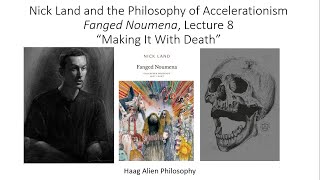
Nick Land Explained Fanged Noumena 8 Making It With Death
Haag Alien Philosophy
SRT - Most compatible format for video players (VLC, media players, video editors)
VTT - Web Video Text Tracks for HTML5 video and browsers
TXT - Plain text with timestamps for easy reading and editing
Scroll to view all subtitles
Welcome to the new channel. Today we
will continue our discussion of
Nickland's Fang Nomina. In this eighth
lecture, we will move on to the essay
making it with death remarks on Thanoos
and Desiring Production. Now, this is a
really difficult essay to actually read
cuz it's very dense and makes references
to a lot of other thinkers. But in a lot
of ways, um, I think what Nickland is
trying to do here is he's just trying
to, um, break the stereotype that Doo is
quote unquote just another French post
structuralist thinker. So we usually
think of D. Lewis as being just another,
you know, uh mid to late 20th century
French radical who is maybe um using
different terminology to um express it,
but is ultimately uh doing the same
thing as like a deconstructivist like
Jacqu de well um Niklan argues in this
essay that that's actually wrong. Um if
anything uh the most different thinker
from Doo is just himself. It's not Hegel
as people usually think. People usually
think of Hegel as being the exact
opposite of Duluth. He Hegel is the
thinker who can't um understand
difference in itself but um only
understands a dialectical difference a
difference light a weak difference um
which is actually useful for moving
dialectic forward. The only difference
Hegel can think is between the the
thesis its antithesis and then you move
on to the the synthesis. Now obviously
um Hegel did not use those terms himself
but this is how it's usually thought of.
Well, Nick argues that um it's not
Hegel, but rather um who is the most
different from Doo because Doo for um
for Nick is not really just another
French radical, but is actually more
like um the German thinkers he's usually
contrasted with. He's more like a
Schopenhau or if you go even further
back in time, he's more like Spinosa
because Spinosa allows us to think of
substance as um something which kind of
runs itself despite not being alive in
like a biological sense of the term. And
um that really leads us to uh one of the
most important things in Deloo's
philosophy, which is oh the desiring
machine. The the desiring machine can
also run itself despite not being alive.
So um Doo is interested in this essay in
showing that um uh excuse me Nickland is
interested in this essay in showing that
Doo and Da are polar opposites because
although Deida seems to be like the most
extreme rebellion against modernity he's
actually not that at all. Instead, Deida
um is simply doing in maybe a more
seemingly complicated manner um what
always happens in modernity. Uh because
modernity to uh quote land himself is
essentially reconstructive. What that
means is um the tendency for anything
which has been encoded to be decoded
like almost immediately over and over
again. Um that's uh maybe put on
particularly vivid display within the uh
work of Deid deconstruction. But um it's
what um is happening around us all the
time because that's just the essence of
capital. The funny thing about capital
is um you never really encounter capital
as such. You always encounter the
reconstructed version of capital, the
newer version of it. Um he says himself
it's always neo capital that you
actually encounter because within
capitalism nothing is allowed to stay
upto-date for very long. There's a
mandate for everything to be up to date.
uh anything which is quote outdated has
to be thrown away and then replaced with
a more up-to-date version of itself. But
uh the funny thing is um that the
up-to-date version doesn't stay that way
for long. Anything which is encoded is
immediately decoded over and over again.
So we see this within capitalism. Um in
uh Len's other essays he describes this
as the passage through zero which has to
happen over and over again. Zero is that
kind of strange threshold um where um
you have value neither positive nor
negative but rather that which allows
capitalism to function by allowing you
to uh numerically conceptualize profits.
Those are your positive numbers and
losses. Those are your negative numbers.
And this is um something which is sort
of built into the very logic of
capitalism. This passage through zero um
because that's exactly what um allows
you to uh get rid of an outdated version
of a product and then have a new version
of the product emerge from zero in what
is really uh structurally akin to a
passage through death. It has to pass
through death over and over again to be
reborn as something new. And this is um
once again uh something which uh Gered
dot seems to be rebelling against but
he's actually just purifying it. He's
kind of uh condensing it into a very um
explicitly philosophical form. And
therefore uh the difference between Doo
and Dereda is that dered allows you to
think about that passage into the
outside. that passage into zero, that
passage through death, not for the
purpose of recoding it into a newer
product within capitalism, but rather to
think of a passage through death,
figuratively speaking, of course, um,
which is so intense that can actually
reach a point of singularity where all
of those temporary ephemereral
structurations
um, come to have their laws suspended.
And that is of course the essence of
accelerationism. Accelerationism is
different from deconstruction because
they're both radical movements of
course, but a very fine technical
difference between the two is that
acceleration isn't about just repeating
the same process that is already going
on in capital. It's rather about um
accelerating the intensive
difference in itself, the line of flight
into the virtual to the point that the
laws of capitalism come to be suspended
in a singularity. Now, another way that
Doo and Dered can be thought of as doing
very different things has to do with the
relation to time. Now, time can only
really be understood for Doo through the
three synthesis that you see featured
within a difference in repetition. The
first synthesis simply gives you um the
present moment as a passing present. Um
you have kind of a passive synthesis in
the background that allows um you know
each moment to pass from one to the next
which is kind of the least interesting
uh the most ordinary of the three
syntheses. In addition to that, you can
also have a synthesis that refers back
to the past through specifically
relating by means of a memory of
something, not to the thing itself,
which is gone. You know, the actual
identifiable um uh bottle of whiskey,
for example, that you drank years ago,
that's obviously gone. But you can use a
memory of it to relate to the idea of
something associated with that whiskey.
like say uh it had a very spicy flavor
because it it was a rye whiskey. Okay.
So um even though the bottle is gone as
an actual identifiable thing um memory
can uh uh generate um a second synthesis
of time into the past where I relate to
the virtual idea and it is virtual
because the actual identifiable bottle
of whiskey when it did exist um was able
to connect to the idea of spiciness but
the idea was um kind of like um
something from the platonic world of
forms. Now dul doesn't believe in a
beyond in the platonic sense but he did
acknowledge that ideas are virtual
because um they preede the actual
identifiable things which can relate to
them because uh in and of themselves uh
the ideas are kind of just different
concentrations of that intensity in the
realm of pure difference in itself. Now
the third one, the synthesis that gives
you the future um uh is the one that
doesn't just relate to the intensive qua
a particular idea or particular
concentration of intensities like say
the idea of spiciness rather this is the
one that just takes you into the outside
uh it takes you into zero. It takes you
into where the new the really new is
located and that's exactly where
acceleration is supposed to take you.
Now um you may argue that capital is
also all about giving you the new but
it's it's kind of a condition to new. Um
capital does repeatedly pass into the
outside. This is zero where the old is
dissolved and something else replaces
it. Uh but this is a kind of a
conditional new which doesn't go quite
as far as acceleration but is still
dealing enough with the outside for its
own sake that it cannot be understood
through subordinating it to any
humanistic teological goals. What this
means is that um the caricature that
capital is all about generating profits
for corporations or wealthy people.
Well, it kind of misses the point that
capital is um not um an inherently human
um dominated procedure which is
completely under the control of even the
most wealthy people or corporations on
the earth. Rather, capital is kind of
that impersonal machine that runs itself
and is able to um produce not for the
sake of making money for particular
pathological greedy individuals, but
rather to produce for the sake of
producing. What it produces is just
production itself. And therefore, in so
far as it might seem to be associated
with human bo values, um Nicholine warns
that these are more like barnacles.
there. They hang on to capital uh but
are not really in control of it and
they're not even essential to it. He
compares uh these two a dwarf riding a
dragon to use his own quote from two
page 265.
And for that reason uh capitalism
uh might be on a path to self-destruct
quote unquote but not for the reasons
that traditional Marxists think. It's
not that capitalism is going to collapse
from its own dialectical contradictions
in which case it'll simply evolve
notionally into socialism or then
communism. Rather, capital is unstable
because um it has um an inherent
connection to madness. There's always
madness incited in the form of the
schizoanalytic passage into the outside.
So an anti-edipus by doul and guadi um
the skitso is uh the one who takes a
line of flight into the outside by not
being under the control of the edible
structure mommy daddy me and really that
is structurally quite analogous uh to um
capital itself and for this reason um
the death drive which Freud basically
used to understand that sort of a drive
which is not domesticated by the edible
structure. The death drive is all too
often misunderstood if we think of it as
the paradoxical or nonsensical desire we
have unconsciously um to die. Well,
nobody really desires that. And yet, we
all have the death drive because the
death drive doesn't seek death as
something beyond itself. Rather, the
death drive is in a certain sense the
explosion
of um death within aka zero. And this is
uh something which of course explains
how capital itself works. And this is a
death drive um which uh is a death drive
because um it drives the unliving
machine of capital forward all the time.
It drives it without having to make it
alive. Now, this very different
understanding of the death drive also
allowed Nick Land to uh call into
question the Marxist idea that um
there's an alienation of the worker in
capitalism. He argued that it's not so
much an alienation of the worker so much
as it's the worker is becoming zombie.
It's more fitting to call it the
becoming zombie of the worker because
just as the commodities have to
constantly pass through death
figuratively speaking of course they
have to pass through zero uh to be
deconstructed only to be reconstructed
again as something else well that
happens to humans too I mean that's why
they're human resources in capital they
have to uh participate in the same sort
of process uh because you may have
noticed that in this era especially
nobody can really have the luxury of
being only one career niche uh for their
entire working lives. Rather, you might
work a job for a little bit only to be
inevitably laid off and then you'll have
to be um reconstructed with a new
identity within the system with a
different career which you'll then be
laid off from again and the process will
just go on and on. And it really
couldn't be any other way because at the
end of the day, this relation to the
death drive, this relation to zero, um
is what's really essential. It's just
built within the body without organs
because um as he quotes uh Duzian Guadi
from near the very end of anti-edipus um
on page 268 um quote unquote the body
without organs is the model of death. So
it's a body without organs because the
organs are also constantly deconstructed
than reconstructed. The body without
organs has a lot more to do with just
the death drive itself. Now, you may
recall that uh as early as the first
essay in this book, Kant Capital and the
Prohibition of Incest, Nick Land showed
the surprising connection between what I
just described about capital and the
dominant philosophy of our era, which
remains that of Emanuel Kant by arguing
that critique actually does something
very similar. Well, um he uh expound
expands upon that, excuse me, uh within
this essay by noting that critique is
also about that sort of um
deconstruction and reconstruction by
passage through zero because um it's all
about separating an object which looks
to the naive viewer to the naked eye to
be one coherent um self-identical thing.
um he separates that object from
something else which is its
transcendental conditions and by
separating the object from its
conditions he uh shows how there's
actually something of a production. The
object is produced from what? From its
conditions and therefore it's produced
reconstructed through a passage through
zero which is actually um the main point
of um the uh philosophy of Emanuel Kant
even before capitalism as such becomes
this dominant economic phenomena within
history. Now the opposite of this
emphasis on producing the object from
its conditions would be um the sort of
dogmatic rationalist metaphysics that
you find with someone like a libonitz.
Um libinets uh would hold that the thing
is so set in its essence um through
being created by God to be the only
maybe piece of that puzzle that will fit
exactly with all the others. That's why
Lebanon says this is the best of all
possible worlds. This is um the main
joke in Voltater's Condid is you have a
caricature of Lieinets, a philosopher
who says this is the best of all
possible worlds while many many things
are going wrong in that world. Well,
Linets was able to argue that through um
showing that rather than have the object
be separated from its conditions and
then be produced like something within
capitalism. um you instead have the
thing so set in its essence that um even
its relations with all other things in
that universe are um not established
secondarily after it's created after
it's set into that puzzle to interact
with them. No, it's already predefined
as its own um essential uh attributes.
Um so the attributes or properties of
the thing are not just you know it's its
colors like you know it's white um it's
its cubicle you know if it's a piece of
salt um it's sharp tasting etc. No, it's
uh inherent properties that it has
essentially as part of its essence um or
its relations with all the other things.
And this is um the exact opposite of
course of what you have in content
critique and capital for there you
cannot have anything be set and
determined like that everything is
constantly passing back through zero yet
again in order to be deconstructed and
then reconstructed. Now this moves us uh
on to uh section two where he asks
whether um the uh standard idea about
the political critique in anti-edipus
especially with regard to um Italian
totalitarianism
you know 20th century Italian
totalitarianism as being the exact
opposite of uh revolution. how exactly
that um um idea or characterization by
dou might differ from how you would
usually think of it. Now the biggest
problem with the way that we tell the
story of the 20th century is we tend to
think of um 20th century Italian
totalitarianism
which we're not even allowed to say the
real name for that on YouTube. Um we
tend to think of that as the worst
possible political configuration. So
much so in fact that if you um ease
repressions on society just a little bit
you might have a full-blown return to
it. So the idea here that we all
understand as people who grew up in the
west is that um if you don't repress
dangerous unconscious drives um then
it's only a short slippery slope from
not repressing something the system said
needs to be controlled um to having the
population have a full-blown return to
20th century Italian totalitarianism
because ultimately that's just the
result of letting the drives get out of
control. Nick Line calls into question
though whether that's really what
explains how that happened. Whether
that's really the purpose of all of this
repression, what if what actually
happens when you accept that level of
repression as the lesser of two evils,
uh what if what actually happens is that
the population comes to be infantilized.
we come to remain in a childlike state
for our entire lives because um lun the
no and law of the father play on words
within French. Uh what if that
prohibition uh from the parental figure
that has become the state? Um what if
it's not there just to keep the really
dangerous drives under control so we
don't have the worst of all possible
outcomes uh come to fruition as a
result? What if uh the point of that is
just to radicalize the edible
interiorization of the father figure?
And what if uh the opposite of that
would be not the worst of all possible
outcomes, but rather the sort of
acceleration not to a particular
political configuration, but rather the
acceleration into the new, the outside,
the intensive, as opposed to this really
rigid structuration of the actual and
identifiable. Uh what if the uh uh
opposite of that repression is actually
the sort of acceleration which could
suspend the laws rather than
radicalizing particular human laws in
the form of a totalitarian dictatorship?
Well, that's a question which you're not
really allowed to ask, but I suppose
we'll ask it today anyway.
Full transcript without timestamps
Welcome to the new channel. Today we will continue our discussion of Nickland's Fang Nomina. In this eighth lecture, we will move on to the essay making it with death remarks on Thanoos and Desiring Production. Now, this is a really difficult essay to actually read cuz it's very dense and makes references to a lot of other thinkers. But in a lot of ways, um, I think what Nickland is trying to do here is he's just trying to, um, break the stereotype that Doo is quote unquote just another French post structuralist thinker. So we usually think of D. Lewis as being just another, you know, uh mid to late 20th century French radical who is maybe um using different terminology to um express it, but is ultimately uh doing the same thing as like a deconstructivist like Jacqu de well um Niklan argues in this essay that that's actually wrong. Um if anything uh the most different thinker from Doo is just himself. It's not Hegel as people usually think. People usually think of Hegel as being the exact opposite of Duluth. He Hegel is the thinker who can't um understand difference in itself but um only understands a dialectical difference a difference light a weak difference um which is actually useful for moving dialectic forward. The only difference Hegel can think is between the the thesis its antithesis and then you move on to the the synthesis. Now obviously um Hegel did not use those terms himself but this is how it's usually thought of. Well, Nick argues that um it's not Hegel, but rather um who is the most different from Doo because Doo for um for Nick is not really just another French radical, but is actually more like um the German thinkers he's usually contrasted with. He's more like a Schopenhau or if you go even further back in time, he's more like Spinosa because Spinosa allows us to think of substance as um something which kind of runs itself despite not being alive in like a biological sense of the term. And um that really leads us to uh one of the most important things in Deloo's philosophy, which is oh the desiring machine. The the desiring machine can also run itself despite not being alive. So um Doo is interested in this essay in showing that um uh excuse me Nickland is interested in this essay in showing that Doo and Da are polar opposites because although Deida seems to be like the most extreme rebellion against modernity he's actually not that at all. Instead, Deida um is simply doing in maybe a more seemingly complicated manner um what always happens in modernity. Uh because modernity to uh quote land himself is essentially reconstructive. What that means is um the tendency for anything which has been encoded to be decoded like almost immediately over and over again. Um that's uh maybe put on particularly vivid display within the uh work of Deid deconstruction. But um it's what um is happening around us all the time because that's just the essence of capital. The funny thing about capital is um you never really encounter capital as such. You always encounter the reconstructed version of capital, the newer version of it. Um he says himself it's always neo capital that you actually encounter because within capitalism nothing is allowed to stay upto-date for very long. There's a mandate for everything to be up to date. uh anything which is quote outdated has to be thrown away and then replaced with a more up-to-date version of itself. But uh the funny thing is um that the up-to-date version doesn't stay that way for long. Anything which is encoded is immediately decoded over and over again. So we see this within capitalism. Um in uh Len's other essays he describes this as the passage through zero which has to happen over and over again. Zero is that kind of strange threshold um where um you have value neither positive nor negative but rather that which allows capitalism to function by allowing you to uh numerically conceptualize profits. Those are your positive numbers and losses. Those are your negative numbers. And this is um something which is sort of built into the very logic of capitalism. This passage through zero um because that's exactly what um allows you to uh get rid of an outdated version of a product and then have a new version of the product emerge from zero in what is really uh structurally akin to a passage through death. It has to pass through death over and over again to be reborn as something new. And this is um once again uh something which uh Gered dot seems to be rebelling against but he's actually just purifying it. He's kind of uh condensing it into a very um explicitly philosophical form. And therefore uh the difference between Doo and Dereda is that dered allows you to think about that passage into the outside. that passage into zero, that passage through death, not for the purpose of recoding it into a newer product within capitalism, but rather to think of a passage through death, figuratively speaking, of course, um, which is so intense that can actually reach a point of singularity where all of those temporary ephemereral structurations um, come to have their laws suspended. And that is of course the essence of accelerationism. Accelerationism is different from deconstruction because they're both radical movements of course, but a very fine technical difference between the two is that acceleration isn't about just repeating the same process that is already going on in capital. It's rather about um accelerating the intensive difference in itself, the line of flight into the virtual to the point that the laws of capitalism come to be suspended in a singularity. Now, another way that Doo and Dered can be thought of as doing very different things has to do with the relation to time. Now, time can only really be understood for Doo through the three synthesis that you see featured within a difference in repetition. The first synthesis simply gives you um the present moment as a passing present. Um you have kind of a passive synthesis in the background that allows um you know each moment to pass from one to the next which is kind of the least interesting uh the most ordinary of the three syntheses. In addition to that, you can also have a synthesis that refers back to the past through specifically relating by means of a memory of something, not to the thing itself, which is gone. You know, the actual identifiable um uh bottle of whiskey, for example, that you drank years ago, that's obviously gone. But you can use a memory of it to relate to the idea of something associated with that whiskey. like say uh it had a very spicy flavor because it it was a rye whiskey. Okay. So um even though the bottle is gone as an actual identifiable thing um memory can uh uh generate um a second synthesis of time into the past where I relate to the virtual idea and it is virtual because the actual identifiable bottle of whiskey when it did exist um was able to connect to the idea of spiciness but the idea was um kind of like um something from the platonic world of forms. Now dul doesn't believe in a beyond in the platonic sense but he did acknowledge that ideas are virtual because um they preede the actual identifiable things which can relate to them because uh in and of themselves uh the ideas are kind of just different concentrations of that intensity in the realm of pure difference in itself. Now the third one, the synthesis that gives you the future um uh is the one that doesn't just relate to the intensive qua a particular idea or particular concentration of intensities like say the idea of spiciness rather this is the one that just takes you into the outside uh it takes you into zero. It takes you into where the new the really new is located and that's exactly where acceleration is supposed to take you. Now um you may argue that capital is also all about giving you the new but it's it's kind of a condition to new. Um capital does repeatedly pass into the outside. This is zero where the old is dissolved and something else replaces it. Uh but this is a kind of a conditional new which doesn't go quite as far as acceleration but is still dealing enough with the outside for its own sake that it cannot be understood through subordinating it to any humanistic teological goals. What this means is that um the caricature that capital is all about generating profits for corporations or wealthy people. Well, it kind of misses the point that capital is um not um an inherently human um dominated procedure which is completely under the control of even the most wealthy people or corporations on the earth. Rather, capital is kind of that impersonal machine that runs itself and is able to um produce not for the sake of making money for particular pathological greedy individuals, but rather to produce for the sake of producing. What it produces is just production itself. And therefore, in so far as it might seem to be associated with human bo values, um Nicholine warns that these are more like barnacles. there. They hang on to capital uh but are not really in control of it and they're not even essential to it. He compares uh these two a dwarf riding a dragon to use his own quote from two page 265. And for that reason uh capitalism uh might be on a path to self-destruct quote unquote but not for the reasons that traditional Marxists think. It's not that capitalism is going to collapse from its own dialectical contradictions in which case it'll simply evolve notionally into socialism or then communism. Rather, capital is unstable because um it has um an inherent connection to madness. There's always madness incited in the form of the schizoanalytic passage into the outside. So an anti-edipus by doul and guadi um the skitso is uh the one who takes a line of flight into the outside by not being under the control of the edible structure mommy daddy me and really that is structurally quite analogous uh to um capital itself and for this reason um the death drive which Freud basically used to understand that sort of a drive which is not domesticated by the edible structure. The death drive is all too often misunderstood if we think of it as the paradoxical or nonsensical desire we have unconsciously um to die. Well, nobody really desires that. And yet, we all have the death drive because the death drive doesn't seek death as something beyond itself. Rather, the death drive is in a certain sense the explosion of um death within aka zero. And this is uh something which of course explains how capital itself works. And this is a death drive um which uh is a death drive because um it drives the unliving machine of capital forward all the time. It drives it without having to make it alive. Now, this very different understanding of the death drive also allowed Nick Land to uh call into question the Marxist idea that um there's an alienation of the worker in capitalism. He argued that it's not so much an alienation of the worker so much as it's the worker is becoming zombie. It's more fitting to call it the becoming zombie of the worker because just as the commodities have to constantly pass through death figuratively speaking of course they have to pass through zero uh to be deconstructed only to be reconstructed again as something else well that happens to humans too I mean that's why they're human resources in capital they have to uh participate in the same sort of process uh because you may have noticed that in this era especially nobody can really have the luxury of being only one career niche uh for their entire working lives. Rather, you might work a job for a little bit only to be inevitably laid off and then you'll have to be um reconstructed with a new identity within the system with a different career which you'll then be laid off from again and the process will just go on and on. And it really couldn't be any other way because at the end of the day, this relation to the death drive, this relation to zero, um is what's really essential. It's just built within the body without organs because um as he quotes uh Duzian Guadi from near the very end of anti-edipus um on page 268 um quote unquote the body without organs is the model of death. So it's a body without organs because the organs are also constantly deconstructed than reconstructed. The body without organs has a lot more to do with just the death drive itself. Now, you may recall that uh as early as the first essay in this book, Kant Capital and the Prohibition of Incest, Nick Land showed the surprising connection between what I just described about capital and the dominant philosophy of our era, which remains that of Emanuel Kant by arguing that critique actually does something very similar. Well, um he uh expound expands upon that, excuse me, uh within this essay by noting that critique is also about that sort of um deconstruction and reconstruction by passage through zero because um it's all about separating an object which looks to the naive viewer to the naked eye to be one coherent um self-identical thing. um he separates that object from something else which is its transcendental conditions and by separating the object from its conditions he uh shows how there's actually something of a production. The object is produced from what? From its conditions and therefore it's produced reconstructed through a passage through zero which is actually um the main point of um the uh philosophy of Emanuel Kant even before capitalism as such becomes this dominant economic phenomena within history. Now the opposite of this emphasis on producing the object from its conditions would be um the sort of dogmatic rationalist metaphysics that you find with someone like a libonitz. Um libinets uh would hold that the thing is so set in its essence um through being created by God to be the only maybe piece of that puzzle that will fit exactly with all the others. That's why Lebanon says this is the best of all possible worlds. This is um the main joke in Voltater's Condid is you have a caricature of Lieinets, a philosopher who says this is the best of all possible worlds while many many things are going wrong in that world. Well, Linets was able to argue that through um showing that rather than have the object be separated from its conditions and then be produced like something within capitalism. um you instead have the thing so set in its essence that um even its relations with all other things in that universe are um not established secondarily after it's created after it's set into that puzzle to interact with them. No, it's already predefined as its own um essential uh attributes. Um so the attributes or properties of the thing are not just you know it's its colors like you know it's white um it's its cubicle you know if it's a piece of salt um it's sharp tasting etc. No, it's uh inherent properties that it has essentially as part of its essence um or its relations with all the other things. And this is um the exact opposite of course of what you have in content critique and capital for there you cannot have anything be set and determined like that everything is constantly passing back through zero yet again in order to be deconstructed and then reconstructed. Now this moves us uh on to uh section two where he asks whether um the uh standard idea about the political critique in anti-edipus especially with regard to um Italian totalitarianism you know 20th century Italian totalitarianism as being the exact opposite of uh revolution. how exactly that um um idea or characterization by dou might differ from how you would usually think of it. Now the biggest problem with the way that we tell the story of the 20th century is we tend to think of um 20th century Italian totalitarianism which we're not even allowed to say the real name for that on YouTube. Um we tend to think of that as the worst possible political configuration. So much so in fact that if you um ease repressions on society just a little bit you might have a full-blown return to it. So the idea here that we all understand as people who grew up in the west is that um if you don't repress dangerous unconscious drives um then it's only a short slippery slope from not repressing something the system said needs to be controlled um to having the population have a full-blown return to 20th century Italian totalitarianism because ultimately that's just the result of letting the drives get out of control. Nick Line calls into question though whether that's really what explains how that happened. Whether that's really the purpose of all of this repression, what if what actually happens when you accept that level of repression as the lesser of two evils, uh what if what actually happens is that the population comes to be infantilized. we come to remain in a childlike state for our entire lives because um lun the no and law of the father play on words within French. Uh what if that prohibition uh from the parental figure that has become the state? Um what if it's not there just to keep the really dangerous drives under control so we don't have the worst of all possible outcomes uh come to fruition as a result? What if uh the point of that is just to radicalize the edible interiorization of the father figure? And what if uh the opposite of that would be not the worst of all possible outcomes, but rather the sort of acceleration not to a particular political configuration, but rather the acceleration into the new, the outside, the intensive, as opposed to this really rigid structuration of the actual and identifiable. Uh what if the uh uh opposite of that repression is actually the sort of acceleration which could suspend the laws rather than radicalizing particular human laws in the form of a totalitarian dictatorship? Well, that's a question which you're not really allowed to ask, but I suppose we'll ask it today anyway.
Keep this transcript
Save it to LunaNotes and it becomes a real note in your library — editable, searchable, and ready to turn into flashcards or a diagram. Free to start.
Save to LunaNotesOr download subtitles for another video.
These subtitles were extracted using the Free YouTube subtitle downloader by LunaNotes.
Related videos
Download Subtitles for Nick Land's Fanged Noumena Lecture 3
Access accurate subtitles for Nick Land's Fanged Noumena Lecture 3: Delighted to Death to enhance your understanding and engagement. Download captions easily to follow complex ideas and revisit key points anytime.
Download Subtitles for Nick Land's Fanged Noumena Lecture 2
Access accurate subtitles for Nick Land's 'Fanged Noumena Lecture 2: Narcissism and Dispersion' to enhance your understanding and engagement. Download captions to follow complex ideas effortlessly and improve your learning experience.

Download Subtitles for Altered States: AI, Occult & Kabbalah
Enhance your understanding of the Altered States video featuring Tucker Carlson as it explores AI, the occult, Kabbalah, and Nick Land. Download accurate subtitles to follow complex ideas clearly and engage more deeply with the content. Perfect for learners and enthusiasts seeking detailed insights with accessible captions.

Download Subtitles for The War Between The Land And The Sea Documentary
Enhance your viewing experience by downloading accurate subtitles for the full documentary "The War Between The Land And The Sea." Subtitles help improve understanding, support accessibility, and allow you to enjoy the film in various environments without missing any details.
Download Subtitles for 90-Second Brain Capture Video
Enhance your viewing experience with accurate subtitles for the 90-Second Brain Capture video. Easily follow along, improve comprehension, and make the content accessible anytime you watch. Perfect for learners and viewers seeking clarity and accessibility.
Most viewed

Untertitel für 'Nicos Weg' Deutsch lernen A1 Film herunterladen
Laden Sie die Untertitel für den gesamten Film 'Nicos Weg' herunter, um Ihr Deutschlernen auf A1 Niveau zu unterstützen. Untertitel helfen Ihnen, Wortschatz und Aussprache besser zu verstehen und verbessern das Hörverständnis effektiv.

ดาวน์โหลดซับไตเติ้ล DMD LAND 3 The Final Land Day 1
ดาวน์โหลดซับไตเติ้ลสำหรับวิดีโอ DMD LAND 3 The Final Land Day 1 เพื่อช่วยให้เข้าใจเนื้อหาได้ง่ายขึ้น และเพิ่มความสะดวกในการติดตามทุกช่วงเวลา เหมาะสำหรับผู้ชมที่ต้องการความชัดเจนและเข้าถึงข้อมูลอย่างครบถ้วน

Subtítulos para TIPOS DE APEGO | 6 DE COPAS Episodio 56
Descarga los subtítulos para el episodio 56 de la tercera temporada de 6 DE COPAS, centrado en los tipos de apego. Mejora tu comprensión y disfruta del contenido en detalle con nuestros subtítulos precisos y accesibles.
Download Subtitles for Harvard CS50 2026 Computer Science Course
Enhance your learning experience with downloadable subtitles for the Harvard CS50 2026 full computer science course. Easily follow along with lectures, improve comprehension, and access the content offline anytime. Perfect for students and enthusiasts aiming to master computer science concepts.

Descarga Subtítulos para NARCISISMO | 6 DE COPAS - Episodio 63
Accede fácilmente a los subtítulos del episodio 63 de '6 DE COPAS', centrado en el narcisismo. Descargar estos subtítulos te ayudará a entender mejor el contenido y mejorar la experiencia de visualización.
Found this transcript useful?
Take it with you. One click puts it in your own LunaNotes library.
Save to LunaNotes