Download Subtitles for Nick Land's Fanged Noumena Lecture 2
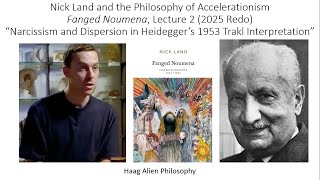
Nick Land Fanged Noumena Lecture 2 Narcissism and Dispersion
Haag Alien Philosophy
SRT - Most compatible format for video players (VLC, media players, video editors)
VTT - Web Video Text Tracks for HTML5 video and browsers
TXT - Plain text with timestamps for easy reading and editing
Scroll to view all subtitles
Hey, how's it going? This is Chad H
reporting from Southern India. I'd like
to continue the series of videos in our
group reading of Nickland's Fang Nomina.
In this second lecture, we will examine
the essay Narcissism and dispersion in
Haidiger's 1953 Trole interpretation.
All right. So, if we go ahead and get
into the essay itself, we'll notice that
um Land opens his own essay about
Haidiger's essay about Truckle's poem by
asking the legitimate question whether
that essay by Haidiger succeeds in um
doing any of the things which we would
normally expect an essay about a poem to
do. For example, it would seem perfectly
reasonable to expect an essay about a
poem to succeed in telling us something.
for example, telling us something about
poetry or um history or even language in
general to um go through the list of
hypothetical items which Land himself
puts forth. Land asks though not only um
whether the poem succeeds in in
conveying information about those
topics, but um asks instead whether it
succeeds in doing anything at all. Now,
you'd have to I I guess be familiar with
the later Hideiger to see the humor in
this uh borderline sarcastic set of
questions which Land opens the essay
with in so far as Land is really trying
to um make a joke about all of the
things which he himself obviously knew
that the later Haidiger um did not think
about language. A reader familiar with
the later Haidiger will recall that um
he largely sought to overturn our common
sense ideas about language. Above all
the idea that language is in itself
nothing more than a tool which we humans
use in order to accomplish tasks which
are teologically oriented towards some
goal. Above all, the task which humans
think they use language to accomplish is
to convey information from one person to
another through reducing language to a
set of words which are themselves
understood to be so many labels which
can be arbitrarily but still reliably
correlated with various objects out
there in the quote unquote real world.
These labels under this view can allow
anybody who speaks that language to
reach an intersubjective consensus
regarding some shared meaning which
would be universally transmissible to
anyone else in the social network in the
more traditional sense of that now
widely abused term. If you look closely
though, each of the things which land
implicitly admits right from the start
that um Haidiger fails to use language
to do in this um short list um is really
just another instance of using language
as a tool to convey information about a
given topic or subject matter. His own
examples of poetry, history, and
language in general, however, is
something of a loose set in which one of
these um items doesn't really fit.
Because if you really think about it, um
language, the final item he cites, um is
uh would would be a strange uh contender
for the subject matter which language is
supposed to tell us about because even
if succeeded in doing that, that would
be a case of language telling us about
itself, which would imply a circular
relationship, which Land himself later
reveals to be more like narcissist
relation to his own reflection in a pool
of water, which of led him to drown in
his own self-love. The alternative to
that circular narcissism is of course
the kind of dispersion which makes up
the second half of that part of the
title to Nick Lan's essay. We'll notice
that H Highiger's supposed failure to
use language successfully to do anything
productive with the poem by Truckle
might be compared not coincidentally to
Tral's own failures to do anything
productive in his own life since after
all the biography of the man tells us
that he only ended up getting lost in
drugs, alcohol, and psychological
ailments. Lan reminds us that the man's
failure is violently traumatic in an
almost positive sense of an intensive
excess. And this must be kept in mind
when recognizing his poetic style as a
quote unquote dissolution of every
criterion for evaluation. In so far as
we can interpret the man's poetry, this
act of interpretation cannot ever be
thought of as a simple act of obtaining
mastery over these quote unquote
traumatized signs. nor should we even
attempt to do so. Lan tells us that
Trole did not use language to linearly
develop one single coherent argument as
instead H highaidiger um himself use the
metaphor of a wave to describe something
which repeatedly builds itself up into
an intensity which crashes before
receding and then returning again in the
same movement towards the shore. Lan
tells us that Haidiger had avoided the
European tradition of aesthetic theory
when discussing trle because any attempt
to re-ransate a given poem into a
clearer language of philosophical
mastery only leads to the creation of a
new meta language and a corresponding
metaphysics which would negate the goal
of allowing the poem to give us that
impersonal thinking which would no
longer be tied down to a thinking which
belongs to any one subject. This
impersonal thinking which is not just my
own use of language allows language to
come to itself in a speaking which has
no need for any teological orientation
towards getting stuff done for me. The
later Haidiger was of course concerned
with poetry above all other forms of
language because the poem is what allows
language to be freed up to concern
itself with itself and only with itself
rather than say communicate information
about external facts, objects or subject
matters.
Land dares to ask though whether
language's concern with itself is
inherently narcissistic, for that would
imply a circular desire which leads back
to itself. Under those grounds, language
would seem to have an autoerotic desire
for its own self. But we must recall
from the myth of narcissists that this
selfdesiring led him to fall into the
pool and drown. As the opening chapter
of Moby Dick warns that the sailors in
the story can also paradoxically gaze
into the deepest ocean which spans the
whole earth but still only ever see
themselves and find that in so far as a
deeper truth lies below the surface of
that water it is only one's own death
which one will find by drowning. At any
rate, to return to Lan's essay, he notes
that Haidiger's own reinterpret
reinterpretation of Nichzche's eternal
return was more like this circular
return of language to itself than the
alternative of say the Freudian cliche
of the death drive. The death drive, in
contrast, is a return to the inorganic
through the idea that quote unquote,
"We're alive now, but we wish to return
to a state of inanimate matter." Len
questions whether Haidiger's preference
for languages narcissism over the
Freudian death drive is, in properly
psychoanalytic terms, a repression in
itself. But we'll have to return to this
question much later to see the answer.
At any rate, we can finally consider
that the only poem cited in its entirety
in this essay by Haidiger is Truckle's
Gista Damong. Land notes that Haidiger's
um own discourse on the poem about
languages self-love is itself circular
in essence for there is no clear point
where Haidiger's discussion of the poem
begins. A little bit like how Leonardo
DiCaprio's character in the film
Inception noted that one never actually
sees the beginning of the dream. For
once one realizes one is dreaming, one
is already deep in the middle of that
same dream. The poem speaks of something
like a wild beast. But Lan criticizes
the translation of the German word vilt
as inadequate. For what is being
discussed here is more like a feral
animal which would be hunted as game.
Not coincidentally, a feral animal as
one which is vil lives in the forest or
vault.
Even if we have this animological
clarification, the question remains, who
exactly is this mysterious beast which
has gone feral and now lives in a dark
forest? Well, the mysterious blue beast
mentioned in the poem is presented as
something of a threshold between animal
as such and a certain opening of the
horizon of Daazine where being can
interpret itself. And therefore, it's
not really a wild animal so much as it
presents an edible riddle for which the
answer is once again just me. The blue
beast in the poem is just man himself.
Lan tells us that the kind of thinking
opened up by that hermeneutical horizon
which that thing does sort of have
access to is not reducible to any sort
of biological calculation which even a
very sophisticated animal might be
capable of. For this hermeneutics
concerns itself with the temporalization
of the ontological difference or the
difference between being and beings. But
in so far as the ontological differences
dealt with in classical philosophy, it
is through the hermeneutical space of a
transcendental thinking or as Kant tells
us a type of reflective thinking which
is carried out by a subject with that
unique power of reflective reflective
transcendental thinking which is for
that reason also a narcissistic circle
through which the human animal uses its
thinking to think about its own
reflective thought and the limits of its
reason. We must ask at this point which
reflection
yields the reflection of daine as that
which exists fully behind any idea of
mere animality. Well, it's no
coincidence that even within this poem
itself, the thing which allows us to
reflect is a pool lying nearby much like
the one which narcissist himself had
fallen into. Lan asks then the
legitimate question whether we desire
ourselves like he did but notes that the
poem itself does not provide a
conclusive answer one way or the other
regarding this problem. One thing which
is clear from the poem though is that
what returns to us from that pool is not
the image which we had sought out. In
fact, what returns to us from the pool
is no image at all, but instead only the
groundlessness of Daine as a certain
oblig. To understand this groundlessness
though, we have to make another quick
detour into Haidiger's obscure talk,
what is metaphysics? A text which um at
least 10 years ago when I was in college
um was not really officially translated
from German into English. So when I was
in undergrad, my professor had to
provide his own translation um while
teaching it. Um, I had a I still have a
physical copy of that translation with
all of his footnotes and I made a full
video over it um for YouTube back in
July 2018, which I've provided a link
for in the video description um which
I'd recommend you to check out. But for
our purposes um the big theme of
relevance here is the idea of a certain
groundlessness of da which does indeed
make it meaningful to speak of nothing.
Now, Haidiger noted from the start of
this talk that the idea of nothing
really cannot be discussed anywhere
except in philosophy because um science
and even logic tell us that um nothing
is not only useless but it's also
impossible. In so far as logic allows us
to speak of that which is not. It
presumes that this negation is always a
higher order operation which had to have
been applied to something which already
was. The idea of an obkund is for Heidi
however not simply a negation of some
more originarily given positivity of
some other object on which this relation
would be parasitic. It is rather
something which the original German
wording escaped nisht um reveals in a
way that I guess is only ever you know
imperfectly translated into English. If
you look at the um German wording
esipnished that could obviously uh mean
um the uh intuitive uh sense of
something which uh does not exist
because esipped means there is. So if
esnished it means it doesn't exist. But
um it could also mean that nothing is
given okay or that it is somehow
disclosed to us within experience but on
its own terms. Modern science of course
assumes that the only thing which is
given is data which makes sense on
etmological grounds considering that
data just is the Latin transliteration
of givens. But the giveness of this
nothing
calls into question
the relation to the ground which we
would normally take for granted. Grund
of course is the German word for the
ground that you stand on but also the
idea of the grounding of a system or
science of knowledge. Right?
is therefore the negation of that but is
really more like the almost positive
idea of an abyss. Grund is also though a
word for a type of understanding. So
obund Haidiger tells us of the
understanding cannot be any faculty of
reason but rather something far more
fundamental than that. We are somehow
familiar with nothing even if we try not
to think about it. For we don't know
this nothing through subsuming it under
a concept in the contine sense we are
somehow already thrown to it and it is
precisely when we are confronted with
being as a whole rather than any one
particular being with a little B in
experiences like say extreme boredom
which does not even have a cause which
could be pinned down one particular
object like say a really boring movie
rather we say it is boring in a very
creepy um symmetrical manner to the it
which is indeterminate which is more
like the mood as a whole which discloses
being in all of its groundlessness. The
mood which discloses that is of course
dread. But this does not disclose the
nothing as any sort of object. Rather,
in so far as metaphysics goes beyond
physics or the ancient Greek idea of
ausis or physical nature, it has not
taken us to the ultimate being of say
medieval scholasticism. It has rather
taken us to the groundlessness of the
nothing as the obund
or the lack of grounding of our own
daine. To return to Nick Lan's essay, he
notes that we know from H Highiger that
this abyss or abundant is the
precondition of any ontology. But now
suddenly with the nihilism of this
groundlessness of Daine established out
in the open. Suddenly we find within the
poem itself the voice of a mysterious
figure called the sister.
This voice appears
ironically enough after the flight of
the Greek gods had, you know, been a
historical problem. So the sister is
associated with the moon in much the
same way that Julius Evol's revolt of
the modern world noted a connection
between the feminine lunar principle as
something which follows after a shift
from the golden age of the masculine
solar to the successive ages of decline
leading to technological modernity as
the worst dark age. Well, Land notes
here that because the moon gives us a
kind of light, but one which shines
during the nighttime in so far as we are
able to have a world disclosed into
visibility by the moon's light. This
light is just tracing a path through the
darkness. Given that this is a post
golden age and post Greek gods era of
technological decline, this must be the
darkness of nihilism. In so far as any
path is traced out for us in that
darkness, that path is only a drifting
away from the theological metaphysics of
long ago and towards something which can
now only be identified in the positively
negative title of the stranger.
The sister's voice is then a transition
from the past to the future, but in
itself it belongs to neither of them. At
this point, suddenly a whole cast of
mythical characters appears within the
poem. One of these includes a female
character who Zeus had an affair with,
but who was then tricked by Zeus's wife,
Hera, into having Zeus reveal his true
form in her presence. Zeus's true godly
form was of course so dazzling that no
mere mortal could withstand it. So the
lover exploded in the presence of Zeus's
radiance.
Land uses this humorous myth perhaps to
warn the reader that any attempt we make
to provide a full and clear genealogy of
the gods is by definition a repression
of this dazzlingly bright lightning
bolt. or for the god Bakus, a repression
of the drunken frenzy. But such
repression misses the point that these
excesses are exactly what those gods in
themselves are. The only reason why such
repression could occur would be to
satisfy the needs of civilization to
make discontents of its inmates in order
to meet the police's requirement for
over socialization. That over
socialization of course reaches its
worst form in the modern technopile SJW.
But at any rate, Lan notes that
civilization and its discontents also
repress or rec or covers over the
originary delirium of western history.
Because in so far as this history ever
does come to be written, this writing is
a recursive forgetting of an amnesia
that was already there. In other words,
writing is the forgetting of a
forgetting. But what is the first
forgetting? A forgetting of. Well, land
tells us it is a forgetting of the lack
of any pre-given foundational discourse
which could hope to ground even the
knowledge of the sciences. This is a
lack which is repressed in an act which
substitutes another lack for the one
which was already there in order to
forget the first forgetting. Therefore,
we find the sister speaking within the
poem, but it is a question whether we
can really interpret her words. For in
so far as the moon speaks at night, this
night is a time of derangement, land
tells us. It is all too fitting, then
that the kind of person associated with
both the darkness of the night and the
halflight of the moon is even on a
purely etmological level someone who is
called a lunatic. The sisters speaking
of lunatic words then leads to a
transition in which the poem suddenly
speaks of a shattered mirror but also of
the movement of astronomical stuff. Lan
asks what connection there might be
between these two themes. Well, if we
consider the mirror cracking first, this
is something which happens because
desire is an excess which explodes any
attempt to contain it within the closed
circuit of a selfloving reflection. But
this explosion coincides with a lunar
process um in which the sister no longer
sublimates the family's desire of
itself.
Now with the mirror and circle broken,
the family is truly opened up to the
possibility of an encounter with radical
alterity or radical otherness, a theme
which interests Lan over and over again
within these books.
Is not this alterity though the true
uncanny night which negates the familiar
light of the day? And is it a
coincidence that in so far as the mother
has two eyes, they're really two moons?
Well, even if we accept these premises,
it remains somewhat unclear whether this
cracking of the lunar mirror is the
dialectical restoration of a first order
which had been lost but has now been
found again. Or in contrast with this
easy pseudo Hegelian reading, Lan asks
whether um this must instead coincide
with the spreading out of an endless
open space. Under these conditions, it
would seem that the moon's relation to
the stars was ultimately that it just
caused their light to fade from sight.
But with these stars now restored with
the cracking of that moon, their endless
space can no longer be repressed into
the self-encclosed circle. For now we
get the kind of difference in itself
which deloo referenced in difference and
repetition as a pure difference which
cannot be reduced to any mathematical
overmining in Graham Harmon's sense of
that term such as the abstract formula
of equality or identity. Lan notes that
we repress the threat of such pure
difference in itself in order to write
the foundation of a cosmology which
perverts this dispersion of the stars
into just another pseudo science of
epistemological containment. It makes
sense then that philosophers of all
people would tend to repress this
dispersion of the stars because the
first Greek philosopher Thales had
famously made the mistake of falling
into the pit while gazing at those same
stars. Hegel also expressed discomfort
over the topic of the stars in his um
nature volume of the three volume
encyclopedia because such a dispersion
has no ordering to it. Land humorously
notes though that this lack of order
makes this dispersion of the stars more
like the outbreak of a rash which
spreads because it is the rash of
irrationality.
Not sure if the pun is intended or not
on his part. But in classical land
fashion, he notes that the threat does
not come to us from somewhere on the
outside. And this is perhaps related to
the very strange way that Haidiger never
dealt with TroL's many poetic references
to lepers because lepers are after all
those who are excluded or segregated to
a colony lying outside the limits of the
city. Well, the rash spreads because any
attempt to repress it only leads to an
ironic repetition of it in the form of a
symptom. In so far as a kind of light is
given by such stars, it is not the kind
of light which provides the
transcendental grounding for the
phenomenon to appear clearly in the
disclosure of truth. Rather, the light
of the stars is just a secondary effect
of an uneven distribution of
differential intensities which defies
any principle of logical ordering. No
longer then are we in the realm of
metaphysics. This must instead be a
stratophysics such that whereas
metaphysics is defined by form and law.
Stratoysics is an open-ended
stratification of impersonal and
unconscious intensive positivities.
Land notes that such a generation of
intensities is possible only due to a
certain redundancy. But a redundancy
which is more like the redundancy
between the 26 letters of the alphabet
and the countless words which can be
formed from them or the countless
sentences which can be formed from those
words in turn. Once again each
repetition here is a symptom which
spreads the rash further without ever
containing it. He notes that the flame
of the star might seem initially to be
like Dawine because it is outside of
itself in the literal sense of being
explosive. But there is a certain
ambiguity in H Highiger regarding
whether the flame could be on the one
hand the gentle illumination of truth or
on the other the devastation of
unordered intensities. Yet, the very
need to consider a dichotomy between the
good binarity of the former and the bad
binarity of the latter, which would be
one of conflict or antagonism, is one
which Nickland accuses Haidiger of um
espousing
because he was not ready to confront
anything except an equally gentle
critique of Western metaphysics despite
his project of trying to deconstruct
exactly that. Nor was Haidiger yet ready
to fully acknowledge the real conflict
which was building up between the
patriarchal boogeois capital and a
fluctuating pool of insurrectionary
energy tracing its genealogy to the or
catastrophe of organic matter to quote
land himself.
Uh, Land notes that Haidiger responded
by simply closing the book, closing his
eyes, and perhaps doing so because he
still believed in God after all.
Full transcript without timestamps
Hey, how's it going? This is Chad H reporting from Southern India. I'd like to continue the series of videos in our group reading of Nickland's Fang Nomina. In this second lecture, we will examine the essay Narcissism and dispersion in Haidiger's 1953 Trole interpretation. All right. So, if we go ahead and get into the essay itself, we'll notice that um Land opens his own essay about Haidiger's essay about Truckle's poem by asking the legitimate question whether that essay by Haidiger succeeds in um doing any of the things which we would normally expect an essay about a poem to do. For example, it would seem perfectly reasonable to expect an essay about a poem to succeed in telling us something. for example, telling us something about poetry or um history or even language in general to um go through the list of hypothetical items which Land himself puts forth. Land asks though not only um whether the poem succeeds in in conveying information about those topics, but um asks instead whether it succeeds in doing anything at all. Now, you'd have to I I guess be familiar with the later Hideiger to see the humor in this uh borderline sarcastic set of questions which Land opens the essay with in so far as Land is really trying to um make a joke about all of the things which he himself obviously knew that the later Haidiger um did not think about language. A reader familiar with the later Haidiger will recall that um he largely sought to overturn our common sense ideas about language. Above all the idea that language is in itself nothing more than a tool which we humans use in order to accomplish tasks which are teologically oriented towards some goal. Above all, the task which humans think they use language to accomplish is to convey information from one person to another through reducing language to a set of words which are themselves understood to be so many labels which can be arbitrarily but still reliably correlated with various objects out there in the quote unquote real world. These labels under this view can allow anybody who speaks that language to reach an intersubjective consensus regarding some shared meaning which would be universally transmissible to anyone else in the social network in the more traditional sense of that now widely abused term. If you look closely though, each of the things which land implicitly admits right from the start that um Haidiger fails to use language to do in this um short list um is really just another instance of using language as a tool to convey information about a given topic or subject matter. His own examples of poetry, history, and language in general, however, is something of a loose set in which one of these um items doesn't really fit. Because if you really think about it, um language, the final item he cites, um is uh would would be a strange uh contender for the subject matter which language is supposed to tell us about because even if succeeded in doing that, that would be a case of language telling us about itself, which would imply a circular relationship, which Land himself later reveals to be more like narcissist relation to his own reflection in a pool of water, which of led him to drown in his own self-love. The alternative to that circular narcissism is of course the kind of dispersion which makes up the second half of that part of the title to Nick Lan's essay. We'll notice that H Highiger's supposed failure to use language successfully to do anything productive with the poem by Truckle might be compared not coincidentally to Tral's own failures to do anything productive in his own life since after all the biography of the man tells us that he only ended up getting lost in drugs, alcohol, and psychological ailments. Lan reminds us that the man's failure is violently traumatic in an almost positive sense of an intensive excess. And this must be kept in mind when recognizing his poetic style as a quote unquote dissolution of every criterion for evaluation. In so far as we can interpret the man's poetry, this act of interpretation cannot ever be thought of as a simple act of obtaining mastery over these quote unquote traumatized signs. nor should we even attempt to do so. Lan tells us that Trole did not use language to linearly develop one single coherent argument as instead H highaidiger um himself use the metaphor of a wave to describe something which repeatedly builds itself up into an intensity which crashes before receding and then returning again in the same movement towards the shore. Lan tells us that Haidiger had avoided the European tradition of aesthetic theory when discussing trle because any attempt to re-ransate a given poem into a clearer language of philosophical mastery only leads to the creation of a new meta language and a corresponding metaphysics which would negate the goal of allowing the poem to give us that impersonal thinking which would no longer be tied down to a thinking which belongs to any one subject. This impersonal thinking which is not just my own use of language allows language to come to itself in a speaking which has no need for any teological orientation towards getting stuff done for me. The later Haidiger was of course concerned with poetry above all other forms of language because the poem is what allows language to be freed up to concern itself with itself and only with itself rather than say communicate information about external facts, objects or subject matters. Land dares to ask though whether language's concern with itself is inherently narcissistic, for that would imply a circular desire which leads back to itself. Under those grounds, language would seem to have an autoerotic desire for its own self. But we must recall from the myth of narcissists that this selfdesiring led him to fall into the pool and drown. As the opening chapter of Moby Dick warns that the sailors in the story can also paradoxically gaze into the deepest ocean which spans the whole earth but still only ever see themselves and find that in so far as a deeper truth lies below the surface of that water it is only one's own death which one will find by drowning. At any rate, to return to Lan's essay, he notes that Haidiger's own reinterpret reinterpretation of Nichzche's eternal return was more like this circular return of language to itself than the alternative of say the Freudian cliche of the death drive. The death drive, in contrast, is a return to the inorganic through the idea that quote unquote, "We're alive now, but we wish to return to a state of inanimate matter." Len questions whether Haidiger's preference for languages narcissism over the Freudian death drive is, in properly psychoanalytic terms, a repression in itself. But we'll have to return to this question much later to see the answer. At any rate, we can finally consider that the only poem cited in its entirety in this essay by Haidiger is Truckle's Gista Damong. Land notes that Haidiger's um own discourse on the poem about languages self-love is itself circular in essence for there is no clear point where Haidiger's discussion of the poem begins. A little bit like how Leonardo DiCaprio's character in the film Inception noted that one never actually sees the beginning of the dream. For once one realizes one is dreaming, one is already deep in the middle of that same dream. The poem speaks of something like a wild beast. But Lan criticizes the translation of the German word vilt as inadequate. For what is being discussed here is more like a feral animal which would be hunted as game. Not coincidentally, a feral animal as one which is vil lives in the forest or vault. Even if we have this animological clarification, the question remains, who exactly is this mysterious beast which has gone feral and now lives in a dark forest? Well, the mysterious blue beast mentioned in the poem is presented as something of a threshold between animal as such and a certain opening of the horizon of Daazine where being can interpret itself. And therefore, it's not really a wild animal so much as it presents an edible riddle for which the answer is once again just me. The blue beast in the poem is just man himself. Lan tells us that the kind of thinking opened up by that hermeneutical horizon which that thing does sort of have access to is not reducible to any sort of biological calculation which even a very sophisticated animal might be capable of. For this hermeneutics concerns itself with the temporalization of the ontological difference or the difference between being and beings. But in so far as the ontological differences dealt with in classical philosophy, it is through the hermeneutical space of a transcendental thinking or as Kant tells us a type of reflective thinking which is carried out by a subject with that unique power of reflective reflective transcendental thinking which is for that reason also a narcissistic circle through which the human animal uses its thinking to think about its own reflective thought and the limits of its reason. We must ask at this point which reflection yields the reflection of daine as that which exists fully behind any idea of mere animality. Well, it's no coincidence that even within this poem itself, the thing which allows us to reflect is a pool lying nearby much like the one which narcissist himself had fallen into. Lan asks then the legitimate question whether we desire ourselves like he did but notes that the poem itself does not provide a conclusive answer one way or the other regarding this problem. One thing which is clear from the poem though is that what returns to us from that pool is not the image which we had sought out. In fact, what returns to us from the pool is no image at all, but instead only the groundlessness of Daine as a certain oblig. To understand this groundlessness though, we have to make another quick detour into Haidiger's obscure talk, what is metaphysics? A text which um at least 10 years ago when I was in college um was not really officially translated from German into English. So when I was in undergrad, my professor had to provide his own translation um while teaching it. Um, I had a I still have a physical copy of that translation with all of his footnotes and I made a full video over it um for YouTube back in July 2018, which I've provided a link for in the video description um which I'd recommend you to check out. But for our purposes um the big theme of relevance here is the idea of a certain groundlessness of da which does indeed make it meaningful to speak of nothing. Now, Haidiger noted from the start of this talk that the idea of nothing really cannot be discussed anywhere except in philosophy because um science and even logic tell us that um nothing is not only useless but it's also impossible. In so far as logic allows us to speak of that which is not. It presumes that this negation is always a higher order operation which had to have been applied to something which already was. The idea of an obkund is for Heidi however not simply a negation of some more originarily given positivity of some other object on which this relation would be parasitic. It is rather something which the original German wording escaped nisht um reveals in a way that I guess is only ever you know imperfectly translated into English. If you look at the um German wording esipnished that could obviously uh mean um the uh intuitive uh sense of something which uh does not exist because esipped means there is. So if esnished it means it doesn't exist. But um it could also mean that nothing is given okay or that it is somehow disclosed to us within experience but on its own terms. Modern science of course assumes that the only thing which is given is data which makes sense on etmological grounds considering that data just is the Latin transliteration of givens. But the giveness of this nothing calls into question the relation to the ground which we would normally take for granted. Grund of course is the German word for the ground that you stand on but also the idea of the grounding of a system or science of knowledge. Right? is therefore the negation of that but is really more like the almost positive idea of an abyss. Grund is also though a word for a type of understanding. So obund Haidiger tells us of the understanding cannot be any faculty of reason but rather something far more fundamental than that. We are somehow familiar with nothing even if we try not to think about it. For we don't know this nothing through subsuming it under a concept in the contine sense we are somehow already thrown to it and it is precisely when we are confronted with being as a whole rather than any one particular being with a little B in experiences like say extreme boredom which does not even have a cause which could be pinned down one particular object like say a really boring movie rather we say it is boring in a very creepy um symmetrical manner to the it which is indeterminate which is more like the mood as a whole which discloses being in all of its groundlessness. The mood which discloses that is of course dread. But this does not disclose the nothing as any sort of object. Rather, in so far as metaphysics goes beyond physics or the ancient Greek idea of ausis or physical nature, it has not taken us to the ultimate being of say medieval scholasticism. It has rather taken us to the groundlessness of the nothing as the obund or the lack of grounding of our own daine. To return to Nick Lan's essay, he notes that we know from H Highiger that this abyss or abundant is the precondition of any ontology. But now suddenly with the nihilism of this groundlessness of Daine established out in the open. Suddenly we find within the poem itself the voice of a mysterious figure called the sister. This voice appears ironically enough after the flight of the Greek gods had, you know, been a historical problem. So the sister is associated with the moon in much the same way that Julius Evol's revolt of the modern world noted a connection between the feminine lunar principle as something which follows after a shift from the golden age of the masculine solar to the successive ages of decline leading to technological modernity as the worst dark age. Well, Land notes here that because the moon gives us a kind of light, but one which shines during the nighttime in so far as we are able to have a world disclosed into visibility by the moon's light. This light is just tracing a path through the darkness. Given that this is a post golden age and post Greek gods era of technological decline, this must be the darkness of nihilism. In so far as any path is traced out for us in that darkness, that path is only a drifting away from the theological metaphysics of long ago and towards something which can now only be identified in the positively negative title of the stranger. The sister's voice is then a transition from the past to the future, but in itself it belongs to neither of them. At this point, suddenly a whole cast of mythical characters appears within the poem. One of these includes a female character who Zeus had an affair with, but who was then tricked by Zeus's wife, Hera, into having Zeus reveal his true form in her presence. Zeus's true godly form was of course so dazzling that no mere mortal could withstand it. So the lover exploded in the presence of Zeus's radiance. Land uses this humorous myth perhaps to warn the reader that any attempt we make to provide a full and clear genealogy of the gods is by definition a repression of this dazzlingly bright lightning bolt. or for the god Bakus, a repression of the drunken frenzy. But such repression misses the point that these excesses are exactly what those gods in themselves are. The only reason why such repression could occur would be to satisfy the needs of civilization to make discontents of its inmates in order to meet the police's requirement for over socialization. That over socialization of course reaches its worst form in the modern technopile SJW. But at any rate, Lan notes that civilization and its discontents also repress or rec or covers over the originary delirium of western history. Because in so far as this history ever does come to be written, this writing is a recursive forgetting of an amnesia that was already there. In other words, writing is the forgetting of a forgetting. But what is the first forgetting? A forgetting of. Well, land tells us it is a forgetting of the lack of any pre-given foundational discourse which could hope to ground even the knowledge of the sciences. This is a lack which is repressed in an act which substitutes another lack for the one which was already there in order to forget the first forgetting. Therefore, we find the sister speaking within the poem, but it is a question whether we can really interpret her words. For in so far as the moon speaks at night, this night is a time of derangement, land tells us. It is all too fitting, then that the kind of person associated with both the darkness of the night and the halflight of the moon is even on a purely etmological level someone who is called a lunatic. The sisters speaking of lunatic words then leads to a transition in which the poem suddenly speaks of a shattered mirror but also of the movement of astronomical stuff. Lan asks what connection there might be between these two themes. Well, if we consider the mirror cracking first, this is something which happens because desire is an excess which explodes any attempt to contain it within the closed circuit of a selfloving reflection. But this explosion coincides with a lunar process um in which the sister no longer sublimates the family's desire of itself. Now with the mirror and circle broken, the family is truly opened up to the possibility of an encounter with radical alterity or radical otherness, a theme which interests Lan over and over again within these books. Is not this alterity though the true uncanny night which negates the familiar light of the day? And is it a coincidence that in so far as the mother has two eyes, they're really two moons? Well, even if we accept these premises, it remains somewhat unclear whether this cracking of the lunar mirror is the dialectical restoration of a first order which had been lost but has now been found again. Or in contrast with this easy pseudo Hegelian reading, Lan asks whether um this must instead coincide with the spreading out of an endless open space. Under these conditions, it would seem that the moon's relation to the stars was ultimately that it just caused their light to fade from sight. But with these stars now restored with the cracking of that moon, their endless space can no longer be repressed into the self-encclosed circle. For now we get the kind of difference in itself which deloo referenced in difference and repetition as a pure difference which cannot be reduced to any mathematical overmining in Graham Harmon's sense of that term such as the abstract formula of equality or identity. Lan notes that we repress the threat of such pure difference in itself in order to write the foundation of a cosmology which perverts this dispersion of the stars into just another pseudo science of epistemological containment. It makes sense then that philosophers of all people would tend to repress this dispersion of the stars because the first Greek philosopher Thales had famously made the mistake of falling into the pit while gazing at those same stars. Hegel also expressed discomfort over the topic of the stars in his um nature volume of the three volume encyclopedia because such a dispersion has no ordering to it. Land humorously notes though that this lack of order makes this dispersion of the stars more like the outbreak of a rash which spreads because it is the rash of irrationality. Not sure if the pun is intended or not on his part. But in classical land fashion, he notes that the threat does not come to us from somewhere on the outside. And this is perhaps related to the very strange way that Haidiger never dealt with TroL's many poetic references to lepers because lepers are after all those who are excluded or segregated to a colony lying outside the limits of the city. Well, the rash spreads because any attempt to repress it only leads to an ironic repetition of it in the form of a symptom. In so far as a kind of light is given by such stars, it is not the kind of light which provides the transcendental grounding for the phenomenon to appear clearly in the disclosure of truth. Rather, the light of the stars is just a secondary effect of an uneven distribution of differential intensities which defies any principle of logical ordering. No longer then are we in the realm of metaphysics. This must instead be a stratophysics such that whereas metaphysics is defined by form and law. Stratoysics is an open-ended stratification of impersonal and unconscious intensive positivities. Land notes that such a generation of intensities is possible only due to a certain redundancy. But a redundancy which is more like the redundancy between the 26 letters of the alphabet and the countless words which can be formed from them or the countless sentences which can be formed from those words in turn. Once again each repetition here is a symptom which spreads the rash further without ever containing it. He notes that the flame of the star might seem initially to be like Dawine because it is outside of itself in the literal sense of being explosive. But there is a certain ambiguity in H Highiger regarding whether the flame could be on the one hand the gentle illumination of truth or on the other the devastation of unordered intensities. Yet, the very need to consider a dichotomy between the good binarity of the former and the bad binarity of the latter, which would be one of conflict or antagonism, is one which Nickland accuses Haidiger of um espousing because he was not ready to confront anything except an equally gentle critique of Western metaphysics despite his project of trying to deconstruct exactly that. Nor was Haidiger yet ready to fully acknowledge the real conflict which was building up between the patriarchal boogeois capital and a fluctuating pool of insurrectionary energy tracing its genealogy to the or catastrophe of organic matter to quote land himself. Uh, Land notes that Haidiger responded by simply closing the book, closing his eyes, and perhaps doing so because he still believed in God after all.
Keep this transcript
Save it to LunaNotes and it becomes a real note in your library — editable, searchable, and ready to turn into flashcards or a diagram. Free to start.
Save to LunaNotesOr download subtitles for another video.
These subtitles were extracted using the Free YouTube subtitle downloader by LunaNotes.
Related videos
Download Subtitles for Nick Land's Fanged Noumena Lecture 3
Access accurate subtitles for Nick Land's Fanged Noumena Lecture 3: Delighted to Death to enhance your understanding and engagement. Download captions easily to follow complex ideas and revisit key points anytime.
Download Subtitles for Nick Land Explained Fanged Noumena 8
Easily download subtitles for the video "Nick Land Explained Fanged Noumena 8 Making It With Death" to enhance your understanding and accessibility. Subtitles help you follow complex ideas and improve comprehension, especially for in-depth philosophical content.

Download Subtitles for Altered States: AI, Occult & Kabbalah
Enhance your understanding of the Altered States video featuring Tucker Carlson as it explores AI, the occult, Kabbalah, and Nick Land. Download accurate subtitles to follow complex ideas clearly and engage more deeply with the content. Perfect for learners and enthusiasts seeking detailed insights with accessible captions.

Download Subtitles for Health Care Data Analytics Lecture B
Access accurate and easily downloadable subtitles for the Health Care Data Analytics Unit 6 lecture on Machine Learning and Natural Language Processing. Enhance your learning experience with clear captions that help you understand complex topics and improve retention.
Download Subtitles for 90-Second Brain Capture Video
Enhance your viewing experience with accurate subtitles for the 90-Second Brain Capture video. Easily follow along, improve comprehension, and make the content accessible anytime you watch. Perfect for learners and viewers seeking clarity and accessibility.
Most viewed

Untertitel für 'Nicos Weg' Deutsch lernen A1 Film herunterladen
Laden Sie die Untertitel für den gesamten Film 'Nicos Weg' herunter, um Ihr Deutschlernen auf A1 Niveau zu unterstützen. Untertitel helfen Ihnen, Wortschatz und Aussprache besser zu verstehen und verbessern das Hörverständnis effektiv.

ดาวน์โหลดซับไตเติ้ล DMD LAND 3 The Final Land Day 1
ดาวน์โหลดซับไตเติ้ลสำหรับวิดีโอ DMD LAND 3 The Final Land Day 1 เพื่อช่วยให้เข้าใจเนื้อหาได้ง่ายขึ้น และเพิ่มความสะดวกในการติดตามทุกช่วงเวลา เหมาะสำหรับผู้ชมที่ต้องการความชัดเจนและเข้าถึงข้อมูลอย่างครบถ้วน

Subtítulos para TIPOS DE APEGO | 6 DE COPAS Episodio 56
Descarga los subtítulos para el episodio 56 de la tercera temporada de 6 DE COPAS, centrado en los tipos de apego. Mejora tu comprensión y disfruta del contenido en detalle con nuestros subtítulos precisos y accesibles.

Download Subtitles for Harvard CS50 2026 Computer Science Course
Enhance your learning experience with downloadable subtitles for the Harvard CS50 2026 full computer science course. Easily follow along with lectures, improve comprehension, and access the content offline anytime. Perfect for students and enthusiasts aiming to master computer science concepts.

Descarga Subtítulos para NARCISISMO | 6 DE COPAS - Episodio 63
Accede fácilmente a los subtítulos del episodio 63 de '6 DE COPAS', centrado en el narcisismo. Descargar estos subtítulos te ayudará a entender mejor el contenido y mejorar la experiencia de visualización.
Found this transcript useful?
Take it with you. One click puts it in your own LunaNotes library.
Save to LunaNotes