Core Grammar Topics Covered
Articles (A/An/The)
The Great "Honest" Debate
- Mistake: "He is a honest man" ❌
- Rule: Use "an" before words starting with a vowel sound, not just a vowel letter. "Honest" begins with a silent 'h', so the first sound is a vowel.
- Correct: "He is an honest man." ✅
Other Article Examples
- Specific vs. General: Use "the" for specific items (e.g., "the kindness with which he treated").
- Proper Nouns: Names like "Mary" do NOT take articles.
- Unique Nouns: "The moon" ✅ (only one moon)
For more on tricky article rules and common pitfalls, check out Common English Mistakes: Bored vs Boring, Past Tenses & Articles Explained.
Countable vs. Uncountable Nouns
Many vs. Much
- Many + plural countable nouns: many books, many people, many cows
- Much + uncountable nouns: much water, much advice
- Common Error: "many persons" ❌ (use "many people" ✅)
Few vs. A Few vs. A Lot Of
- Few friends (negative): implies not enough friends
- A few friends (positive): some friends
- A lot of friends: many friends
Understanding noun types is foundational; see The 8 Parts of Speech in English: A Complete Guide for Beginners for a broader overview.
Adjectives and Superlatives
Forming Superlatives
- Rule: most + adjective (e.g., "most beautiful sight")
- Exception: Irregular forms like "best" (not "most good")
- Example: "It is the most vital issue."
Using "Very" vs. "Very Much"
- Very + adjective: very honest ✅
- Very much + verb/adverb: I like it very much ✅
To dive deeper into superlative and comparative structures, refer to 120 Rules of Grammar: Each, Every, Both, Who, Whom, Which & That Explained.
Key Sentence Correction
| Incorrect | Correct | Reason | |-----------|---------|--------| | I saw a one-eyed man | I saw a one-eyed man ✅ | 'one' starts with consonant sound /w/ | | The poor are very honestly | The poor are very honest | 'honest' is adjective; 'honestly' is adverb | | He made few mistakes (if positive intent) | He made a few mistakes | 'a few' = some; 'few' = not many |
Final Quick Tips
- Vowel sounds matter: 'University' starts with consonant sound /juː/ → "a university"
- Abstract nouns: Kindness, honesty → can take 'the' when specific
- Comparative structures: "The more, the merrier" uses double comparatives
For additional practice with punctuation that complements these rules, see Mastering English Punctuation: 13 Essential Rules for Better Writing. If you're preparing for competitive exams, Master English for SSC Exams: Weightage, Strategy & Grammar Tips offers targeted strategies.
foreign foreign foreign
foreign foreign all of the above
right answer okay is
demonstrative demons pretty but why
is that um
he is honest what will be the right answer okay I know is
he is an honestly foreign foreign
foreign okay he is
a honest ly Generations wrong
suggestion foreign is used
based on fill in the gap the articles pronunciation pronunciation
so who can say right answer is
foreign I saw a one-eyed man is
and that's why I saw a one-eyed man when I was walking on the road complete the test in an hour again
um foreign select dot dot 1 that I
s h o w e d should U before so normally is foreign
spreading beautiful fragments Airport right dot dot
many persons many people many cows many books right but foreign
singular singular is singular
ity consonant that's why many foreign persons
yes full foreign
I saw a most beautiful sight I mean really it is the most vital issue um
in the school of the people superlative
our superlative foreign foreign
vary simply very almost okay positive degree positive sentence simple at a sentence
positive subscribe of all
of all the alarm right um
foreign it's a proper noun so definitely
it is foreign my name is
foreign it's a proper noun proper noun
it's a common noun selves foreign
foreign best subscribe
foreign foreign foreign
rule five a cow is a very innocent animal a horse is a very powerful animal
s any type of article articles foreign
foreign anyway s
nothing else you foreign
he made a few mistakes negative foreign
[Music] a lot of friends
tickets I have few friends I have a lot of friends say
sorry sorry so foreign foreign
foreign Hospital because
he had a heart attack um I cannot forget the kindness with AJ
kindness it is abstract nounselves I cannot forget the kindness with which
he treated foreign foreign
foreign foreign speak and any specific
definite article but I need restore is used for specific
something is is
used to indicate fill in the gap optionable
specific things similar things
on specific things Etc um
foreign foreign foreign
comparative subscribe the
more the merrier comparative more many more more competitive good
noise better so comparatively articles foreign
just guess foreign
adverbial ad for BL
ah is [Music] sentences
very very important foreign honest
ly poor man
are very honest h o n e s t honest
ly the board main are very honest Italy
um the poor are very honestly
it is is equal to foreign
[Music] so definitely it's the right answer is
foreign and last rule is foreign
foreign foreign foreign
foreign huh football you like most Cricket you like most the cricket noise
such a beautiful thing so love what's up
um okay such a beautiful thing is foreign
basic yes [Music]
Use 'a' before words that begin with a consonant sound, and 'an' before words that begin with a vowel sound. For instance, 'a university' is correct because 'university' starts with a /juː/ sound, while 'an honest man' is correct because 'honest' starts with a silent 'h' and the first sound is a vowel.
'Few' has a negative connotation, implying not enough of something (e.g., 'He has few friends' suggests he lacks friends). 'A few' has a positive connotation, meaning some or a small number (e.g., 'He has a few friends' suggests he has some friends, which is enough).
Use 'many' with plural countable nouns, such as 'many books' or 'many people'. Use 'much' with uncountable nouns, such as 'much water' or 'much advice'. Avoid saying 'many persons'; instead say 'many people'.
Use 'the' with abstract nouns when they refer to a specific instance or are followed by a phrase that makes them specific. For example, 'the kindness with which he treated' specifies a particular kindness, whereas general statements like 'Kindness is important' do not use 'the'.
For most adjectives, form the superlative by adding 'most' before the adjective, for example, 'the most beautiful sight'. However, some adjectives have irregular forms, such as 'best' instead of 'most good'. Always use 'the' before a superlative, as in 'it is the most vital issue'.
Use 'very' directly before an adjective, for example, 'very honest' or 'very beautiful'. Use 'very much' after a verb or adverb, for example, 'I like it very much' or 'He is very much interested'. Never say 'very much honest' or 'very better'.
Keep this summary
Save it to LunaNotes and it becomes a real note in your library — editable, searchable, and ready to turn into flashcards or a diagram. Free to start.
Save to LunaNotesOr summarise for another video.


32K+ people have turned 65K+ videos into notes
“Very useful tool. I'm using it for the last couple weeks and I'm loving it so far. Makes learning on YouTube a great experience.”
 Bhai Chrome Web Store review
This summary and transcript were automatically generated using AI with the Free YouTube transcript summary tool by LunaNotes.
Related summaries
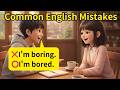
Common English Mistakes: Bored vs Boring, Past Tenses & Articles Explained
This video features a friendly conversation between Ken and Mina that explores frequent English errors made by learners. Key topics include the difference between "bored" and "boring," correct use of past tense verbs, natural verb patterns, and proper article usage, providing clear examples and practical tips to boost your English confidence.

120 Rules of Grammar: Each, Every, Both, Who, Whom, Which & That Explained
Master the first 5 rules of the 120 Rules of Grammar series. This detailed lesson covers the correct usage of each, every, both, who, whom, which, and that, including subject-verb agreement, possessive adjectives, and conditional sentences.

Mastering Everyday English: Practical Tips for Confident Communication
This video offers practical English learning tips through relatable real-life scenarios like ordering coffee, asking hotel questions, and sharing past experiences. It emphasizes simple corrections, natural phrasing, and building confidence, making English communication less intimidating and more effective.
Master English for SSC Exams: Weightage, Strategy & Grammar Tips
This session emphasizes the critical importance of English in SSC and other competitive exams, highlighting its high weightage (135 marks in Mains) compared to Math (90 marks) and Reasoning. The speaker provides a strategic study plan and clarifies common English grammar errors, including the correct usage of 'teacher of,' 'for' vs. 'since,' and reflexive pronouns, using relatable examples to boost exam scores.

100 English Tense Rules: Simple to Advanced Grammar Guide
Master all 100 essential English tense rules in this comprehensive video guide, covering basic to advanced grammar for simple, continuous, perfect, and conditional tenses. Perfect for learners aiming to achieve incredible English fluency with clear explanations and examples.
Most viewed summaries

A Comprehensive Guide to Using Stable Diffusion Forge UI
Explore the Stable Diffusion Forge UI, customizable settings, models, and more to enhance your image generation experience.
Kolonyalismo at Imperyalismo: Ang Kasaysayan ng Pagsakop sa Pilipinas
Tuklasin ang kasaysayan ng kolonyalismo at imperyalismo sa Pilipinas sa pamamagitan ni Ferdinand Magellan.

Mastering Inpainting with Stable Diffusion: Fix Mistakes and Enhance Your Images
Learn to fix mistakes and enhance images with Stable Diffusion's inpainting features effectively.

Pamamaraan at Patakarang Kolonyal ng mga Espanyol sa Pilipinas
Tuklasin ang mga pamamaraan at patakaran ng mga Espanyol sa Pilipinas, at ang epekto nito sa mga Pilipino.

How to Install and Configure Forge: A New Stable Diffusion Web UI
Learn to install and configure the new Forge web UI for Stable Diffusion, with tips on models and settings.
Found this summary useful?
Take it with you. One click puts it in your own LunaNotes library.
Save to LunaNotes