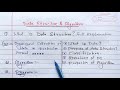
What is a Data Structure?
A data structure is the organization of data in a way that allows it to be used efficiently, both in terms of time and space.
Key Insight: Data Structure vs. ADT
- An Abstract Data Type (ADT) tells what operations are to be performed (the blueprint).
- A data structure tells how to perform those operations (the implementation).
For a deeper look into this distinction, explore Data Types vs Abstract Data Types: ADT Explained Simply.
Example: A stack ADT can be implemented using an array or a linked list. Both are valid data structures for the same ADT.
How to Choose Which Data Structure to Use?
Different implementations of an ADT are compared for time efficiency and space efficiency. To master the fundamentals of selecting and applying these structures, check out Comprehensive Guide to Core Data Structures and Algorithms.
| Criteria | Focus | |----------|-------| | Time Efficiency | Faster execution of operations | | Space Efficiency | Lower memory usage |
- If the user needs speed, choose a data structure with better time complexity.
- If the user needs memory savings, choose a more space-efficient structure.
Result: The best-suited data structure is selected based on the current requirement.
Advantages of Data Structures
1. Efficiency
A proper choice of data structure makes the program efficient in both time and space.
2. Reusability
One implementation of a data structure can be reused by multiple client programs, saving development effort.
3. Abstraction
The data structure is specified by an ADT. The client program only sees the interface (the ADT), not the underlying implementation details.
- This provides a level of abstraction, making the code easier to manage and modify.
For a broad overview of how different structures serve different needs, refer to the Comprehensive Guide to Data Structures: Arrays to Graphs Explained.
Summary
| Concept | Role | |---------|------| | ADT | Blueprint (what to do) | | Data Structure | Implementation (how to do it) | | Selection | Based on time/space trade-offs | | Advantages | Efficiency, reusability, abstraction |
To put these concepts into practice with a hands-on language, see Understanding Data Structures Through C Language: A Comprehensive Guide.
In this presentation, we will discuss the formal definition of data structures and we also discuss some of the advantages of it.
So, let's get started. What is a data structure? From the previous lecture, we get this information that
a stack ADT can be implemented using arrays or linked lists. Right? We can use these two data structures to implement a stack ADT. These are my data structures.
Right? Now, what information we get from this line? First of all, a data structure is the organization of the data in a way so that it can be used efficiently.
When I say efficiently, it means in terms of time as well as space. From the previous lecture, we got this information that a stack ADT is implemented using arrays or linked lists.
From that particular text we get this information that, a data structure is used to implement an ADT. Isn't that so?
We can say that, a data structure is used to implement an ADT. We know from this example that, in order to implement stack ADT, we can use
an array data structure or linked list data structure. We can use any of these data structures to implement this ADT. So, basically we can say that
a data structure is used to implement an ADT. ADT tells us what is to be done and data structures tells us how to do it.
So, data structures cares about how, not what. ADT just gives us the blue print, while data structures gives us the implementation.
But, how to know which data structure to use for a particular ADT? That is the basic question. Obviously, this question immediately arises
after knowing this point that, there are multiple data structures for a particular ADT. But, which data structure to use
for a particular ADT is the question of concern. Let's tackle this question. Which data structure?
In reality, different implementations of ADT are compared for time and space efficiency. For example, we know that stack ADT
can be implemented using arrays or linked lists. We can compare these two data structures, for time and space efficiency.
The one best suited according to the current requirement of the user will be selected. May be one data structure will lead to
space efficiency while other data structure will lead to time efficiency. We will select the one according to
the current requirement of the user. May be user wants to save space, then we can use a particular data structure
which can save space. May be a user wants run the programmer faster, then we will use the data structure, which will run faster.
So, the one best suited according to the current requirement of the user will get selected. Okay. So, it is depending upon the user.
Now, let's discuss some of the advantages of data structures. First advantage is efficiency. We know that, proper choice of data structure
make program efficient in terms of space and time. Proper choice of data structure is very important This leads to space and time efficiency.
Second advantage is reusability. One implementation can be used by multiple client programs. Just one data structure can be used by multiple client programs.
So, re-usability is also provided by data structures. Right? Apart from this, the one advantage which we already know is abstraction.
Data structure is specified by an ADT. ADT is the blueprint, while data structure is the implementation. We can say that, it provides a level of abstraction. Right?
The client program doesn't have to worry about what is going inside. It just sees the ADT, just the interface, nothing else. So, these are the advantages of
data structures which we should remember. Okay. Okay friends, this is it for now. Thank you for watching this presentation.
ADT acts like a blueprint, defining what operations should be performed (e.g., push/pop for a stack), while a Data Structure is the actual implementation, specifying how those operations are carried out in code (e.g., using an array or a linked list). The same ADT can have multiple valid data structure implementations.
Selection is based on comparing different implementations using time efficiency (how fast operations execute) and space efficiency (how much memory is used). If speed is critical, choose the data structure with better time complexity; if memory is limited, prioritize a more space-efficient structure based on your program's specific requirements.
The three key advantages are: Efficiency by optimizing time and space usage; Reusability, where one implementation can serve multiple client programs; and Abstraction, where the ADT interface hides implementation details, allowing code to be modified without disrupting client programs.
Yes. A stack ADT defines operations like push and pop, but it doesn't specify the implementation. You can implement a stack using an array (fixed size, faster access) or a linked list (dynamic size, slower lookup). Both are valid data structures for the same ADT, with different trade-offs in time and space.
Abstraction means that when a client program uses a data structure, it only sees the ADT interface (the public methods). The internal implementation details (like whether the data is stored in an array or a linked list) are hidden. This allows developers to change the underlying implementation without affecting the rest of the program.
Reusability means that one well-written data structure implementation (like a queue or hash table) can be reused across multiple different client programs. This saves significant development time and reduces code duplication by providing a tested, standardized component that can be reused whenever a similar data management need arises.
Keep this summary
Save it to LunaNotes and it becomes a real note in your library — editable, searchable, and ready to turn into flashcards or a diagram. Free to start.
Save to LunaNotesOr summarise for another video.


32K+ people have turned 65K+ videos into notes
“Very useful tool. I'm using it for the last couple weeks and I'm loving it so far. Makes learning on YouTube a great experience.”
 Bhai Chrome Web Store review
This summary and transcript were automatically generated using AI with the Free YouTube transcript summary tool by LunaNotes.
Related summaries
Data Types vs Abstract Data Types: ADT Explained Simply
Understand the key difference between data types and abstract data types (ADTs) in data structures. Learn how ADTs provide abstraction, separate implementation from usage, and why they are crucial for software design.
Linear vs Non-Linear Data Structures Explained Simply
Learn the key differences between linear and non-linear data structures, including arrays, linked lists, stacks, queues, trees, and graphs. This guide also covers static vs dynamic data structures to help you choose the right one for your needs.
Comprehensive Guide to Data Structures: Arrays to Graphs Explained
Explore fundamental concepts of data structures from arrays, lists, stacks, queues to trees and graphs. Learn definitions, real-world examples, implementation strategies, and algorithmic insights for efficient data organization and manipulation.
Comprehensive Guide to Core Data Structures and Algorithms
Explore foundational concepts in data structures, computational complexity, and advanced algorithms. This guide covers arrays, linked lists, stacks, queues, priority queues, union-find, trees, hash tables, Fenwick trees, suffix arrays, balanced BSTs, and indexed priority queues, with insights on implementation and performance optimization.
Introduction to Data Structures and Algorithms
This video provides a comprehensive introduction to data structures and algorithms, explaining key concepts such as data, data structures, their purpose, classifications, and operations. It also covers algorithms, their properties, and practical implementation examples.
Most viewed summaries

A Comprehensive Guide to Using Stable Diffusion Forge UI
Explore the Stable Diffusion Forge UI, customizable settings, models, and more to enhance your image generation experience.

Kolonyalismo at Imperyalismo: Ang Kasaysayan ng Pagsakop sa Pilipinas
Tuklasin ang kasaysayan ng kolonyalismo at imperyalismo sa Pilipinas sa pamamagitan ni Ferdinand Magellan.

Mastering Inpainting with Stable Diffusion: Fix Mistakes and Enhance Your Images
Learn to fix mistakes and enhance images with Stable Diffusion's inpainting features effectively.

Pamamaraan at Patakarang Kolonyal ng mga Espanyol sa Pilipinas
Tuklasin ang mga pamamaraan at patakaran ng mga Espanyol sa Pilipinas, at ang epekto nito sa mga Pilipino.

How to Install and Configure Forge: A New Stable Diffusion Web UI
Learn to install and configure the new Forge web UI for Stable Diffusion, with tips on models and settings.
Found this summary useful?
Take it with you. One click puts it in your own LunaNotes library.
Save to LunaNotes