Introduction to Wave Properties
Waves have several key characteristics essential for understanding their behavior: amplitude, wavelength, frequency, period, energy, and speed. This guide clarifies these concepts using practical examples and graph analysis.
Amplitude and Wavelength
-
Amplitude: The height between the centerline and the peak (crest) or trough of a wave.
- Calculated as half the difference between the maximum and minimum values on a graph: ((\text{max} - \text{min}) / 2).
- Example: For values 5 and -5, amplitude is (5 - (-5)) / 2 = 5.
-
Wavelength ((\lambda)): The horizontal length of one complete cycle of the wave.
- One cycle consists of a summit (crest), passing through the midpoint, a trough, and returning to the midpoint.
- Example: If two cycles cover 10 m, one cycle (wavelength) is 5 m.
Frequency and Period
-
Period (T): Time taken for one complete cycle.
- Calculated as total time divided by number of cycles.
- Unit: seconds.
-
Frequency (f): Number of cycles per second.
- Calculated as number of cycles divided by total time.
- Frequency is the reciprocal of the period: (f = 1/T).
- Unit: Hertz (Hz).
-
Example: Four cycles in 8 seconds give a period (T = 8 / 4 = 2) seconds and frequency (f = 1/2 = 0.5) Hz.
Calculating Wave Parameters from Graphs
- Count the number of complete cycles.
- Measure the total distance or time covered.
- Divide total distance or time by number of cycles to find wavelength or period.
- Apply relationships to find frequency or amplitude.
Relationships Between Wave Properties
- Wavelength (\lambda) and frequency (f) are inversely related: as wavelength increases, frequency decreases.
- Frequency and energy are directly related: higher frequency means higher energy.
- Wavelength and energy are inversely related. For a deeper understanding of energy measurement and wave functions, see Understanding Quantum Mechanics: Energy Measurements and Wave Functions.
Speed of Light and Wave Behavior in Different Media
- Speed of light in vacuum (c = 3 \times 10^8) m/s.
- Frequency remains constant when light passes through different materials.
- Speed in material (V = c / n), where (n) is the index of refraction.
- Wavelength in material (\lambda_n = \lambda / n).
- Examples:
- In water ((n=1.33)), speed slows to (2.26 \times 10^8) m/s, and wavelength shortens.
- Light slows further in glass and diamond with higher indices of refraction.
To explore wave propagation and reflection phenomena related to these concepts, refer to Understanding the Reflection of Electromagnetic Waves: A Comprehensive Guide.
Electromagnetic Spectrum Overview
- From long to short wavelength (low to high energy): Radio waves, Microwaves, Infrared, Visible Light (ROYGBIV), Ultraviolet, X-rays, Gamma rays, Cosmic radiation.
- Frequency and energy increase from left to right.
- Visible spectrum wavelength ranges:
- Red: 620–700 nm
- Orange: 590–620 nm
- Yellow: 570–590 nm
- Green: 500–570 nm
- Blue: 450–500 nm
- Violet: 400–450 nm
For a broader context on electromagnetism principles underpinning this spectrum, see Understanding Electromagnetism: Key Concepts and Principles.
Calculating Photon Energy
- Energy (E = h \times f), where (h = 6.626 \times 10^{-34}) J·s (Planck's constant).
- Frequency (f = c / \lambda).
- Convert Joules to electron volts (eV) as needed.
For more on the quantum mechanical aspects of energy, momentum, and wave functions, visit Understanding Quantum Mechanics: Wave Functions, Momentum, and Energy Discreteness.
Summary
By understanding and applying these principles and formulas, you can analyze wave graphs, calculate their properties, and comprehend wave behavior across different media and parts of the electromagnetic spectrum. This knowledge is fundamental to physics, optics, and various engineering fields.
in this video we're going to talk about waves and characteristic of waves like frequency wavelength energy amplitude
speed period things like that so let's say if you have a graph and on this
graph you have a sine wave let's say this value is five and this is neg
five and this point is about 10 m so what is the amplitude and the wavelength of this wave if you're given
this information the amplitude of the wave is simply the height between the center and
the peak the peak is called the trough this is known as the
crust so as you can see the amplitude is five another way you can calculate the amplitude is you
can subtract these two numbers and then divide by two so it's the top number minus the bottom number / two so that's
going to be 10 / two and you're going to get five that's another way in which you can calculate the amplitude of a sine
wave now what about the wavelength the wavelength is the length of one
cycle so let me highlight what a cycle is so the wave has to go up then it goes back to the middle and then
it has to make the trip all the way down and then return back to where it started that is one cycle the length of that
cycle is 5 m notice that two cycles is 10 m the second cycle is right here so the wavelength which is typically
represented by the symbol Lambda the wavelength in this example is 5 m let's try another
example so let's say if we have a wave that looks like this and at this
point let's say it's 28 M and the
trough is located at a value of eight and let's say the Crest is located at a value of
-2 what is the amplitude and what is the wavelength what I would do is draw the
center point of the graph notice that it's been shifted up the question is how many units has it
been shifted up the y- AIS to find that value it's simply the
midpoint between the highest value and the lowest value to calculate it we need to take the average of of -2 and 8 the
average is the sum divid two that's going to give us the midpoint -2 + 8 is the same as 8 - 2
which is 6 6 / 2 is 3 so 3 is right between 8 and -2 so we can see what the amplitude is the
amplitude is the distance or the difference between the trough and the midpoint or the center line so 8 minus 3
that's a value of five also you can also calculate it by subtracting 3 minus -2 which is also
value of five or you could use that other equation that I showed you
earlier the amplitude is the difference between the highest point and
the lowest point divided by two so 8 - -2 / 2 8 - -2 is the same as 8 + 2 which is 10 and 10 / 2 is 5 so there's a lot
of different ways in which you can calculate the amplitude of a wave now what about the
wavelength how long is it in this particular example so let's count how many cycles
that we have we need to find the length of one cycle so the
wavelength is basically the distance in meters divided by the number of Cycles our goal is to find the distance
of one cycle so we need to find the ratio between distance and Cycles so this is the first
cycle that's one here's the second cycle that's two here's the third cycle that's
three and we have a half of a cycle so we have a total of 3.5 Cycles so it's 28 /
3.5 let's multiply top and bottom by two so we can get rid of the decimal 28 * 2 is 56 3.5 * 2 is 7 how many times
does 7 go into 56 56 ID 7 is 8 so that's the length of one cycle which is the def as the wavelength so the wavelength is 8
m this position is 16 M and at this point it's 24 and then we have half a cycle which is four which lends us to or
leaves us at uh 28 so now you know how to calculate the wavelength from a
graph so now what about the relationship between frequency and period the period is the time it takes
for the wave to compl complete one cycle so the period is the time divided by the number of
Cycles frequency is the inverse of a period frequency is the number of cycles that the wave makes in a single second
so frequency is the number of Cycles divided by the time the number of Cycles doesn't really
have a unit so for period it's time over Cycles so the unit for period is like seconds the period is the type of time
it's the time it takes to make one cycle so it's measured in seconds frequency is the inverse not the
inverse but the reciprocal of the period so frequency is 1 over P now in some textbooks the period is
represented by capital T so this is the same as 1 over T you probably seen this equation fals 1/ T somewhere so that
just tells the frequency and period or inversely related so the unit for frequency is one over seconds or you can
simply view it as s to Theus one which is the same as the unit Hertz so that's the unit for
frequency so make sure that you know this equation frequency is one over period And if you want to find the
period from a graph use this equation it's the time divided by the number of cycles and if you want to find the
frequency from a graph is the number of Cycles divided by the time consider this
example so let's say instead of having meters on the xaxis we have the unit
time so let's say it's A8 seconds at that point what is the period of this wave so our goal is to find the time it
takes to complete a single cycle we need to find the time it takes to get to that point from the
origin so let's count the number of Cycles so that's the first cycle this is the second
cycle and this this is the third cycle and here's the fourth cycle so there four Cycles the period which I'm
going to use as capital t is the time divided by the number of Cycles so in four Cycles we have a time
of 8 seconds so therefore it's 2 seconds per cycle and that's the period so at this point here
this correlates to two seconds the second cycle ends at 4 seconds the third one ends at six and the last one ends at
eight so the period is two cycles per second now what about the frequency so the frequency is 1 over
period so the frequency is 1 over two which is 0.5 the frequency is the number of
cycles that occurs in a single second so if the frequency is .5 that means that there's .5
Cycles in 1 second now let's make sense of it 1 second occurs here and at this
point we only completed half of a cycle so that's the frequency we've completed half a cycle in 1
second the frequency is the number of Cycles in 1 second so .5 Cycles corresponds to 1 second that's the
frequency so you can say say it's 0.5 Herz let's try another example now let's say if this point
represents. 25 seconds what is the frequency and what is the period so notice that we have the time
it takes to complete one cycle that's the period so therefore the period is25
seconds now to calculate the frequency it's one over the period so 1 /25 gives you four or four Hertz which
is four cycles per second notice that this is 0.5 this is 75 and this is
1 so notice the number of cycles that we complete in one second this is one cycle here's the second
cycle this is the third cycle and this is the fourth cycle so there are four cycles that occurs in a
single second and that's the frequency the number number of cycles that occurs in in one second so that's why the
frequency is four Herz in one second there are four Cycles so you can use the equation to
calculate all of the answers we said the period is the time divided by the number of
Cycles so if you take a time of 1 second and divide it by the four cycles that corresponds to
it you're going to get the period which is 1 over 4 1 over 4 is 0.25 now to calculate the
frequency it's the number of Cycles divided by the time so in this example there are four
cycles that occurs in a single second so four over one gives you a frequency of 4 Hertz so there's many ways in which you
can calculate the period or the frequency if you could find one then you could find the other you just got to
find out which way is easier now let's try one last example with
graphs so let's say if you have a wave that looks like this and at this point you know that the
time is 14 seconds how can you figure out the time at this point which is the time for one
cycle so we know that the period how can you find the period of this particular graph feel free to pause the video and
try this example so notice that we can break this wave into seven
segments 1 2 3 4 5 6 7 so the length of each segment is 14 / 7 so it's 2
seconds so this therefore is 2 4 6 8 10 12 14 and the length of one cycle we could
see is 8 seconds so that's the period so that's a technique that you can use to find the period of a wave if
you're given a value that doesn't end at a complete cycle in such a situation it helps to
break each cycle into four equal parts now let's go over some other equations that you need to
know you need to know the relationship between wavelength and frequency as the wavelength increases which is
represented by this Lambda symbol the frequency which is V or you can write F if you want the frequency decreases the
wavelength and the frequency are inversely related now we know that the
frequency is inversely related to the period so as the wavelength goes up up the period goes
up the wavelength is inversely related to the energy as the wavelength goes up the energy goes
down so wavelength and period are directly related and the
frequency and the energy are directly related the equation that relates wavelength and frequency is this one C
is equal to Lambda * V or we'll just use Lambda time f f is fre C is the speed of light this is how fast
light travels in a vacuum or empty space so the speed of light is 3 * 10 8 m/s and that's very fast that means in 1
second a light can travel a distance of 300 million met now let's say if you have a
wavelength of 600 nanometers how can you use this information to calculate the frequency
of this wavelength frequency is the speed of light /
wavelength so it's going to be 3 * 10 8 m/s divided by we don't want to put 600 nanometers because nanometers and meters
they don't match we need to convert the nanometers into meters it turns out that one nanom
is equal 1 * 10- 9 M so 600 NM is simply 600 * 109 M so we can see that the unit meters will cancel
and you're going to get the unit 1 / s one/ seconds which is frequency which is the same as
Hertz so let's type it in 3 * 10 8 / 600 * 109 gives you a frequency of 5 time 10^
14 Hertz now once you have the frequency of a photon of light you can calculate the
energy of that Photon using this equation the energy is equal to Plank's constant time
frequency Plank's constant is 6626 * 10-34 Jew time
seconds so let's pay attention to the units frequency which is in hertz we can also represent
it as one/ seconds so notice that the unit seconds cancel which means that in this equation
the energy of the photon is in Jews so if we multiply those two numbers this is going to give us an energy value
of 3313 * 1019 now sometimes you may need to
convert it to electron volts one electron volt is equal to 1.62 *
1019 so to convert it we need to divide by 1.62 * 1019 as you can see the unit Jewels will
cancel if we set it up this way notice that the 10^9 value will cancel as well so all we need to do is
type in 3313 / 1. 1602 and that's going to give us the energy and electron volts so it's
going to be 2.07 electron volts so far we've considered how to calculate
the frequency of a photon in pure empty space in a vacuum and also the energy under those
conditions but let's say if light is passing through water or glass or Diamond what's going to
change whenever light passes through a material it slows down the speed changes and also the wavelength Chang changes
with it but not the frequency the frequency Remains the Same there's an equation that helps you
to calculate the speed of light in a different material here's the equation V not the
frequency V but velocity V is the speed of light in a vacuum divided by the index of
refraction so C is still 3 * 10 8 this is the speed of light in a vacuum n is the index of a fraction
so let's use water as our example the index of refraction for water is about 1.33 now V represents the speed of light
in this material in this case the speed of light in water we can use this equation to calculate the speed of light
in glass or the speed of light in Diamond as the index of a fraction increases the speed of light in that
material decreases the index of refraction for glass is about 1.5 for Diamond I believe
it's about 2.4 so light travels much slower in Diamond than it does in glass and light
travels slower in glass than it does in water but in pure empty space light travels at its maximum speed of 3 * 10
8 m/s so let's let's calculate the speed in water so all you have to do is divide
3 by 1.33 and you should get
2. 26 and then you can simply add this value time 10 to 8 m/s so as you can see light is a little
bit slower in water than it is in pure empty space now what about the wavelength
we see that as the index of refraction decreases the speed of light decreases but what about the wavelength
what effect does it have on it as the index of refraction increases it turns out that the wavelength decreases as
well the equation that you need is the wavelength in a material with an index of
refraction of n is equal to the wavelength in empty space / n so this time let's choose the same
wavelength that we had in the last example that is 600 nanom so it's going to be 600
nanom divided by the index of a fraction for water which is 1.33 and so we're going to get a
wavelength of approximately 41.1
nanom so that's the wavelength of light in water so as you can see the wavelength in empty space
was originally 600 but now in water it decreased to 451 .1 and the
speed is now 2.26 * 10 8 so what we're going to do is calculate the
frequency so using this equation we know that the speed of light is the wavelength times
frequency now we have to use not the speed of light of or in a vacuum we have to use the speed of light in water which
is V and we have to use the wavelength in water which is Lambda n times frequency so the frequency is going to
be V divided Lambda so the speed of light in water is 2.26 * 10 8 m/ Second and the wavelength
of light in water in this example is 41.1 * 109 M so if we divide those two numbers
we're going to get 5.01 * 10 14 Hertz now granted these answers are
rounded so that's where the 01 comes from but if we didn't round it we would get exactly 5 * 10^ 14 Herz which is
what we had in a previous example so notice that the frequency it does change if light is in empty space or if it's in
water so as light passes from one material to another the speed of light will change
and the wavelength will change but the frequency Remains the Same and because the frequency is the same the energy is
going to be the same as well because the energy is proportional to the frequency so we're going to get the same
answer as we did in the last example so here's a question for you let's say if you have two
materials let's say this is diamond and this is glass as light passes through
Diamond to Glass what's going to happen to the speed of light will it increase or
decrease as it travels from Diamond to Glass think about it now we know what happens as light
travels from empty space to water so let's say if we have a container with water as light travels from air to water
it's going to bend this is known as refraction and as it passes from air to
water will the speed increase or decrease so you have to think about what's happening um to the index of
refraction or how it's changing the index of refraction of air is one and for water is
1.33 so the index of refraction increases in this particular example as the index of refraction
increases the speed of light decreases light travels slower in water than it does in air because water has a
higher index of refraction and also the wavelength will decrease as it goes from Air to water the frequency is going to
stay the same and the energy of the photon will be the same as well now from Diamond to Glass the
reverse is true the diamond has an index of refraction of 2.4 and for glasses 1.5 so we're going from a material that
has a high index of refraction to a material that has a low index of refraction therefore n is decreasing and
whenever the index of refraction decreases the speed of light will increase and the wavelength will
increase as well as light travels from Diamond to Glass now the next thing that you need
to be familiar with is the electromagnetic spectrum we're going to rank it
from Long wavelength to short wavelength or from low energy to high energy so the first one in the list are
radio waves radio waves have the lowest energy the lowest frequency but the longest wavelengths after radio waves
you have microwaves and then after microwaves there are there's infrared and then
after that you have visible light voy Biv red
orange yellow green blue there's Indigo and then
there's Violet after Violet you have ultraviolet radiation
and then xrays and then uh gamma rays and after that you have a cosmic radiation which
I'll just write C for Cosmic radiation so as you go to the right in the electromagnetic
spectrum the frequency increases so gamma radiation has a higher frequency than X-rays and also
the energy increases frequency and energy are directly related so x-rays has a lot more energy than UV
rays now on the left the wavelength increases radio waves they have the lowest energy but they have the longest
wavelength so which one has a higher frequency microwaves or ultraviolet light so frequency increases to the
right ultraviolet light has a higher frequency now which one has more energy blue light or red
light energy increases to the right so since blue is to the right of red blue has more energy now which one has a
longer wavelength xrays or gamma rays wavelength increases to the left so xrays which is to the left of gamma rays
x-rays have a longer wavelength now which one has a lower frequency infrared radiation or red
light IF frequency increases to the right the one to the left has the lower frequency so that's infrared
radiation now which one has less energy microwaves or green light so energy decreases to the left so
microwaves have less energy than green light and which one has a shorter wavelength infrared or ultraviolet
radiation the shorter wavelength is the one that's on the right side so ultraviolet radiation has the shorter
wavelength now the next thing you need to know is the range of the visible light
spectrum red light is around 700 NM in wavelength and violet light is about 400 NM
so at this point it's 700 nomers and over here it's 400 violet light is about between 400
and 450 blue light it ranges about 450 to 500 and green light is 500 to 570
Nom yellow light has a smaller range it's like 570 to 590 orange is about 590 to
620 and red light has the the longest range it's 620 to 700 so now you know the visible light
spectrum and the wav lamps that corresponds to each color so that is it for this video thanks for watching and
have a great day
To calculate amplitude, find the maximum and minimum values on the wave graph. Use the formula (max - min) divided by 2. For example, if the max is 5 and the min is -5, the amplitude is (5 - (-5))/2 = 5. Amplitude represents the height from the centerline to the crest or trough.
Frequency and wavelength are inversely related, meaning that as wavelength increases, frequency decreases and vice versa. This is because frequency refers to how many cycles occur per second, while wavelength measures the physical length of one cycle. This relationship affects wave energy, as higher frequency waves carry more energy.
Count the total number of complete wave cycles within a given time interval. Calculate the period (T) by dividing total time by the number of cycles (T = total time ÷ cycles). Frequency (f) is the reciprocal of the period (f = 1/T), indicating the number of cycles per second measured in Hertz (Hz). For example, 4 cycles in 8 seconds means T = 2 seconds and f = 0.5 Hz.
Light speed decreases in materials with higher refractive indices (n) compared to vacuum speed (c). The speed in a medium is V = c/n, which also shortens the wavelength as λ_n = λ/n, while the frequency remains constant. For instance, in water (n=1.33), light slows to about 2.26 × 10^8 m/s and its wavelength decreases proportionally.
Photon energy (E) is calculated using E = h × f, where h is Planck's constant (6.626 × 10^-34 J·s) and f is the frequency. Frequency can be found by dividing the speed of light (c) by the wavelength (λ), f = c/λ. You can convert energy from Joules to electron volts (eV) for practical applications in quantum physics.
Key wave properties include amplitude (height of wave peaks), wavelength (length of one full cycle), frequency (cycles per second), period (time for one cycle), energy (related to frequency), and speed (which depends on the medium). Understanding these factors helps analyze wave graphs and predict wave interactions across different environments.
The electromagnetic spectrum organizes waves from long wavelength/low frequency (radio waves) to short wavelength/high frequency (gamma rays). Frequency and energy increase together across the spectrum. For example, visible light includes colors from red (lowest frequency) to violet (highest frequency), with corresponding energy changes influencing their physical effects and applications.
Keep this summary
Save it to LunaNotes and it becomes a real note in your library — editable, searchable, and ready to turn into flashcards or a diagram. Free to start.
Save to LunaNotesOr summarise for another video.
This summary and transcript were automatically generated using AI with the Free YouTube transcript summary tool by LunaNotes.
Related summaries
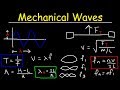
Mechanical Waves Explained: Amplitude, Frequency, Wavelength, and Harmonics
This video tutorial provides step-by-step solutions to fundamental mechanical wave problems, including calculating amplitude, wavelength, frequency, period, and wave speed. It also explains harmonic frequencies on a string, providing formulas and examples to understand wave behavior in physical systems.
Understanding Maxwell's Equations and Wave Propagation
Explore Maxwell's equations, wave equations, and their significance in electromagnetism and light.
Understanding Quantum Mechanics: Wave Functions, Momentum, and Energy Discreteness
Explore quantum mechanics concepts like wave functions, time dependence, and energy quantization in an engaging manner.
Understanding Electromagnetism: Key Concepts and Principles
Explore the fundamentals of electromagnetism, including wave behavior, Maxwell's equations, and the relationship between electric and magnetic fields.
Understanding the Fundamentals of Quantum Mechanics: A Comprehensive Overview
Explore the core concepts of quantum mechanics, including wave functions, uncertainty, and energy levels in this in-depth guide.
Most viewed summaries

A Comprehensive Guide to Using Stable Diffusion Forge UI
Explore the Stable Diffusion Forge UI, customizable settings, models, and more to enhance your image generation experience.

Kolonyalismo at Imperyalismo: Ang Kasaysayan ng Pagsakop sa Pilipinas
Tuklasin ang kasaysayan ng kolonyalismo at imperyalismo sa Pilipinas sa pamamagitan ni Ferdinand Magellan.

Mastering Inpainting with Stable Diffusion: Fix Mistakes and Enhance Your Images
Learn to fix mistakes and enhance images with Stable Diffusion's inpainting features effectively.

Pamamaraan at Patakarang Kolonyal ng mga Espanyol sa Pilipinas
Tuklasin ang mga pamamaraan at patakaran ng mga Espanyol sa Pilipinas, at ang epekto nito sa mga Pilipino.

How to Install and Configure Forge: A New Stable Diffusion Web UI
Learn to install and configure the new Forge web UI for Stable Diffusion, with tips on models and settings.
Found this summary useful?
Take it with you. One click puts it in your own LunaNotes library.
Save to LunaNotes