
Download Subtitles for Endotoxin Retention Testing Video
Endotoxin Retention Testing for Filters
Nelson Labs
SRT - Most compatible format for video players (VLC, media players, video editors)
VTT - Web Video Text Tracks for HTML5 video and browsers
TXT - Plain text with timestamps for easy reading and editing
Scroll to view all subtitles
Hello everyone and thank you for joining
us today. You have logged on to the
Nelson Labs webinar on endotoxin
retention testing for filters.
I'd just like to go through a few
housekeeping items before we get started
today.
If you miss one of our webinars or want
to refer back to them, you can always
find them on the Nelson Labs website on
the on demand webinars page listed under
our education tab.
You can receive notifications of
upcoming live and on demand webinars by
uh following Nelson Labs on LinkedIn.
We'd also like to invite you to register
for free for the Sauteraalth Academy at
soteralth.comacademy.
There you will find curated content from
industry thought leaders
from Nelson Laboratories, Sterogenics,
Regulatory Compliance Associates, and
Nordon.
From introductory sterilization and lab
testing topics to advanced in-depth
learnings, our expert adviserss have
filled this academy with cutting edge
educational content and resources to
help you mitigate risk, go to market
faster, and achieve excellence in your
field.
Nelson Laboratories is a leading global
provider of laboratory testing
for medtech and pharmaceutical
companies.
The company performs over 900 rigorous
microbiological and analytical
laboratory tests across the medical
device, pharmaceutical, and protective
barrier industries.
The experts at Nelson know every test
matters and requires solutions to
complex problems to improve patient
outcomes and minimize client risk. So,
let's get started. Today, we're joined
by Emily Spackman and Jennifer
Jorgensson.
Emily has worked for Nelson Laboratories
in the bacterial endotoxins test lab for
over 18 years.
She has an extensive knowledge and
experience with testing medical devices
and pharmaceutical products for
bacterial endotoxins
and enjoys helping sponsors with their
endotoxin questions and needs and
appreciates learning more about the
various BET assays and how each assay
can be applied to various products.
Jennifer has been with Nelson
Laboratories for over 12 years
experience across several departments.
She began in the protective barrier
department where she served as study
director and subject matter expert for
gown and drape testing. She then managed
bacterial endotoxin uh test department
before transitioning to her current role
as a study director and the filtration
sterilization department. In her in this
role, her focus is on filter validation
testing
and she a field she's especially enjoyed
exploring throughout her career at
Nelson. She's valued the opportunity to
learn about the diverse testing Nelson
performs and aimed to deepen her
expertise and validation processes.
This webinar we do encourage your them
at any time in the questions box on your
tab. Um, and Emily and Jennifer will try
to answer as many questions as possible
at the end of this presentation.
So, now beginning today's webinar, I'd
like to turn the time over to Emily and
Jennifer.
>> Thanks, Mike. We are excited to be here
with you. We'll just start with our
agenda for the day. So, I will start by
discussing bacterial endotoxin testing
and when it's typically performed. We'll
talk about what bacterial endotoxins are
and why it's important to test for them.
And then we'll talk about how we test
for them and then after that I will turn
it over to Jen. Yeah. And then from
there we'll kind of look into
considerations for filter selection kind
of the details of removing endotoxin
through filtration and then also the
endotoxin retention test method and that
we perform here.
Okay. So let's get into it. What is
bacterial endotoxin testing or bet?
Um
this test the bacterial endotoxin test
is used to measure the presence of
bacterial endotoxin. You may have
previously reheard heard this test
referred to as the limulus amiebasite
lysate or LAL test as it was previously
known um and it was named after the
lysate that was used in the testing.
The lysate or LL is derived from the
blood of an American horseshoe crab,
limulus polyphimmis, which you can see
in the picture below.
Because the bacterial endotoxin test is
run using the horseshoe crab's blood, it
is helpful and interesting to understand
a bit about the horseshoe crab. Their
blood cells are called amiebastes.
The amiebocytes are liced or ruptured to
access the chemicals within the cell
that cause the clotting reaction.
They are then purified and freeze dried
to make the lysate that we use in the
bacterial endotoxin test.
The picture below on the left is of the
crabs donating their blood.
Essentially, we take the crabs from the
ocean. We scrub them, give them a good
bath, and then we fold them in half so
that we can access a soft spot in the
middle of their backs, and they stick
the crabs with a little spike that it's
kind of like a needle, and they bleed
them into these jars that you see.
So, these crabs are essentially blood
donors. And although the process doesn't
typically hurt the crabs, there is an
approximate 15% mortality rate for the
crabs that donate their blood.
After the crabs are bled, they return
them to the ocean on these large slides
that you see on the picture on the
right. And these slides run from the
facility to the ocean. So, it's kind of
interesting. And this whole process
takes less than 24 hours.
Um, one thing you might note on the
picture on the left is that the crab's
blood is blue. And that's because it
contains copper to carry oxygen instead
of iron like humans have, which is what
causes our blood to be red.
Okay, so now that we know what the
bacterial endotoxin it is test is, when
is the test performed?
The test is used by medical device
manufacturers frequently as it is
considered a lot release test meaning
that every lot of product labeled as
non-pyrogenic needs to be tested.
The non-pyiogenic label claim is used
for all devices with direct or indirect
blood contact, lymphatic contact,
cerebral spinal fluid contact, and for
intraocular opalic devices.
It's also commonly used in the
pharmaceutical in industry to test each
batch of injectable drug products.
Products that are consumed orally are
not typically tested. We ingest
endotoxin every day in the water that we
drink and in the air that we breathe,
but it doesn't have the same impact on
us when it's ingested as it does when it
comes in contact with blood or some of
those other areas mentioned.
The pharmaceutical industry can also use
the bacterial endotoxin test to test raw
materials and inprocessed materials.
So what are bacterial endotoxins?
They come from the cell wall of gram
negative organisms.
The cell wall consists of
lipopolysaccharide or LPS which you can
see here on the diagram.
Outer membrane, peptooglycan
which is another pyrogen but much less
toxic and an inner membrane.
Purified endotoxin
which is endotoxin
that is not found in nature. It's
purified in a lab is sometimes referred
to as LPS as this is the biologically
active component of endotoxin.
The LPS consists of two components. The
lipid A portion which is embedded in the
membrane of the cell wall and is
hydrophobic meaning that it does not
like water.
and a polysaccharide chain that contains
the extracellular environment and it's
hydrophilic and it is hydrophilic
meaning that it does like water.
The amp amphipathic nature of the LPS
causes them to form aggregates of myels
where endotoxin clumps together.
LPS is released from the cell during
normal cell growth as an outer membrane
vesicle or OMV.
OMVS are pieces of the cell wall that
during the growth of the cell are
pinched off and float freely in the
extracellular environment.
This naturally occurring form of
endotoxin does not aggregate or clump as
purified endotoxin does. They also can't
replicate, but it is difficult to
destroy.
And this is the endotoxin that
contaminates water systems, drugs, and
medical devices.
So, as I mentioned before, bacterial
endotoxin is a component of the cell
wall of gram negative bacteria.
It's considered a pyrogen because it can
cause a fever.
And because it can cause a fever, the
bacterial endotoxin test or bet can also
be referred to as pyrogen testing.
Although endotoxin is not the only
pyrogen or material that can cause a
fever, it is the most significant in the
pharmaceutical and medical device
industry.
There are a few reasons why endotoxins
are the most significant pyrogen.
One is due to its very high potency.
The next most potent pyrogen is
pepidoglycan and it is 50,000 times less
pyrogenic than endotoxin.
I like to think of endotoxin as the
skeleton of gram negative bacteria.
Even after the bacteria die, endotoxin
can still be present and is not always
mitigated via common sterilization
methods.
Lastly, gram negative bacteria can grow
in low nutrient environments such as
water systems and can easily contaminate
pharmaceuticals and medical devices.
It is very easy to contaminate samples
with endotoxin, but it can be difficult
to remove endotoxin. So, it's best to
keep it from getting into your samples
in the first place.
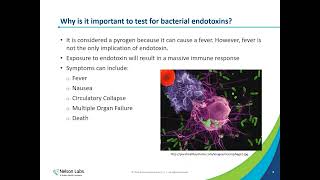
We have identified the endotoxin is a
pyrogen. Pyro means fire. Hence, a
pyrogen can cause a fever. However,
fever is not the only implication of or
symptom of endotoxin.
Exposure to endotoxin can cause a
massive immune response and can cause
macrofasages throughout the entire body
to release cytoines.
Some of the symptoms that can be seen
due to endotoxins in the human body
include fever, nausea, circulatory
collapse, multiple organ failure, or
even death.
Now that we know what endotoxins are and
the impact they can have on the human
body, how do we test for them? For
medical devices, we immerse the entire
device or the applicable components of
the device in water
or we may flush a fluid pathway with
water
to obtain a liquid test solution.
For pharmaceuticals,
liquids can be tested directly or we may
need to dilute them in water or other
dilluents and powders are dissolved in
water or other solvents to obtain a
liquid test solution.
Once we have that liquid test solution,
we mix equal parts of the sample and
lysate, which is the reagent that comes
from the horseshoe crab blood in a 96
well microp plate. On each plate, we
include a standard control series,
including four standard concentrations
of endotoxin and a negative water
control.
We incubate that plate in a micro plate
reader at 37 plus or minus 1° C until
the lowest standard reacts
and a curve is generated.
From here, we use software to compare
the test samples to the standard curve
and determine the level of endotoxin in
each sample.
At Nelson Laboratories, we offer two
different test methods.
The first is the kinetic turbidometric
test method and it measures a change in
turbidity or cloudiness.
It's run at a wavelength of 340
nanometers and this is our most routine
and more cost effective option.
The second test we offer is the kinetic
chromogenic test method. Rather than
measuring a change in turbidity, it
measures a change in color and it's
specifically a yellow color. Because
we're measuring a change in color, it is
run at a different wavelength of 405
nanometers.
And this test is capable of achieving an
assay sensitivity of 0.001
endotoxin units per milliliter.
When we look at how these tests are
similar, we can see that both tests can
be run at an assay sensitivity of 0.005
endotoxin units per milliliter. So that
chromogenic test method can be run at a
sensitivity that is five times higher.
Some other similarities they have are
they're both run on a spectr
photoometer. They're both quantitative,
meaning we can provide you with an exact
level of endotoxin.
They both have inhibition enhancement
built into the assay to demonstrate the
validity of the results. And they both
generate results in EU or endotoxin unit
per milliliter units.
And now we'll turn the time over to Jen.
>> Thank you, Emily. So now we're going to
focus a little on the filter side of
things. Um and so the beginning part we
just want to talk about some
considerations for selecting the right
filter. Um so part of that right is kind
of looking at your process um flow rate
and and also understanding the filter
throughput. Um so your flow rate right
can can be affected by the effective
filtration area of the filter your
membrane porocity pore size the
thickness differential pressure flow
path design and the viscosity of the
fluid including temperature. Um and then
also the filter throughput um is really
refers to the total volume of liquid or
gas that can be filtered through that
filter through the um effective
filtration area
under specific process conditions.
I'm sorry trying to find the mouse here.
Um sorry. And then so knowing those
things can help you establish the number
of filters and kind of the housing
sizing that you need um for your
process. And then you also want to make
sure that your filter can support kind
of your peak operating flow rates
without exceeding those validated
pressures and flux limits of the filters
themselves.
Um, and then other considerations that
you'll want to look at are kind of your
process monitoring and sample strategy.
So you want to define the frequency for
bioden and endotoxin testing. Um, you'll
want it includes filter integrity
testing, right? where it's like a pre
and post use to kind of confirm the
performance of that filter that it's
within those validated parameters. Um,
of course, some filters might not have a
specification, um, which we can kind of
talk about during the testing portion of
this. Um, you'll also want to consider
kind of the filter service life or again
the capacity that it can handle. So you
might want to determine some process
specific fouling or throughput studies
and kind of the allowable differential
pressure increase.
Um a lot of this is supported by
validation studies including bacterial
retention testing.
And then you'll kind of want to consider
the filter change out strategy. You know
kind of timebased or conditionbased
criteria. you know, maybe after a
certain differential pressure is reached
or a flow decay or maybe endotoxin
breakthrough is kind of the the time,
you know, when you should change out the
filter. Um, but also you can kind of
performing this, right? You can replace
the maybe the endotoxin filter or the
filter you're using to help filter out
endotoxin, you know, can be replaced
independently of the other filters.
Um other considerations would be kind of
your bio burden or microbial load. Um
this knowing this helps drive the
sterilizing grade filter selection and
then kind of if you need a preiltration
strategy to kind of ensure that you're
reaching your target sterility assurance
level and then you also want to kind of
understand your endotoxin load as well.
So for low endotoxin levels, right,
positively charged sterilizing filters
may provide sufficient endotoxin
reduction all on their own. But if you
have high endotoxin levels, um maybe
implementing a stage filtration with
like a preiltration or a sterilizing
grade filter and then followed by maybe
a filter that can help remove endotoxin.
Um that can kind of help. And then you
also kind of want to understand um kind
of endotoxin specifications, you know.
So for final endotoxin limits
established per dosage form or route of
administration usually following USP85
um and just as an example a typical
target for um water for injections is
less than 0.25 endotoxin units per mill
and then we're going to kind of talk a
little bit about removing endotoxin
through filtration. So the amount of
endotoxin removed will generally depend
on the design of the system and the load
of endotoxin obviously in the product or
media or liquid that you're filtering.
So some of the filters right um you know
a size exclusion is a way to remove
bacteria and potentially endotoxin. Um
and this is just where the particles are
retained based on their size relative to
the pore size.
And it does usually require high
pressure in a large surface area of the
filter.
And then part of that right is ultra
filtration or reverse osmosis filters
are kind of a good one to use um for
endotoxins.
So they usually have smaller pore sizes
where it's 1 to 100 nmters.
This is um these can help depending on
the size can help uh retain endotoxin
while allowing smaller molecules to
pass. Um, these are best for small
molecule solutions because large protein
solutions can also be removed from the
filtrate because they'll get um stuck
within the pores.
The um it is effective for water
purification and deyrogenation of
buffers. Now, small subunits can still
pass through, so you might want to
combine this with other methods for
complete removal.
I'm sorry I did want to say sorry the
MWCO that is a molecular weight cut off
so that these filters are usually based
on that. So it really just kind of talks
it indicates the pore size or rejection
capability of the membrane. It's usually
um expressed in kilodins or dolton.
So for endotoxins for example like they
could be approximately 15 kilodins or up
to 900 kilodins when aggregated. Um so
kind of picking a filter that could
potentially be within you know around 15
kilodolins might be a good choice.
Um other things so there are positively
charged filters that can remove by
absorption rather than relying solely on
size exclusion. So for endotoxins
they're usually negatively charged at a
pH of greater than two. Um, and this is
an optimal method for removing residual
endotoxin traces traces, excuse me, from
ultra pure water systems. So, a couple
positively charged filters would be if
you have pleated membranes where it's a
common method to use these filters. It
goes off of both size inclusion
exclusion, sorry, and charge absorption.
And usually you can have pore sizes
between 0.1 to one micron. and they're
highly effective for endotoxin removal.
And then you also have depth filters um
where they have an open pore structure
with charged sites. It allows kind of
larger part particles to pass through
while reducing endotoxin levels through
these positively charged binding sites.
Usually you can get an endotoxin
reduction of fortified logs. It's
effective in water systems and for
dehyrogenation of non-sterile processes
including chromatography steps.
And then a couple other filters. There's
the activated carbon filters where they
can remove endotoxin through absorption.
Um they have a highly porous structure
which gives it a very large surface
specific surface area allowing it to
trap a wide range of contaminants
including endotoxins.
Uh there are some specialized activated
carbon depth filters with a kind of
tight three-dimensional structure along
with a positively charged surface. That
way you're kind of able to absorb the
endotoxin as well. Um, it also though
with the activated carbon filters,
they're non- selective, so it can absorb
components like desirable components
through like maybe in your
pharmaceutical product or things like
that that you might want. So, it could
also absorb those as well. Um but there
there's also the microporous
polyethylene holo fiber membrane filters
where they remove via um so size
exclusion and absorption.
They do capture very small endotoxins so
less than 0.025 micron and the dep the
performance depends on the binding
capacity.
Um, and so we'll talk just a little uh
go into the the actual endotoxin
retention test method that we perform
here at Nelson Labs. Um, so it kind of
takes into account, you know, once you
know kind of you got your filter and
everything and and you want to ensure
that the filter can kind of retain the
endotoxin,
we can perform this testing for you. Um
it is adapted from our ASM F838 standard
test method which is determining
bacterial retention of membrane filters
utilized for liquid filtration.
Um so that test method right focuses on
the B diamonduda bacterial challenge
whereas performing um the endotoxin
retention test method we would
substitute that bacterial challenge with
a kind of standard bacterial endotoxin
solution.
we will perform an integrity test.
Again, it may not be possible for
certain filters. You know, maybe there's
not an established specification, but
usually um if that's the case, we can
upon request, we could do more of a
visual evaluation.
Um just to kind of see if there's any
noticeable signs of damage or
deterioration in the filter before and
after the test. Um the test includes
using an appropriate volume of
pyrogen-free water um or low endotoxin
water to kind of pass through the filter
to help wet the filter out.
Um the effluent
at the end is or excuse me is collected
at the end um or at defined time points
and evaluated for the presence of
endotoxin where we'll send it off to be
to our BET group to be tested. Um so
some of the parameters that can be
considered for this test right are the
endotoxin concentration
um which could vary. it it can
definitely be specific to you know your
process. Um since there isn't an exact
standard for this in particular and this
is really adapted from the ASM F838
right there isn't a set amount um of
challenge to use but again it could be
variable and might be more specific to
kind of what you're looking for. You
know maybe you know a certain amount of
endotoxin is in your product or water
and you want to see if the filter
filters it completely out. So at that
point we can start with the you know a
known concentration in the beginning to
see if it gets filtered out. Um we can
also look at you know focus on flow
rates, pressures, temperatures um kind
of endotoxin limits that you're looking
for.
Um so during the test we do prepare our
equipment. We do deyrogenate everything
we can the glassware test tubes metal.
Um, and that really is just where we're
heating it to greater than 250 Celsius,
um, a dry heat. But of course, there are
some items that might not be able to
handle a high heat as 250° C, um, like
plastic, silicone, rubber gaskets. So,
in that case, we do also will rinse it
with IPA and then sterilize it through a
standard autoclave to try to decrease or
um, get rid of the any endotoxin
present. Sorry, I skipped ahead.
quicker. Um, we also can sterilize the
filters here as well. We perform
sterilization. Uh, different methods. We
mo the most common are the autoclave or
steam in place. We also perform gamma
um and EO. Usually steam sterilization
is one of the most stressful conditions
filters are exposed to uh because of the
high temperature, high pressures and
then kind of the radical temperature and
pressure changes.
Gamma exposure
um is kind of a good one as well for
filters and when we do have the option
to sterilize through gamma as well. Um
it doesn't leave usually leave residual
gas components um but some filters might
not be compatible with the high doses of
gamma. We also have the EO. It's not as
common of a sterilization method as it
it can leave residual gases or
byproducts that could remain in the
filter.
And then part of the test again was the
integrity test. It's a non-destructive
test that kind of helps verify the
sterilizing grade filters integrity
before and after the kind of retention
test. Um it can help detect flaws that
would compromise the filter's
performance without causing damage. So
we could test it over and over again
without damaging the filter. Um so the
methods there's different methods for
this integrity test that we can perform
here. could be bubble point diffusive um
or forward flow water intrusion or the
pressure hold decay test we can perform
um manually or with an automatic
integrity tester although that's still
um getting validated but we do have
currently a manual integrity test um and
the and again if an integrity test is
not possible or maybe there's no
specification we can do a visual
inspection to kind of just help you know
see if the the filter is good before and
after the retention test.
For the challenge procedure portion of
the test, we really will make sure we
just assemble the challenge apparatus.
Then we'll wet the system with the
pyrogen-free water. We do collect a
portion of that water um in sterile
deyrogenated test tubes to test it for
BET
for the bacterial endo endotoxin test.
Um, we usually use this as a negative
control to kind of help confirm that our
test system and filter were sterile
prior to performing the test. We can
again perform it pressure base. We can
do a flow rate um if that is kind of to
match your process as well. After that,
we can we'll add an appropriate volume
of the challenge to achieve kind of that
worst case concentration that you're
looking for. We also confirm that
concentration as well through the BET
test to make sure it is where we we
needed it to start and then we'll
perform the filtration.
I kind of allow the the liquid, you
know, the challenge and toxin challenge
to um filter through the filter. And
then we'll collect that filtrate again
in the deyrogenated container. Um and
then we will transfer an aloquat of that
to be tested for the bet test to see if
any um endotoxin is is left or present.
Um usually again this is you know an
adapted test but we do kind of still try
to have some test method acceptance
criteria where you know we want to make
sure that we have met that endotoxin
concentration that was required or that
you required for the test. We want to
make sure our negative control rinse
meets specific criteria like maybe it's
negative
you know completely or less than 0.5 you
know it is these specifics are really
things we'll work with um each customer
individually
and then the testing parameters were met
you know if you wanted us to do a
certain flow rate for this testing we
just want to make sure that we've met
that as well
um I guess that was it in a nutshell uh
sorry the And um so I do want to turn
the time over uh back over to Mike to
kind of go through the questions and
answers portion of things.
>> Great. Thank you both uh Emily and
Jennifer for this uh presentation on the
back uh endotoxin retention testing for
filters. Um again we encourage everyone
to submit their questions um and you can
submit them any time um in the questions
tab of this platform.
So we'll just get straight to it. Um
our first question is
the medical device with the filter needs
to go for all manufacturer process and
after that for the worst case EO
sterilization 2X
or do you have it do you have any other
approach?
Let me know if you need me to repeat it.
>> Yeah. Could you repeat the question? I'm
sorry.
>> Yeah. So the uh so the medical device
with the filter needs to go for all
manufacturer process and after that for
the worst case EO sterilization 2X.
That's the question or is there another
approach? Any other approach?
Um yeah, so usually right for the
filter, you'll want to um test it in its
worst case
uh situation. So if it is doing EO two
times, you will want to kind of evaluate
the filter after that because that kind
of puts it in its worst case condition.
Um so I hope I understood the question.
Okay. But yes, you'll again you'll want
to evaluate the filter at its um kind of
worst case condition.
>> Perfect. Our
next question is
what actually is an EU and or an
endotoxin unit? Uh so what is and how is
it defined?
>> Yeah. So this is defined by a a body a
global body. It's
it's a it's just a specific amount that
has been previously defined. I don't
have that in like a weight or or a
certain number of organisms. That could
really vary based on the organism. Um
some gram negative organisms have more
endotoxin than others. So
um yeah, I don't have a better answer
for you than that. It's just a defined
unit by regulatory bodies and everybody
is using that same unit. It's based on
the reference standard endotoxin.
Um and then all control standard
endotoxin which is what we use to
perform the test or what we would
probably use to challenge these devices
are are compared against against that
RSSE or reference standard endotoxin.
>> Perfect. Thank you Emily. Uh here's our
next question.
Will gamma irradiation have a
deletterious effect on endotoxin?
What would be worst case pre or
postgamma testing of a product?
So all sterilization methods are going
to have a little bit different impact on
the endotoxin.
It may remove or destroy some endotoxin,
but likely there's going to be endotoxin
left over.
Generally, it's
um kind of the gold standard or best
practice to test post sterile rather
than pre-sterile.
Um, and there's a few reasons for that.
It could be that the sterilization
breaks up or releases additional
endotoxin.
Um, but also if you test pre-sterile,
you may not be testing at,
let me back up. If you test pre-sterile
and your product does contain live
organisms that are continuing to grow
and replicate, they could be generating
additional endotoxin.
So, if you were to test your pre-sterile
product,
um let's say 10 days after
manufacturing,
but the sterilization wasn't done till
20 days after manufacturing, then you've
tested that product 10 days earlier than
the post sterile product and and you've
you've kind of cut any time to continue
growing and producing more organism by
10 days. Those timelines may not be uh
you know
very accurate for every manufacturing
process but just to try to help
um understand that
that process. So test post sterile.
>> Perfect. Thank you. Thank you for that
recommendation. Um here's our next
question.
One of the bottlenecks we see is
overchallenging our samples with a
higher dose of endotoxin than is needed.
Is validation the only way of evaluating
this?
>> Sorry, could you repeat the question one
more time? I'm sorry.
>> Absolutely. So one of the bottlenecks we
see is overchallenging our samples with
a higher dose of endotoxin than is
needed. Is validation the only way of
evaluating this?
>> Yeah. Um I guess I might have some
follow-up questions to that. um because
we could right adjust the we might not
need to challenge it over challenge it
right and just kind of focus on a lower
concentration that still falls within um
the potential amount of endotoxin you
might have in your product or water um
but I guess my other follow-up question
would just be um right are you this is
something that you are filtering through
a filter um if so right I think part
Part of that is just confirming that in
the end, you know, if this product or
water, you know, or fluid that you're
testing that has endotoxin in it is
being filtered. Um, and you do want that
confirmation that the filtrate has
removed or the filter itself has removed
the endotoxin from the filtrate. It
would be something that you should
perform. Um I don't know if there's
other tests to perform or to confirm
right if a filter was able to retain and
that all the endotoxin
in your your process. Um but at least if
you are evaluating the kind of the
filter if it's able to remove or retain
the endotoxin it is something that you
would want to still perform. I don't
know if that helped answer the question.
Thanks. Thanks for doing the best you
could on that, uh, Jennifer. Um, we may
have some follow-up questions, but, uh,
here's our next question.
The filter may be used for a certain
duration or to filter a large amount of
solution.
How is this taken into account in the
testing? I guess my question is related
to aging of the filter due to use.
Um I guess for aging of a filter um so
backtrack I guess right like performing
like if you're filtering you know 10
liters through a filter um we would also
want to kind of replicate
try to replicate the amount that you're
able that you're filtering through um
and the potential endotoxin amounts as
well to kind of evaluate that. But you
would also want to kind of send your
filters,
you know, in their aged um condition as
well to evaluate, right? It's kind of
putting them in that worst case. If
you're you're wondering if that filter
is able to still retain and perform
after their, you know, again, if maybe
it's 10 liters, if they've filtered out
the 10 liters and you want to confirm
that it's still good after that 10
liters, then you'll want to send it in
at that, you know, or test it, right?
Um, at that point, you know, at its end
of life or aged if you're aging your
filters as well. Um, so you'll kind of
want to do it at that point to kind of
evaluate as well.
Okay, perfect. Thank you. Here is our
next question.
Uh the medical device aging
needs to be completed
be uh the question I think is does the
medical device aging need to be
completed
as well before bacteria retention.
Um, so technically we can I'm trying to
think. Um, so you really when we perform
a bacterial retention test, we will we
prefer to have the filters in the same
condition as you know you will see them
in your process. Um, so if you do want
to evaluate them and and know if they
are still good, you know, after they've
been aged, then yes, you know, we do
want to kind of test them in that that
aged condition as well. Um, or if you
just want to kind of see like after 10,
again, I keep using 10 liters, it's the
first one in my head. Um, but you know,
if you want to see after 10 liters of
filtering through a filter,
um, if it's still good, we we can just
replicate that, you know, in the test
where we'll, you know, kind of allow 10
liters to filter through the filter and
then test it after that. So, if that is
how your um filter is going to be the
conditions, uh, sorry. So, we do want to
replicate the conditions that your
filters are going to be in during um the
the bacterial retention test to confirm
that, you know, your process will still
be able to either retain or not retain
that that endotoxin.
>> Perfect. Thank you. Going on to the next
one. We lot lots of good questions here.
Um, this will probably be for you,
Emily, but I'm not sure. If kinetic
chromogenic testing is used to test a
filter postmanufacturing,
when does endotoxin retention testing
come in handy?
>> So, I don't think the test method would
necessarily impact the answer to this
question. We could use either test
method.
Maybe I'll pass that back to Jen.
>> Yeah. Uh we have seen both test test
methods used. Um I'm sure right if there
is a coloration
right
>> to the solution.
>> Yeah. Sure. Yeah. If your filter
after you filter liquid through it, if
that liquid is going to be colored in
some way or it's cloudy, that may help
us determine which test method to use.
If it's cloudy, it may be better to use
the chromogenic test method where it
could measure that color change. If the
filter somehow provided a a yellow
solution, then maybe that turbometric
test method would be better.
>> Yeah. Yeah. And I think again, we've
seen both test methods used. And I know
it could also depend on the sensitivity
that you're looking for.
>> Absolutely. Um, so since the chromogenic
test can can do go down to the 0.0001
um endotoxin unit per mill um you know
maybe that's that's a a different um
that's you know the kind of option.
>> Yeah, the option you'd like to go with.
>> Um but yeah,
>> great. Uh thank you. Here's our next
one.
Is there any requirement to storage of
the product? uh and then in in in
parenthesis it's endotoxin extract.
When we perform endotoxin testing, we do
generally store that extract
refrigerated.
That's because endotoxin testing isn't
typically performed in a sterile
environment. So there is potential for
some contamination from the environment.
Um, and so we like to store that extract
refrigerated to minimize any growth.
With that being said, it is a very quick
test. Um, once we have that extract, we
can test it and have a result within
about an hour or two if we needed to.
So,
usually storage is not an issue. We
don't store them for very long amounts
of time, but if we did, we do store them
refrigerated to help minimize any
growth.
>> Okay, here is our here's our next
question.
After the bacteria retention, that
filter needs to be part of integrity
test evaluation.
Um so with that since it is adapted from
the ASM F838
um we usually
right want to perform kind of a postuse
integrity test just what that does is
just kind of help especially so
backtrack if we do have kind of a
specification
uh you know a manufacturer specification
um for the integrity test you do want to
kind of compare your postuse integrity
test with that specification as well to
kind of help confirm that the filter was
still integral um through kind of that
that challenge endotoxin challenge
portion of testing um to kind of help
confirm the results in the end. Um but
again like if if you don't have a
specification we could kind of omit the
integrity testing and maybe just you not
do anything or just use a a visual kind
of check as well to kind of help. I
mean, it might not be as comparable as
comparing it to like an actual
manufacturer's, excuse me,
specification. Um, but usually a postuse
you kind of want to do to just again
confirm that the filter was still
integral
um throughout the testing and nothing
had occurred during the testing to
affect the filter.
>> Okay, thank you.
Here's our next one. I have heard about
a new endotoxin test method using
recombinant reagents. You didn't mention
these in the presentation. Is that an
option moving forward?
>> Yeah, this is a great question. We are
working to validate the re combinant
cascade reagent assay right now. We
expect that to go live um mid July
about. So in about another month, we
could also use that assay to perform
this test as well.
>> Okay, thank you on that. Here's another
one. We just have a time for a few more.
Um,
for an IV set, we'll need fungus test
retention 2.
It is following the same ASM F838
and which fungus is appropriate for the
retention test.
Um I do apologize. I'm not familiar with
a fungal test. Like I'm sure there is a
way to adapt it. It's not something
we've performed here at Nelson. Um at
least not yet. Um, so I'm not sure if I
can answer that question or if I
understand the question 100%. I
apologize.
>> That's fine. Um, on that um, if you have
if you're still online, just reach out
to us for with further um,
uh, comments if you have uh, more uh,
around that test that that that question
so that we could help answer that. Um
our our second to last question here is
the filter we manufacture is made from
cellulose. I have heard that this can
cause interference in the BET. Is that
true? And how would you address that?
>> Yes, that is true. So cellulose contains
beta glucans which can cause a false
positive in the bet assay. So, if we
knew that your product contained
cellulose or other plant-based
materials,
um, then we would use a beta glucan
blocker during the bacterial endotoxin
test to rule out any false positive
results. So, yes, that would be really
helpful to know if your filter does
contain any of those plant-based
material or cellulose components.
>> Great. And this this will be our last
question of the day. Um,
how do I know what test method is
appropriate and best for my product?
>> Okay, I'm assuming that we're coming
back to the endotoxin with the different
test methods that we offer. Um, and I
think we've kind of touched on this
question a little bit earlier.
It could be based on the specification
for your product,
what limit you're trying to meet,
endotoxin unit per milliliter. Um, we
may decide that the kinetic chromogenic,
which is more sensitive, may be more
helpful if your limit is really low.
Um, and again,
if your filter generates a cloudy or a
colored solution, we could also use that
to determine what test method we may
want to use as well. So, um, yeah, some
of those things we've already touched
on.
>> Great.
Well, thank you everyone. Thank you uh
to you Emily and and Jennifer for this
thorough and informative presentation
and we thank you the viewer as well. Um
Nelson Labs does host educational
seminars uh for medtech uh professionals
to to establish or refresh their
fundamental testing knowledge and
therefore achieve more efficient and
accurate and effective testing outcomes.
If you would be interested in joining
any of these, please visit
nelsonlabs.com and under the news and
events section, you can see our seminars
page. Again, we'd like to thank Emily
and Jennifer for their insights and I'd
like to thank you, the viewer, for
attending this session. We hope it to be
you found it to be valuable and
informative experience and we hope that
you have a great rest of your day.
Full transcript without timestamps
Hello everyone and thank you for joining us today. You have logged on to the Nelson Labs webinar on endotoxin retention testing for filters. I'd just like to go through a few housekeeping items before we get started today. If you miss one of our webinars or want to refer back to them, you can always find them on the Nelson Labs website on the on demand webinars page listed under our education tab. You can receive notifications of upcoming live and on demand webinars by uh following Nelson Labs on LinkedIn. We'd also like to invite you to register for free for the Sauteraalth Academy at soteralth.comacademy. There you will find curated content from industry thought leaders from Nelson Laboratories, Sterogenics, Regulatory Compliance Associates, and Nordon. From introductory sterilization and lab testing topics to advanced in-depth learnings, our expert adviserss have filled this academy with cutting edge educational content and resources to help you mitigate risk, go to market faster, and achieve excellence in your field. Nelson Laboratories is a leading global provider of laboratory testing for medtech and pharmaceutical companies. The company performs over 900 rigorous microbiological and analytical laboratory tests across the medical device, pharmaceutical, and protective barrier industries. The experts at Nelson know every test matters and requires solutions to complex problems to improve patient outcomes and minimize client risk. So, let's get started. Today, we're joined by Emily Spackman and Jennifer Jorgensson. Emily has worked for Nelson Laboratories in the bacterial endotoxins test lab for over 18 years. She has an extensive knowledge and experience with testing medical devices and pharmaceutical products for bacterial endotoxins and enjoys helping sponsors with their endotoxin questions and needs and appreciates learning more about the various BET assays and how each assay can be applied to various products. Jennifer has been with Nelson Laboratories for over 12 years experience across several departments. She began in the protective barrier department where she served as study director and subject matter expert for gown and drape testing. She then managed bacterial endotoxin uh test department before transitioning to her current role as a study director and the filtration sterilization department. In her in this role, her focus is on filter validation testing and she a field she's especially enjoyed exploring throughout her career at Nelson. She's valued the opportunity to learn about the diverse testing Nelson performs and aimed to deepen her expertise and validation processes. This webinar we do encourage your them at any time in the questions box on your tab. Um, and Emily and Jennifer will try to answer as many questions as possible at the end of this presentation. So, now beginning today's webinar, I'd like to turn the time over to Emily and Jennifer. >> Thanks, Mike. We are excited to be here with you. We'll just start with our agenda for the day. So, I will start by discussing bacterial endotoxin testing and when it's typically performed. We'll talk about what bacterial endotoxins are and why it's important to test for them. And then we'll talk about how we test for them and then after that I will turn it over to Jen. Yeah. And then from there we'll kind of look into considerations for filter selection kind of the details of removing endotoxin through filtration and then also the endotoxin retention test method and that we perform here. Okay. So let's get into it. What is bacterial endotoxin testing or bet? Um this test the bacterial endotoxin test is used to measure the presence of bacterial endotoxin. You may have previously reheard heard this test referred to as the limulus amiebasite lysate or LAL test as it was previously known um and it was named after the lysate that was used in the testing. The lysate or LL is derived from the blood of an American horseshoe crab, limulus polyphimmis, which you can see in the picture below. Because the bacterial endotoxin test is run using the horseshoe crab's blood, it is helpful and interesting to understand a bit about the horseshoe crab. Their blood cells are called amiebastes. The amiebocytes are liced or ruptured to access the chemicals within the cell that cause the clotting reaction. They are then purified and freeze dried to make the lysate that we use in the bacterial endotoxin test. The picture below on the left is of the crabs donating their blood. Essentially, we take the crabs from the ocean. We scrub them, give them a good bath, and then we fold them in half so that we can access a soft spot in the middle of their backs, and they stick the crabs with a little spike that it's kind of like a needle, and they bleed them into these jars that you see. So, these crabs are essentially blood donors. And although the process doesn't typically hurt the crabs, there is an approximate 15% mortality rate for the crabs that donate their blood. After the crabs are bled, they return them to the ocean on these large slides that you see on the picture on the right. And these slides run from the facility to the ocean. So, it's kind of interesting. And this whole process takes less than 24 hours. Um, one thing you might note on the picture on the left is that the crab's blood is blue. And that's because it contains copper to carry oxygen instead of iron like humans have, which is what causes our blood to be red. Okay, so now that we know what the bacterial endotoxin it is test is, when is the test performed? The test is used by medical device manufacturers frequently as it is considered a lot release test meaning that every lot of product labeled as non-pyrogenic needs to be tested. The non-pyiogenic label claim is used for all devices with direct or indirect blood contact, lymphatic contact, cerebral spinal fluid contact, and for intraocular opalic devices. It's also commonly used in the pharmaceutical in industry to test each batch of injectable drug products. Products that are consumed orally are not typically tested. We ingest endotoxin every day in the water that we drink and in the air that we breathe, but it doesn't have the same impact on us when it's ingested as it does when it comes in contact with blood or some of those other areas mentioned. The pharmaceutical industry can also use the bacterial endotoxin test to test raw materials and inprocessed materials. So what are bacterial endotoxins? They come from the cell wall of gram negative organisms. The cell wall consists of lipopolysaccharide or LPS which you can see here on the diagram. Outer membrane, peptooglycan which is another pyrogen but much less toxic and an inner membrane. Purified endotoxin which is endotoxin that is not found in nature. It's purified in a lab is sometimes referred to as LPS as this is the biologically active component of endotoxin. The LPS consists of two components. The lipid A portion which is embedded in the membrane of the cell wall and is hydrophobic meaning that it does not like water. and a polysaccharide chain that contains the extracellular environment and it's hydrophilic and it is hydrophilic meaning that it does like water. The amp amphipathic nature of the LPS causes them to form aggregates of myels where endotoxin clumps together. LPS is released from the cell during normal cell growth as an outer membrane vesicle or OMV. OMVS are pieces of the cell wall that during the growth of the cell are pinched off and float freely in the extracellular environment. This naturally occurring form of endotoxin does not aggregate or clump as purified endotoxin does. They also can't replicate, but it is difficult to destroy. And this is the endotoxin that contaminates water systems, drugs, and medical devices. So, as I mentioned before, bacterial endotoxin is a component of the cell wall of gram negative bacteria. It's considered a pyrogen because it can cause a fever. And because it can cause a fever, the bacterial endotoxin test or bet can also be referred to as pyrogen testing. Although endotoxin is not the only pyrogen or material that can cause a fever, it is the most significant in the pharmaceutical and medical device industry. There are a few reasons why endotoxins are the most significant pyrogen. One is due to its very high potency. The next most potent pyrogen is pepidoglycan and it is 50,000 times less pyrogenic than endotoxin. I like to think of endotoxin as the skeleton of gram negative bacteria. Even after the bacteria die, endotoxin can still be present and is not always mitigated via common sterilization methods. Lastly, gram negative bacteria can grow in low nutrient environments such as water systems and can easily contaminate pharmaceuticals and medical devices. It is very easy to contaminate samples with endotoxin, but it can be difficult to remove endotoxin. So, it's best to keep it from getting into your samples in the first place. We have identified the endotoxin is a pyrogen. Pyro means fire. Hence, a pyrogen can cause a fever. However, fever is not the only implication of or symptom of endotoxin. Exposure to endotoxin can cause a massive immune response and can cause macrofasages throughout the entire body to release cytoines. Some of the symptoms that can be seen due to endotoxins in the human body include fever, nausea, circulatory collapse, multiple organ failure, or even death. Now that we know what endotoxins are and the impact they can have on the human body, how do we test for them? For medical devices, we immerse the entire device or the applicable components of the device in water or we may flush a fluid pathway with water to obtain a liquid test solution. For pharmaceuticals, liquids can be tested directly or we may need to dilute them in water or other dilluents and powders are dissolved in water or other solvents to obtain a liquid test solution. Once we have that liquid test solution, we mix equal parts of the sample and lysate, which is the reagent that comes from the horseshoe crab blood in a 96 well microp plate. On each plate, we include a standard control series, including four standard concentrations of endotoxin and a negative water control. We incubate that plate in a micro plate reader at 37 plus or minus 1° C until the lowest standard reacts and a curve is generated. From here, we use software to compare the test samples to the standard curve and determine the level of endotoxin in each sample. At Nelson Laboratories, we offer two different test methods. The first is the kinetic turbidometric test method and it measures a change in turbidity or cloudiness. It's run at a wavelength of 340 nanometers and this is our most routine and more cost effective option. The second test we offer is the kinetic chromogenic test method. Rather than measuring a change in turbidity, it measures a change in color and it's specifically a yellow color. Because we're measuring a change in color, it is run at a different wavelength of 405 nanometers. And this test is capable of achieving an assay sensitivity of 0.001 endotoxin units per milliliter. When we look at how these tests are similar, we can see that both tests can be run at an assay sensitivity of 0.005 endotoxin units per milliliter. So that chromogenic test method can be run at a sensitivity that is five times higher. Some other similarities they have are they're both run on a spectr photoometer. They're both quantitative, meaning we can provide you with an exact level of endotoxin. They both have inhibition enhancement built into the assay to demonstrate the validity of the results. And they both generate results in EU or endotoxin unit per milliliter units. And now we'll turn the time over to Jen. >> Thank you, Emily. So now we're going to focus a little on the filter side of things. Um and so the beginning part we just want to talk about some considerations for selecting the right filter. Um so part of that right is kind of looking at your process um flow rate and and also understanding the filter throughput. Um so your flow rate right can can be affected by the effective filtration area of the filter your membrane porocity pore size the thickness differential pressure flow path design and the viscosity of the fluid including temperature. Um and then also the filter throughput um is really refers to the total volume of liquid or gas that can be filtered through that filter through the um effective filtration area under specific process conditions. I'm sorry trying to find the mouse here. Um sorry. And then so knowing those things can help you establish the number of filters and kind of the housing sizing that you need um for your process. And then you also want to make sure that your filter can support kind of your peak operating flow rates without exceeding those validated pressures and flux limits of the filters themselves. Um, and then other considerations that you'll want to look at are kind of your process monitoring and sample strategy. So you want to define the frequency for bioden and endotoxin testing. Um, you'll want it includes filter integrity testing, right? where it's like a pre and post use to kind of confirm the performance of that filter that it's within those validated parameters. Um, of course, some filters might not have a specification, um, which we can kind of talk about during the testing portion of this. Um, you'll also want to consider kind of the filter service life or again the capacity that it can handle. So you might want to determine some process specific fouling or throughput studies and kind of the allowable differential pressure increase. Um a lot of this is supported by validation studies including bacterial retention testing. And then you'll kind of want to consider the filter change out strategy. You know kind of timebased or conditionbased criteria. you know, maybe after a certain differential pressure is reached or a flow decay or maybe endotoxin breakthrough is kind of the the time, you know, when you should change out the filter. Um, but also you can kind of performing this, right? You can replace the maybe the endotoxin filter or the filter you're using to help filter out endotoxin, you know, can be replaced independently of the other filters. Um other considerations would be kind of your bio burden or microbial load. Um this knowing this helps drive the sterilizing grade filter selection and then kind of if you need a preiltration strategy to kind of ensure that you're reaching your target sterility assurance level and then you also want to kind of understand your endotoxin load as well. So for low endotoxin levels, right, positively charged sterilizing filters may provide sufficient endotoxin reduction all on their own. But if you have high endotoxin levels, um maybe implementing a stage filtration with like a preiltration or a sterilizing grade filter and then followed by maybe a filter that can help remove endotoxin. Um that can kind of help. And then you also kind of want to understand um kind of endotoxin specifications, you know. So for final endotoxin limits established per dosage form or route of administration usually following USP85 um and just as an example a typical target for um water for injections is less than 0.25 endotoxin units per mill and then we're going to kind of talk a little bit about removing endotoxin through filtration. So the amount of endotoxin removed will generally depend on the design of the system and the load of endotoxin obviously in the product or media or liquid that you're filtering. So some of the filters right um you know a size exclusion is a way to remove bacteria and potentially endotoxin. Um and this is just where the particles are retained based on their size relative to the pore size. And it does usually require high pressure in a large surface area of the filter. And then part of that right is ultra filtration or reverse osmosis filters are kind of a good one to use um for endotoxins. So they usually have smaller pore sizes where it's 1 to 100 nmters. This is um these can help depending on the size can help uh retain endotoxin while allowing smaller molecules to pass. Um, these are best for small molecule solutions because large protein solutions can also be removed from the filtrate because they'll get um stuck within the pores. The um it is effective for water purification and deyrogenation of buffers. Now, small subunits can still pass through, so you might want to combine this with other methods for complete removal. I'm sorry I did want to say sorry the MWCO that is a molecular weight cut off so that these filters are usually based on that. So it really just kind of talks it indicates the pore size or rejection capability of the membrane. It's usually um expressed in kilodins or dolton. So for endotoxins for example like they could be approximately 15 kilodins or up to 900 kilodins when aggregated. Um so kind of picking a filter that could potentially be within you know around 15 kilodolins might be a good choice. Um other things so there are positively charged filters that can remove by absorption rather than relying solely on size exclusion. So for endotoxins they're usually negatively charged at a pH of greater than two. Um, and this is an optimal method for removing residual endotoxin traces traces, excuse me, from ultra pure water systems. So, a couple positively charged filters would be if you have pleated membranes where it's a common method to use these filters. It goes off of both size inclusion exclusion, sorry, and charge absorption. And usually you can have pore sizes between 0.1 to one micron. and they're highly effective for endotoxin removal. And then you also have depth filters um where they have an open pore structure with charged sites. It allows kind of larger part particles to pass through while reducing endotoxin levels through these positively charged binding sites. Usually you can get an endotoxin reduction of fortified logs. It's effective in water systems and for dehyrogenation of non-sterile processes including chromatography steps. And then a couple other filters. There's the activated carbon filters where they can remove endotoxin through absorption. Um they have a highly porous structure which gives it a very large surface specific surface area allowing it to trap a wide range of contaminants including endotoxins. Uh there are some specialized activated carbon depth filters with a kind of tight three-dimensional structure along with a positively charged surface. That way you're kind of able to absorb the endotoxin as well. Um, it also though with the activated carbon filters, they're non- selective, so it can absorb components like desirable components through like maybe in your pharmaceutical product or things like that that you might want. So, it could also absorb those as well. Um but there there's also the microporous polyethylene holo fiber membrane filters where they remove via um so size exclusion and absorption. They do capture very small endotoxins so less than 0.025 micron and the dep the performance depends on the binding capacity. Um, and so we'll talk just a little uh go into the the actual endotoxin retention test method that we perform here at Nelson Labs. Um, so it kind of takes into account, you know, once you know kind of you got your filter and everything and and you want to ensure that the filter can kind of retain the endotoxin, we can perform this testing for you. Um it is adapted from our ASM F838 standard test method which is determining bacterial retention of membrane filters utilized for liquid filtration. Um so that test method right focuses on the B diamonduda bacterial challenge whereas performing um the endotoxin retention test method we would substitute that bacterial challenge with a kind of standard bacterial endotoxin solution. we will perform an integrity test. Again, it may not be possible for certain filters. You know, maybe there's not an established specification, but usually um if that's the case, we can upon request, we could do more of a visual evaluation. Um just to kind of see if there's any noticeable signs of damage or deterioration in the filter before and after the test. Um the test includes using an appropriate volume of pyrogen-free water um or low endotoxin water to kind of pass through the filter to help wet the filter out. Um the effluent at the end is or excuse me is collected at the end um or at defined time points and evaluated for the presence of endotoxin where we'll send it off to be to our BET group to be tested. Um so some of the parameters that can be considered for this test right are the endotoxin concentration um which could vary. it it can definitely be specific to you know your process. Um since there isn't an exact standard for this in particular and this is really adapted from the ASM F838 right there isn't a set amount um of challenge to use but again it could be variable and might be more specific to kind of what you're looking for. You know maybe you know a certain amount of endotoxin is in your product or water and you want to see if the filter filters it completely out. So at that point we can start with the you know a known concentration in the beginning to see if it gets filtered out. Um we can also look at you know focus on flow rates, pressures, temperatures um kind of endotoxin limits that you're looking for. Um so during the test we do prepare our equipment. We do deyrogenate everything we can the glassware test tubes metal. Um, and that really is just where we're heating it to greater than 250 Celsius, um, a dry heat. But of course, there are some items that might not be able to handle a high heat as 250° C, um, like plastic, silicone, rubber gaskets. So, in that case, we do also will rinse it with IPA and then sterilize it through a standard autoclave to try to decrease or um, get rid of the any endotoxin present. Sorry, I skipped ahead. quicker. Um, we also can sterilize the filters here as well. We perform sterilization. Uh, different methods. We mo the most common are the autoclave or steam in place. We also perform gamma um and EO. Usually steam sterilization is one of the most stressful conditions filters are exposed to uh because of the high temperature, high pressures and then kind of the radical temperature and pressure changes. Gamma exposure um is kind of a good one as well for filters and when we do have the option to sterilize through gamma as well. Um it doesn't leave usually leave residual gas components um but some filters might not be compatible with the high doses of gamma. We also have the EO. It's not as common of a sterilization method as it it can leave residual gases or byproducts that could remain in the filter. And then part of the test again was the integrity test. It's a non-destructive test that kind of helps verify the sterilizing grade filters integrity before and after the kind of retention test. Um it can help detect flaws that would compromise the filter's performance without causing damage. So we could test it over and over again without damaging the filter. Um so the methods there's different methods for this integrity test that we can perform here. could be bubble point diffusive um or forward flow water intrusion or the pressure hold decay test we can perform um manually or with an automatic integrity tester although that's still um getting validated but we do have currently a manual integrity test um and the and again if an integrity test is not possible or maybe there's no specification we can do a visual inspection to kind of just help you know see if the the filter is good before and after the retention test. For the challenge procedure portion of the test, we really will make sure we just assemble the challenge apparatus. Then we'll wet the system with the pyrogen-free water. We do collect a portion of that water um in sterile deyrogenated test tubes to test it for BET for the bacterial endo endotoxin test. Um, we usually use this as a negative control to kind of help confirm that our test system and filter were sterile prior to performing the test. We can again perform it pressure base. We can do a flow rate um if that is kind of to match your process as well. After that, we can we'll add an appropriate volume of the challenge to achieve kind of that worst case concentration that you're looking for. We also confirm that concentration as well through the BET test to make sure it is where we we needed it to start and then we'll perform the filtration. I kind of allow the the liquid, you know, the challenge and toxin challenge to um filter through the filter. And then we'll collect that filtrate again in the deyrogenated container. Um and then we will transfer an aloquat of that to be tested for the bet test to see if any um endotoxin is is left or present. Um usually again this is you know an adapted test but we do kind of still try to have some test method acceptance criteria where you know we want to make sure that we have met that endotoxin concentration that was required or that you required for the test. We want to make sure our negative control rinse meets specific criteria like maybe it's negative you know completely or less than 0.5 you know it is these specifics are really things we'll work with um each customer individually and then the testing parameters were met you know if you wanted us to do a certain flow rate for this testing we just want to make sure that we've met that as well um I guess that was it in a nutshell uh sorry the And um so I do want to turn the time over uh back over to Mike to kind of go through the questions and answers portion of things. >> Great. Thank you both uh Emily and Jennifer for this uh presentation on the back uh endotoxin retention testing for filters. Um again we encourage everyone to submit their questions um and you can submit them any time um in the questions tab of this platform. So we'll just get straight to it. Um our first question is the medical device with the filter needs to go for all manufacturer process and after that for the worst case EO sterilization 2X or do you have it do you have any other approach? Let me know if you need me to repeat it. >> Yeah. Could you repeat the question? I'm sorry. >> Yeah. So the uh so the medical device with the filter needs to go for all manufacturer process and after that for the worst case EO sterilization 2X. That's the question or is there another approach? Any other approach? Um yeah, so usually right for the filter, you'll want to um test it in its worst case uh situation. So if it is doing EO two times, you will want to kind of evaluate the filter after that because that kind of puts it in its worst case condition. Um so I hope I understood the question. Okay. But yes, you'll again you'll want to evaluate the filter at its um kind of worst case condition. >> Perfect. Our next question is what actually is an EU and or an endotoxin unit? Uh so what is and how is it defined? >> Yeah. So this is defined by a a body a global body. It's it's a it's just a specific amount that has been previously defined. I don't have that in like a weight or or a certain number of organisms. That could really vary based on the organism. Um some gram negative organisms have more endotoxin than others. So um yeah, I don't have a better answer for you than that. It's just a defined unit by regulatory bodies and everybody is using that same unit. It's based on the reference standard endotoxin. Um and then all control standard endotoxin which is what we use to perform the test or what we would probably use to challenge these devices are are compared against against that RSSE or reference standard endotoxin. >> Perfect. Thank you Emily. Uh here's our next question. Will gamma irradiation have a deletterious effect on endotoxin? What would be worst case pre or postgamma testing of a product? So all sterilization methods are going to have a little bit different impact on the endotoxin. It may remove or destroy some endotoxin, but likely there's going to be endotoxin left over. Generally, it's um kind of the gold standard or best practice to test post sterile rather than pre-sterile. Um, and there's a few reasons for that. It could be that the sterilization breaks up or releases additional endotoxin. Um, but also if you test pre-sterile, you may not be testing at, let me back up. If you test pre-sterile and your product does contain live organisms that are continuing to grow and replicate, they could be generating additional endotoxin. So, if you were to test your pre-sterile product, um let's say 10 days after manufacturing, but the sterilization wasn't done till 20 days after manufacturing, then you've tested that product 10 days earlier than the post sterile product and and you've you've kind of cut any time to continue growing and producing more organism by 10 days. Those timelines may not be uh you know very accurate for every manufacturing process but just to try to help um understand that that process. So test post sterile. >> Perfect. Thank you. Thank you for that recommendation. Um here's our next question. One of the bottlenecks we see is overchallenging our samples with a higher dose of endotoxin than is needed. Is validation the only way of evaluating this? >> Sorry, could you repeat the question one more time? I'm sorry. >> Absolutely. So one of the bottlenecks we see is overchallenging our samples with a higher dose of endotoxin than is needed. Is validation the only way of evaluating this? >> Yeah. Um I guess I might have some follow-up questions to that. um because we could right adjust the we might not need to challenge it over challenge it right and just kind of focus on a lower concentration that still falls within um the potential amount of endotoxin you might have in your product or water um but I guess my other follow-up question would just be um right are you this is something that you are filtering through a filter um if so right I think part Part of that is just confirming that in the end, you know, if this product or water, you know, or fluid that you're testing that has endotoxin in it is being filtered. Um, and you do want that confirmation that the filtrate has removed or the filter itself has removed the endotoxin from the filtrate. It would be something that you should perform. Um I don't know if there's other tests to perform or to confirm right if a filter was able to retain and that all the endotoxin in your your process. Um but at least if you are evaluating the kind of the filter if it's able to remove or retain the endotoxin it is something that you would want to still perform. I don't know if that helped answer the question. Thanks. Thanks for doing the best you could on that, uh, Jennifer. Um, we may have some follow-up questions, but, uh, here's our next question. The filter may be used for a certain duration or to filter a large amount of solution. How is this taken into account in the testing? I guess my question is related to aging of the filter due to use. Um I guess for aging of a filter um so backtrack I guess right like performing like if you're filtering you know 10 liters through a filter um we would also want to kind of replicate try to replicate the amount that you're able that you're filtering through um and the potential endotoxin amounts as well to kind of evaluate that. But you would also want to kind of send your filters, you know, in their aged um condition as well to evaluate, right? It's kind of putting them in that worst case. If you're you're wondering if that filter is able to still retain and perform after their, you know, again, if maybe it's 10 liters, if they've filtered out the 10 liters and you want to confirm that it's still good after that 10 liters, then you'll want to send it in at that, you know, or test it, right? Um, at that point, you know, at its end of life or aged if you're aging your filters as well. Um, so you'll kind of want to do it at that point to kind of evaluate as well. Okay, perfect. Thank you. Here is our next question. Uh the medical device aging needs to be completed be uh the question I think is does the medical device aging need to be completed as well before bacteria retention. Um, so technically we can I'm trying to think. Um, so you really when we perform a bacterial retention test, we will we prefer to have the filters in the same condition as you know you will see them in your process. Um, so if you do want to evaluate them and and know if they are still good, you know, after they've been aged, then yes, you know, we do want to kind of test them in that that aged condition as well. Um, or if you just want to kind of see like after 10, again, I keep using 10 liters, it's the first one in my head. Um, but you know, if you want to see after 10 liters of filtering through a filter, um, if it's still good, we we can just replicate that, you know, in the test where we'll, you know, kind of allow 10 liters to filter through the filter and then test it after that. So, if that is how your um filter is going to be the conditions, uh, sorry. So, we do want to replicate the conditions that your filters are going to be in during um the the bacterial retention test to confirm that, you know, your process will still be able to either retain or not retain that that endotoxin. >> Perfect. Thank you. Going on to the next one. We lot lots of good questions here. Um, this will probably be for you, Emily, but I'm not sure. If kinetic chromogenic testing is used to test a filter postmanufacturing, when does endotoxin retention testing come in handy? >> So, I don't think the test method would necessarily impact the answer to this question. We could use either test method. Maybe I'll pass that back to Jen. >> Yeah. Uh we have seen both test test methods used. Um I'm sure right if there is a coloration right >> to the solution. >> Yeah. Sure. Yeah. If your filter after you filter liquid through it, if that liquid is going to be colored in some way or it's cloudy, that may help us determine which test method to use. If it's cloudy, it may be better to use the chromogenic test method where it could measure that color change. If the filter somehow provided a a yellow solution, then maybe that turbometric test method would be better. >> Yeah. Yeah. And I think again, we've seen both test methods used. And I know it could also depend on the sensitivity that you're looking for. >> Absolutely. Um, so since the chromogenic test can can do go down to the 0.0001 um endotoxin unit per mill um you know maybe that's that's a a different um that's you know the kind of option. >> Yeah, the option you'd like to go with. >> Um but yeah, >> great. Uh thank you. Here's our next one. Is there any requirement to storage of the product? uh and then in in in parenthesis it's endotoxin extract. When we perform endotoxin testing, we do generally store that extract refrigerated. That's because endotoxin testing isn't typically performed in a sterile environment. So there is potential for some contamination from the environment. Um, and so we like to store that extract refrigerated to minimize any growth. With that being said, it is a very quick test. Um, once we have that extract, we can test it and have a result within about an hour or two if we needed to. So, usually storage is not an issue. We don't store them for very long amounts of time, but if we did, we do store them refrigerated to help minimize any growth. >> Okay, here is our here's our next question. After the bacteria retention, that filter needs to be part of integrity test evaluation. Um so with that since it is adapted from the ASM F838 um we usually right want to perform kind of a postuse integrity test just what that does is just kind of help especially so backtrack if we do have kind of a specification uh you know a manufacturer specification um for the integrity test you do want to kind of compare your postuse integrity test with that specification as well to kind of help confirm that the filter was still integral um through kind of that that challenge endotoxin challenge portion of testing um to kind of help confirm the results in the end. Um but again like if if you don't have a specification we could kind of omit the integrity testing and maybe just you not do anything or just use a a visual kind of check as well to kind of help. I mean, it might not be as comparable as comparing it to like an actual manufacturer's, excuse me, specification. Um, but usually a postuse you kind of want to do to just again confirm that the filter was still integral um throughout the testing and nothing had occurred during the testing to affect the filter. >> Okay, thank you. Here's our next one. I have heard about a new endotoxin test method using recombinant reagents. You didn't mention these in the presentation. Is that an option moving forward? >> Yeah, this is a great question. We are working to validate the re combinant cascade reagent assay right now. We expect that to go live um mid July about. So in about another month, we could also use that assay to perform this test as well. >> Okay, thank you on that. Here's another one. We just have a time for a few more. Um, for an IV set, we'll need fungus test retention 2. It is following the same ASM F838 and which fungus is appropriate for the retention test. Um I do apologize. I'm not familiar with a fungal test. Like I'm sure there is a way to adapt it. It's not something we've performed here at Nelson. Um at least not yet. Um, so I'm not sure if I can answer that question or if I understand the question 100%. I apologize. >> That's fine. Um, on that um, if you have if you're still online, just reach out to us for with further um, uh, comments if you have uh, more uh, around that test that that that question so that we could help answer that. Um our our second to last question here is the filter we manufacture is made from cellulose. I have heard that this can cause interference in the BET. Is that true? And how would you address that? >> Yes, that is true. So cellulose contains beta glucans which can cause a false positive in the bet assay. So, if we knew that your product contained cellulose or other plant-based materials, um, then we would use a beta glucan blocker during the bacterial endotoxin test to rule out any false positive results. So, yes, that would be really helpful to know if your filter does contain any of those plant-based material or cellulose components. >> Great. And this this will be our last question of the day. Um, how do I know what test method is appropriate and best for my product? >> Okay, I'm assuming that we're coming back to the endotoxin with the different test methods that we offer. Um, and I think we've kind of touched on this question a little bit earlier. It could be based on the specification for your product, what limit you're trying to meet, endotoxin unit per milliliter. Um, we may decide that the kinetic chromogenic, which is more sensitive, may be more helpful if your limit is really low. Um, and again, if your filter generates a cloudy or a colored solution, we could also use that to determine what test method we may want to use as well. So, um, yeah, some of those things we've already touched on. >> Great. Well, thank you everyone. Thank you uh to you Emily and and Jennifer for this thorough and informative presentation and we thank you the viewer as well. Um Nelson Labs does host educational seminars uh for medtech uh professionals to to establish or refresh their fundamental testing knowledge and therefore achieve more efficient and accurate and effective testing outcomes. If you would be interested in joining any of these, please visit nelsonlabs.com and under the news and events section, you can see our seminars page. Again, we'd like to thank Emily and Jennifer for their insights and I'd like to thank you, the viewer, for attending this session. We hope it to be you found it to be valuable and informative experience and we hope that you have a great rest of your day.
Keep this transcript
Save it to LunaNotes and it becomes a real note in your library — editable, searchable, and ready to turn into flashcards or a diagram. Free to start.
Save to LunaNotesOr download subtitles for another video.
These subtitles were extracted using the Free YouTube Subtitle Downloader by LunaNotes.
Related videos

Download Accurate Subtitles and Captions for Your Videos
Easily download high-quality subtitles to enhance your video viewing experience. Subtitles improve comprehension, accessibility, and engagement for diverse audiences. Get captions quickly for better understanding and enjoyment of any video content.

Download Subtitles for 90-Second Brain Capture Video
Enhance your viewing experience with accurate subtitles for the 90-Second Brain Capture video. Easily follow along, improve comprehension, and make the content accessible anytime you watch. Perfect for learners and viewers seeking clarity and accessibility.

Download Subtitles for Essentials: Tools to Boost Attention & Memory
Access accurate subtitles for Dr. Wendy Suzuki's informative video on boosting attention and memory. Downloading these captions enhances understanding and allows you to follow along easily, improving retention and learning effectiveness.

Download Subtitles for All Machine Learning Concepts Video
Enhance your understanding by downloading accurate subtitles for the 'All Machine Learning Concepts Explained in 22 Minutes' video. Access clear captions to follow complex topics with ease and improve your learning experience.

Download Subtitles for Scientific Study Tips Video
Enhance your learning experience by downloading accurate subtitles for the video '벼락치기 성공하는 과학적인 공부법 (feat.궤도)'. Subtitles help you follow along easily, improve comprehension, and make studying more effective.
Most viewed

Untertitel für 'Nicos Weg' Deutsch lernen A1 Film herunterladen
Laden Sie die Untertitel für den gesamten Film 'Nicos Weg' herunter, um Ihr Deutschlernen auf A1 Niveau zu unterstützen. Untertitel helfen Ihnen, Wortschatz und Aussprache besser zu verstehen und verbessern das Hörverständnis effektiv.

ดาวน์โหลดซับไตเติ้ล DMD LAND 3 The Final Land Day 1
ดาวน์โหลดซับไตเติ้ลสำหรับวิดีโอ DMD LAND 3 The Final Land Day 1 เพื่อช่วยให้เข้าใจเนื้อหาได้ง่ายขึ้น และเพิ่มความสะดวกในการติดตามทุกช่วงเวลา เหมาะสำหรับผู้ชมที่ต้องการความชัดเจนและเข้าถึงข้อมูลอย่างครบถ้วน

Subtítulos para TIPOS DE APEGO | 6 DE COPAS Episodio 56
Descarga los subtítulos para el episodio 56 de la tercera temporada de 6 DE COPAS, centrado en los tipos de apego. Mejora tu comprensión y disfruta del contenido en detalle con nuestros subtítulos precisos y accesibles.

Descarga Subtítulos para NARCISISMO | 6 DE COPAS - Episodio 63
Accede fácilmente a los subtítulos del episodio 63 de '6 DE COPAS', centrado en el narcisismo. Descargar estos subtítulos te ayudará a entender mejor el contenido y mejorar la experiencia de visualización.

Download Subtitles for Inside Out 2 Extended Preview 2024
Get accurate and easy-to-follow subtitles for the Inside Out 2 extended preview (2024) featured on Fandango at Home. Enhance your viewing experience and ensure you catch every detail of this exciting preview with our downloadable captions.
Found this transcript useful?
Take it with you. One click puts it in your own LunaNotes library.
Save to LunaNotes