Download Accurate Subtitles and Captions for Your Videos
null
null
SRT - Most compatible format for video players (VLC, media players, video editors)
VTT - Web Video Text Tracks for HTML5 video and browsers
TXT - Plain text with timestamps for easy reading and editing
Scroll to view all subtitles
The Illumina sequencing workflow is composed of 4 basic steps– sample prep, cluster generation,
sequencing and data analysis.
There are a number of different ways to
prepare samples.
All preparation methods
add adaptors to the ends of the DNA
fragments.
Through reduced cycle
amplification, additional motifs are
introduced, such as the sequencing binding
site, indices and regions complementary to
the flow cell oligos.
Clustering is a process where each fragment
molecule is isothermally amplified.
The flow
cell is a glass slide with lanes.
Each lane is a channel coated with a lawn,
composed of two types of oligos.
Hybridization is enabled by the first of the
two types of oligos on the surface.
This oligo
is complimentary to the adapter region on
one of the fragment strands.
A polymerase creates a complement of the
hybridized fragment.
The double stranded
molecule is denatured and the original
template is washed away.
The strands are
clonally amplified through bridge
amplification.
In this process the strand folds
over and the adapter region hybridizes to the
second type of oligo on the flow cell.
Polymerases generate the complimentary
strand forming a double stranded bridge.
This bridge is denatured, resulting in 2 single
stranded copies of the molecule that are
tethered to the flow cell.
The process is then repeated over and over,
and occurs simultaneously for millions of
clusters resulting in clonal amplification of all
the fragments.
After bridge amplification the
reverse strands are cleaved and washed off,
leaving only the forward strands.
The three
prime ends are blocked to prevent unwanted
priming.
Sequencing begins with the extension of the
first sequencing primer to produce the first
read.
With each cycle, fluorescently tagged
nucleotides compete for addition to the
growing chain.
Only one is incorporated
based on the sequence of the template.
After the addition of each nucleotide the
clusters are excited by a light source and a
characteristic fluorescent signal is emitted.
This proprietary process is called
Sequencing-by- Synthesis.
The number of
cycles determines the length of the read.
The emission wave length, along with the
signal intensity, determines the base call.
For a given cluster, all identical strands are
read simultaneously.
Hundreds of millions of clusters are
sequenced in a massively parallel process.
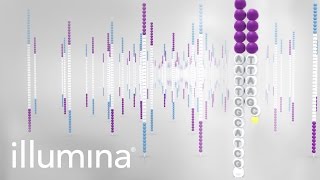
This image represents a small fraction of the
flow cell.
After the completion of the first read, the
read product is washed away.
In this step
the index 1 read primer is introduced and
hybridized to the template.
The read is
generated, similar to the first read.
After completion of the index read, the read
product is washed off, and the three prime
ends of the template are deprotected.
The
template now folds over and binds the
second oligo on the flow cell.
Index 2 is read in the same manner as index
1.
Polymerases extend the second flow cell
oligo forming a double stranded bridge.
This
double stranded DNA is then linearized and
the three prime ends are blocked.
The
original forward strand is cleaved off and
washed away leaving only the reverse
strand.
Read 2 begins with the introduction of the
read 2 sequencing primer.
As with read 1,
the sequencing steps are repeated until the
desired read length is achieved.
The read 2
product is then washed away.
Full transcript without timestamps
The Illumina sequencing workflow is composed of 4 basic steps– sample prep, cluster generation, sequencing and data analysis. There are a number of different ways to prepare samples. All preparation methods add adaptors to the ends of the DNA fragments. Through reduced cycle amplification, additional motifs are introduced, such as the sequencing binding site, indices and regions complementary to the flow cell oligos. Clustering is a process where each fragment molecule is isothermally amplified. The flow cell is a glass slide with lanes. Each lane is a channel coated with a lawn, composed of two types of oligos. Hybridization is enabled by the first of the two types of oligos on the surface. This oligo is complimentary to the adapter region on one of the fragment strands. A polymerase creates a complement of the hybridized fragment. The double stranded molecule is denatured and the original template is washed away. The strands are clonally amplified through bridge amplification. In this process the strand folds over and the adapter region hybridizes to the second type of oligo on the flow cell. Polymerases generate the complimentary strand forming a double stranded bridge. This bridge is denatured, resulting in 2 single stranded copies of the molecule that are tethered to the flow cell. The process is then repeated over and over, and occurs simultaneously for millions of clusters resulting in clonal amplification of all the fragments. After bridge amplification the reverse strands are cleaved and washed off, leaving only the forward strands. The three prime ends are blocked to prevent unwanted priming. Sequencing begins with the extension of the first sequencing primer to produce the first read. With each cycle, fluorescently tagged nucleotides compete for addition to the growing chain. Only one is incorporated based on the sequence of the template. After the addition of each nucleotide the clusters are excited by a light source and a characteristic fluorescent signal is emitted. This proprietary process is called Sequencing-by- Synthesis. The number of cycles determines the length of the read. The emission wave length, along with the signal intensity, determines the base call. For a given cluster, all identical strands are read simultaneously. Hundreds of millions of clusters are sequenced in a massively parallel process. This image represents a small fraction of the flow cell. After the completion of the first read, the read product is washed away. In this step the index 1 read primer is introduced and hybridized to the template. The read is generated, similar to the first read. After completion of the index read, the read product is washed off, and the three prime ends of the template are deprotected. The template now folds over and binds the second oligo on the flow cell. Index 2 is read in the same manner as index 1. Polymerases extend the second flow cell oligo forming a double stranded bridge. This double stranded DNA is then linearized and the three prime ends are blocked. The original forward strand is cleaved off and washed away leaving only the reverse strand. Read 2 begins with the introduction of the read 2 sequencing primer. As with read 1, the sequencing steps are repeated until the desired read length is achieved. The read 2 product is then washed away.
Keep this transcript
Save it to LunaNotes and it becomes a real note in your library — editable, searchable, and ready to turn into flashcards or a diagram. Free to start.
Save to LunaNotesOr download subtitles for another video.
These subtitles were extracted using the Free YouTube subtitle downloader by LunaNotes.
Related videos

Download Subtitles and Captions for Any Video Easily
Enhance your viewing experience by downloading accurate subtitles and captions for any video. Improve comprehension, accessibility, and enjoy content in multiple languages effortlessly with our easy-to-use subtitle downloader.

Download Subtitles for Your Favorite Videos Easily
Enhance your video watching experience by downloading accurate subtitles and captions. Enjoy better understanding, accessibility, and language support for all your favorite videos.
Download Subtitles for Creaconnect V3 Video Easily
Enhance your viewing experience by downloading accurate subtitles for the Creaconnect V3 video. Subtitles improve understanding, accessibility, and ensure you don't miss any important details. Get your captions now and enjoy seamless video content.

Download Subtitles for When They Come for Me Video
Easily access and download accurate subtitles for the video 'When They Come for Me.' Enhance your viewing experience with clear captions that improve understanding and accessibility, perfect for all audiences.

Download Subtitles for SMCCC2 Video and Enhance Understanding
Download accurate subtitles for the SMCCC2 video to improve comprehension and accessibility. Enjoy clear captions that help you follow along easily and grasp key content effortlessly.
Most viewed

Untertitel für 'Nicos Weg' Deutsch lernen A1 Film herunterladen
Laden Sie die Untertitel für den gesamten Film 'Nicos Weg' herunter, um Ihr Deutschlernen auf A1 Niveau zu unterstützen. Untertitel helfen Ihnen, Wortschatz und Aussprache besser zu verstehen und verbessern das Hörverständnis effektiv.

ดาวน์โหลดซับไตเติ้ล DMD LAND 3 The Final Land Day 1
ดาวน์โหลดซับไตเติ้ลสำหรับวิดีโอ DMD LAND 3 The Final Land Day 1 เพื่อช่วยให้เข้าใจเนื้อหาได้ง่ายขึ้น และเพิ่มความสะดวกในการติดตามทุกช่วงเวลา เหมาะสำหรับผู้ชมที่ต้องการความชัดเจนและเข้าถึงข้อมูลอย่างครบถ้วน

Subtítulos para TIPOS DE APEGO | 6 DE COPAS Episodio 56
Descarga los subtítulos para el episodio 56 de la tercera temporada de 6 DE COPAS, centrado en los tipos de apego. Mejora tu comprensión y disfruta del contenido en detalle con nuestros subtítulos precisos y accesibles.

Download Subtitles for Harvard CS50 2026 Computer Science Course
Enhance your learning experience with downloadable subtitles for the Harvard CS50 2026 full computer science course. Easily follow along with lectures, improve comprehension, and access the content offline anytime. Perfect for students and enthusiasts aiming to master computer science concepts.

Descarga Subtítulos para NARCISISMO | 6 DE COPAS - Episodio 63
Accede fácilmente a los subtítulos del episodio 63 de '6 DE COPAS', centrado en el narcisismo. Descargar estos subtítulos te ayudará a entender mejor el contenido y mejorar la experiencia de visualización.
Found this transcript useful?
Take it with you. One click puts it in your own LunaNotes library.
Save to LunaNotes