Microservices Explained: Benefits, Challenges, When to Use
What are Microservices? An Introduction
This video by Monis offers a comprehensive overview of microservices architecture. It uses the example of a large e-commerce site (like Amazon or eBay) to illustrate the problems with monolithic applications and how microservices solve them.
The Problem: Monolithic Applications
- Definition: A monolithic application is a single, unified codebase where all features (browse, search, cart, account management) are packaged and deployed together.
- Challenges with Monoliths:
- Slow Deployment: Even a small change (e.g., changing a button color) requires rebuilding and redeploying the entire application.
- Scalability Issues: You cannot scale individual features independently. A surge in search traffic forces you to scale the entire application, which is inefficient and costly.
- Fault Isolation: A single bug in one module (e.g., account management) can bring down the entire application, affecting all features.
The Solution: Microservices Architecture
- Definition: Microservices break down a monolithic application into small, independent modules. Each module owns a single responsibility.
- Key Characteristics:
- Independent Teams: Each service can have its own dedicated team.
- Independent Technology: Services can use different programming languages and databases (e.g., Postgres for cart, NoSQL for search).
- Independent Deployment: Services can be deployed, updated, and scaled individually.
How Microservices Communicate
- HTTP REST APIs: Services can expose REST endpoints for synchronous, request-response style communication (e.g., adding an item to the cart).
- Asynchronous Messaging (e.g., Apache Kafka): Services can publish messages to a central topic. Other services interested in that event can read and react to it (e.g., placing an order triggers order history, email, and warehouse notifications). For a deeper introduction to message brokers, consider learning about RabbitMQ Introduction: Message Broker Basics for Microservices.
Key Benefits of Microservices
- Faster Feature Delivery: Only the relevant service needs to be changed and deployed.
- Scalability: High-traffic services (like browse and search) can be scaled independently from low-traffic services (like account management). To master these concepts for interviews, review System Design Basics: Scalability, Cloud Hosting & API Explained.
- Fault Isolation: A failure in one service does not affect the others. Users can still browse and place orders even if the account service is down.
Challenges and When Not to Use Microservices
- Challenges:
- Network Latency: Communication between services adds overhead and potential latency.
- Distributed Transactions: Managing transactions that span multiple services is complex. For a broader overview of these patterns, see Message Queues for System Design Interviews: Complete Guide.
- When a Monolith is Better: For small projects or startups undergoing rapid change, a monolithic architecture is often simpler, faster to develop, and easier to manage. The complexity of microservices is not justified in these cases. You can also explore an alternative approach for front-end applications in Unlocking Microservices in the Browser with Single-SPA.
is Monis and today we will talk about Microservices. At the end of this video you will be able to clearly understand what microservices are and why do we need them, what problems do they solve and when not to use microservices. So without further ado, let's get
started. If we take an example of any e-commerce website like Amazon or Ebay or Walmart there is a lot going on behind the scenes. Applications like these have a lot of complex features running
under the hood and maintaining all of that, is no easy feat. There are different teams for managing different aspects of the application. For example, a team to work on the browse and search part of the application. A team for cart and checkout. A team for Account Management and a team for maintaining
the UI and UX of the application. Not so long ago, these teams usually had a single code base. Every person from these different teams used to add their changes to this Central codebase. Ultimately, all this was packaged in a single heavy unit and deployed on a set of computers so that
the public could access it. These kind of one unit for everything applications are called Monolithic Applications. Now, although this monolithic approach works, it comes with its own set of problems. Let's take the example of changing the color of a button. The code to do this could probably be
a single line and if you wanted to change that, you'd have to repackage the whole codebase again into a new unit and deploy on the computers. This process could be quite cumbersome for a small change. Therefore, a lot of organisations started clubbing the changes from various modules over a
period of let's say 2 weeks and deployed multiple changes all together. This meant that the frequency of changes was quite low and if something went wrong in one of the features, the complete set of changes had to be rolled back fixed and redeployed. Another problem is scalability. Now a lot of people
browse and search for products on the e-commerce websites. They go through a lot of stuff and then they decide whether to buy something or not. Even if you intend to buy something you go through a lot of items to find that one perfect article that would fit best to your requirements. Now thinking a
little bit from a technical perspective, the browse and search part of the application receives a lot of traffic compared to the checkout part of the application. Even if a customer goes through an average of 10 products to just buy 1, we can simply say that the browse and search receives
10 times more traffic than the cart and checkout. And that is assuming everybody buys a product. This number could of course change based on a number of factors - like the popularity of the website, percentage of people not buying anything but just browsing and so on. Now, a food for thought
is although we need high powered systems to manage the browse and search requests but we only need 10 to 20% of the Firepower for cart and checkout. And this goes down even further for account management modules. I mean how often do we really change our email addresses and these type of things?
Quite rarely. So if there is an upcoming Christmas sale which will increase the load on the website by let's say double, which means we might have to scale up and add more servers. Now, we do expect the load of search and checkout to probably be doubled as well but the chances of account management load
getting doubled seems quite unlikely. So in this situation, it is not possible that we scale some parts and skip the others. This is not optimal from an architectural perspective nor is it cost effective. Now, these are not the only problems that we have. A significant Challenge in a monolithic
system is handling faults. Imagine a case where there is an error in account management module because of which the whole application cannot function. In this case, it is not possible to isolate this fault. Although there might be nothing wrong with with the browse search and
checkout they cannot be used as long as account management is not fixed. So as you can see, a large monolith brings a lot of problems with it and to solve these problems microservices came into the picture. Microservices came with the idea of dividing the whole big application into logically
separate modules. Each of which owning a single responsibility. For those who have been in the software engineering for quite a bit of time, can consider microservice architecture as a flavour of service oriented architecture (SOA). Now when we roughly try to split this e-commerce monolith into
microservices, we can have the browse and search as one service which deals with homepage browsing and searching for products and these kind of things. And then we can have cart and checkout - which deals with adding items to the cart and the journey to place the order including the payments. And then,
we can also have Account Management - which deals with the account side of things like change and view email addresses, passwords and viewing order history. So each of these modules can have their own teams which would be responsible only for this part of the project and can be quite agnostic to
any other team. Similarly, they all can have their own databases depending on the requirements. Each module can have its own database and can choose the database technology accordingly. For example cart and checkout teams can decide for something like Postgres for managing transactions whereas
browse and search could have a NoSQL database because of high performance and less need of concurrent transactions. Each of these modules can also implement their codebase in different technologies. For example, the Account Management team can decide to create their codebase in Java
while other teams are free to decide on other programming languages. Now, separating all of these services is cool but how will these services be connected with each other? For example, a person browsing something wants to add an item to the cart and buy it. In a monolith service, it
was quite easy because we have the same codebase which could interact with different modules inside of it but now that the services are separated, how will the browse service tell the cart service, "hey cart !add this jeans to the cart" and once the user places the order how will this order appear in the
order history? So, there has to be some sort of communication between these microservices so that they can talk to each other and delegate responsibility when needed. Let's explore that a little more. The communication between microservices can happen in a variety of ways.
A very common way of communication is through HTTP REST APIs. So each microservice can have a bunch of computers running behind the scenes this set of computers or servers is called a "cluster". Each cluster can have an IP address or a URL. Just like we type in a web address to reach a
website from our browser, these microservices can also be reached using these IP addresses. Now each microservice can expose a set of actions that you can perform on those microservices and can also specify what data it needs to perform those actions. For example, the cart service can expose a
REST API which can take some basic data to add an item to the users's cart so when we click "Add to Cart" from the browse feature it sends a REST call to the cart service and the cart service adds two quantities of this product to this user's cart and return the success message back. So that we. as
users, can see that the item has been added to the cart. Similarly, this service can expose different endpoints to perform different actions like - remove items from the cart, check out place orders and so on. Although these HTTP REST APIs are quite a common communication practice, microservices can
also communicate in a different way. For example, when a user places an order we want to do multiple actions with this order data. For example, updating the order history so that the users can see the order in their profile, sending email to the users like an order confirmation email, sending
order details to to the warehouse so that they can ship the products to the user, send order details to analytics. All of these actions require order details like the items in the order, total order amount, shipping address, billing address and so on. Assuming all of these actions are handled
by different microservices we can either make multiple REST calls to different places or we can publish a message with order details at one common place from where all microservices can read this message. There are quite quite a few technologies which have this messaging system
and one of such Technologies is called Kafka by Apache. So when we publish a message using Kafka to a "topic", these services which are supposed to read our messages can be provided access to this topic. So when we send a message the services can read it and perform their actions accordingly. So,
this is another way of communication. Now, once the microservices have been separated and their communication is correctly established, we can now talk a little bit about how it solves the problems that we have discussed before. Remember the example we took for changing the color of a
button? Well with microservices we no longer have to repackage the whole application into a single unit and do a heavy deployment. We just have to repackage the smaller chunk of the application which only deals with the frontend side of things. Other features like browse, search, cart
and checkout no longer have to be even touched for this change to happen. This also enables us to ship out features much faster. With better modularity, it now becomes feasible to scale up certain parts of the application. The browse and search traffic, cart and checkout traffic, account
management traffic - all can be scaled separately and according to the expected traffic. Another advantage is Fault isolation. This is quite a decent advantage of microservices. Imagine that in a monolith, something goes wrong and the whole application goes down and the user will see this.
However, in microservices architecture if something goes down in the account management module, only that module suffers. The remaining parts of the application like browse, search and checkout will still continue to work. Which means that the user could still place orders. So microservices solve
a lot of problems that come with monoliths. But these advantages don't come without a catch. Since now the services are separated, they no longer are tightly coupled but this means that they have an extra communication overhead between the services. It simply means that since microservices
communicate to each other over a network, there is also a problem of network latency which can make the application relatively slower. Another pain point with microservices is that it is quite difficult to manage transactions across different services. In a monolith, it was quite
easy to perform transactions as there was a single codebase in a single technology so you could just put everything that you want to update in a single transaction block. However when microservices are separated, the transactions can span over multiple microservices and have to be explicitly handled.
For example, when a user places an order - the inventory or the stock has to be decreased. Now, this inventory management could be handled in a different service altogether and now the transaction has to be maintained across different services. This can become quite complex when more
microservices are involved in a transaction. So, as you can see there is a lot of baggage that comes with microservices but that doesn't mean that we cannot handle this baggage. There are design patterns which we can use to mitigate these problems. But that's a topic for another video. So we talked
a lot about microservices and how they solve a lot of problems but that doesn't mean that microservices are a solution to everything. There are very specific use cases for which monoliths are actually a really good fit. For example, if you're working at a startup which is undergoing
a lot of changes - it might be a wise decision to go ahead with a monolithic architecture. For smaller projects, it's actually easier to work on a single codebase rather than having the complexity of microservices. So there you have it! Some fundamentals about microservices. Write
down in the comments below if you have any questions, see you in the next video, Bis Dann!
A monolithic application is built as a single, unified codebase where all features are deployed together, making updates and scaling slow and risky. In contrast, a microservices architecture breaks the application into small, independent modules, each with its own responsibility, team, and technology stack, enabling faster deployment, independent scaling, and better fault isolation.
Microservices communicate primarily through two methods: synchronous communication using HTTP REST APIs for request-response interactions (e.g., adding an item to a cart), and asynchronous messaging using message brokers like Apache Kafka for event-driven actions (e.g., placing an order triggers updates in order history, email, and warehouse services without waiting for each response).
Key benefits include faster feature delivery because changes only affect the relevant service, independent scalability so high-traffic services like search can scale without affecting low-traffic services like account management, and fault isolation where a failure in one service (e.g., account management) doesn't bring down the entire application, allowing other features like browsing and placing orders to continue working.
The main challenges include network latency due to increased inter-service communication adding overhead, and complexity in managing distributed transactions that span multiple services, which requires careful coordination and patterns like sagas or event sourcing.
For small projects or startups undergoing rapid change with limited teams, a monolith is often simpler, faster to develop, and easier to manage. The added complexity of network communication, distributed data management, and deployment orchestration in microservices is not justified when the application's scale and team size do not require independent scaling or deployment of features.
The video used the example of a large e-commerce platform like Amazon or eBay, where a monolithic application would struggle because even a small change (e.g., changing a button color) requires rebuilding and redeploying the entire application, and a bug in one module like account management could take down the entire site, affecting all features including search, cart, and checkout.
Yes, one of the key characteristics of microservices is that each service can have its own dedicated team and technology stack. For instance, the cart service might use PostgreSQL while the search service uses a NoSQL database like MongoDB, and teams can choose the programming language best suited for each service's needs.
Keep this summary
Save it to LunaNotes and it becomes a real note in your library — editable, searchable, and ready to turn into flashcards or a diagram. Free to start.
Save to LunaNotesOr summarise for another video.


32K+ people have turned 65K+ videos into notes
“Very useful tool. I'm using it for the last couple weeks and I'm loving it so far. Makes learning on YouTube a great experience.”
 Bhai Chrome Web Store review
This summary and transcript were automatically generated using AI with the Free YouTube transcript summary tool by LunaNotes.
Related summaries
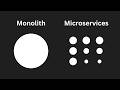
Microservices Explained: What They Are, Problems They Solve & When Not To Use
This comprehensive guide explains the core concepts of microservices architecture, contrasting it with traditional monolithic applications. You'll learn what problems microservices solve, such as scalability and fault isolation, and also discover key scenarios where a monolithic approach is still the better choice.

Unlocking Microservices in the Browser with Single-SPA
Explore how Single-SPA enables microservices in JavaScript applications effortlessly.

Comprehensive System Design Series: From Monolith to Microservices and Beyond
This extensive video series covers crucial system design concepts essential for software engineers, students, and developers preparing for FAANG interviews or building scalable startup systems. Dive deep into foundational topics like monolithic vs microservice architectures, API gateways, load balancers, networking protocols, caching strategies, distributed systems, rate limiting, SSL certificates, database choices, avoiding single points of failure, messaging queues, consistent hashing, and more with real-world examples and hands-on coding projects.

Complete System Design Course: Scalable Architectures & Key Concepts
This comprehensive system design tutorial covers everything from basic components and SQL/NoSQL databases to advanced topics like load balancing, caching, partitioning, replication, and the CAP theorem. Learn how to build scalable applications capable of serving millions of users, with a practical video streaming design example.

RabbitMQ Introduction: Message Broker Basics for Microservices
This video launches a new series on RabbitMQ, an open-source message broker written in Erlang. It explains how RabbitMQ facilitates asynchronous communication between microservices using message queues, enabling scalability, load distribution, and fault tolerance. The overview covers core concepts like producers, consumers, FIFO queues, supported protocols (AMQP, MQTT, HTTP), and differences from Kafka.
Most viewed summaries

A Comprehensive Guide to Using Stable Diffusion Forge UI
Explore the Stable Diffusion Forge UI, customizable settings, models, and more to enhance your image generation experience.

Kolonyalismo at Imperyalismo: Ang Kasaysayan ng Pagsakop sa Pilipinas
Tuklasin ang kasaysayan ng kolonyalismo at imperyalismo sa Pilipinas sa pamamagitan ni Ferdinand Magellan.

Mastering Inpainting with Stable Diffusion: Fix Mistakes and Enhance Your Images
Learn to fix mistakes and enhance images with Stable Diffusion's inpainting features effectively.

Pamamaraan at Patakarang Kolonyal ng mga Espanyol sa Pilipinas
Tuklasin ang mga pamamaraan at patakaran ng mga Espanyol sa Pilipinas, at ang epekto nito sa mga Pilipino.

How to Install and Configure Forge: A New Stable Diffusion Web UI
Learn to install and configure the new Forge web UI for Stable Diffusion, with tips on models and settings.
Found this summary useful?
Take it with you. One click puts it in your own LunaNotes library.
Save to LunaNotes