Mastering the conventions of academic writing style is crucial for success in higher education. This guide breaks down the key 'dos and don'ts' of formal academic writing, from avoiding informal language to effectively using passive structures and hedging. We'll provide practical rewriting exercises to help you elevate your academic essays.
Understanding Academic Writing Style
Academic writing is a formal, structured, and evidence-based style of communication used in scholarly contexts. Unlike casual conversation or creative writing, it prioritizes clarity, precision, and objectivity. The goal is to present ideas and arguments in a way that is credible and persuasive to an academic audience. To truly grasp this, it's helpful to first understand What Is Academic Writing? | Definition and 7 Key Features Explained.
The Key Dos of Academic Writing
1. Use Formal Vocabulary
Ditch colloquial words and phrases in favor of more precise, formal alternatives. For example, replace "get" with "obtain" or "acquire", and "a lot of" with "numerous" or "significant". This shift in diction is a cornerstone of Mastering Effective Sentence Writing: Unity, Coherence, and Emphasis.
2. Employ Hedging Language
Academic writing is often cautious in its claims. Use hedging words like "suggests," "indicates," "may," and "could" to express probability rather than absolute certainty. This makes your arguments more defensible and reflects the tentative nature of knowledge.
3. Use Nominalization
Nominalization is the process of turning verbs into nouns (e.g., "investigate" becomes "investigation"). This technique makes your writing more concise and formal, and it helps to create a more academic, objective tone.
4. Prioritize Clarity and Logic
Every sentence should contribute to your overall argument. Use clear topic sentences, logical transitions, and a consistent line of reasoning. Avoid fluff and ensure your ideas flow seamlessly from one to the next.
The Key Don'ts of Academic Writing
1. Avoid Contractions
Contractions like "don't," "can't," and "won't" are too informal. Always write them out as "do not," "cannot," and "will not." This is a simple but essential rule for maintaining a formal tone.
2. Avoid Phrasal Verbs
Phrasal verbs (e.g., "look into," "find out," "give up") are often considered too casual. Replace them with single-word synonyms like "investigate," "determine," and "relinquish." This is a common area where students struggle, and knowing the Common English Mistakes: Bored vs Boring, Past Tenses & Articles Explained can help you avoid similar pitfalls.
3. Avoid Rhetorical Questions
Questions like "Who would disagree with this?" are too informal and assume a reader's response. Instead, state your claim directly: "This is a widely accepted principle."
4. Avoid Oversimplifications
Words like "always" and "never" are absolute and often inaccurate. Use more nuanced language like "frequently" or "rarely." This demonstrates a more sophisticated understanding of complexity.
Practical Rewriting Exercises
Let's apply these principles. Rewrite the following informal sentence into a formal academic style:
Informal: "The experiment didn't work because the scientists couldn't get the equipment to work right."
Academic Style: "The experiment was unsuccessful due to the researchers' inability to calibrate the equipment correctly."
Notice how we removed the contraction, replaced the phrasal verb ("get...to work"), and used a more formal noun ("inability").
Mastering Punctuation for Clarity
Proper punctuation is essential for conveying complex ideas with precision. Without it, sentences can become ambiguous or confusing. Review Mastering English Punctuation: 13 Essential Rules for Better Writing to ensure your writing is as clear as it is formal.
A Note on the Passive Voice
While the passive voice is often associated with academic writing, it should be used purposefully. Use it to emphasize the action or result rather than the agent (e.g., "The solution was heated to 100°C"). However, overusing it can make your writing dull and wordy. Use it strategically.
Conclusion
Mastering academic writing style is a process of learning to be precise, objective, and formal. By following these dos and don'ts, and by practicing rewriting exercises, you can dramatically improve the quality of your academic essays. For more specific guidance on essay structures, check out our advice on Top Mistakes to Avoid in AP Lang Synthesis Essays, which highlights common pitfalls in formal argumentation.
Hello and welcome to Academic English UK. Today's video is on academic style in academic writing.
All the links are below, but if you want further information, then go to our website forward slashwriting.
Okay, we're going to start with a definition of academic style. So academic style is the conventions often
associated with academic writing. Now although there is much debate over what exactly academic style is, generally
there is an agreement among most academic English teachers to the key elements that should or should not be
included. The following is a list of the dos and the don'ts. So before we begin, I'd like you to
think about what you should not do in academic writing and what you should do considering academic writing style. So
to give you an example, no idiomatic or colloquial language should be used and the yes would be
academic vocabulary should be used such as the academic word list. Pause this slide and see if you can
think of four or five nos and four and five yeses. Okay. So, the nose,
no phrasal verbs. Phrasal verbs are seen as informal. These are verbs plus prepositions and their use should be
limited and alternatives should be found. Personal pronouns I, we in my opinion. Again, these are seen as
informal. They create informal structures and their use should be limited. Some universities and
departments do not accept I in written academic essays. Contractions ital should be written in
full form. For example, questions. It's not common to use questions forms in academic essays and
positive statements should be written. Personal adverbs again personalizing language creates a more narrative feel.
So words like surprising, unfortunately should be emitted. Numbering and bullet points in
paragraphing is not common. Vague language such as and so on etc is also not normally accepted and we should be
more specific. Repetition repeating the same words constantly is seen as lack of vocabulary
and an inability to use synonyms. Finally, basic language that we use in spoken English should be avoided in
academic writing. Here are some examples with possible alternatives. Okay, the yeses.
Yes, we should be using more passive structures. So, for example, language like we analyze the data could be
changed into a more formal structure. The data was analyzed. We can also take this one step further and make it more
complex by using nominalization or noun structures by taking the verb analyzed and using it as a noun. An analysis of
the data showed we should be using referencing systems. We should be using cautious or tentative
hedging language. These kind of words, these adverbs and verbs are used just to show that we are not 100% certain of the
facts that we state. We should be accurate in our vocabulary and show the differences between key
words and we should be precise and show the exact specific figures. So being specific is a key part of academic
writing. Right? If you would like to test yourself, here is the same slide with
the words emitted. Please pause this and see if you can name some of the nos and the yeses.
Okay, academic style practice. So, see if you can rewrite this sentence so it's more academic.
Another thing to think about is the chance of crime getting worse. So, pause this slide and see if you can rewrite
it, please. answer. So the first thing you should do really is look at the sentence and see
if you can highlight the informal or non-academic words. So here we have thing. Think about phrasal verb chance
and getting our informal words. From here you should perhaps go to the internet.
something like thesaurus.com is a good website to go to to check synonyonyms. So if I put in thing
thesaurus.com highlights the keywords um that are specific to that one word and the brighter orange are the key more
frequent words and the lighter orange are the less frequent words connected to that word. You can also use Google
and Google you can put in thing plus sin and this will highlight a whole list too and you can pick words that you feel are
appropriate to the word in context. So through that I come up with a list. So I could use thing area aspect feature
point or think about. I could change to consider, note, understand, acknowledge, chance, possibility, probability,
situation, and getting. The the most common similar word to this is becoming. I then choose which word I'd like to use
or which is the most appropriate. So here I'm choosing aspect, consider, possibility becoming, and then I rewrite
the sentence. So another aspect to consider is the possibility of crime becoming worse. I can take this to a
further step which is by nominalizing it. So here uh I'm changing the main verb into a noun form. So I take
consider and I turn it into the noun of consideration. Consideration with of preposition
and it's done and it's more academic. So I would like you to do these exercises. your first one. Please pause this slide
and see if you can rewrite this using some of the information you've learned from today.
Answer. Currently, the rate of unemployment is at an unprecedented level.
C. Pause this slide. See if you can rewrite it.
answer. It has been proposed that by 2017 a vaccine for malaria will have possibly
been discovered. Notice hedging cautious language. Next, pause this slide.
Answer. After 2013, the Japanese property market inhouse value fell dramatically. Or since 2013, the price
of property fell dramatically in Japan. For all of these exercises, there are a variety of answers, and these are just
some of the possible answers you could use. If you want more then please go here academicenglish UK/academicstyle
where there's a worksheet and everything I've talked about today you can download and fortunately it will cost you 50 p
but it's a good investment and there's lots more on our website. A lot of what I've done today has been
taken from this book academic writing a handbook for international students. This is Steven Bailey 2014. Um, it costs
about £25 and here's the link here connected to the publisher. Thank you for watching my video today.
If you would like more information on academic style or academic writing, please go to our website/writing.
Thank you.
Hedging language involves using cautious words like 'suggests,' 'indicates,' 'may,' or 'could' to express probability rather than absolute certainty. This makes your arguments more defensible and reflects the tentative nature of knowledge, showing that you are aware of alternative viewpoints and limitations. For example, instead of saying 'This proves the theory,' say 'This suggests the theory may be correct.'
To make your writing more formal, replace contractions with their full forms (e.g., 'don't' → 'do not'), substitute phrasal verbs with single-word synonyms (e.g., 'look into' → 'investigate'), and avoid rhetorical questions by stating your claims directly. Also, replace colloquial words like 'get' with 'obtain' and 'a lot of' with 'numerous' or 'significant.'
Nominalization is the process of turning verbs into nouns, such as changing 'investigate' to 'investigation.' This technique makes your writing more concise and formal, and it helps create an objective, academic tone. For instance, instead of 'We analyzed the data,' you could write 'The analysis of the data was conducted.'
The passive voice is useful when you want to emphasize the action or result rather than the person performing it, such as in scientific methods ('The solution was heated to 100°C'). However, overusing it can make your writing dull and wordy. Use it strategically to maintain clarity and objectivity, but prefer active voice for directness when the agent is important.
An informal sentence like 'The experiment didn't work because the scientists couldn't get the equipment to work right' can be rewritten as 'The experiment was unsuccessful due to the researchers' inability to calibrate the equipment correctly.' The revision removes contractions, replaces the phrasal verb 'get...to work' with 'calibrate,' and uses a formal noun ('inability') for greater precision and objectivity.
Keep this summary
Save it to LunaNotes and it becomes a real note in your library — editable, searchable, and ready to turn into flashcards or a diagram. Free to start.
Save to LunaNotesOr summarise for another video.


32K+ people have turned 65K+ videos into notes
“Very useful tool. I'm using it for the last couple weeks and I'm loving it so far. Makes learning on YouTube a great experience.”
 Bhai Chrome Web Store review
This summary and transcript were automatically generated using AI with the Free YouTube transcript summary tool by LunaNotes.
Related summaries
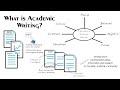
What Is Academic Writing? | Definition and 7 Key Features Explained
Learn the definition and essential features of academic writing, including structure, evidence, and formality. This guide explains both student and expert academic writing, with clear examples to improve your skills.
Master Advanced Writing Skills for Professional Success in Business
This lecture explores the critical importance of writing in professional life, contrasting it with other communication skills. Key takeaways include mastering direct and indirect writing plans, structuring content for clarity, and aligning your writing with audience needs for maximum impact.
Mastering Report Writing: Structure, Content and Language Essentials
This lecture provides a comprehensive guide to report structure, covering the main body (introduction, discussion, conclusions, recommendations) and the back matter (appendices, bibliography, glossary, index). Learn how to analyze data effectively, present logical conclusions, and reference sources correctly using APA or MLA styles.
Technical Report Writing: Choosing Clear Words and Avoiding Jargon
This lecture focuses on the critical elements of style in technical report writing. Learn how to choose familiar words over cliches, jargon, and circumlocutions to ensure your report is clear and actionable for all readers.
Top Mistakes to Avoid in AP Lang Synthesis Essays
In this video, Coach All Writes discusses the most common mistakes students make in AP Lang synthesis essays and provides practical tips to improve their writing. Key areas of focus include the importance of using three sources, developing commentary, proper citations, and creating a conversation among sources.
Most viewed summaries

A Comprehensive Guide to Using Stable Diffusion Forge UI
Explore the Stable Diffusion Forge UI, customizable settings, models, and more to enhance your image generation experience.

Kolonyalismo at Imperyalismo: Ang Kasaysayan ng Pagsakop sa Pilipinas
Tuklasin ang kasaysayan ng kolonyalismo at imperyalismo sa Pilipinas sa pamamagitan ni Ferdinand Magellan.

Mastering Inpainting with Stable Diffusion: Fix Mistakes and Enhance Your Images
Learn to fix mistakes and enhance images with Stable Diffusion's inpainting features effectively.

Pamamaraan at Patakarang Kolonyal ng mga Espanyol sa Pilipinas
Tuklasin ang mga pamamaraan at patakaran ng mga Espanyol sa Pilipinas, at ang epekto nito sa mga Pilipino.

How to Install and Configure Forge: A New Stable Diffusion Web UI
Learn to install and configure the new Forge web UI for Stable Diffusion, with tips on models and settings.
Found this summary useful?
Take it with you. One click puts it in your own LunaNotes library.
Save to LunaNotes