Download Subtitles for Press Secretary Karoline Leavitt Briefing
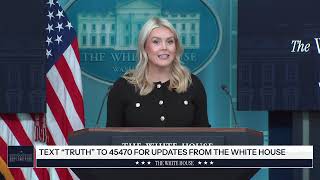
Press Secretary Karoline Leavitt Briefs Members of the Media, Feb. 18, 2026
The White House
SRT - Most compatible format for video players (VLC, media players, video editors)
VTT - Web Video Text Tracks for HTML5 video and browsers
TXT - Plain text with timestamps for easy reading and editing
Scroll to view all subtitles
Hello everybody.
>> Good afternoon. Thank you for your
patience as always.
Let's begin with some scheduling
announcements for the remainder of
President Trump's very busy week. Today
at 300 PM, President Trump will host a
Black History Month reception in the
East Room of the White House. I know
many of you will attend and we will see
you up there. Tomorrow, President Trump
will host a Board of Peace meeting at
the Donald J. Trump Institute of Peace,
where he will announce that member
states have pledged more than five
billion dollars towards the Gaza
Humanitarian and Reconstruction efforts
and have also committed thousands of
personnel to the International
Stabilization Force and local police to
maintain security and peace for Gazins.
Tomorrow afternoon, the president will
travel to the great state of Georgia
where he will visit two local businesses
and give a speech on his efforts to make
life affordable for working people. On
Friday, President Trump will host a
working breakfast with governors in the
East Room here at the White House. And
on Saturday night, President Trump and
the first lady will host the annual
governor's dinner. Next, I'd like to
provide an update on the economy. We're
seeing promising signs every day that
2026 is going to be a record successful
year for the American people, just as
President Trump promised them. The
January jobs report shattered
expectations, highlighting how the
president's progrowth economic agenda is
fueling American prosperity. The economy
added 172,000
new private sector jobs to kick off the
year. That's more than two and a half
times economist predictions. The labor
force participation rate went up while
the unemployment rate fell. The prime
age labor force participation rate is
now at its highest since 2001.
Most importantly, 100% of all job
creation under President Trump continues
to be in the private sector. This is
truly remarkable. That's 615,000
private sector jobs that have been added
in President Trump's second term thus
far. These are real working people.
These are real American families who
will be living out their American dream.
Meanwhile, federal government employment
has shrunk to its lowest level since
1966,
saving taxpayers 29 billion dollar
annually. And all of the net job growth
under President Trump has gone to
nativeborn Americans, ending the
disgraceful pattern under Joe Biden of
job gains going to non-citizens and
illegal aliens. Additionally, on
inflation, the new CPI report is even
more proof of the progress made by
President Trump. Despite all of the doom
casting from the so-called experts, the
president has managed to utilize
powerful tariffs to secure trillions of
dollars in investments into our country
and rebalance our trade deals while
simultaneously cooling inflation.
Year-over-year inflation fell to 2.4% in
January, beating expectations again and
marking the lowest level since May. Core
inflation, the best measure of
inflation, dropped to its lowest level
in nearly five years. Meanwhile, real
average hourly earnings for all private
sector workers rose in the month of
January, which means more money is going
back directly into people's pockets.
After only one year of President Trump
back in office, real earnings for all
private sector workers have outpaced
inflation by nearly $1,400,
earning back roughly half of the $2,900
they lost under Joe Biden when 40-year
high inflation was stealing Americans
purchasing power. President Trump's
policies are and will continue to allow
Americans incomes to go further for
bills, retirement, and achieving the
American dream. A key part of the
American dream is buying a home. It's
and that is finally becoming more
affordable under this president. This
past week, it was announced the annual
mortgage cost for a new home has fallen
by $4,000 so far under President Trump
after rising by roughly $15,000
under Joe Biden. As a result, mortgage
affordability has reached a 4-year best
following recent bold action by the
president to make home ownership more
attainable for American families, not
large Wall Street corporate
institutional investors. At the same
time, national median rates rents have
fallen to a 4-year low and have declined
for six consecutive months. The annual
rental cost for a new rental unit has
fallen nearly $100 so far under
President Trump after rising more than
$3,000 under Joe Biden. And many are
crediting that to the president's
deportation efforts to remove illegal
aliens from our communities and
therefore from housing that should be
used for American citizens. At the
grocery store, the price of eggs, dairy,
cheese, fresh fruit, apples, oranges,
potatoes, tomatoes, and butter have
fallen since President Trump took
office. And he is continuing to fight
for even lower prices at the grocery
store for the American consumer. At the
gas pump, fuel prices are down by almost
10% over the past year. The average
national price for a gallon of regular
gas is now less than $3 and is
approaching $2.70
in some states and much lower than that.
In many states across the country as
well, we've seen in several states gas
is under $2 a gallon. And at the
pharmacy, prescription drug prices are
down over the past year with even more
price relief ahead for American patients
thanks to President Trump's most favored
nation drug pricing deals and the great
health care plan, which he is calling on
Congress to pass as soon as possible.
What President Trump wants Americans to
understand is that this is only the
start and the best is yet to come. The
historic success that we have seen since
he took office is just the beginning of
enormous growth and opportunity that we
are about to witness and I know the
president looks forward to hitting the
road and being with the great people of
Georgia tomorrow to talk about just
this. So with that today, I know there's
a lot of news. I will open it up to take
your questions and we're going to start
as always with our new media seat, the
great Michael Graham from Inside
Sources. Thank you for being here,
Michael.
>> Thank you for having us and uh thanks to
from our 200 newspaper partners around
the country. So, you mentioned gas, but
we didn't mention natural gas. And back
where you live, your friends and family
are paying among the highest prices for
natural gas to heat their home and for
electricity generation, the number one
source of power across New England. The
cheap gas is in Pennsylvania, the two
highest places to buy gas in the
country, New York City and Boston. The
problem is the blue states will not
allow the gas to travel to produce
electricity or to reach customers. When
President Trump first came back in
office, there was some talk him and
Governor Hokll in New York possibly
reaching a deal. When will consumers in
the Northeast feel relief from President
Trump's energy uh policies
[clears throat] and what can he do about
state objections to expansion of
infrastructure? Then I have a quick
followup.
>> Sure. Absolutely. Well, the president
has promised all Americans across the
country and in particular in the
Northeast where we do face much higher
costs of electricity and of energy
unfortunately uh because of the Democrat
policies in the area. From the federal
government's perspective, the president
and the National Energy Dominance
Council, Secretaries Wright and Bergam
are doing all we can when it comes to
federal permitting. The drill baby drill
agenda is obviously underway. The
president has made a huge push for more
fossil fuels in this country. Uh you
look at what he did last week with
respect to coal. Coal truly keeps the
lights on in this country. We learned
that in the recent winter storms.
However, there's only so much that can
be done at the federal level. That's why
the president has called on blue state
governors to participate in this energy
dominance agenda uh including governors
in New England in the northeast by
contacting Governor Hokll directly to
get this Constitution pipeline underway.
This is not only going to bring down the
cost of energy in the Northeast, it's
also going to support job growth uh and
and energy affordability uh and more
opportunity for workers in the
Northeast. And I just have a a quick
statistic uh here on energy that I found
fascinating and it's obviously true
because I'm saying it up here. Red
states with Republican legislators
currently enjoy lower average retail
electricity prices than blue states with
Democrat legislatures. Uh and that's
exactly why the president is calling on
all blue state governors uh across New
England and the northeast to get on
board. Let's bring prices down for all
Americans whether they live in a red or
a blue state. So right down the street
from your alma mada san college talk
about building an ice facility uh that's
causing a lot of political aida in New
Hampshire and for the Republican
governor Kelly Aayat seems to be some
miscommunications argued on both sides.
Even Republican supporters of Trump who
live in the town say we're not sure we
want this. What's your message to the
folks in New Hampshire about this
proposed ICE facility?
>> The message is that uh illegal
immigration while the border is secure
is still a problem across our entire
homeland. uh in the previous
administration allowed nearly 20 million
illegal aliens from countries all over
the world into our country and the
president and secretary gnome have done
a phenomenal job at deporting uh nearly
3 million illegals have left the country
either through deportation or
self-deportation under the over the past
year. Uh but obviously there are a lot
more illegal alien criminals left in our
homeland. That includes in New England.
Uh there are many within our communities
in New Hampshire, uh in Maine, and
definitely in Massachusetts, and in the
Boston suburbs that need to be arrested,
detained, and deported back to their
home countries. Um and so the president
and Secretary Gnome and I know ICE are
engaged with local governors across the
whole country, including in New
Hampshire, to open more detention
facilities. This is an unfortunate
consequence of the previous
administration's border invasion um that
the president has thankfully put a stop
to. But of course, we still need to
grapple with the illegal alien criminals
who are here, and that requires more
detention space.
>> Thank you, Michael. Garrett
>> um on Iran. I'm not asking you for like
military secrets here, but can you
[laughter]
>> can you can you share
>> unless you want to give them um can you
share a little bit about the president's
thinking on whether or not to strike
Iran, who he's talking to, what
information he's consuming, and why a
strike might be necessary on a nuclear
program he says was obliterated by the
last US strike.
>> Well, there's many reasons and arguments
that one could make uh for a strike
against the uh against Iran. Uh the
president had a very successful
operation as commander-in-chief with
operation midnight hammer as you know as
you just said uh totally obliterated
Iran's nuclear facilities. Um the
president has always been very clear
though with respect to Iran or any
country around the world. Diplomacy is
always his first option and Iran would
be very wise to make a deal with
President Trump and with this
administration. Uh he's talking to many
people of course his national security
team first and foremost uh and you know
who the members of that team are uh and
this is something obviously the
president takes seriously he's always
thinking about what's in the best
interest of the United States of America
of our military of the American people.
Um and that's how he makes decisions
with respect to military action of any
kind.
>> And on the flip side of that he's got
the State of the Union speech next week.
if he is going to take military action,
does the administration believe it's
important to sort of convince the
American people, sell the American
people? Will we hear something about
that in the State of the Union to make
the case for why something like that
might be necessary to risk American
lives?
>> Look, again, I'm not going to engage in
a hypothetical. Good try, Garrett. But I
you can't catch me there. I will say
with respect to the State of the Union,
you'll be hearing more about what is to
come from the president's speech very
soon at the appropriate time. It is
going to be a very good and powerful
speech, so everyone should tune in. Ed,
>> Caroline, thank you. I got two questions
for you. Sure. Um, about Independence
Hall in Philadelphia. Um, the
administration's decided to appeal a
judge's ruling that in essence was
trying to put the slavery displays back,
arguing that the federal government
believed it had the power to dissemble
and disassemble historical truths when
it has some domain over historical
facts. The judge said it does not. The
administration said that you were
planning to uh put up a updated
interpretive materials and provide a
fuller account of the history of slavery
uh at Independence Hall. What more was
the administration or is the
administration planning to add?
>> I'm not familiar with this specific
instance, Ed, to be honest with you, but
I will check in with the appropriate
people who are overseeing this and we'll
get you a more firm answer.
>> One other question then. Yesterday in
his statement about Jesse Jackson, the
president said, "Despite the fact that
I'm falsely and consistently called a
racist by the scoundrels and lunatics on
the radical left, Democrats all, it was
always my pleasure to help Jesse along
the way. Where or when does the
president believe he's been falsely
called racist?"
>> You're kidding, right? [laughter]
>> I will pull you plethora of examples.
So, I'm going to get my team in that
room to start uh going through the
internet of radical Democrats throughout
the years, Ed, who have accused this
president falsely of being a racist. And
I'm sure there's many people in this
room and on network television across
the country who have accused him of the
same. In fact, I know that because I've
seen it with my own eyes. And the
president very much looks forward to
having a event later this uh afternoon
at 3 pm to celebrate Black History Month
and to talk about how his policies are
advancing opportunity and prosperity for
all Americans through uh record tax cuts
through the Trump accounts that all
Americans can access regardless of race.
These are a great thing for the next
generation of Americans. The president
has also awarded hundreds of millions of
dollars in additional funding to
strengthen educational outcomes at
historically back black colleges and
universities across the country. Uh
again, the president is protecting the
hardearned benefits of the 2.4 million
black veterans who honorably served in
our nation's armed forces by reducing
the black backlog of veterans waiting
for their VA benefits uh and for their
home loans through the veteran uh
Department of Veterans Affairs. So,
there is a lot this president has done
for all Americans regardless of race,
and he has absolutely been falsely
called and smeared as a racist, and I'm
happy to provide you those receipts, and
we gladly will right after this
briefing. Uh, Jennifer, go ahead.
>> U, you mentioned the 5 billion in
pledges for the Board of Peace. Will we
be able to get a breakdown of which
countries are providing each of those
pledges and which countries are are
providing troops?
>> Sure, we're happy to provide that
breakdown. And I'm also happy to provide
the list of countries that will be
attending tomorrow. I know it's more
than 20 countries. I know there's a lot
of interest in that. I'll spare myself
reading you the list of 20 countries
from the podium, but we will provide it.
And the president will be opening the
meeting tomorrow with remarks and will
sort of formally be chairing the meeting
at the beginning before he departs uh
for Georgia tomorrow.
>> And then on the sewage spill, the sewage
pipe that broke on PTOAC, can you give
us an update on the federal government's
response? and officials have told CBS
that some of that aging infrastructure
is a concern that this particular pipe
wasn't even of the most urgent concern.
Do you know if the government is is
looking into which other pipes could be
at at risk of of collapsing? Well, the
next step in this process is for uh any
of the three local jurisdictions
involved, whether that's the
Commonwealth of Virginia, the state of
Maryland and Governor Moore, or the
District of Columbia to step forward and
to ask the federal government for help
uh and to ask uh for the Stafford Act to
be implemented here so that the federal
government can go and take control of
this local infrastructure that has been
abandoned and neglected by Governor
Moore in Maryland for far too long. In
fact, it's no secret uh that Maryland's
water and infrastructure are have been
in dire need of repair. Uh their
infrastructure has received a nearly
failing grade in the 2025 report card
from the American Society of Civil
Engineers. This is the same grade
they've received uh five years earlier.
There has been no improvement under the
leadership of Governor Moore. He's
clearly shown he's incapable of fixing
this problem, which is why President
Trump and the federal government are
standing by to step in. Uh, and for all
of the environmentalists in the room and
across the District of Columbia, let's
all hope and pray that this governor
does the right thing and ask President
Trump to get involved because it will be
an ecological and environmental disaster
uh if the federal government does not
step in to help. But of course, we need
the state and local jurisdictions to
make that formal request. That's part of
the legal process to move forward.
Follow
>> Peter.
>> So, you said that any of the three
Democrats just need to ask. A few
minutes ago, Maryland's Governor Wes
Moore Wow.
>> asked. He said, "If the president wants
me to ask nicely, our response is this.
Please, Mr. President, do your job."
>> To which I say, "I'll ask the president
and we will provide you with the next
steps." But in all seriousness, the
federal government has been preparing
plans. We've the White House has been in
contact uh with FEMA, with the Army
Corps of Engineers, with the
Environmental Protection Agency. Again,
we've been standing by. This is a
problem we want to fix, not just uh for
the federal government, but for everyone
who lives in the District of Columbia,
including all of you. So, you're
welcome.
>> To your point about that, there are a
lot of events coming up for America 250.
The president wants people from all over
to come to the nation's capital. Is he
worried that by the summer, the Ptoic
River will still smell like poop?
>> He is worried about that, which is why
uh the federal government wants to fix
it. and we hope that the local uh
authorities will cooperate with us in
doing so.
>> Steve,
>> what will the5 billion dollars be used
for in in board of peace and will that
be sort of a down payment for much more
money?
>> You'll be hearing more about that
tomorrow at the meeting. If you recall
at the first meeting when we were in
Davos, uh Jared Kushner did provide a
very detailed PowerPoint presentation
for the vision of Gaza, the
reconstruction and the humanitarian
efforts. of course providing local
security on the ground. That will be
part of the discussion tomorrow is how
can we maintain uh security. Uh first
you must uh achieve security to get to
prosperity which is sort of the second
part of this plan. So you'll be hearing
more about that tomorrow. But I would
just point out $5 billion worth of
investment. We're talking about
reconstructing Gaza. I remember when
those words came from the president's
lips uh in the East Room many months ago
and all of you in the press were
bewildered at how the president uh could
have such an ambitious goal of
rebuilding Gaza which is obviously a
place that has been just turmoiled by
violence and chaos for many many years
but we are well underway in doing that
and it's a historic accomplishment for
this president.
>> Secondly, is the president seeing seeing
enough progress in the Iran talks to let
negotiations go a little further? Where
do things stand after yesterday's talks?
I I think you heard uh from the
administration and the State Department
yesterday that there was a little bit of
progress made, but we're still very far
apart on some issues. I believe the
Iranians are expected to come back to us
uh with some more detail in the next
couple of weeks and so the president
will continue to watch how this plays
out.
>> Follow up on that. Thank you, Caroline.
On on these Iran uh talks, I mean, how
much time is the president willing to
give it before he is seriously maybe
considering military action? Is he
willing to give it that full two weeks?
And has he given the Iranian officials a
deadline on when he wants to see a deal?
>> It's a fair question, Rachel, but I'm
not going to set deadlines on behalf of
the president of the United States from
up.
>> And just one more on the shutdown. Um,
we're now in this partial shutdown um
over uh DHS funding. Has the president
personally spoken to the Democratic
leaders in Congress? Can we expect to
see them at the White House to try to
make a deal on this?
>> Uh, not to my knowledge. He hasn't had
any direct conversation or
correspondence with Democrat lawmakers
recently. It doesn't mean he's not
willing to. I'm just not aware of any
conversations that have taken place. I
do know the White House uh and the
president's representatives have been in
direct conversations with both Democrats
and Republicans, but of course,
Democrats are the reason that the
Department of Homeland Security is
currently shut down. Um they have chosen
to act against the American people for
political reasons. Uh, and now we have
FEMA workers, the men and women of the
United States Coast Guard, men and women
of TSA who keep our airports moving, who
will be working without paychecks, uh,
for no good reason other than the
Democrats wanting to pick a fight with
Donald Trump. And the president thinks
that is irresponsible and despicable. He
wants the government to be open. We've
been engaged in good faith negotiations
with Democrats. Last night they sent
over a counter proposal that frankly was
very unserious and we hope they get
serious very soon because Americans are
going to be impacted by this.
>> Sure.
>> Thanks Caroline. Um President Trump has
talked about a forthcoming executive
order on voter ID. Is there more details
you can provide about for that and can
you talk about any steps that you're
taking to overcome core challenges that
you've kind of faced in this area before
on voting? Well, as the president said
in that truth social post, he's
discussing and exploring legal options
for a potential executive order with
respect to voter ID, but this is
something he's made very clear he wants
Congress to get done. The Save America
Act is a common sense piece of
legislation that has now passed the
House of Representatives to ensure that
voter ID is a requirement in the United
States of America. This is a common
sense policy that nearly 90% of the
country agrees with. You need an ID to
go and and purchase alcohol. You need an
ID to go to the library and check out a
book. Uh and so the president thinks you
should have an ID to vote in our
nation's elections. And I know the vast
majority of Americans agree with him on
that. And he wants Congress to move and
move quickly to get it done.
>> Thank you so
on on Cuba. You know, it's increasingly
being described as a humanitarian
crisis. Can what is a successful outcome
for the US that the US wants to see in
Cuba? Is there anything less than regime
change that would be considered success?
>> I think as Secretary Rubio has
articulated and the president himself,
we obviously want to see uh flourishing
and prosperous democracies all over the
world. Uh especially in our own
hemisphere. Uh I'm not dictating any
actions the United States may take to
get there. Uh but I of course that's in
the United States best interest to have
Cuba be a truly free and prosperous
democracy. Unfortunately, right now that
is not the case. They are uh a regime
that is falling. Their country is
collaps collapsing and that's why we
believe it's in their best interest to
make very dramatic changes very soon. Um
and we'll see what they decide to do.
>> Sure.
>> Thank you so much. Uh following up on
Gaza, this $5 billion, who exactly would
be in charge of managing this this
money? Would that be the president
himself making the final decisions on
how these funds are are spent?
>> It will be the board of peace which the
president is of course the chairman of
but all of the member parties I believe
will have votes on the funding and then
of course there is that technocratic
layer underneath the official board of
peace with the member countries that
will be making decisions as well. So,
uh, if you just go back and look at the
first event that we had where we sort of
unveiled the structure of the board of
peace, um, that structure remains in
place and they'll be overseeing the
funds that will be announced tomorrow
for their reconstruction and
humanitarian efforts.
>> Sure.
>> Another question on that board of peace
announcement. You mentioned uh there
will be the announcement of who
comprises that international stability
force. How soon will that force be
deployed? And have all of the regional
partners, all of the regional countries
signed off on the makeup of that force?
I don't have a timeline for you today,
but again, I'm sure you'll hear more
about this tomorrow. So,
>> you'll join us at the event. Deanna,
>> thanks Caroline. Two questions. First,
the president has talked a lot about
housing affordability and several
countries that are facing housing
shortages, including Canada, for
example, have imposed a ban on
noncitizens,
like foreigners, um, from buying their
houses. Do you know if that's a strategy
that the president would be willing to
deploy? Uh well, first of all, the
president is obviously committed to
deporting illegal aliens from our
country and those who are not lawfully
present in the United States, which he
has done at a record pace, which has led
to the falling of rents, as I pointed
out in my opening remarks. Uh secondly,
the president has recently announced
that he is fighting for a ban uh on
institutional investors in Wall Street
billionaire corporations um from buying
up single family homes that should be
lived in in his opinion by American
families. We know this is going to have
a remarkable in impact uh on the housing
market and on prices and supply and
demand for the American consumer and the
American family. And then thirdly, the
president is also expediting permitting
as fast as we possibly can uh to build
more homes to increase supply to
obviously bring down the cost of of of
home ownership and and purchasing homes
for the American people. And then also,
as I mentioned as well, we do see
mortgage rates falling. So, all of this
is is combining to make housing more
affordable in this country. There's
still a lot more to do. Uh the president
is still digging his way out of the mess
that was created uh by Joe Biden's
administration and jacking up mortgage
rates and jacking up housing costs. Uh
but we do see very positive trends in
this direction. And the president wants
the United States to be a nation uh of
owners, not renters. He wants families
to live in homes, not institutions and
big corporations. Michael
>> Ukraine, Caroline, secondly on Ukraine.
Yesterday, Zalinski said in an interview
that he doesn't he says that it's not
fair that the president is saying that
Ukraine has to make concessions. He's
saying this publicly and not Russia. Has
the president seen these comments? And
when the president says that Ukraine has
to make concessions, is he referring to
giving up Dunbos?
>> I think the president would respond to
that by saying he does not think it's
fair that thousands of Ukrainians are
losing their lives and Russians too in
this deadly war. And that's why the
president and his team have committed a
tremendous amount of time and energy in
bringing this war that is very far away
from the United States of America. But
nevertheless, this is a president of
peace and so he's committed a tremendous
amount of time and energy to bringing
this war to an end. Just yesterday,
there was another round of trilateral
talks between the US, Russia, and
Ukraine. Uh there was meaningful
progress made uh in both parties, both
sides agreed to update their respective
leaders and to continue to work towards
a peace deal together. So there will be
another round of talks in the future,
but I think the president views this
entire situation as very unfair, not
just for Russians and Ukrainians who
have lost their lives, but also for the
American people uh and the American
taxpayer who were footing the bill for
this war effort before President Trump
put a stop to it. And I would just
remind uh remind everyone around the
world that the United States is still
selling weapons to NATO that are then
being sent to Ukraine in their defense
of their freedom uh in their borders.
>> Michael Caroline, Russia is reportedly
joining Iran for joint naval exercises
in the Gulf of Oman this week. Has the
president issued any kind of warning to
Russia or even China not to involve
itself if the US decides to strike Iran?
>> Uh not to my knowledge, no or not that I
would dictate from this podium. I
wouldn't reveal the president's private
conversations with world leaders uh with
respect to that. Again, when it comes to
Iran, uh the president uh has a decision
to make and he will do that and I'm not
going to broadcast what that decision
may be ahead of him.
>> President Barack Obama, Caroline, was
recently asked if aliens are real. He
says they're real, but he hasn't seen
them. President's daughter-in-law, Laura
Trump, told Miranda Divine of the New
York Post that the president has a
prepared speech on this issue that he
prepares to deliver at the right time.
Is that true? And [laughter] does the
Trump administration believe aliens are
real?
>> Well, a speech on aliens would be news
to me. That sounds very exciting,
though. I'll have to check in with our
speech writing team. Uh, and that would
be of great interest to me personally,
and I'm sure all of you in this room and
apparently former President Obama, too.
So, we'll keep you posted on that.
Tyler,
>> Caroline, um the White House has touted
uh an unprecedented amount of
cooperation with counties in Minneapolis
after uh the negotiations with Tom Hman.
Are those written or verbal deals with
the sheriff? Um how many have agreed to
cooperate on immigration enforcement who
previously refused to do so?
>> Yeah, the last time I spoke with Mr.
Hman, which was just a few days ago, he
assured us that nearly every single
county in the state of Minnesota has
agreed uh to notify ICE when they are
releasing criminal illegal aliens from
their jails. This is an unprecedented
level of cooperation that we have not
seen. Uh it has led to not only
cooperation uh to detain illegal aliens
in Minnesota, uh which just this past
week, I have looked at the list, they've
detained some very heinous people who
none of you would want living in your
communities. uh but has also led to a
much more calm situation on the ground.
We've also seen and you've seen this
with your own eyes play out. Uh the
local police and the state police have
now cooperated in the arrests of
left-wing agitators and criminals who
are unlawfully obstructing immigration
enforcement in their efforts. So this is
a huge win. Uh and again the president
sent Mr. their home into Minnesota to uh
do a job and he has done it well and I
think the situation on the ground proves
that.
>> Are those like written agreements that
they've been signed by various officials
in the state?
>> These are agreements that have been made
by state and local officials uh in the
federal government and we are seeing
that cooperation play out every single
day. Uh these counties are notifying ICE
when they are releasing criminal
illegals from their jail and we do know
that they are arresting left-wing
agitators who are impe unlawfully
impeding law enforcement. There's video
to show that them show it yourself. You
can view it with your own eyes.
>> John,
>> thank you.
>> The uh you mentioned two things. DHS
closed and the Save Act IDs. Both of
these could get solved in 15 minutes if
Senate leader John Thoon simply got rid
of this phony 60 vote closure rule and
got 51 votes and that would be the end
of it because everyone in this room
knows if the Democrats take over they'll
get rid of that rule in 90 minutes. They
already tried it one time and the two
two Democratic senators that stopped it
are no longer there. Mansion and Cinema.
President Trump is backing a lot of
these senators for reelection and yet
they will not get rid of the 60 vote
closure rule which is holding everything
up. What is the president's position on
John Thoon in the Senate finally getting
rid of this so this legislation can get
moved?
>> Well, the president has a good
relationship with Senate Majority Leader
John Thun. They keep in very close
contact and they work together all of
the time. I hear your passion and your
voice and I know it's shared by many
Americans across the country including
the president himself. He wants to see
the safe act voted and he's expressed
that uh both publicly to all of you the
American people but also privately in
his conversations uh with Senate
Majority Leader Thoon and many other
members of Congress as well.
>> Yes, Rav. Go ahead. Good to see So JB
Pritzker just recently signed uh the
bill the law went into effect in January
and it's supposedly going to allocate
about 2.5 billion to illegals to go to
college and financial aid um in the
state of Illinois. What is the White
House's reaction to this? Illinois is
already by 2027 they're supposed to have
a $3 billion deficit. What's your
reaction to that?
>> Yeah, we'll have to take a look at that.
Uh I would say the president certainly
thinks that Governor Pritsker is not
doing a very good job of managing his
state as evidenced by the not only the
waste, fraud and abuse uh but also the
crime in the city of Chicago that
unfortunately Governor Prit Pritsker has
refused to pick up the phone call phone
and and call the White House and ask for
help on uh which is something his
residents want him to do but he refuses
to do for political reasons. As for the
specific money, we'll take a look and
get you an answer. You're welcome, John.
Thanks a lot, Caroline. Two questions.
One is about the president's trip to
Georgia tomorrow. If you can provide
some additional information about that,
why northwest Georgia uh was chosen for
this particular trip, for instance.
>> Sure. Uh well, Georgia is obviously a
very important state to the president
and to the Republican party. Uh and the
president loves the people of Georgia.
He'll be touring, like I said, a steel
facility. And then he'll also be
stopping by another local business. And
he will be giving remarks on
affordability, on the economy, on all of
the great economic news that I just
shared with you earlier. He'll be
meeting and greeting with everyday
Americans. Uh, and that's what the
president loves to do, to get out across
the country. Uh, and he's spoken about
his intention to, uh, go across the
country a lot more, and obviously
tomorrow's trip is evidence of that. And
then secondly, uh, last week, as you
know, big event that took place in the
Roosevelt room, the president announcing
that the EPA has repealed these [snorts]
federal limits on emissions for cars,
trucks, and power plants. And in the
president's presentation, he mentioned
that American families will save $2500
for a new car or truck. Where is the
promise coming from automakers that
they're going to pass along their
savings to those families all across the
country?
>> It's a great question, John. That was an
economic analysis that was provided to
the president and I'm I'd be happy to
provide that to you. Uh so you can take
a look yourself, but I'm glad you
brought up the president's announcement
last week because this is one of the
largest deregulatory actions ever taken
uh in the United States of America. And
overall, it's going to save our country.
$1.3 trillion dollar uh in regulatory
regulatory burdens um that have really
done nothing for our country, nothing
for our environment, nothing for our
economy. In fact, this announcement
received widespread and bipartisan
praise. I think I recall seeing the
editorial board of the Washington Post
of all places even commending the
president and administrator Zelden for
this historic action last week. So
there's no doubt it is going to save the
American consumer money and I'd be happy
to provide that specific economic
analysis to you.
>> Sure. In the middle. Go ahead.
>> Yes.
>> Thank you. Uh Governor Moore in Maryland
signed a bill that is ending the law
enforcement cooperation with ICE and by
doing that a lot of local sheriffs are
not happy and in fact they met today in
Annapolis to come up with a legal
action. What is the message of the White
House to those sheriffs and to the
residents of Maryland? Well, first of
all, it's another despicable action by
Governor Wes Moore. Why would you
prevent your state and local law
enforcement from cooperating with
federal law enforcement? If you just ask
them, to your point, if you ask sheriff
across the country, if they want to have
that level of cooperation and
coordination with the federal
government, of course they do. It makes
their jobs easier. It keeps them out of
hostile and dangerous environments. It
allows them to detain illegal alien
criminals who have committed heinous
crimes in our country. uh with with um
the most safe circumstances possible.
So, the president of course continues to
always stand on the side of law
enforcement and this is another just
horrible and frankly political action
taken by Governor Wesmore and
unfortunately the people of his state
are going to reap the consequences of
it.
>> Sure.
>> Thank you, Caroline. Um, President Trump
just said on True Social that it would
be a big mistake for the UK to hand over
control of Chagos Islands to Maitius,
but the State Department earlier this
week has said the US does support that
handover. So, does this post now suggest
that the US does not or that Trump uh,
President Trump had changed his mind on
this?
>> The post should be taken as the policy
of the Trump administration. It's coming
straight from the horse's mouth. When
you see it on Truth Social, you know
it's directly from President Trump.
That's the beauty of this president and
his transparency and and relaying uh
this administration's policies to all of
you and to the rest of the world.
>> Go ahead.
>> There's been a series of walkouts from
public school students uh that have been
sort of provoked by uh number of public
school administrators. Uh what are your
thoughts on this? What's the
administration's thoughts on this? Will
they be taking any actions on these
walkouts against ICE? Uh, look, I think
obviously the president and the
administration support the First
Amendment rights of all American
citizens and if they're peacefully
protesting, um, then that that's their
constitutional obligation and right and
responsibility to do so. Of course, the
administration also wants to see
American school children in school uh,
learning and educating. And I think it
does speak to uh, the left-wing bias
that is unfortunately very present uh,
in our nation's public school system.
And it's something that uh Secretary
McMahon has been working very hard to
root out of our public school system by
ensuring that local governance and local
control uh takes place over our nation's
public schools and that parents and
educators closest to students uh have a
a greater say over curriculum and
academia in our country.
>> Take a couple more. Go ahead.
>> Thank you, Caroline. Uh the Vatican
announced earlier today that they would
not be joining the Board of Peace
initiatives over concerns that it could
potentially compete with the United
Nations over handling crisis conflicts.
What's the White House's response to
that?
>> Yeah, look, we saw that. I think it's
deeply unfortunate. Uh I don't think
that peace should be partisan or
political or controversial. Uh and of
course the administration wants all
those who were invited to join the Board
of Peace to join because again the Board
of Peace is overseeing the
reconstruction of a territory that has
been plagued with violence, with
bloodshed, with poverty for far too
long. And this president has a very bold
and ambitious plan and vision to rebuild
and reconstruct Gaza, which is well
underway because of the Board of Peace.
this is a a legitimate organization
where there are tens of of member
countries from around the world. Um, and
we think that's an unfortunate decision
>> in the back. Sure. Caroline,
>> I'll go to both of you. Sure.
>> Go ahead and then Jake, you can go.
>> Caroline, can you tell me um is there an
update regarding the tariff rate checks
uh that the White House has promised? I
don't have an update for you on
timeline, but I know that it's something
that the president and his economic team
continue to very seriously discuss.
>> Thank you, Carolyn. I've got two
questions. Uh, first, does the president
see some sort of religious or prophetic
component to the unfolding developments
in the Middle East?
>> Um, I haven't spoken to him about that
particular perspective, uh, to be honest
with you. But of course the president
wants peace for all people of all faiths
all around the world and that's part of
his his push uh to create peace in the
Middle East which he has done
successfully.
>> And my second question is as this
popularity rises around the world um and
especially in regions where he's
invested so much effort in promoting
peace and ending wars. Uh do you think
we might be watching the emergence of a
global MAGA movement? [cough] Is this
something that the president has has uh
discussed at all? Well, I don't know,
Jake, but I sure hope so.
>> Take a couple more. Go ahead.
>> Sure.
>> I wanted to ask you about Iran. As the
US military builds up uh around Iran, is
President Trump coordinating war plans
with Israel so that if he does decide to
strike that Israel be a part of those
strikes?
>> Uh, look, I don't have any specifics on
the president's recent conversations
with Israel. As you know, Prime Minister
Netanyahu was just here at the White
House last week or the week before. Uh,
but again, with respect to Iran, there
was some progress made yesterday. There
are still a lot of details to discuss uh
and we'll continue to to see how this
plays out. You know, the United States
government of course is is always in
close communication and correspondence
with the state of Israel and that starts
right at the top with the president and
Prime Minister Netanyahu themselves.
>> One more. Go ahead.
>> Last week we saw the underlying
affidavit for the search warrant that
was executed in Fulton County and there
was not any mention in that document
about foreign election interference in
the 2020 election. I'm wondering if DNI
Gabbard has uncovered that in Georgia or
in Puerto Rico where we know her team
was sent as well.
>> I don't have any updates for you on that
today. I would defer you to uh the
director's office herself.
>> Two questions. One, on the pres on the
president's schedule today, it says he
has signing time. What is he signing
today? Are we expecting executive orders
or actions? Uh that's the first
question. And then second, uh the Wall
Street Journal is reporting that a US
arm sale package for Taiwan is in limbo.
Um, can you just confirm this reporting
slash offer any additional comment? And
how concerned is the administration that
if a if an arms deal with Taiwan went
through that this could disrupt the
China US uh trade truce?
>> Sure. Well, I haven't read the full Wall
Street Journal report. I will just say
with respect to an arms sale to Taiwan,
I don't have any announcements or
updates on that for you today. Uh and to
your first question about what the
president will be signing, he will be
signing an executive order uh which you
will all be hearing about later this
afternoon and you will see him in one
hour at the Black History Month
reception. We'll see you there. Thank
you.
Full transcript without timestamps
Hello everybody. >> Good afternoon. Thank you for your patience as always. Let's begin with some scheduling announcements for the remainder of President Trump's very busy week. Today at 300 PM, President Trump will host a Black History Month reception in the East Room of the White House. I know many of you will attend and we will see you up there. Tomorrow, President Trump will host a Board of Peace meeting at the Donald J. Trump Institute of Peace, where he will announce that member states have pledged more than five billion dollars towards the Gaza Humanitarian and Reconstruction efforts and have also committed thousands of personnel to the International Stabilization Force and local police to maintain security and peace for Gazins. Tomorrow afternoon, the president will travel to the great state of Georgia where he will visit two local businesses and give a speech on his efforts to make life affordable for working people. On Friday, President Trump will host a working breakfast with governors in the East Room here at the White House. And on Saturday night, President Trump and the first lady will host the annual governor's dinner. Next, I'd like to provide an update on the economy. We're seeing promising signs every day that 2026 is going to be a record successful year for the American people, just as President Trump promised them. The January jobs report shattered expectations, highlighting how the president's progrowth economic agenda is fueling American prosperity. The economy added 172,000 new private sector jobs to kick off the year. That's more than two and a half times economist predictions. The labor force participation rate went up while the unemployment rate fell. The prime age labor force participation rate is now at its highest since 2001. Most importantly, 100% of all job creation under President Trump continues to be in the private sector. This is truly remarkable. That's 615,000 private sector jobs that have been added in President Trump's second term thus far. These are real working people. These are real American families who will be living out their American dream. Meanwhile, federal government employment has shrunk to its lowest level since 1966, saving taxpayers 29 billion dollar annually. And all of the net job growth under President Trump has gone to nativeborn Americans, ending the disgraceful pattern under Joe Biden of job gains going to non-citizens and illegal aliens. Additionally, on inflation, the new CPI report is even more proof of the progress made by President Trump. Despite all of the doom casting from the so-called experts, the president has managed to utilize powerful tariffs to secure trillions of dollars in investments into our country and rebalance our trade deals while simultaneously cooling inflation. Year-over-year inflation fell to 2.4% in January, beating expectations again and marking the lowest level since May. Core inflation, the best measure of inflation, dropped to its lowest level in nearly five years. Meanwhile, real average hourly earnings for all private sector workers rose in the month of January, which means more money is going back directly into people's pockets. After only one year of President Trump back in office, real earnings for all private sector workers have outpaced inflation by nearly $1,400, earning back roughly half of the $2,900 they lost under Joe Biden when 40-year high inflation was stealing Americans purchasing power. President Trump's policies are and will continue to allow Americans incomes to go further for bills, retirement, and achieving the American dream. A key part of the American dream is buying a home. It's and that is finally becoming more affordable under this president. This past week, it was announced the annual mortgage cost for a new home has fallen by $4,000 so far under President Trump after rising by roughly $15,000 under Joe Biden. As a result, mortgage affordability has reached a 4-year best following recent bold action by the president to make home ownership more attainable for American families, not large Wall Street corporate institutional investors. At the same time, national median rates rents have fallen to a 4-year low and have declined for six consecutive months. The annual rental cost for a new rental unit has fallen nearly $100 so far under President Trump after rising more than $3,000 under Joe Biden. And many are crediting that to the president's deportation efforts to remove illegal aliens from our communities and therefore from housing that should be used for American citizens. At the grocery store, the price of eggs, dairy, cheese, fresh fruit, apples, oranges, potatoes, tomatoes, and butter have fallen since President Trump took office. And he is continuing to fight for even lower prices at the grocery store for the American consumer. At the gas pump, fuel prices are down by almost 10% over the past year. The average national price for a gallon of regular gas is now less than $3 and is approaching $2.70 in some states and much lower than that. In many states across the country as well, we've seen in several states gas is under $2 a gallon. And at the pharmacy, prescription drug prices are down over the past year with even more price relief ahead for American patients thanks to President Trump's most favored nation drug pricing deals and the great health care plan, which he is calling on Congress to pass as soon as possible. What President Trump wants Americans to understand is that this is only the start and the best is yet to come. The historic success that we have seen since he took office is just the beginning of enormous growth and opportunity that we are about to witness and I know the president looks forward to hitting the road and being with the great people of Georgia tomorrow to talk about just this. So with that today, I know there's a lot of news. I will open it up to take your questions and we're going to start as always with our new media seat, the great Michael Graham from Inside Sources. Thank you for being here, Michael. >> Thank you for having us and uh thanks to from our 200 newspaper partners around the country. So, you mentioned gas, but we didn't mention natural gas. And back where you live, your friends and family are paying among the highest prices for natural gas to heat their home and for electricity generation, the number one source of power across New England. The cheap gas is in Pennsylvania, the two highest places to buy gas in the country, New York City and Boston. The problem is the blue states will not allow the gas to travel to produce electricity or to reach customers. When President Trump first came back in office, there was some talk him and Governor Hokll in New York possibly reaching a deal. When will consumers in the Northeast feel relief from President Trump's energy uh policies [clears throat] and what can he do about state objections to expansion of infrastructure? Then I have a quick followup. >> Sure. Absolutely. Well, the president has promised all Americans across the country and in particular in the Northeast where we do face much higher costs of electricity and of energy unfortunately uh because of the Democrat policies in the area. From the federal government's perspective, the president and the National Energy Dominance Council, Secretaries Wright and Bergam are doing all we can when it comes to federal permitting. The drill baby drill agenda is obviously underway. The president has made a huge push for more fossil fuels in this country. Uh you look at what he did last week with respect to coal. Coal truly keeps the lights on in this country. We learned that in the recent winter storms. However, there's only so much that can be done at the federal level. That's why the president has called on blue state governors to participate in this energy dominance agenda uh including governors in New England in the northeast by contacting Governor Hokll directly to get this Constitution pipeline underway. This is not only going to bring down the cost of energy in the Northeast, it's also going to support job growth uh and and energy affordability uh and more opportunity for workers in the Northeast. And I just have a a quick statistic uh here on energy that I found fascinating and it's obviously true because I'm saying it up here. Red states with Republican legislators currently enjoy lower average retail electricity prices than blue states with Democrat legislatures. Uh and that's exactly why the president is calling on all blue state governors uh across New England and the northeast to get on board. Let's bring prices down for all Americans whether they live in a red or a blue state. So right down the street from your alma mada san college talk about building an ice facility uh that's causing a lot of political aida in New Hampshire and for the Republican governor Kelly Aayat seems to be some miscommunications argued on both sides. Even Republican supporters of Trump who live in the town say we're not sure we want this. What's your message to the folks in New Hampshire about this proposed ICE facility? >> The message is that uh illegal immigration while the border is secure is still a problem across our entire homeland. uh in the previous administration allowed nearly 20 million illegal aliens from countries all over the world into our country and the president and secretary gnome have done a phenomenal job at deporting uh nearly 3 million illegals have left the country either through deportation or self-deportation under the over the past year. Uh but obviously there are a lot more illegal alien criminals left in our homeland. That includes in New England. Uh there are many within our communities in New Hampshire, uh in Maine, and definitely in Massachusetts, and in the Boston suburbs that need to be arrested, detained, and deported back to their home countries. Um and so the president and Secretary Gnome and I know ICE are engaged with local governors across the whole country, including in New Hampshire, to open more detention facilities. This is an unfortunate consequence of the previous administration's border invasion um that the president has thankfully put a stop to. But of course, we still need to grapple with the illegal alien criminals who are here, and that requires more detention space. >> Thank you, Michael. Garrett >> um on Iran. I'm not asking you for like military secrets here, but can you [laughter] >> can you can you share >> unless you want to give them um can you share a little bit about the president's thinking on whether or not to strike Iran, who he's talking to, what information he's consuming, and why a strike might be necessary on a nuclear program he says was obliterated by the last US strike. >> Well, there's many reasons and arguments that one could make uh for a strike against the uh against Iran. Uh the president had a very successful operation as commander-in-chief with operation midnight hammer as you know as you just said uh totally obliterated Iran's nuclear facilities. Um the president has always been very clear though with respect to Iran or any country around the world. Diplomacy is always his first option and Iran would be very wise to make a deal with President Trump and with this administration. Uh he's talking to many people of course his national security team first and foremost uh and you know who the members of that team are uh and this is something obviously the president takes seriously he's always thinking about what's in the best interest of the United States of America of our military of the American people. Um and that's how he makes decisions with respect to military action of any kind. >> And on the flip side of that he's got the State of the Union speech next week. if he is going to take military action, does the administration believe it's important to sort of convince the American people, sell the American people? Will we hear something about that in the State of the Union to make the case for why something like that might be necessary to risk American lives? >> Look, again, I'm not going to engage in a hypothetical. Good try, Garrett. But I you can't catch me there. I will say with respect to the State of the Union, you'll be hearing more about what is to come from the president's speech very soon at the appropriate time. It is going to be a very good and powerful speech, so everyone should tune in. Ed, >> Caroline, thank you. I got two questions for you. Sure. Um, about Independence Hall in Philadelphia. Um, the administration's decided to appeal a judge's ruling that in essence was trying to put the slavery displays back, arguing that the federal government believed it had the power to dissemble and disassemble historical truths when it has some domain over historical facts. The judge said it does not. The administration said that you were planning to uh put up a updated interpretive materials and provide a fuller account of the history of slavery uh at Independence Hall. What more was the administration or is the administration planning to add? >> I'm not familiar with this specific instance, Ed, to be honest with you, but I will check in with the appropriate people who are overseeing this and we'll get you a more firm answer. >> One other question then. Yesterday in his statement about Jesse Jackson, the president said, "Despite the fact that I'm falsely and consistently called a racist by the scoundrels and lunatics on the radical left, Democrats all, it was always my pleasure to help Jesse along the way. Where or when does the president believe he's been falsely called racist?" >> You're kidding, right? [laughter] >> I will pull you plethora of examples. So, I'm going to get my team in that room to start uh going through the internet of radical Democrats throughout the years, Ed, who have accused this president falsely of being a racist. And I'm sure there's many people in this room and on network television across the country who have accused him of the same. In fact, I know that because I've seen it with my own eyes. And the president very much looks forward to having a event later this uh afternoon at 3 pm to celebrate Black History Month and to talk about how his policies are advancing opportunity and prosperity for all Americans through uh record tax cuts through the Trump accounts that all Americans can access regardless of race. These are a great thing for the next generation of Americans. The president has also awarded hundreds of millions of dollars in additional funding to strengthen educational outcomes at historically back black colleges and universities across the country. Uh again, the president is protecting the hardearned benefits of the 2.4 million black veterans who honorably served in our nation's armed forces by reducing the black backlog of veterans waiting for their VA benefits uh and for their home loans through the veteran uh Department of Veterans Affairs. So, there is a lot this president has done for all Americans regardless of race, and he has absolutely been falsely called and smeared as a racist, and I'm happy to provide you those receipts, and we gladly will right after this briefing. Uh, Jennifer, go ahead. >> U, you mentioned the 5 billion in pledges for the Board of Peace. Will we be able to get a breakdown of which countries are providing each of those pledges and which countries are are providing troops? >> Sure, we're happy to provide that breakdown. And I'm also happy to provide the list of countries that will be attending tomorrow. I know it's more than 20 countries. I know there's a lot of interest in that. I'll spare myself reading you the list of 20 countries from the podium, but we will provide it. And the president will be opening the meeting tomorrow with remarks and will sort of formally be chairing the meeting at the beginning before he departs uh for Georgia tomorrow. >> And then on the sewage spill, the sewage pipe that broke on PTOAC, can you give us an update on the federal government's response? and officials have told CBS that some of that aging infrastructure is a concern that this particular pipe wasn't even of the most urgent concern. Do you know if the government is is looking into which other pipes could be at at risk of of collapsing? Well, the next step in this process is for uh any of the three local jurisdictions involved, whether that's the Commonwealth of Virginia, the state of Maryland and Governor Moore, or the District of Columbia to step forward and to ask the federal government for help uh and to ask uh for the Stafford Act to be implemented here so that the federal government can go and take control of this local infrastructure that has been abandoned and neglected by Governor Moore in Maryland for far too long. In fact, it's no secret uh that Maryland's water and infrastructure are have been in dire need of repair. Uh their infrastructure has received a nearly failing grade in the 2025 report card from the American Society of Civil Engineers. This is the same grade they've received uh five years earlier. There has been no improvement under the leadership of Governor Moore. He's clearly shown he's incapable of fixing this problem, which is why President Trump and the federal government are standing by to step in. Uh, and for all of the environmentalists in the room and across the District of Columbia, let's all hope and pray that this governor does the right thing and ask President Trump to get involved because it will be an ecological and environmental disaster uh if the federal government does not step in to help. But of course, we need the state and local jurisdictions to make that formal request. That's part of the legal process to move forward. Follow >> Peter. >> So, you said that any of the three Democrats just need to ask. A few minutes ago, Maryland's Governor Wes Moore Wow. >> asked. He said, "If the president wants me to ask nicely, our response is this. Please, Mr. President, do your job." >> To which I say, "I'll ask the president and we will provide you with the next steps." But in all seriousness, the federal government has been preparing plans. We've the White House has been in contact uh with FEMA, with the Army Corps of Engineers, with the Environmental Protection Agency. Again, we've been standing by. This is a problem we want to fix, not just uh for the federal government, but for everyone who lives in the District of Columbia, including all of you. So, you're welcome. >> To your point about that, there are a lot of events coming up for America 250. The president wants people from all over to come to the nation's capital. Is he worried that by the summer, the Ptoic River will still smell like poop? >> He is worried about that, which is why uh the federal government wants to fix it. and we hope that the local uh authorities will cooperate with us in doing so. >> Steve, >> what will the5 billion dollars be used for in in board of peace and will that be sort of a down payment for much more money? >> You'll be hearing more about that tomorrow at the meeting. If you recall at the first meeting when we were in Davos, uh Jared Kushner did provide a very detailed PowerPoint presentation for the vision of Gaza, the reconstruction and the humanitarian efforts. of course providing local security on the ground. That will be part of the discussion tomorrow is how can we maintain uh security. Uh first you must uh achieve security to get to prosperity which is sort of the second part of this plan. So you'll be hearing more about that tomorrow. But I would just point out $5 billion worth of investment. We're talking about reconstructing Gaza. I remember when those words came from the president's lips uh in the East Room many months ago and all of you in the press were bewildered at how the president uh could have such an ambitious goal of rebuilding Gaza which is obviously a place that has been just turmoiled by violence and chaos for many many years but we are well underway in doing that and it's a historic accomplishment for this president. >> Secondly, is the president seeing seeing enough progress in the Iran talks to let negotiations go a little further? Where do things stand after yesterday's talks? I I think you heard uh from the administration and the State Department yesterday that there was a little bit of progress made, but we're still very far apart on some issues. I believe the Iranians are expected to come back to us uh with some more detail in the next couple of weeks and so the president will continue to watch how this plays out. >> Follow up on that. Thank you, Caroline. On on these Iran uh talks, I mean, how much time is the president willing to give it before he is seriously maybe considering military action? Is he willing to give it that full two weeks? And has he given the Iranian officials a deadline on when he wants to see a deal? >> It's a fair question, Rachel, but I'm not going to set deadlines on behalf of the president of the United States from up. >> And just one more on the shutdown. Um, we're now in this partial shutdown um over uh DHS funding. Has the president personally spoken to the Democratic leaders in Congress? Can we expect to see them at the White House to try to make a deal on this? >> Uh, not to my knowledge. He hasn't had any direct conversation or correspondence with Democrat lawmakers recently. It doesn't mean he's not willing to. I'm just not aware of any conversations that have taken place. I do know the White House uh and the president's representatives have been in direct conversations with both Democrats and Republicans, but of course, Democrats are the reason that the Department of Homeland Security is currently shut down. Um they have chosen to act against the American people for political reasons. Uh, and now we have FEMA workers, the men and women of the United States Coast Guard, men and women of TSA who keep our airports moving, who will be working without paychecks, uh, for no good reason other than the Democrats wanting to pick a fight with Donald Trump. And the president thinks that is irresponsible and despicable. He wants the government to be open. We've been engaged in good faith negotiations with Democrats. Last night they sent over a counter proposal that frankly was very unserious and we hope they get serious very soon because Americans are going to be impacted by this. >> Sure. >> Thanks Caroline. Um President Trump has talked about a forthcoming executive order on voter ID. Is there more details you can provide about for that and can you talk about any steps that you're taking to overcome core challenges that you've kind of faced in this area before on voting? Well, as the president said in that truth social post, he's discussing and exploring legal options for a potential executive order with respect to voter ID, but this is something he's made very clear he wants Congress to get done. The Save America Act is a common sense piece of legislation that has now passed the House of Representatives to ensure that voter ID is a requirement in the United States of America. This is a common sense policy that nearly 90% of the country agrees with. You need an ID to go and and purchase alcohol. You need an ID to go to the library and check out a book. Uh and so the president thinks you should have an ID to vote in our nation's elections. And I know the vast majority of Americans agree with him on that. And he wants Congress to move and move quickly to get it done. >> Thank you so on on Cuba. You know, it's increasingly being described as a humanitarian crisis. Can what is a successful outcome for the US that the US wants to see in Cuba? Is there anything less than regime change that would be considered success? >> I think as Secretary Rubio has articulated and the president himself, we obviously want to see uh flourishing and prosperous democracies all over the world. Uh especially in our own hemisphere. Uh I'm not dictating any actions the United States may take to get there. Uh but I of course that's in the United States best interest to have Cuba be a truly free and prosperous democracy. Unfortunately, right now that is not the case. They are uh a regime that is falling. Their country is collaps collapsing and that's why we believe it's in their best interest to make very dramatic changes very soon. Um and we'll see what they decide to do. >> Sure. >> Thank you so much. Uh following up on Gaza, this $5 billion, who exactly would be in charge of managing this this money? Would that be the president himself making the final decisions on how these funds are are spent? >> It will be the board of peace which the president is of course the chairman of but all of the member parties I believe will have votes on the funding and then of course there is that technocratic layer underneath the official board of peace with the member countries that will be making decisions as well. So, uh, if you just go back and look at the first event that we had where we sort of unveiled the structure of the board of peace, um, that structure remains in place and they'll be overseeing the funds that will be announced tomorrow for their reconstruction and humanitarian efforts. >> Sure. >> Another question on that board of peace announcement. You mentioned uh there will be the announcement of who comprises that international stability force. How soon will that force be deployed? And have all of the regional partners, all of the regional countries signed off on the makeup of that force? I don't have a timeline for you today, but again, I'm sure you'll hear more about this tomorrow. So, >> you'll join us at the event. Deanna, >> thanks Caroline. Two questions. First, the president has talked a lot about housing affordability and several countries that are facing housing shortages, including Canada, for example, have imposed a ban on noncitizens, like foreigners, um, from buying their houses. Do you know if that's a strategy that the president would be willing to deploy? Uh well, first of all, the president is obviously committed to deporting illegal aliens from our country and those who are not lawfully present in the United States, which he has done at a record pace, which has led to the falling of rents, as I pointed out in my opening remarks. Uh secondly, the president has recently announced that he is fighting for a ban uh on institutional investors in Wall Street billionaire corporations um from buying up single family homes that should be lived in in his opinion by American families. We know this is going to have a remarkable in impact uh on the housing market and on prices and supply and demand for the American consumer and the American family. And then thirdly, the president is also expediting permitting as fast as we possibly can uh to build more homes to increase supply to obviously bring down the cost of of of home ownership and and purchasing homes for the American people. And then also, as I mentioned as well, we do see mortgage rates falling. So, all of this is is combining to make housing more affordable in this country. There's still a lot more to do. Uh the president is still digging his way out of the mess that was created uh by Joe Biden's administration and jacking up mortgage rates and jacking up housing costs. Uh but we do see very positive trends in this direction. And the president wants the United States to be a nation uh of owners, not renters. He wants families to live in homes, not institutions and big corporations. Michael >> Ukraine, Caroline, secondly on Ukraine. Yesterday, Zalinski said in an interview that he doesn't he says that it's not fair that the president is saying that Ukraine has to make concessions. He's saying this publicly and not Russia. Has the president seen these comments? And when the president says that Ukraine has to make concessions, is he referring to giving up Dunbos? >> I think the president would respond to that by saying he does not think it's fair that thousands of Ukrainians are losing their lives and Russians too in this deadly war. And that's why the president and his team have committed a tremendous amount of time and energy in bringing this war that is very far away from the United States of America. But nevertheless, this is a president of peace and so he's committed a tremendous amount of time and energy to bringing this war to an end. Just yesterday, there was another round of trilateral talks between the US, Russia, and Ukraine. Uh there was meaningful progress made uh in both parties, both sides agreed to update their respective leaders and to continue to work towards a peace deal together. So there will be another round of talks in the future, but I think the president views this entire situation as very unfair, not just for Russians and Ukrainians who have lost their lives, but also for the American people uh and the American taxpayer who were footing the bill for this war effort before President Trump put a stop to it. And I would just remind uh remind everyone around the world that the United States is still selling weapons to NATO that are then being sent to Ukraine in their defense of their freedom uh in their borders. >> Michael Caroline, Russia is reportedly joining Iran for joint naval exercises in the Gulf of Oman this week. Has the president issued any kind of warning to Russia or even China not to involve itself if the US decides to strike Iran? >> Uh not to my knowledge, no or not that I would dictate from this podium. I wouldn't reveal the president's private conversations with world leaders uh with respect to that. Again, when it comes to Iran, uh the president uh has a decision to make and he will do that and I'm not going to broadcast what that decision may be ahead of him. >> President Barack Obama, Caroline, was recently asked if aliens are real. He says they're real, but he hasn't seen them. President's daughter-in-law, Laura Trump, told Miranda Divine of the New York Post that the president has a prepared speech on this issue that he prepares to deliver at the right time. Is that true? And [laughter] does the Trump administration believe aliens are real? >> Well, a speech on aliens would be news to me. That sounds very exciting, though. I'll have to check in with our speech writing team. Uh, and that would be of great interest to me personally, and I'm sure all of you in this room and apparently former President Obama, too. So, we'll keep you posted on that. Tyler, >> Caroline, um the White House has touted uh an unprecedented amount of cooperation with counties in Minneapolis after uh the negotiations with Tom Hman. Are those written or verbal deals with the sheriff? Um how many have agreed to cooperate on immigration enforcement who previously refused to do so? >> Yeah, the last time I spoke with Mr. Hman, which was just a few days ago, he assured us that nearly every single county in the state of Minnesota has agreed uh to notify ICE when they are releasing criminal illegal aliens from their jails. This is an unprecedented level of cooperation that we have not seen. Uh it has led to not only cooperation uh to detain illegal aliens in Minnesota, uh which just this past week, I have looked at the list, they've detained some very heinous people who none of you would want living in your communities. uh but has also led to a much more calm situation on the ground. We've also seen and you've seen this with your own eyes play out. Uh the local police and the state police have now cooperated in the arrests of left-wing agitators and criminals who are unlawfully obstructing immigration enforcement in their efforts. So this is a huge win. Uh and again the president sent Mr. their home into Minnesota to uh do a job and he has done it well and I think the situation on the ground proves that. >> Are those like written agreements that they've been signed by various officials in the state? >> These are agreements that have been made by state and local officials uh in the federal government and we are seeing that cooperation play out every single day. Uh these counties are notifying ICE when they are releasing criminal illegals from their jail and we do know that they are arresting left-wing agitators who are impe unlawfully impeding law enforcement. There's video to show that them show it yourself. You can view it with your own eyes. >> John, >> thank you. >> The uh you mentioned two things. DHS closed and the Save Act IDs. Both of these could get solved in 15 minutes if Senate leader John Thoon simply got rid of this phony 60 vote closure rule and got 51 votes and that would be the end of it because everyone in this room knows if the Democrats take over they'll get rid of that rule in 90 minutes. They already tried it one time and the two two Democratic senators that stopped it are no longer there. Mansion and Cinema. President Trump is backing a lot of these senators for reelection and yet they will not get rid of the 60 vote closure rule which is holding everything up. What is the president's position on John Thoon in the Senate finally getting rid of this so this legislation can get moved? >> Well, the president has a good relationship with Senate Majority Leader John Thun. They keep in very close contact and they work together all of the time. I hear your passion and your voice and I know it's shared by many Americans across the country including the president himself. He wants to see the safe act voted and he's expressed that uh both publicly to all of you the American people but also privately in his conversations uh with Senate Majority Leader Thoon and many other members of Congress as well. >> Yes, Rav. Go ahead. Good to see So JB Pritzker just recently signed uh the bill the law went into effect in January and it's supposedly going to allocate about 2.5 billion to illegals to go to college and financial aid um in the state of Illinois. What is the White House's reaction to this? Illinois is already by 2027 they're supposed to have a $3 billion deficit. What's your reaction to that? >> Yeah, we'll have to take a look at that. Uh I would say the president certainly thinks that Governor Pritsker is not doing a very good job of managing his state as evidenced by the not only the waste, fraud and abuse uh but also the crime in the city of Chicago that unfortunately Governor Prit Pritsker has refused to pick up the phone call phone and and call the White House and ask for help on uh which is something his residents want him to do but he refuses to do for political reasons. As for the specific money, we'll take a look and get you an answer. You're welcome, John. Thanks a lot, Caroline. Two questions. One is about the president's trip to Georgia tomorrow. If you can provide some additional information about that, why northwest Georgia uh was chosen for this particular trip, for instance. >> Sure. Uh well, Georgia is obviously a very important state to the president and to the Republican party. Uh and the president loves the people of Georgia. He'll be touring, like I said, a steel facility. And then he'll also be stopping by another local business. And he will be giving remarks on affordability, on the economy, on all of the great economic news that I just shared with you earlier. He'll be meeting and greeting with everyday Americans. Uh, and that's what the president loves to do, to get out across the country. Uh, and he's spoken about his intention to, uh, go across the country a lot more, and obviously tomorrow's trip is evidence of that. And then secondly, uh, last week, as you know, big event that took place in the Roosevelt room, the president announcing that the EPA has repealed these [snorts] federal limits on emissions for cars, trucks, and power plants. And in the president's presentation, he mentioned that American families will save $2500 for a new car or truck. Where is the promise coming from automakers that they're going to pass along their savings to those families all across the country? >> It's a great question, John. That was an economic analysis that was provided to the president and I'm I'd be happy to provide that to you. Uh so you can take a look yourself, but I'm glad you brought up the president's announcement last week because this is one of the largest deregulatory actions ever taken uh in the United States of America. And overall, it's going to save our country. $1.3 trillion dollar uh in regulatory regulatory burdens um that have really done nothing for our country, nothing for our environment, nothing for our economy. In fact, this announcement received widespread and bipartisan praise. I think I recall seeing the editorial board of the Washington Post of all places even commending the president and administrator Zelden for this historic action last week. So there's no doubt it is going to save the American consumer money and I'd be happy to provide that specific economic analysis to you. >> Sure. In the middle. Go ahead. >> Yes. >> Thank you. Uh Governor Moore in Maryland signed a bill that is ending the law enforcement cooperation with ICE and by doing that a lot of local sheriffs are not happy and in fact they met today in Annapolis to come up with a legal action. What is the message of the White House to those sheriffs and to the residents of Maryland? Well, first of all, it's another despicable action by Governor Wes Moore. Why would you prevent your state and local law enforcement from cooperating with federal law enforcement? If you just ask them, to your point, if you ask sheriff across the country, if they want to have that level of cooperation and coordination with the federal government, of course they do. It makes their jobs easier. It keeps them out of hostile and dangerous environments. It allows them to detain illegal alien criminals who have committed heinous crimes in our country. uh with with um the most safe circumstances possible. So, the president of course continues to always stand on the side of law enforcement and this is another just horrible and frankly political action taken by Governor Wesmore and unfortunately the people of his state are going to reap the consequences of it. >> Sure. >> Thank you, Caroline. Um, President Trump just said on True Social that it would be a big mistake for the UK to hand over control of Chagos Islands to Maitius, but the State Department earlier this week has said the US does support that handover. So, does this post now suggest that the US does not or that Trump uh, President Trump had changed his mind on this? >> The post should be taken as the policy of the Trump administration. It's coming straight from the horse's mouth. When you see it on Truth Social, you know it's directly from President Trump. That's the beauty of this president and his transparency and and relaying uh this administration's policies to all of you and to the rest of the world. >> Go ahead. >> There's been a series of walkouts from public school students uh that have been sort of provoked by uh number of public school administrators. Uh what are your thoughts on this? What's the administration's thoughts on this? Will they be taking any actions on these walkouts against ICE? Uh, look, I think obviously the president and the administration support the First Amendment rights of all American citizens and if they're peacefully protesting, um, then that that's their constitutional obligation and right and responsibility to do so. Of course, the administration also wants to see American school children in school uh, learning and educating. And I think it does speak to uh, the left-wing bias that is unfortunately very present uh, in our nation's public school system. And it's something that uh Secretary McMahon has been working very hard to root out of our public school system by ensuring that local governance and local control uh takes place over our nation's public schools and that parents and educators closest to students uh have a a greater say over curriculum and academia in our country. >> Take a couple more. Go ahead. >> Thank you, Caroline. Uh the Vatican announced earlier today that they would not be joining the Board of Peace initiatives over concerns that it could potentially compete with the United Nations over handling crisis conflicts. What's the White House's response to that? >> Yeah, look, we saw that. I think it's deeply unfortunate. Uh I don't think that peace should be partisan or political or controversial. Uh and of course the administration wants all those who were invited to join the Board of Peace to join because again the Board of Peace is overseeing the reconstruction of a territory that has been plagued with violence, with bloodshed, with poverty for far too long. And this president has a very bold and ambitious plan and vision to rebuild and reconstruct Gaza, which is well underway because of the Board of Peace. this is a a legitimate organization where there are tens of of member countries from around the world. Um, and we think that's an unfortunate decision >> in the back. Sure. Caroline, >> I'll go to both of you. Sure. >> Go ahead and then Jake, you can go. >> Caroline, can you tell me um is there an update regarding the tariff rate checks uh that the White House has promised? I don't have an update for you on timeline, but I know that it's something that the president and his economic team continue to very seriously discuss. >> Thank you, Carolyn. I've got two questions. Uh, first, does the president see some sort of religious or prophetic component to the unfolding developments in the Middle East? >> Um, I haven't spoken to him about that particular perspective, uh, to be honest with you. But of course the president wants peace for all people of all faiths all around the world and that's part of his his push uh to create peace in the Middle East which he has done successfully. >> And my second question is as this popularity rises around the world um and especially in regions where he's invested so much effort in promoting peace and ending wars. Uh do you think we might be watching the emergence of a global MAGA movement? [cough] Is this something that the president has has uh discussed at all? Well, I don't know, Jake, but I sure hope so. >> Take a couple more. Go ahead. >> Sure. >> I wanted to ask you about Iran. As the US military builds up uh around Iran, is President Trump coordinating war plans with Israel so that if he does decide to strike that Israel be a part of those strikes? >> Uh, look, I don't have any specifics on the president's recent conversations with Israel. As you know, Prime Minister Netanyahu was just here at the White House last week or the week before. Uh, but again, with respect to Iran, there was some progress made yesterday. There are still a lot of details to discuss uh and we'll continue to to see how this plays out. You know, the United States government of course is is always in close communication and correspondence with the state of Israel and that starts right at the top with the president and Prime Minister Netanyahu themselves. >> One more. Go ahead. >> Last week we saw the underlying affidavit for the search warrant that was executed in Fulton County and there was not any mention in that document about foreign election interference in the 2020 election. I'm wondering if DNI Gabbard has uncovered that in Georgia or in Puerto Rico where we know her team was sent as well. >> I don't have any updates for you on that today. I would defer you to uh the director's office herself. >> Two questions. One, on the pres on the president's schedule today, it says he has signing time. What is he signing today? Are we expecting executive orders or actions? Uh that's the first question. And then second, uh the Wall Street Journal is reporting that a US arm sale package for Taiwan is in limbo. Um, can you just confirm this reporting slash offer any additional comment? And how concerned is the administration that if a if an arms deal with Taiwan went through that this could disrupt the China US uh trade truce? >> Sure. Well, I haven't read the full Wall Street Journal report. I will just say with respect to an arms sale to Taiwan, I don't have any announcements or updates on that for you today. Uh and to your first question about what the president will be signing, he will be signing an executive order uh which you will all be hearing about later this afternoon and you will see him in one hour at the Black History Month reception. We'll see you there. Thank you.
Keep this transcript
Save it to LunaNotes and it becomes a real note in your library — editable, searchable, and ready to turn into flashcards or a diagram. Free to start.
Save to LunaNotesOr download subtitles for another video.
These subtitles were extracted using the Free YouTube subtitle downloader by LunaNotes.
Related videos

Download Subtitles for U.S.-Iran Crisis 2026 Insights
Access accurate and timely subtitles for the video "U.S.-Iran Crisis 2026" to better understand the intricate backgrounds, strategic balance, and potential escalation risks discussed. Downloading these captions ensures clear comprehension and enhanced engagement with the critical geopolitical analysis presented.

Download Subtitles for Deputy Secretary-General on Violence Against Women
Access accurate subtitles for the United Nations' Deputy Secretary-General video addressing the elimination of violence against women. Enhances understanding and accessibility for all viewers. Perfect for educational and advocacy purposes.

Download Subtitles for Abortion and Women’s Rights 1970 Trailer
Enhance your understanding of the 2024 creative short documentary on Abortion and Women’s Rights by downloading accurate subtitles. Accessing captions helps ensure you don't miss any critical insights and supports viewers with hearing impairments or non-native English speakers.

MASTERCLASS 2026 Subtitles Download - June 11 Session Captions
Download accurate subtitles for the MASTERCLASS held on June 11, 2026, to enhance your learning experience. Access clear captions that help you follow the session easily and revisit key points anytime. Improve comprehension and accessibility with our high-quality subtitles.

Download Subtitles for 2022 ICT Mentorship Episode 2 Video
Enhance your understanding of the 2022 ICT Mentorship Episode 2 by downloading accurate subtitles. Subtitles make it easier to follow technical discussions and ensure you don’t miss any important insights. Perfect for learners who prefer reading along or need accessibility support.
Most viewed

Untertitel für 'Nicos Weg' Deutsch lernen A1 Film herunterladen
Laden Sie die Untertitel für den gesamten Film 'Nicos Weg' herunter, um Ihr Deutschlernen auf A1 Niveau zu unterstützen. Untertitel helfen Ihnen, Wortschatz und Aussprache besser zu verstehen und verbessern das Hörverständnis effektiv.

ดาวน์โหลดซับไตเติ้ล DMD LAND 3 The Final Land Day 1
ดาวน์โหลดซับไตเติ้ลสำหรับวิดีโอ DMD LAND 3 The Final Land Day 1 เพื่อช่วยให้เข้าใจเนื้อหาได้ง่ายขึ้น และเพิ่มความสะดวกในการติดตามทุกช่วงเวลา เหมาะสำหรับผู้ชมที่ต้องการความชัดเจนและเข้าถึงข้อมูลอย่างครบถ้วน

Subtítulos para TIPOS DE APEGO | 6 DE COPAS Episodio 56
Descarga los subtítulos para el episodio 56 de la tercera temporada de 6 DE COPAS, centrado en los tipos de apego. Mejora tu comprensión y disfruta del contenido en detalle con nuestros subtítulos precisos y accesibles.

Download Subtitles for Harvard CS50 2026 Computer Science Course
Enhance your learning experience with downloadable subtitles for the Harvard CS50 2026 full computer science course. Easily follow along with lectures, improve comprehension, and access the content offline anytime. Perfect for students and enthusiasts aiming to master computer science concepts.

Descarga Subtítulos para NARCISISMO | 6 DE COPAS - Episodio 63
Accede fácilmente a los subtítulos del episodio 63 de '6 DE COPAS', centrado en el narcisismo. Descargar estos subtítulos te ayudará a entender mejor el contenido y mejorar la experiencia de visualización.
Found this transcript useful?
Take it with you. One click puts it in your own LunaNotes library.
Save to LunaNotes