Download Subtitles for How to Reset Your Entire Life Video
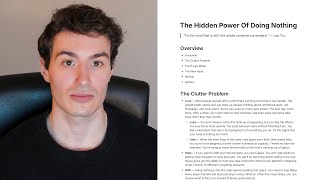
how to reset your entire life by doing nothing.
Daniel Barada
SRT - Most compatible format for video players (VLC, media players, video editors)
VTT - Web Video Text Tracks for HTML5 video and browsers
TXT - Plain text with timestamps for easy reading and editing
Scroll to view all subtitles
All right. Hello and welcome to this
training. As you can see from the title,
what we're going to be covering today is
the hidden power of doing nothing. And
as you can see from the overview, what
we're going to be talking about more
specifically is first the overview
itself, then the clutter problem, the
purge ritual, the new input, the review,
and your action items for the day or the
next few days. So without further ado,
let's get started and talk about the
clutter problem. So most people uh
operate with a mind that's basically
carrying more than it can handle and the
weight builds slowly and you wake up
already thinking about unfinished tasks,
old messages and some loose plans for
the week. And as the day goes on more
gets added and the next day some more.
And after a while your mind starts to
feel crowded and even basic decisions
take more effort than they actually
should. And you don't you don't really
always notice this buildup is actually
happening, but you feel the effects. You
lose focus more quickly. You jump
between tasks without finishing them.
You feel a mild strain that sits in the
background of everything you do. And is
the signal that your mind is holding too
much. When the mind stays in this state,
new goals don't stick. You don't have
the motivation to chase them. New habits
fade away pretty quickly and you
basically try to force progress, but the
system is already at capacity. There's
literally no room for direction and
you're trying to move forward with a
mind that's running out of space. It's
almost like your computer is full,
completely full in terms of its hard
drive, and you try to cram more in
there. It's just not going to happen.
Um, and at the very least, your computer
is just going to be running pretty
slowly. So if you want to shift your
internal state, you need space. You
don't get clarity by adding more
thoughts or more pressure. You get it by
removing what's sitting in the way.
Space gives you the ability to hold one
clear instruction without your attention
really collapsing under a bunch of
different competing demands. So doing
nothing is the really the first step
towards creating that space. You need to
stop filling every moment and stop
reacting to every stimulus. And when
that noise drops, you can choose what to
focus on instead of being pulled around.
So your mind can get crowded without you
even really realizing it. And before
long, your inner world will start to
feel overfilled. And you will keep
adding new thoughts on top of old ones.
And unfinished ideas will start piling
up. And you're basically holding on to
so much that you don't even notice how
tightly you're actually gripping
everything. And after a while, that
noise will become so constant that it
starts to feel like this is your life,
like it's normal. You're just thinking
all the time, but none of these thoughts
actually go anywhere. They just stack up
layer after layer, and they don't move
you forward in any direction at all. And
once those layers get thick enough, even
simple task will start to feel harder
than they actually should. There's no
breathing room between your thoughts.
Nothing fresh can actually land because
there's simply no space for it. There's
no space for any new ideas or any any
way to basically move forward in your
life. And when your mind fills up like
this, thinking becomes less like a
smooth process and more like trying to
move around in a room where furniture
has been pushed too close together.
You're just going to basically keep
bumping into things all the time and
you'll lose track of what you came in
for. And even a simple idea will start
to feel like it requires a ton of effort
because it has to push through
everything you've you're already
carrying. And since you're juggling so
much internally, the quality of your
attention will also drop and the quality
of your focus and the signal in general
will get weaker. And that's when people
start losing interest in things that
they used to really care about or find
themselves stuck uh basically staring at
a screen without knowing what they were
supposed to be doing in the first place.
It's just so many thoughts at the same
time that you just freeze. And this is
also when a lot of people start to call
themselves burnt out. When in reality,
it's just that they're holding so much
in their m in their mind and in their
thoughts that of course they're going to
feel burned out. Of course, they're
going to feel like they can't move in
any direction. Of course, they're going
to feel like everything is too much. So,
the more the clutter builds, the more
your focus breaks apart into very
scattered pieces, and you start shifting
your attention before you finished
anything. You open tabs that stay open
for days, and you write notes that you
don't return to. You set some goals that
you never look at again. And each shift
takes a little bit of strength. And
actually, science has proven this.
Anytime you shift your attention from
one thing to the other, you lose a
little bit of energy. And and this is
oversimplified, but that's a topic for a
different day. And the cumulative effect
is that by the time you want to do
something that's actually meaningful,
you're already tired. And it's like
you're running small errands in your
brain and in your mind all day long. And
then you wonder why you can't really
focus or why you can't move forward. And
that mental clutter will create a
heaviness essentially that settles into
your thoughts and makes even the simple
tasks you need to get done feel like
these humongous projects. And you'll
notice this on days when everything
feels slightly slower or when even
choosing a next step feels like work.
Your mind essentially has to sift
through too much noise before it finds a
direction. And when it takes that long
to locate uh a clear point of focus, you
begin avoiding tasks altogether. As I
said, you start freezing. You start or
flying,
not flying, but um basically escaping
it. So, it's either fight, flight, or
freeze. And it's less that you're
unwilling and more that you feel weighed
down before you even begin. And so, when
you're so stressed out, when there's so
much going on in your mind, basically
the same kind of hormone uh shows up as
as when you're actually afraid of
something, as as if a tiger has shown up
in front of you. You're either going to
fight, fight or freeze. And [snorts]
you're doing this to yourself
essentially in today's world because
most of us are not not surrounded by any
dangerous animals that can actually, you
know, u attack us. Uh I don't want to
say the other word, but you get the gist
here. So this this constant load will
just drain you steadily and every open
loop will take a tiny piece of your
energy to hold in place. And one by one
they they don't necessarily seem like
much but then they accumulate and that
drain will start become uh becoming
obvious. And you'll feel it when you
wake up already tired or when you can't
really fully concentrate or focus on
anything. No matter how hard you try,
the body responds to mental clutter the
same way it responds to physical
clutter. It tightens up. Your thinking
basically narrows and you use more
effort for less work. And by the end of
the day, you're spent without even
having created anything of substance,
anything of value, without actually
doing anything. And the mind tends to
collect residue from these unresolved
things. A decision you haven't made or a
message you avoided answering, an errand
you've been putting off for a while.
Each one of those stays active somewhere
in the background, like an open tab in a
different window. Uh, and you may not be
thinking about them consciously, but
they still remain there and they drain
basically your RAM. uh in in the RAM of
your brain essentially. Uh and when
there are enough of these open loops,
they glue themselves together and they
create this general sense of unease. So
you don't always know what you're
carrying. You just you just basically
feel that you're carrying something. And
when your mind is cluttered, your
perception starts bending as well. You
might interpret basically neutral
situations through a lens of of
agitation and of [clears throat] anger.
You you you might assume that pre you
might assume that there's pressure where
none of it actually exists and simple
requests will start to feel demanding
and just ordinary days in general will
start to feel strangely full and and
generally you would feel like you can't
actually take on life and a clutter mind
doesn't really perceive reality clearly.
It absorbs everything as additional
weight as additional load to everything
that you're already carrying. And after
a while this will shape the way you
experience the world. The external
begins to basically feel heavier and
more dangerous that because the internal
is and so the noise becomes a kind of a
invisible fog and this is also what
people uh mean when they say that they
have this mental fog. You you can think
but the thinking isn't necessarily
sharp. Ideas arrive but they don't stay
long enough to develop and your
intuition basically gets quiet. you you
sense that there's something underneath
the the agitation, but you don't really
quite reach it. And it's similar to
hearing someone talking through a wall
in the other room. There's sound, but
the message doesn't really land. You
can't really hear it. And you end up
living in reaction to whatever is
loudest in your head instead of
responding to what matters. And clutter,
that clutter flattens the depth of your
thinking. You lose the sense of that
inner spaciousness that allows for
insight or creativity or even just
direction. and you begin to operate on
the surface of things because that's all
there's actually room for. And when
everything inside you feels compressed,
nothing can really expand. So a
cluttered mind thickens in a way that
makes reflection difficult as well.
You're thinking all day, but you're
rarely reaching a a real conclusion to
anything. You're planning constantly,
but you're rarely starting or or you
start, but you ne rarely finish. And
you're dreaming occasionally, but never
grounding the the dream. And there's no
room for the idea to open and unfold
because the mind keeps circling around
the noise instead of the signal. And
this creates a kind of stagnation where
nothing really moves forward even though
you feel like you're mentally active all
the time and maybe even physically. And
the most concerning uh part is how
easily the state drowns out the quiet
voice inside you that usually guides
your direction. And as the load
increases, your system just shifts
gradually into a low-level crisis mode.
Essentially, you respond to small things
with quick emotional spikes. You get
irritated faster. You lose patience
sooner. Your energy feels thin and
stretched. And there's a steady hum of
basically internal fatigue like a fan in
the background. And because this becomes
familiar, you begin treating it as your
baseline when it's actually just a sign
of cognitive excess. So your sense of
preference, desire, and inner alignment
actually starts to get quieter and you
stop hearing what you actually want. you
start defaulting to basically whatever
is easiest or whatever is yelling for
your attention in the current moment and
you have no time to actually think about
the future or plan for it. And when when
the inner signal fades, it becomes
incredibly difficult to shift into a new
phase of life because you've lost the
clarity you need to choose it. And this
is the moment where doing nothing begins
making sense. Right? Emptiness doesn't
require any effort. It doesn't demand
any focus or productivity. It removes
instead of adding. And when you create
even a little bit of that emptiness and
quietness, the pressure inside your mind
will start to soften and your thoughts
will start to settle and you see more
clearly what was clutter and what was
real. And once that space clears and
once that space actually appears, you
finally have room for a new reality to
really take shape. And this is what
we're going to be covering in the next
section is basically clearing out the
excess so that the mind can breathe
again. So let's talk about the purge
ritual. So clearing your mind really
starts in a pretty simple way. You
basically just sit with yourself in
silence for long enough to notice all
the thoughts and unfinished tasks or
unfinished open loops start boiling up.
And believe me, if you really turn off
all stimuli and just sit there, things
will start coming to the surface and you
will start feeling this urgency and
pressure. And that's what you're looking
for. You want to you want that urgency
and pressure to come up and why? Because
we're going to use it in just a bit. So,
most people don't stop long enough to
actually see that and to actually allow
themselves to feel that urgency and
pressure, which is why it builds up so
easily and why it's constantly building
up in the background. Once you catch it
though, once you actually pay attention
to it and stop yourself for a moment to
actually notice it, you can finally do
something about it. It's a slow removal
of pressure. You're lowering the volume
in your head so that the important
things can actually stand out again. And
I mean that in a very literal sense.
When you're clear, when you clear some
space in your head, when you quiet down
for a bit, your thinking becomes
clearer. Your attention doesn't scatter
as much. And the weight you're carrying
internally becomes far easier to manage.
But you need to stop for a moment to
actually notice that and stop adding
things. So just take a day. It couldn't
be a Sunday if you a lot of people say
that some of the things I say are not
applicable to people working a 9 to5
which obviously that that's a discussion
for another day but you can take any day
off and just take a moment and sit down
and be quiet for a moment and notice all
the pressure and all the urgency and all
the unfinished open loops and tasks and
open doors that you've left basically
from running around mentally but also
physically.
let them come up. And once you've done
that, the way you start clearing that
space, the way you actually move into
move forward and move in a direction is
writing things down. It's pretty simple.
And yes, it it feels almost too simple,
but it works every time. And I think
everybody could do this. So, you're
taking whatever's been looping in your
head and giving it a physical place to
sit. no structure, no filtering or
sensoring, just a clean unload,
basically a mental dump essentially. So,
a brain dump. Uh, so you'll see that if
you start doing this, your thoughts will
stop bouncing around once they land on
paper and once you actually have to
write them down as you're thinking them.
And it's surprising how much tension
will start to disappear when you're not
holding everything in your working
memory. You can see what you're dealing
with rather than carrying it by instinct
and memory. And when you write down
everything without trying to fix
anything, you get a clearer picture of
what's actually running in the
background. And some of it will look
trivial once you see it uh written out.
Some of it will remind you that you've
been dragging certain tasks for way too
long. Either way, the pressure will drop
and there's a moment where where you
will feel your mind not pressing forward
so hard. And once you start doing it,
you'll almost physically feel the mental
unload or mental load finally easing up,
right? And I personally try I personally
try to have as little as possible in my
memory. I I I don't want to remember
things. I don't want to have to remember
things. So everything is written down
either in notion or in my reminders app
on my phone, which actually also reminds
me to put everything from there in
notion. So, anytime I actually put down
something in the reminders app, I also
set a reminder to put those things in my
notion, especially if they're not some
smaller smaller tasks that I can get
done in 5 minutes. So
once you have a centralized place for
all of these thoughts and and all of
these random tasks in your head and you
actually start actively putting and
organizing everything in there, you'll
be free from overthinking and you'll be
free from the the overthinking that you
have subjected yourself to for so long.
And I'm not saying you should use notion
or anything like that for that matter.
It has worked great for me. But you can
use whatever basically works for you.
the system you use is not that that
important or or how you organize the
things as long as you organize them and
put them in somewhere that works for you
essentially. And what I'm saying is that
you can't really figure out ways to move
your life forward. You can't actually
really think about the future and plan
for the future if if if your brain is
constantly busy with remembering trivial
tasks and errands that you haven't done
from 3 weeks ago. It's just you're just
constantly in in catching up mode
essentially. You'll never be able to
really look to the future, plan for the
future, and actually take action for
your future self now because you're
constantly catching up with with tasks
and things you're doing from the past
because you're constantly trying to
remember everything. Now, after the
writing itself, silence works as a
second clearing tool. So, even a few
minutes of it can reset your mind. you
step away from the noise, away from your
screens, away from uh things that
basically ask for your attention. And
honestly, it will feel very odd at
first. You're most likely used to
constant input. And I'm not blaming you
for it. Most people
are in are addicted to constant input.
It's it's a way to escape as well. U we
have to remember that. So once you sit
in silence for a bit, um you'll notice
the internal pace slowing down and
you're not being pulled in every
direction because you're you're sitting
in in that quiet and you've unloaded
everything in your head and now you're
just sitting there and you're what
you're doing is basically you're giving
your brain the first real break it's had
all day or maybe all month for that
matter. And in that silence your
thoughts will start spreading out
instead of clumping together. And you
don't have to make them really do
anything. They settle on their own once
the constant stimulus stops. Once you
stop constantly putting things in your
brain, it's it's a very simple effect,
but it matters. You can think
straighter. You can see what's useful.
You can see what's just noise. You can
see what's not useful, what you need to
just leave behind.
And even better, you can see what you
don't actually have to finish. And it
feels less less like wrestling with your
mind and more like working with a system
that finally has some room to breathe.
And the next step is actually reducing
how much stimulation you take in each
day by default. So once you've unloaded
everything, once you've sat in silence,
once you've basically prioritized things
and organized things and seen what
actually, you know, what actually
matters and what doesn't and what can be
left behind, then the next step is
really reducing how much stimulation you
take in each day by default so that it
doesn't repeat again. So most people
don't realize how much they're actually
consuming until they try cutting back.
Every random scroll or errand adds
mental load. And when there are dozens
of those moments that are stacked
together, your mind ends up stretched
thin, right? So reducing stimulation is
incredibly effective because you're
essentially lowering the baseline noise
level so that your mind can actually
function without straining all the time.
So there's a few ways you can do that.
The first one is taking a short digital
fast u or a digital detox is how some
people call it. Um and it does more than
most people expect. And I'm not saying
you need a long break of a week or
something like that. Just a few hours
every day without any social media or or
constant notifications is really already
enough to create a noticeable change and
you're no longer reacting every few
minutes because of that because you're
taking a break and your attention will
will learn to or you will learn to keep
your attention in one place. You will
learn to not be checking your phone
every 5 minutes. And better yet, never
turn these notifications back on. you're
not going to really miss out on anything
important. And if somebody really wants
to talk to you, they can always call
you. Remember that at the end of the
day, we have phones for a reason. People
can just call you if something is is
really urgent. So after a brief fast,
you might notice that your mind feels
less crowded and your thoughts don't
push against each other the way they did
before. And there's enough space for
them to actually form without pressure,
without that urgency and that pressure
of of needing to do stuff. And another
way to do this is through a content
diet. Now I do this by default at this
point and it [clears throat] works by
basically limiting your input to a small
set of intentional sources. So you're
intentionally choosing specific people
uh and specific topics and specific
formats and everything else gets cut. So
this will create a controlled
information environment basically where
your mind only absorbs what supports
your current direction. And you can
start by listing three to five creators
or sources whose work consistently
aligns with where you're headed. Right?
And these should be people who help you
think more clearly, not people who
simply entertain or distract you. So of
course there is a moment and time um for
entertainment.
However, that should not be bumped
together with with with the content that
you're consuming to help you in moving
forward in your direction. So once you
have your list, commit to consuming only
from those sources for the next few
weeks or a week. And you can also try
setting clear boundaries around the type
of content itself. So if you're focusing
on building a skill, try to consume only
instructional or applied content. And if
you're working on on mindset, stick to
philosophy or reflective writing or
philosophy books. If you've spent the
last few years consuming random content,
your mind will really benefit from some
concentrated input that points in one
direction. And you'll also master
subjects way faster that way. If you for
example set this month as a philosophy
month and all you do is literally read
philosophy books and watch philosophy
related content whether that's videos or
or documentaries or whatever um you're
going to master the well you're not
necessarily going to master the subject
of philosophy itself but you're going to
be way further than most people are on
the subject and I'm not going to lie the
the restraint will most likely feel very
uncomfortable at first uh because you've
you're you're used to watching basically
anything that grabs your attention and
now you're not doing it anymore. Uh one
thing you could also try is just
literally watching just lectures uh for
a month straight and this will re
lectures and books only and this will
rewire your mindset. Now it's going to
feel uncomfortable because it's it's
basically like a nutritional diet but
for the content you actually consume not
for the food you consume. Uh so you'll
feel the pull to check other channels or
explore unrelated topics and that pull
is really part of the clutter you're
trying to remove. Each time you resist
it, you're training your attention to
stay narrow and strong and the
discomfort will fade quickly once your
mind actually adjusts to the reduced
input. Over a few weeks, you will not
want to necessarily
check these videos as much. So the next
step here is also a physical clearing
clear clearing or clearing your
environment around you or where you
spend the most time. Um now if if you're
going to an office I mean clear your
office clear your desk at least you can
always clear clean that up. If you uh
work from home then clean up the room
you're working from uh clean up
everything in fact in your home. Just
try to clear everything around you so
that everything is clean and tidy
because at the end of the day, a clean
desk, a cleaned out corner, uh a cleaned
out room, or even just an organized bag,
like literally organizing your gym bag,
for example, changes how your mind
operates. You're really reducing the
number of things that are asking for
your attention. And it doesn't fix
everything, but it definitely removes a
layer of friction that you didn't
realize was there, right? That you
didn't necessarily realize is crowding
your crowding your mind and crowding
your thoughts. And you get a cleaner
visual field and in a way a cleaner
internal one as well because the
lightness that follows feels very
steady. Once you clean out a room, once
you clear out your your your space in
general, your desk, whatever it is,
you'll feel this you'll feel this
lightness and it's it's a it's a steady
feeling essentially. Your attention
feels less pulled. You can look at one
thing without your mind drifting towards
everything else in the room. And this
kind of environmental clearing will help
you far more than most people assume.
Now, next up are your emotions. And
this is one one subject that I don't
think a lot of people talk about, but
emotional residue also needs clearing.
Now, a lot of people live with with in a
they have a life where they haven't
closed open loops with with people
around them, with the relationships they
have. They have these open loops uh
always in the background, things that
they didn't discuss, things that
conversations that they started and
never finished. It's the leftover
tension from things you haven't dealt
with. And it might be irritation from a
conversation or some kind of a worry you
didn't want to examine. All these small
emotional weights sit in the mind and
take up real space. This is why actually
a lot of people want closure after a
relationship ends. if if they didn't get
the closure is because that weight stays
in their in their mind and it obviously
prevents them from moving forward. Now
I'm not saying you have to analyze every
emotion deeply. In fact quite the
opposite I would say but you should give
them a brief moment of acknowledgement
uh so that they stop circling back right
this doesn't mean indulging the emotion
as I said you're simply noticing it
without really pushing it away without
suppressing it. It's just a short moment
of honesty and it looks pretty simple.
For example if you feel angry literally
mentally in your thoughts admit to
yourself that you feel angry. If you
feel sad, literally just admit to
yourself in your thoughts. You don't
have to share it with anyone, but just
admit to yourself that you feel sad. And
once you see it, or in other words, once
you notice the emotion, the emotion
usually loses its intensity because
you've given it some space, right? It it
you can imagine it almost as as
something that wants to be heard. The
moment you hear it, the moment you
acknowledge that it's trying to say
something to you, it feels heard and
that's it. it quiets down, right? It no
longer holds the same grip because
you're not resisting it anymore. You're
not trying to suppress it. You're not
trying to push it away. And the internal
resistance will start to drop. And
you'll get back a bit of clarity that
you did you you didn't even realize you
had lost because of it. And after that
purge, the change can be pretty
noticeable. Your thinking will get
clearer. Your attention is more stable.
the noise in your mind will drop far
enough for you to actually be able to be
aware and hear your thoughts again. And
this is the environment this is the
environment where new ideas can actually
take root and new patterns can actually
form and that emptiness is useful only
if you fill it with something
deliberate. So the next section will
focus on how to choose that single input
because it will become the anchor for
the reality you build next. Right? So
let's talk about the new input. Now once
you've cleared enough space, your mind
becomes much easier to work with and
there's less noise. There's fewer stray
thoughts pulling at you and a stronger
sense of internal quiet. And this is
where a single clear instruction makes a
real difference. So the mind likes
direction and when you give it one
simple command, it tends to shape
everything around that command without
much resistance. And the key here is
really choosing something specific
enough to guide you, but simple enough
that it doesn't create new clutter.
Right? A clean mind can hold one idea
with surprising strength, but if you
give it a complex kind of goal, then it
will most likely go back to
trying to escape and trying to basically
suppress it or or not focus on that
because it's just it's just more more
than it can actually handle in the
moment. So, you start by actually
choosing one thing or one thought that
actually matters and it doesn't need to
have layers of meaning. It doesn't need
to be complex. Just a simple directive
will keep your attention steady through
the day. And it can be a phrase, it can
be a goal for the day. It could be a
mantra, it could be just a maxim or a
principle you want to operate from. This
single idea becomes your anchor. Right?
And because you've reduced the internal
noise, the anchor sits in your awareness
without you having to force it there.
And to do this, you just ask yourself
what direction you want to lean towards
right now or today. And when the idea
feels clean and uncomplicated, that's a
good sign. If you feel some kind of
tension or confusion around it, it's
probably too complex. So, a simple
directive tends to hold best. Now, one
example is a domino goal. And a domino
goal is the one outcome that if you
achieve it right now or today, knocks
down several other goals at once or at
least makes the others a bit irrelevant.
Um, and so it's the priority that
essentially carries the most weight. It
gives your mind one clear target instead
of spreading your attention across many
small ones. So once you've chosen your
idea, you basically reinforce it by
bringing it back into focus at steady
intervals. And you return to the idea
whenever you get distracted. And you can
do this either casually by every time
you notice it by being slightly more
aware of the moment
because the the mind at the end of the
day learns through simple consistent
reminders. And because all that mental
clutter is is gone, those reminders will
now work a lot better. Or a
straightforward way to just take control
of this process and not leave it up to
your awareness is to just write down
your current domino goal three times a
day, morning, noon, and evening. Now, it
doesn't take long, but you're basically
training your mind to hold one
direction, and the writing will act as a
reset each time. So, in in the morning,
you write down your dominant goal. It
sets the tone for the day. At noon, you
write down your dominant goal. It
basically brings you back on track when
the day starts to starts to pull you in
different directions. And in the
evening, you close the loop.
Essentially, you just remind yourself of
the dominant goal you're working towards
right now. Um, now after a short period
of of repetition, the idea will begin
holding its own place. You won't have to
know necessarily hold it in your
thoughts all the time or write it down
all the time. It's still beneficial if
you do so, but you'll notice it showing
up in your thoughts without any effort
on your side, and you'll start making
choices that essentially line up with it
without having to think too hard. And
the idea will become a filter your mind
uses automatically. It's a pretty quiet
shift, yet it changes the way you move
through your day and through your weeks
or months. You're no longer reminding
yourself of the direction. It's just
constantly there. The mind has accepted
it as the baseline. This is what it's
working towards. And you can do this
with any goal. Once you achieve the
domino goal, obviously you can set
another one and and do the same thing.
And with enough repetition, the idea
will start to settle deeper. It stops
feeling like something external you're
trying to remember. It becomes part of
your internal language. And the mind
starts shaping your habits and attention
around it. Right? And this integration
happens when the idea is simple enough
and repeated enough. So you'll notice
you don't hesitate or procrastinate as
much and you'll get distracted less
often. And you'll act in ways that match
the idea or the goal before you even
think about it. And the mind prefers
consistency and frequency. It's it
doesn't always prefer intensity, right?
Because you could intensely repeat the
same thing for a week. But whenever and
and this is the same when we're talking
about the gym, you can't be super
consistent. you can't work out every day
uh or frequent and at the same time have
the highest intensity possible. So you
can't necessarily make uh do PRs every
day on the same muscle group, right? The
same the same way with your brain or
with your mind.
The mind prefers consistency and
frequency rather than repeating
something for a week as much as possible
and then forgetting about it. So when
you give it one direction and you remind
of it basically here and there over a
longer period of time, it will hold that
direction without much effort. And as
the idea stabilizes, you'll feel less
internal noise around it. You you check
it less. You you don't need to write it
down as much. You correct yourself less.
It becomes a fixed point in your
awareness and it becomes almost like
what breath is during meditation.
[clears throat] So a f it it becomes
basically a focus point to bring you
back to the here and now. Right? Just
like you focus on your breath when you
meditate.
Every time your thoughts start
scattering, you just refocus on your
breath.
And once the idea is embedded, you will
start to act on it consistently without
without necessarily putting in more
effort than usual. One action in line
with the idea is just enough to start
really creating a visible change. And a
clear mind is really a multiplier. It
amplifies the force of a simple action.
And each aligned step reinforces the
internal signal and makes the next one
easier. And each time you act in line
with the idea, you anchor it deeper. And
the mind connects the internal
instruction with the real action with
the external action. And it treats the
idea as a working part of your identity
rather than some kind of a loose
intention. And this will create a loop
where your thoughts and when and and
actions start to feed each other and
your intentions too. And that's also
when confidence increases because what
you think, what you intend to do, and
what you do are all in line. And with
that comes progress. The idea starts
shaping what you notice, what you
choose, and what you ignore. And you
catch opportunities that match it. And
you skip distractions that pull away
from it. And this is what focus is. Is
keeping an idea or a goal in your head
and reminding yourself of it and acting
on it for long enough. And that way,
your mind isn't overloaded. It's
focusing on the one thing and it has the
space and the clarity to follow one
direction and follow it well and
actually achieve
and you'll achieve way more this way. A
lot of people think that if they just
set 20 goals, they're going to achieve
them all and all of that and and they
can work on 20 goals at the same. It
doesn't work guys. Just focus on one
thing, complete it, go to the next
thing. Essentially, just monotasking.
Now once the idea holds, the vacuum you
created becomes a tool instead of a
temporary state. And you're working with
a mind that's now clear, it's steady,
and it's responsive. And you've given it
one clean signal, and you've reinforced
it through repetition. And now you've
grounded it through action afterwards.
So with that being said, let's go over
the review. We talked about the
overview. We went over the clutter
problem, the purge ritual, the new
input, the review, and finally your
action items for the day or the next few
days. First, set a 5minut timer today
and unload every loose thought and every
loose task onto paper, every open loop.
And don't organize it. Don't fix
anything at first. You're just reducing
that internal load so that your mind has
room to work again. And then identify a
domino goal. Pick the one outcome that
would make the rest of your
responsibilities lighter. and then write
it down three times today, morning,
noon, and evening. Or if it's too late,
if you're watching this in the evening,
then just start from tomorrow. Or start
now. Basically, just write the evening
one. And let the domino goal guide one
small action before the day ends.
Nothing large, just one step that aligns
with the direction you chose. And this
will anchor the new input, and it will
also begin to shift the environment
around you. With that being said, I hope
you found this video valuable. If you
did, let me know in the comments. Give
this video a like. Subscribe to the
channel for more. If you want to work
with me personally, especially if you're
an entrepreneur, creator, or
professional, then make sure to book a
call from the second link in the
description. And if you want this
training and the document of this
training, then make sure to join the
free community from the first link in
the description. Once again, thank you
for being here and I'm going to see you
in the next
Full transcript without timestamps
All right. Hello and welcome to this training. As you can see from the title, what we're going to be covering today is the hidden power of doing nothing. And as you can see from the overview, what we're going to be talking about more specifically is first the overview itself, then the clutter problem, the purge ritual, the new input, the review, and your action items for the day or the next few days. So without further ado, let's get started and talk about the clutter problem. So most people uh operate with a mind that's basically carrying more than it can handle and the weight builds slowly and you wake up already thinking about unfinished tasks, old messages and some loose plans for the week. And as the day goes on more gets added and the next day some more. And after a while your mind starts to feel crowded and even basic decisions take more effort than they actually should. And you don't you don't really always notice this buildup is actually happening, but you feel the effects. You lose focus more quickly. You jump between tasks without finishing them. You feel a mild strain that sits in the background of everything you do. And is the signal that your mind is holding too much. When the mind stays in this state, new goals don't stick. You don't have the motivation to chase them. New habits fade away pretty quickly and you basically try to force progress, but the system is already at capacity. There's literally no room for direction and you're trying to move forward with a mind that's running out of space. It's almost like your computer is full, completely full in terms of its hard drive, and you try to cram more in there. It's just not going to happen. Um, and at the very least, your computer is just going to be running pretty slowly. So if you want to shift your internal state, you need space. You don't get clarity by adding more thoughts or more pressure. You get it by removing what's sitting in the way. Space gives you the ability to hold one clear instruction without your attention really collapsing under a bunch of different competing demands. So doing nothing is the really the first step towards creating that space. You need to stop filling every moment and stop reacting to every stimulus. And when that noise drops, you can choose what to focus on instead of being pulled around. So your mind can get crowded without you even really realizing it. And before long, your inner world will start to feel overfilled. And you will keep adding new thoughts on top of old ones. And unfinished ideas will start piling up. And you're basically holding on to so much that you don't even notice how tightly you're actually gripping everything. And after a while, that noise will become so constant that it starts to feel like this is your life, like it's normal. You're just thinking all the time, but none of these thoughts actually go anywhere. They just stack up layer after layer, and they don't move you forward in any direction at all. And once those layers get thick enough, even simple task will start to feel harder than they actually should. There's no breathing room between your thoughts. Nothing fresh can actually land because there's simply no space for it. There's no space for any new ideas or any any way to basically move forward in your life. And when your mind fills up like this, thinking becomes less like a smooth process and more like trying to move around in a room where furniture has been pushed too close together. You're just going to basically keep bumping into things all the time and you'll lose track of what you came in for. And even a simple idea will start to feel like it requires a ton of effort because it has to push through everything you've you're already carrying. And since you're juggling so much internally, the quality of your attention will also drop and the quality of your focus and the signal in general will get weaker. And that's when people start losing interest in things that they used to really care about or find themselves stuck uh basically staring at a screen without knowing what they were supposed to be doing in the first place. It's just so many thoughts at the same time that you just freeze. And this is also when a lot of people start to call themselves burnt out. When in reality, it's just that they're holding so much in their m in their mind and in their thoughts that of course they're going to feel burned out. Of course, they're going to feel like they can't move in any direction. Of course, they're going to feel like everything is too much. So, the more the clutter builds, the more your focus breaks apart into very scattered pieces, and you start shifting your attention before you finished anything. You open tabs that stay open for days, and you write notes that you don't return to. You set some goals that you never look at again. And each shift takes a little bit of strength. And actually, science has proven this. Anytime you shift your attention from one thing to the other, you lose a little bit of energy. And and this is oversimplified, but that's a topic for a different day. And the cumulative effect is that by the time you want to do something that's actually meaningful, you're already tired. And it's like you're running small errands in your brain and in your mind all day long. And then you wonder why you can't really focus or why you can't move forward. And that mental clutter will create a heaviness essentially that settles into your thoughts and makes even the simple tasks you need to get done feel like these humongous projects. And you'll notice this on days when everything feels slightly slower or when even choosing a next step feels like work. Your mind essentially has to sift through too much noise before it finds a direction. And when it takes that long to locate uh a clear point of focus, you begin avoiding tasks altogether. As I said, you start freezing. You start or flying, not flying, but um basically escaping it. So, it's either fight, flight, or freeze. And it's less that you're unwilling and more that you feel weighed down before you even begin. And so, when you're so stressed out, when there's so much going on in your mind, basically the same kind of hormone uh shows up as as when you're actually afraid of something, as as if a tiger has shown up in front of you. You're either going to fight, fight or freeze. And [snorts] you're doing this to yourself essentially in today's world because most of us are not not surrounded by any dangerous animals that can actually, you know, u attack us. Uh I don't want to say the other word, but you get the gist here. So this this constant load will just drain you steadily and every open loop will take a tiny piece of your energy to hold in place. And one by one they they don't necessarily seem like much but then they accumulate and that drain will start become uh becoming obvious. And you'll feel it when you wake up already tired or when you can't really fully concentrate or focus on anything. No matter how hard you try, the body responds to mental clutter the same way it responds to physical clutter. It tightens up. Your thinking basically narrows and you use more effort for less work. And by the end of the day, you're spent without even having created anything of substance, anything of value, without actually doing anything. And the mind tends to collect residue from these unresolved things. A decision you haven't made or a message you avoided answering, an errand you've been putting off for a while. Each one of those stays active somewhere in the background, like an open tab in a different window. Uh, and you may not be thinking about them consciously, but they still remain there and they drain basically your RAM. uh in in the RAM of your brain essentially. Uh and when there are enough of these open loops, they glue themselves together and they create this general sense of unease. So you don't always know what you're carrying. You just you just basically feel that you're carrying something. And when your mind is cluttered, your perception starts bending as well. You might interpret basically neutral situations through a lens of of agitation and of [clears throat] anger. You you you might assume that pre you might assume that there's pressure where none of it actually exists and simple requests will start to feel demanding and just ordinary days in general will start to feel strangely full and and generally you would feel like you can't actually take on life and a clutter mind doesn't really perceive reality clearly. It absorbs everything as additional weight as additional load to everything that you're already carrying. And after a while this will shape the way you experience the world. The external begins to basically feel heavier and more dangerous that because the internal is and so the noise becomes a kind of a invisible fog and this is also what people uh mean when they say that they have this mental fog. You you can think but the thinking isn't necessarily sharp. Ideas arrive but they don't stay long enough to develop and your intuition basically gets quiet. you you sense that there's something underneath the the agitation, but you don't really quite reach it. And it's similar to hearing someone talking through a wall in the other room. There's sound, but the message doesn't really land. You can't really hear it. And you end up living in reaction to whatever is loudest in your head instead of responding to what matters. And clutter, that clutter flattens the depth of your thinking. You lose the sense of that inner spaciousness that allows for insight or creativity or even just direction. and you begin to operate on the surface of things because that's all there's actually room for. And when everything inside you feels compressed, nothing can really expand. So a cluttered mind thickens in a way that makes reflection difficult as well. You're thinking all day, but you're rarely reaching a a real conclusion to anything. You're planning constantly, but you're rarely starting or or you start, but you ne rarely finish. And you're dreaming occasionally, but never grounding the the dream. And there's no room for the idea to open and unfold because the mind keeps circling around the noise instead of the signal. And this creates a kind of stagnation where nothing really moves forward even though you feel like you're mentally active all the time and maybe even physically. And the most concerning uh part is how easily the state drowns out the quiet voice inside you that usually guides your direction. And as the load increases, your system just shifts gradually into a low-level crisis mode. Essentially, you respond to small things with quick emotional spikes. You get irritated faster. You lose patience sooner. Your energy feels thin and stretched. And there's a steady hum of basically internal fatigue like a fan in the background. And because this becomes familiar, you begin treating it as your baseline when it's actually just a sign of cognitive excess. So your sense of preference, desire, and inner alignment actually starts to get quieter and you stop hearing what you actually want. you start defaulting to basically whatever is easiest or whatever is yelling for your attention in the current moment and you have no time to actually think about the future or plan for it. And when when the inner signal fades, it becomes incredibly difficult to shift into a new phase of life because you've lost the clarity you need to choose it. And this is the moment where doing nothing begins making sense. Right? Emptiness doesn't require any effort. It doesn't demand any focus or productivity. It removes instead of adding. And when you create even a little bit of that emptiness and quietness, the pressure inside your mind will start to soften and your thoughts will start to settle and you see more clearly what was clutter and what was real. And once that space clears and once that space actually appears, you finally have room for a new reality to really take shape. And this is what we're going to be covering in the next section is basically clearing out the excess so that the mind can breathe again. So let's talk about the purge ritual. So clearing your mind really starts in a pretty simple way. You basically just sit with yourself in silence for long enough to notice all the thoughts and unfinished tasks or unfinished open loops start boiling up. And believe me, if you really turn off all stimuli and just sit there, things will start coming to the surface and you will start feeling this urgency and pressure. And that's what you're looking for. You want to you want that urgency and pressure to come up and why? Because we're going to use it in just a bit. So, most people don't stop long enough to actually see that and to actually allow themselves to feel that urgency and pressure, which is why it builds up so easily and why it's constantly building up in the background. Once you catch it though, once you actually pay attention to it and stop yourself for a moment to actually notice it, you can finally do something about it. It's a slow removal of pressure. You're lowering the volume in your head so that the important things can actually stand out again. And I mean that in a very literal sense. When you're clear, when you clear some space in your head, when you quiet down for a bit, your thinking becomes clearer. Your attention doesn't scatter as much. And the weight you're carrying internally becomes far easier to manage. But you need to stop for a moment to actually notice that and stop adding things. So just take a day. It couldn't be a Sunday if you a lot of people say that some of the things I say are not applicable to people working a 9 to5 which obviously that that's a discussion for another day but you can take any day off and just take a moment and sit down and be quiet for a moment and notice all the pressure and all the urgency and all the unfinished open loops and tasks and open doors that you've left basically from running around mentally but also physically. let them come up. And once you've done that, the way you start clearing that space, the way you actually move into move forward and move in a direction is writing things down. It's pretty simple. And yes, it it feels almost too simple, but it works every time. And I think everybody could do this. So, you're taking whatever's been looping in your head and giving it a physical place to sit. no structure, no filtering or sensoring, just a clean unload, basically a mental dump essentially. So, a brain dump. Uh, so you'll see that if you start doing this, your thoughts will stop bouncing around once they land on paper and once you actually have to write them down as you're thinking them. And it's surprising how much tension will start to disappear when you're not holding everything in your working memory. You can see what you're dealing with rather than carrying it by instinct and memory. And when you write down everything without trying to fix anything, you get a clearer picture of what's actually running in the background. And some of it will look trivial once you see it uh written out. Some of it will remind you that you've been dragging certain tasks for way too long. Either way, the pressure will drop and there's a moment where where you will feel your mind not pressing forward so hard. And once you start doing it, you'll almost physically feel the mental unload or mental load finally easing up, right? And I personally try I personally try to have as little as possible in my memory. I I I don't want to remember things. I don't want to have to remember things. So everything is written down either in notion or in my reminders app on my phone, which actually also reminds me to put everything from there in notion. So, anytime I actually put down something in the reminders app, I also set a reminder to put those things in my notion, especially if they're not some smaller smaller tasks that I can get done in 5 minutes. So once you have a centralized place for all of these thoughts and and all of these random tasks in your head and you actually start actively putting and organizing everything in there, you'll be free from overthinking and you'll be free from the the overthinking that you have subjected yourself to for so long. And I'm not saying you should use notion or anything like that for that matter. It has worked great for me. But you can use whatever basically works for you. the system you use is not that that important or or how you organize the things as long as you organize them and put them in somewhere that works for you essentially. And what I'm saying is that you can't really figure out ways to move your life forward. You can't actually really think about the future and plan for the future if if if your brain is constantly busy with remembering trivial tasks and errands that you haven't done from 3 weeks ago. It's just you're just constantly in in catching up mode essentially. You'll never be able to really look to the future, plan for the future, and actually take action for your future self now because you're constantly catching up with with tasks and things you're doing from the past because you're constantly trying to remember everything. Now, after the writing itself, silence works as a second clearing tool. So, even a few minutes of it can reset your mind. you step away from the noise, away from your screens, away from uh things that basically ask for your attention. And honestly, it will feel very odd at first. You're most likely used to constant input. And I'm not blaming you for it. Most people are in are addicted to constant input. It's it's a way to escape as well. U we have to remember that. So once you sit in silence for a bit, um you'll notice the internal pace slowing down and you're not being pulled in every direction because you're you're sitting in in that quiet and you've unloaded everything in your head and now you're just sitting there and you're what you're doing is basically you're giving your brain the first real break it's had all day or maybe all month for that matter. And in that silence your thoughts will start spreading out instead of clumping together. And you don't have to make them really do anything. They settle on their own once the constant stimulus stops. Once you stop constantly putting things in your brain, it's it's a very simple effect, but it matters. You can think straighter. You can see what's useful. You can see what's just noise. You can see what's not useful, what you need to just leave behind. And even better, you can see what you don't actually have to finish. And it feels less less like wrestling with your mind and more like working with a system that finally has some room to breathe. And the next step is actually reducing how much stimulation you take in each day by default. So once you've unloaded everything, once you've sat in silence, once you've basically prioritized things and organized things and seen what actually, you know, what actually matters and what doesn't and what can be left behind, then the next step is really reducing how much stimulation you take in each day by default so that it doesn't repeat again. So most people don't realize how much they're actually consuming until they try cutting back. Every random scroll or errand adds mental load. And when there are dozens of those moments that are stacked together, your mind ends up stretched thin, right? So reducing stimulation is incredibly effective because you're essentially lowering the baseline noise level so that your mind can actually function without straining all the time. So there's a few ways you can do that. The first one is taking a short digital fast u or a digital detox is how some people call it. Um and it does more than most people expect. And I'm not saying you need a long break of a week or something like that. Just a few hours every day without any social media or or constant notifications is really already enough to create a noticeable change and you're no longer reacting every few minutes because of that because you're taking a break and your attention will will learn to or you will learn to keep your attention in one place. You will learn to not be checking your phone every 5 minutes. And better yet, never turn these notifications back on. you're not going to really miss out on anything important. And if somebody really wants to talk to you, they can always call you. Remember that at the end of the day, we have phones for a reason. People can just call you if something is is really urgent. So after a brief fast, you might notice that your mind feels less crowded and your thoughts don't push against each other the way they did before. And there's enough space for them to actually form without pressure, without that urgency and that pressure of of needing to do stuff. And another way to do this is through a content diet. Now I do this by default at this point and it [clears throat] works by basically limiting your input to a small set of intentional sources. So you're intentionally choosing specific people uh and specific topics and specific formats and everything else gets cut. So this will create a controlled information environment basically where your mind only absorbs what supports your current direction. And you can start by listing three to five creators or sources whose work consistently aligns with where you're headed. Right? And these should be people who help you think more clearly, not people who simply entertain or distract you. So of course there is a moment and time um for entertainment. However, that should not be bumped together with with with the content that you're consuming to help you in moving forward in your direction. So once you have your list, commit to consuming only from those sources for the next few weeks or a week. And you can also try setting clear boundaries around the type of content itself. So if you're focusing on building a skill, try to consume only instructional or applied content. And if you're working on on mindset, stick to philosophy or reflective writing or philosophy books. If you've spent the last few years consuming random content, your mind will really benefit from some concentrated input that points in one direction. And you'll also master subjects way faster that way. If you for example set this month as a philosophy month and all you do is literally read philosophy books and watch philosophy related content whether that's videos or or documentaries or whatever um you're going to master the well you're not necessarily going to master the subject of philosophy itself but you're going to be way further than most people are on the subject and I'm not going to lie the the restraint will most likely feel very uncomfortable at first uh because you've you're you're used to watching basically anything that grabs your attention and now you're not doing it anymore. Uh one thing you could also try is just literally watching just lectures uh for a month straight and this will re lectures and books only and this will rewire your mindset. Now it's going to feel uncomfortable because it's it's basically like a nutritional diet but for the content you actually consume not for the food you consume. Uh so you'll feel the pull to check other channels or explore unrelated topics and that pull is really part of the clutter you're trying to remove. Each time you resist it, you're training your attention to stay narrow and strong and the discomfort will fade quickly once your mind actually adjusts to the reduced input. Over a few weeks, you will not want to necessarily check these videos as much. So the next step here is also a physical clearing clear clearing or clearing your environment around you or where you spend the most time. Um now if if you're going to an office I mean clear your office clear your desk at least you can always clear clean that up. If you uh work from home then clean up the room you're working from uh clean up everything in fact in your home. Just try to clear everything around you so that everything is clean and tidy because at the end of the day, a clean desk, a cleaned out corner, uh a cleaned out room, or even just an organized bag, like literally organizing your gym bag, for example, changes how your mind operates. You're really reducing the number of things that are asking for your attention. And it doesn't fix everything, but it definitely removes a layer of friction that you didn't realize was there, right? That you didn't necessarily realize is crowding your crowding your mind and crowding your thoughts. And you get a cleaner visual field and in a way a cleaner internal one as well because the lightness that follows feels very steady. Once you clean out a room, once you clear out your your your space in general, your desk, whatever it is, you'll feel this you'll feel this lightness and it's it's a it's a steady feeling essentially. Your attention feels less pulled. You can look at one thing without your mind drifting towards everything else in the room. And this kind of environmental clearing will help you far more than most people assume. Now, next up are your emotions. And this is one one subject that I don't think a lot of people talk about, but emotional residue also needs clearing. Now, a lot of people live with with in a they have a life where they haven't closed open loops with with people around them, with the relationships they have. They have these open loops uh always in the background, things that they didn't discuss, things that conversations that they started and never finished. It's the leftover tension from things you haven't dealt with. And it might be irritation from a conversation or some kind of a worry you didn't want to examine. All these small emotional weights sit in the mind and take up real space. This is why actually a lot of people want closure after a relationship ends. if if they didn't get the closure is because that weight stays in their in their mind and it obviously prevents them from moving forward. Now I'm not saying you have to analyze every emotion deeply. In fact quite the opposite I would say but you should give them a brief moment of acknowledgement uh so that they stop circling back right this doesn't mean indulging the emotion as I said you're simply noticing it without really pushing it away without suppressing it. It's just a short moment of honesty and it looks pretty simple. For example if you feel angry literally mentally in your thoughts admit to yourself that you feel angry. If you feel sad, literally just admit to yourself in your thoughts. You don't have to share it with anyone, but just admit to yourself that you feel sad. And once you see it, or in other words, once you notice the emotion, the emotion usually loses its intensity because you've given it some space, right? It it you can imagine it almost as as something that wants to be heard. The moment you hear it, the moment you acknowledge that it's trying to say something to you, it feels heard and that's it. it quiets down, right? It no longer holds the same grip because you're not resisting it anymore. You're not trying to suppress it. You're not trying to push it away. And the internal resistance will start to drop. And you'll get back a bit of clarity that you did you you didn't even realize you had lost because of it. And after that purge, the change can be pretty noticeable. Your thinking will get clearer. Your attention is more stable. the noise in your mind will drop far enough for you to actually be able to be aware and hear your thoughts again. And this is the environment this is the environment where new ideas can actually take root and new patterns can actually form and that emptiness is useful only if you fill it with something deliberate. So the next section will focus on how to choose that single input because it will become the anchor for the reality you build next. Right? So let's talk about the new input. Now once you've cleared enough space, your mind becomes much easier to work with and there's less noise. There's fewer stray thoughts pulling at you and a stronger sense of internal quiet. And this is where a single clear instruction makes a real difference. So the mind likes direction and when you give it one simple command, it tends to shape everything around that command without much resistance. And the key here is really choosing something specific enough to guide you, but simple enough that it doesn't create new clutter. Right? A clean mind can hold one idea with surprising strength, but if you give it a complex kind of goal, then it will most likely go back to trying to escape and trying to basically suppress it or or not focus on that because it's just it's just more more than it can actually handle in the moment. So, you start by actually choosing one thing or one thought that actually matters and it doesn't need to have layers of meaning. It doesn't need to be complex. Just a simple directive will keep your attention steady through the day. And it can be a phrase, it can be a goal for the day. It could be a mantra, it could be just a maxim or a principle you want to operate from. This single idea becomes your anchor. Right? And because you've reduced the internal noise, the anchor sits in your awareness without you having to force it there. And to do this, you just ask yourself what direction you want to lean towards right now or today. And when the idea feels clean and uncomplicated, that's a good sign. If you feel some kind of tension or confusion around it, it's probably too complex. So, a simple directive tends to hold best. Now, one example is a domino goal. And a domino goal is the one outcome that if you achieve it right now or today, knocks down several other goals at once or at least makes the others a bit irrelevant. Um, and so it's the priority that essentially carries the most weight. It gives your mind one clear target instead of spreading your attention across many small ones. So once you've chosen your idea, you basically reinforce it by bringing it back into focus at steady intervals. And you return to the idea whenever you get distracted. And you can do this either casually by every time you notice it by being slightly more aware of the moment because the the mind at the end of the day learns through simple consistent reminders. And because all that mental clutter is is gone, those reminders will now work a lot better. Or a straightforward way to just take control of this process and not leave it up to your awareness is to just write down your current domino goal three times a day, morning, noon, and evening. Now, it doesn't take long, but you're basically training your mind to hold one direction, and the writing will act as a reset each time. So, in in the morning, you write down your dominant goal. It sets the tone for the day. At noon, you write down your dominant goal. It basically brings you back on track when the day starts to starts to pull you in different directions. And in the evening, you close the loop. Essentially, you just remind yourself of the dominant goal you're working towards right now. Um, now after a short period of of repetition, the idea will begin holding its own place. You won't have to know necessarily hold it in your thoughts all the time or write it down all the time. It's still beneficial if you do so, but you'll notice it showing up in your thoughts without any effort on your side, and you'll start making choices that essentially line up with it without having to think too hard. And the idea will become a filter your mind uses automatically. It's a pretty quiet shift, yet it changes the way you move through your day and through your weeks or months. You're no longer reminding yourself of the direction. It's just constantly there. The mind has accepted it as the baseline. This is what it's working towards. And you can do this with any goal. Once you achieve the domino goal, obviously you can set another one and and do the same thing. And with enough repetition, the idea will start to settle deeper. It stops feeling like something external you're trying to remember. It becomes part of your internal language. And the mind starts shaping your habits and attention around it. Right? And this integration happens when the idea is simple enough and repeated enough. So you'll notice you don't hesitate or procrastinate as much and you'll get distracted less often. And you'll act in ways that match the idea or the goal before you even think about it. And the mind prefers consistency and frequency. It's it doesn't always prefer intensity, right? Because you could intensely repeat the same thing for a week. But whenever and and this is the same when we're talking about the gym, you can't be super consistent. you can't work out every day uh or frequent and at the same time have the highest intensity possible. So you can't necessarily make uh do PRs every day on the same muscle group, right? The same the same way with your brain or with your mind. The mind prefers consistency and frequency rather than repeating something for a week as much as possible and then forgetting about it. So when you give it one direction and you remind of it basically here and there over a longer period of time, it will hold that direction without much effort. And as the idea stabilizes, you'll feel less internal noise around it. You you check it less. You you don't need to write it down as much. You correct yourself less. It becomes a fixed point in your awareness and it becomes almost like what breath is during meditation. [clears throat] So a f it it becomes basically a focus point to bring you back to the here and now. Right? Just like you focus on your breath when you meditate. Every time your thoughts start scattering, you just refocus on your breath. And once the idea is embedded, you will start to act on it consistently without without necessarily putting in more effort than usual. One action in line with the idea is just enough to start really creating a visible change. And a clear mind is really a multiplier. It amplifies the force of a simple action. And each aligned step reinforces the internal signal and makes the next one easier. And each time you act in line with the idea, you anchor it deeper. And the mind connects the internal instruction with the real action with the external action. And it treats the idea as a working part of your identity rather than some kind of a loose intention. And this will create a loop where your thoughts and when and and actions start to feed each other and your intentions too. And that's also when confidence increases because what you think, what you intend to do, and what you do are all in line. And with that comes progress. The idea starts shaping what you notice, what you choose, and what you ignore. And you catch opportunities that match it. And you skip distractions that pull away from it. And this is what focus is. Is keeping an idea or a goal in your head and reminding yourself of it and acting on it for long enough. And that way, your mind isn't overloaded. It's focusing on the one thing and it has the space and the clarity to follow one direction and follow it well and actually achieve and you'll achieve way more this way. A lot of people think that if they just set 20 goals, they're going to achieve them all and all of that and and they can work on 20 goals at the same. It doesn't work guys. Just focus on one thing, complete it, go to the next thing. Essentially, just monotasking. Now once the idea holds, the vacuum you created becomes a tool instead of a temporary state. And you're working with a mind that's now clear, it's steady, and it's responsive. And you've given it one clean signal, and you've reinforced it through repetition. And now you've grounded it through action afterwards. So with that being said, let's go over the review. We talked about the overview. We went over the clutter problem, the purge ritual, the new input, the review, and finally your action items for the day or the next few days. First, set a 5minut timer today and unload every loose thought and every loose task onto paper, every open loop. And don't organize it. Don't fix anything at first. You're just reducing that internal load so that your mind has room to work again. And then identify a domino goal. Pick the one outcome that would make the rest of your responsibilities lighter. and then write it down three times today, morning, noon, and evening. Or if it's too late, if you're watching this in the evening, then just start from tomorrow. Or start now. Basically, just write the evening one. And let the domino goal guide one small action before the day ends. Nothing large, just one step that aligns with the direction you chose. And this will anchor the new input, and it will also begin to shift the environment around you. With that being said, I hope you found this video valuable. If you did, let me know in the comments. Give this video a like. Subscribe to the channel for more. If you want to work with me personally, especially if you're an entrepreneur, creator, or professional, then make sure to book a call from the second link in the description. And if you want this training and the document of this training, then make sure to join the free community from the first link in the description. Once again, thank you for being here and I'm going to see you in the next
Keep this transcript
Save it to LunaNotes and it becomes a real note in your library — editable, searchable, and ready to turn into flashcards or a diagram. Free to start.
Save to LunaNotesOr download subtitles for another video.
These subtitles were extracted using the Free YouTube subtitle downloader by LunaNotes.
Related videos

Download Subtitles: How to Reinvent Yourself in 30 Days 2026
Enhance your learning experience by downloading accurate subtitles for the full guide on reinventing yourself in 30 days. Subtitles help you follow along easily, improve comprehension, and revisit key concepts anytime you want.

Download Subtitles for Like Nothing I've Ever Seen Video
Enhance your viewing experience by downloading accurate subtitles for the video 'Like Nothing I've Ever Seen.' Access captions that help with understanding every detail and improve accessibility for all viewers.

Download Subtitles for 'Your Choice Will Reveal the Truth About You' Video
Enhance your understanding of 'Your Choice Will Reveal the Truth About You' by downloading accurate subtitles. Captions help you follow along easily, improve comprehension, and enjoy the content at your own pace.

Download Subtitles for How I Started My Small Business Video
Enhance your learning experience by downloading accurate subtitles for the 'How I Started My Small Business' video. Captions help you follow along easily, catch every tip for shipping and selling online, and ensure you don't miss any important insights. Perfect for visual learners and non-native speakers alike.

Download Subtitles for Your Favorite Videos Easily
Enhance your video watching experience by downloading accurate subtitles and captions. Enjoy better understanding, accessibility, and language support for all your favorite videos.
Most viewed

Untertitel für 'Nicos Weg' Deutsch lernen A1 Film herunterladen
Laden Sie die Untertitel für den gesamten Film 'Nicos Weg' herunter, um Ihr Deutschlernen auf A1 Niveau zu unterstützen. Untertitel helfen Ihnen, Wortschatz und Aussprache besser zu verstehen und verbessern das Hörverständnis effektiv.

ดาวน์โหลดซับไตเติ้ล DMD LAND 3 The Final Land Day 1
ดาวน์โหลดซับไตเติ้ลสำหรับวิดีโอ DMD LAND 3 The Final Land Day 1 เพื่อช่วยให้เข้าใจเนื้อหาได้ง่ายขึ้น และเพิ่มความสะดวกในการติดตามทุกช่วงเวลา เหมาะสำหรับผู้ชมที่ต้องการความชัดเจนและเข้าถึงข้อมูลอย่างครบถ้วน

Subtítulos para TIPOS DE APEGO | 6 DE COPAS Episodio 56
Descarga los subtítulos para el episodio 56 de la tercera temporada de 6 DE COPAS, centrado en los tipos de apego. Mejora tu comprensión y disfruta del contenido en detalle con nuestros subtítulos precisos y accesibles.

Download Subtitles for Harvard CS50 2026 Computer Science Course
Enhance your learning experience with downloadable subtitles for the Harvard CS50 2026 full computer science course. Easily follow along with lectures, improve comprehension, and access the content offline anytime. Perfect for students and enthusiasts aiming to master computer science concepts.

Descarga Subtítulos para NARCISISMO | 6 DE COPAS - Episodio 63
Accede fácilmente a los subtítulos del episodio 63 de '6 DE COPAS', centrado en el narcisismo. Descargar estos subtítulos te ayudará a entender mejor el contenido y mejorar la experiencia de visualización.
Found this transcript useful?
Take it with you. One click puts it in your own LunaNotes library.
Save to LunaNotes