Download Subtitles for Daily Routine Conversation Video
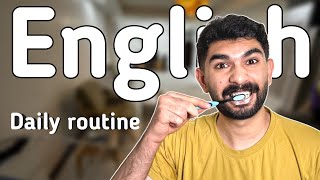
DAILY ROUTINE CONVERSATION | Learn speaking English the easy way (comprehensible input & immersion)
English with Farzin
SRT - Most compatible format for video players (VLC, media players, video editors)
VTT - Web Video Text Tracks for HTML5 video and browsers
TXT - Plain text with timestamps for easy reading and editing
Scroll to view all subtitles
In this video, as you all told me in
comments, I'm gonna do everything I do
in my normal life and I'm going to teach
you talking about routine activities and
routin life. In this video, you will
learn these common words and phrases in
English and I will teach you a grammar
which is very useful in conversation.
And in the end of the video, we have a
challenge that I think you will love it.
Let's go.
So, right now, I just woke up and I
usually wake up at 700 a.m. When you
want to talk about the things you do in
your routine life, you use the grammar
of present simple. I know that most of
you know this grammar, but we use it
when we want to talk about our routine
life. And in the end of my sentence, I
said, "I usually wake up at 700 a.m." So
when you want to talk about the time,
you use at and you say the time. And we
use it in the end of the sentence. So
right now, I just woke up. Sometimes on
the weekends, I sleep more. So we we we
call this sleep in. Sometimes in the
weekend, I sleep more. I sleep more than
usual. We call this sleep in. So
sometimes on the weekend I sleep in.
Right now I'm sleeping in, for example.
Yeah. Now, for example, it's Sunday and
I just woke up and it's 900 a.m. for
example. So when you sleep more than
usual, you can say I sleep in. And now
I got up. Now I just got up. I'm getting
up.
And
I'm stretching. I'm stretching. And now
I'm
I'm yawning. I just yawned. Now, like
everyone, I'm getting out of my bed.
I'm getting out of my bed. And don't
forget to tidy your bed. Make your bed.
So now I will make my bed.
I'm making my bed.
So now, as you can see, my bed is clean.
My bed is made. I was making my bed. The
first thing I do after I wake up, after
I get out of my bed, is that I wash my
face and I brush my teeth. So, now we're
going to go into the uh bathroom. Now, I
wear my slippers. These are called
slippers. I wear them. I put on my
slippers. And then I put my toothbrush
here.
I put it here. And then I wash my face
like this.
I also clean my eyes. If there is
anything inside my eyes, I also clean my
eyes and pick I pick my eyes after I
wash my face. I didn't wash my face.
Actually, just for the video, I did it.
After I wash my face, I grab my
toothbrush
and I brush my teeth. I brush my teeth.
For example, now I'm brushing my teeth.
I'm brushing my teeth. So, after that, I
wash my toothbrush.
I wash my toothbrush and
I wash my mouth. I wash my mouth so that
all the toothpaste,
this is a toothpaste. All the toothpaste
is coming out of my mouth. By the way, I
forgot to tell you something. When you
want to put toothpaste on your
toothbrush, you twist the top off. We
don't say open. I twist it off.
I press press.
I press it out. I press it out. And then
I brush my teeth. Usually after I wash
my face and I brush my teeth, I come in
front of the mirror, the console mirror,
and then I look at myself, I brush my
hair.
By the way, this is a hairbrush. Okay,
this is a hairbrush. and I brush my
hair. You know, let me let me be honest
with you. Onethird of my day is spent in
front of the mirror. I don't know why,
but I always come in front of the
mirror. I look at myself. I brush my
hair. I love it. I don't know why. After
I'm done with my hair, um, I usually
take a Q-tip. I take a Q-tip. This is a
Q-tip. I take one
and I clean my ears. I pick my ears.
Now, it's not morning. Actually, I think
it's 700 p.m. So, I'm not going to pick
my ears because I did it in the morning.
The next thing I do is that I check my
WhatsApp because, you know, I have a lot
of students. I have to check their
homework and a lot of you send me
messages for taking lessons. So I have
to reply and respond to your messages.
So that's why after I do everything I
have to do in the morning, I come on my
mobile phone and I check my WhatsApp,
Telegram, and my emails. The next thing
I do after I brush my hair and I look at
myself in the mirror is that I take a
couple of eggs. A couple of eggs means
two eggs. I take two eggs and I fry one
and I boil the other. I don't do this
every day. I'm just doing this for you
in the video to learn these words, but
usually I fry them. I don't boil them.
So, in order to boil an egg, we need a
sauté pan. This is a sauté pan. I take
the top
and I fill it with water. I fill it with
water.
After I do this, I put it in the pan and
then I put it on the stove.
This is a stove. By the way, this might
also be a question for you. We call this
a kettle. We use it for making tea and
brewing tea and so on. So, after I put
it on the stove, I turn on the stove.
When we want to cook something in water,
we call it boil. Right now, I'm boiling
this egg. Now, as I said, I'm going to
fry this one. What is fry? When we cook
something using oil, we call this action
frying. So, I'm going to put some oil in
the pan. So, this is a normal pan.
First, we put the pan on the stove. By
the way, the stove is on. After it's a
little bit hot, it gets a little bit
hot. I'm going to put the oil inside of
the pan. I'm not going to use a lot of
oil because, you know, it's not really
healthy. It's written it has vitamin D,
but still, it's not really healthy. And
then
I'm going to take this egg.
I'm going to try to separate the oil in
every part of the pan.
So I'm right now circulating the oil.
After the oil is hot, I myself I usually
put some salt
because, you know, I don't want the oil
to splash everywhere. You know, if you
don't put it, the oil will splash
everywhere and it will get dirty and I
don't like cleaning everything. So, I'm
doing this to prevent the oil from
splashing everywhere. So, after I do
this, I'm going to crack I'm going to
crack the egg and put it in the oil. So,
I crack the egg.
I cracked the egg. Crack. And I put it
in the oil. After I crack the egg and I
put it in the pan, I stir. This is
called stir. I stir the egg in order for
the egg to be cooked completely. Now I'm
frying the egg as I told you. And right
now I'm stirring the egg. Some people
might call it mix. Mix is also correct.
So now it's completely cooked. So I'm
going to turn it down
and I'm going to serve it. I'm going to
eat it.
By the way, I say I'm going to a lot.
I'm going to is the short form of I'm
going to. We use going to when we want
to talk about the things we're going to
do in the future and we are certain that
we will do them. After an egg is fried
and it's completed, I usually come to
the refrigerator. This is a refrigerator
or we can also call it a fridge, but
usually we call it a refrigerator. And I
take some olives.
We call these olives. I really like
eating olives with eggs. So, I take
olives and I get it prepared here. And I
wait for the other egg to boil. Right
now, as you can see, the water is
boiling. We call this action boiling.
And the egg is cooking. It's getting
boiled. Here we have the laundry machine
or we can also call it the washing
machine. I have some dirty clothes
inside the laundry machine and I have
one here. So I'm going to put it. This
action is called doing the laundry. I'm
doing the laundry. I do the laundry
twice a week. Two times a week. Twice a
week. I use detergent. Laundry
detergent. This liquid is called laundry
detergent. It's like a soap, but it's
used for cleaning clothes. After I
prepare everything, before I eat my
breakfast, before I have my breakfast, I
grab a big glass of water. It is the
most important thing in my life. I drink
water. No tea, no coffee. I grab a glass
of water and I also go on YouTube and I
watch some paddle matches. I love
paddle. And yeah, I wash them until my
food gets ready. Don't forget drinking
water. After it's boiled completely, I
mean the egg, I
empty the pan and then I refill it with
cold water
because, you know, I want to peel off
the skin. It helps me peel it off.
I do this for several times
and then I crack it.
I crack it and I start peeling it off.
See, I'm peeling the skin off.
This is the skin. And I peel it off.
Peel off.
I put the peeled egg inside a plate.
This is a plate. I put it inside a
plate. And I also put the other egg
inside this plate and I then eat it.
Here's my breakfast. Um, I usually add
cheese to my breakfast, too. But today,
I'm not having cheese. It's only egg, a
little bit honey, and Nutella, and uh,
peanut butter. Here is a Nutella. By the
way, I'm not eating them. I just wanted
to tell you in English. This is
chocolate. Breakfast chocolate. Um, this
is honey. You may all know. This is
honey. This is peanut butter. Peanut
butter. I told you it's olive. Um, you
know, right now, to be honest, it's
evening. It's not morning. So, I'm going
to have some ketchup with my eggs. I
take a slice of bread. We cannot say I
take a bread. A bread we never say in
English. I take a slice of bread.
Actually, that was two slices. Now I
have a slice of bread and I put some egg
on it.
I put some egg on the bread.
And then I put some
ketchup. I put some ketchup on it. Two
hours later and then I eat it. I had my
breakfast and now I'm going to put
everything where they were and I'm going
to wash this plate. So, let's go. Before
I wash the plate, I put these stuff I
put the trash in the trash bin and the
trash basket
like this.
And then I close it.
Then
I put it in the sink.
I get
a sponge. Oh, this is a sponge.
I put some soap on it and then I wash
the dishes. This is a spoon. I wash the
spoon first and then I wash the other
things. One hour later. After I wash
them, I put them in the dish rack. This
is called dish rack or we also call it a
drying rack. Dish rack or drying rack.
Finally, after I'm done with everything,
I had my breakfast. I washed the dishes.
Um I did the laundry. Uh I usually chill
on the love seat and I usually play
games. Like for example, right now I'm
playing this game Rebel Cops. Um it's a
strategy game. I really like it. So, I
play games and I chill out.
Now, let's talk about the challenge and
the grammar that I taught. We're going
to talk about first. Let's talk about
the grammar and let me teach you the
grammar. In order to do the challenge
that I will tell you, knowing this
grammar is crucial and essential. When
do we use this grammar and structure? We
use it when we want to talk about our
routine life, our daily habits and the
things that we do usually. Also, when we
want to talk about the things that are
normally true, we can use this
structure. How can we make sentences
with this structure? We make sentences
as easy as possible. For example, I go
to school. This grammar is present
simple. I know a lot of you may know
this, but let's have a quick revision on
this grammar. When you want to make
sentences, you have to use the base form
of the verb, the normal form of the verb
that I know a lot of you know. For
example, go, come, play, speak, walk,
and so on. The important thing is if
you're talking about I, you, we, and
they, you use the base form of the verb.
It's easy. No problem. But if you want
to talk about another person or another
thing like he, she, it, Alex, that dog
or anything like this, if it is only
one, you have to add an s to the verb.
For example, I play tennis. He plays
tennis. I wake up. She wakes up. I get
out of my bed. my mother, she my mother
gets out of her bed. And if you want to
say that you don't do something again,
we say I don't play, you don't run, we
don't speak English. And if you want to
talk about another person or another
thing like he, she, it, or my mother,
that dog, we say doesn't. For example,
that dog doesn't eat food. My mother
doesn't sleep early. She doesn't play
tennis on the weekend. So, this is how
you should make sentences using the
grammar of present simple. It's super
easy. Now, what's the challenge? For the
challenge, I want you to record your
voice and talk about the things that you
do every day. Talk about your morning
routine from the time you wake up until
12:00 p.m. or maybe 300 p.m. until the
time you have lunch. What do you do
between the time you wake up until you
have lunch? Record your voice and send
it to one of these contact informations
below. I will check them myself and I
will give you feedback. So, I hope you
enjoyed this video and it was useful for
you. Don't forget to do the challenge
and tell me in the comments, do you like
this kind of lessons that I also include
grammar or not? Also, tell me about the
challenge. Do you like it? You don't
like it? What do you think about it? If
you want more of this videos and you
want to learn English more and more
every day, don't forget to watch my
other videos and subscribe to my
channel. See you in the next video.
Bye-bye.
Full transcript without timestamps
In this video, as you all told me in comments, I'm gonna do everything I do in my normal life and I'm going to teach you talking about routine activities and routin life. In this video, you will learn these common words and phrases in English and I will teach you a grammar which is very useful in conversation. And in the end of the video, we have a challenge that I think you will love it. Let's go. So, right now, I just woke up and I usually wake up at 700 a.m. When you want to talk about the things you do in your routine life, you use the grammar of present simple. I know that most of you know this grammar, but we use it when we want to talk about our routine life. And in the end of my sentence, I said, "I usually wake up at 700 a.m." So when you want to talk about the time, you use at and you say the time. And we use it in the end of the sentence. So right now, I just woke up. Sometimes on the weekends, I sleep more. So we we we call this sleep in. Sometimes in the weekend, I sleep more. I sleep more than usual. We call this sleep in. So sometimes on the weekend I sleep in. Right now I'm sleeping in, for example. Yeah. Now, for example, it's Sunday and I just woke up and it's 900 a.m. for example. So when you sleep more than usual, you can say I sleep in. And now I got up. Now I just got up. I'm getting up. And I'm stretching. I'm stretching. And now I'm I'm yawning. I just yawned. Now, like everyone, I'm getting out of my bed. I'm getting out of my bed. And don't forget to tidy your bed. Make your bed. So now I will make my bed. I'm making my bed. So now, as you can see, my bed is clean. My bed is made. I was making my bed. The first thing I do after I wake up, after I get out of my bed, is that I wash my face and I brush my teeth. So, now we're going to go into the uh bathroom. Now, I wear my slippers. These are called slippers. I wear them. I put on my slippers. And then I put my toothbrush here. I put it here. And then I wash my face like this. I also clean my eyes. If there is anything inside my eyes, I also clean my eyes and pick I pick my eyes after I wash my face. I didn't wash my face. Actually, just for the video, I did it. After I wash my face, I grab my toothbrush and I brush my teeth. I brush my teeth. For example, now I'm brushing my teeth. I'm brushing my teeth. So, after that, I wash my toothbrush. I wash my toothbrush and I wash my mouth. I wash my mouth so that all the toothpaste, this is a toothpaste. All the toothpaste is coming out of my mouth. By the way, I forgot to tell you something. When you want to put toothpaste on your toothbrush, you twist the top off. We don't say open. I twist it off. I press press. I press it out. I press it out. And then I brush my teeth. Usually after I wash my face and I brush my teeth, I come in front of the mirror, the console mirror, and then I look at myself, I brush my hair. By the way, this is a hairbrush. Okay, this is a hairbrush. and I brush my hair. You know, let me let me be honest with you. Onethird of my day is spent in front of the mirror. I don't know why, but I always come in front of the mirror. I look at myself. I brush my hair. I love it. I don't know why. After I'm done with my hair, um, I usually take a Q-tip. I take a Q-tip. This is a Q-tip. I take one and I clean my ears. I pick my ears. Now, it's not morning. Actually, I think it's 700 p.m. So, I'm not going to pick my ears because I did it in the morning. The next thing I do is that I check my WhatsApp because, you know, I have a lot of students. I have to check their homework and a lot of you send me messages for taking lessons. So I have to reply and respond to your messages. So that's why after I do everything I have to do in the morning, I come on my mobile phone and I check my WhatsApp, Telegram, and my emails. The next thing I do after I brush my hair and I look at myself in the mirror is that I take a couple of eggs. A couple of eggs means two eggs. I take two eggs and I fry one and I boil the other. I don't do this every day. I'm just doing this for you in the video to learn these words, but usually I fry them. I don't boil them. So, in order to boil an egg, we need a sauté pan. This is a sauté pan. I take the top and I fill it with water. I fill it with water. After I do this, I put it in the pan and then I put it on the stove. This is a stove. By the way, this might also be a question for you. We call this a kettle. We use it for making tea and brewing tea and so on. So, after I put it on the stove, I turn on the stove. When we want to cook something in water, we call it boil. Right now, I'm boiling this egg. Now, as I said, I'm going to fry this one. What is fry? When we cook something using oil, we call this action frying. So, I'm going to put some oil in the pan. So, this is a normal pan. First, we put the pan on the stove. By the way, the stove is on. After it's a little bit hot, it gets a little bit hot. I'm going to put the oil inside of the pan. I'm not going to use a lot of oil because, you know, it's not really healthy. It's written it has vitamin D, but still, it's not really healthy. And then I'm going to take this egg. I'm going to try to separate the oil in every part of the pan. So I'm right now circulating the oil. After the oil is hot, I myself I usually put some salt because, you know, I don't want the oil to splash everywhere. You know, if you don't put it, the oil will splash everywhere and it will get dirty and I don't like cleaning everything. So, I'm doing this to prevent the oil from splashing everywhere. So, after I do this, I'm going to crack I'm going to crack the egg and put it in the oil. So, I crack the egg. I cracked the egg. Crack. And I put it in the oil. After I crack the egg and I put it in the pan, I stir. This is called stir. I stir the egg in order for the egg to be cooked completely. Now I'm frying the egg as I told you. And right now I'm stirring the egg. Some people might call it mix. Mix is also correct. So now it's completely cooked. So I'm going to turn it down and I'm going to serve it. I'm going to eat it. By the way, I say I'm going to a lot. I'm going to is the short form of I'm going to. We use going to when we want to talk about the things we're going to do in the future and we are certain that we will do them. After an egg is fried and it's completed, I usually come to the refrigerator. This is a refrigerator or we can also call it a fridge, but usually we call it a refrigerator. And I take some olives. We call these olives. I really like eating olives with eggs. So, I take olives and I get it prepared here. And I wait for the other egg to boil. Right now, as you can see, the water is boiling. We call this action boiling. And the egg is cooking. It's getting boiled. Here we have the laundry machine or we can also call it the washing machine. I have some dirty clothes inside the laundry machine and I have one here. So I'm going to put it. This action is called doing the laundry. I'm doing the laundry. I do the laundry twice a week. Two times a week. Twice a week. I use detergent. Laundry detergent. This liquid is called laundry detergent. It's like a soap, but it's used for cleaning clothes. After I prepare everything, before I eat my breakfast, before I have my breakfast, I grab a big glass of water. It is the most important thing in my life. I drink water. No tea, no coffee. I grab a glass of water and I also go on YouTube and I watch some paddle matches. I love paddle. And yeah, I wash them until my food gets ready. Don't forget drinking water. After it's boiled completely, I mean the egg, I empty the pan and then I refill it with cold water because, you know, I want to peel off the skin. It helps me peel it off. I do this for several times and then I crack it. I crack it and I start peeling it off. See, I'm peeling the skin off. This is the skin. And I peel it off. Peel off. I put the peeled egg inside a plate. This is a plate. I put it inside a plate. And I also put the other egg inside this plate and I then eat it. Here's my breakfast. Um, I usually add cheese to my breakfast, too. But today, I'm not having cheese. It's only egg, a little bit honey, and Nutella, and uh, peanut butter. Here is a Nutella. By the way, I'm not eating them. I just wanted to tell you in English. This is chocolate. Breakfast chocolate. Um, this is honey. You may all know. This is honey. This is peanut butter. Peanut butter. I told you it's olive. Um, you know, right now, to be honest, it's evening. It's not morning. So, I'm going to have some ketchup with my eggs. I take a slice of bread. We cannot say I take a bread. A bread we never say in English. I take a slice of bread. Actually, that was two slices. Now I have a slice of bread and I put some egg on it. I put some egg on the bread. And then I put some ketchup. I put some ketchup on it. Two hours later and then I eat it. I had my breakfast and now I'm going to put everything where they were and I'm going to wash this plate. So, let's go. Before I wash the plate, I put these stuff I put the trash in the trash bin and the trash basket like this. And then I close it. Then I put it in the sink. I get a sponge. Oh, this is a sponge. I put some soap on it and then I wash the dishes. This is a spoon. I wash the spoon first and then I wash the other things. One hour later. After I wash them, I put them in the dish rack. This is called dish rack or we also call it a drying rack. Dish rack or drying rack. Finally, after I'm done with everything, I had my breakfast. I washed the dishes. Um I did the laundry. Uh I usually chill on the love seat and I usually play games. Like for example, right now I'm playing this game Rebel Cops. Um it's a strategy game. I really like it. So, I play games and I chill out. Now, let's talk about the challenge and the grammar that I taught. We're going to talk about first. Let's talk about the grammar and let me teach you the grammar. In order to do the challenge that I will tell you, knowing this grammar is crucial and essential. When do we use this grammar and structure? We use it when we want to talk about our routine life, our daily habits and the things that we do usually. Also, when we want to talk about the things that are normally true, we can use this structure. How can we make sentences with this structure? We make sentences as easy as possible. For example, I go to school. This grammar is present simple. I know a lot of you may know this, but let's have a quick revision on this grammar. When you want to make sentences, you have to use the base form of the verb, the normal form of the verb that I know a lot of you know. For example, go, come, play, speak, walk, and so on. The important thing is if you're talking about I, you, we, and they, you use the base form of the verb. It's easy. No problem. But if you want to talk about another person or another thing like he, she, it, Alex, that dog or anything like this, if it is only one, you have to add an s to the verb. For example, I play tennis. He plays tennis. I wake up. She wakes up. I get out of my bed. my mother, she my mother gets out of her bed. And if you want to say that you don't do something again, we say I don't play, you don't run, we don't speak English. And if you want to talk about another person or another thing like he, she, it, or my mother, that dog, we say doesn't. For example, that dog doesn't eat food. My mother doesn't sleep early. She doesn't play tennis on the weekend. So, this is how you should make sentences using the grammar of present simple. It's super easy. Now, what's the challenge? For the challenge, I want you to record your voice and talk about the things that you do every day. Talk about your morning routine from the time you wake up until 12:00 p.m. or maybe 300 p.m. until the time you have lunch. What do you do between the time you wake up until you have lunch? Record your voice and send it to one of these contact informations below. I will check them myself and I will give you feedback. So, I hope you enjoyed this video and it was useful for you. Don't forget to do the challenge and tell me in the comments, do you like this kind of lessons that I also include grammar or not? Also, tell me about the challenge. Do you like it? You don't like it? What do you think about it? If you want more of this videos and you want to learn English more and more every day, don't forget to watch my other videos and subscribe to my channel. See you in the next video. Bye-bye.
Keep this transcript
Save it to LunaNotes and it becomes a real note in your library — editable, searchable, and ready to turn into flashcards or a diagram. Free to start.
Save to LunaNotesOr download subtitles for another video.
These subtitles were extracted using the Free YouTube subtitle downloader by LunaNotes.
Related videos
Download Subtitles for Easy English Daily Conversations Practice
Enhance your English speaking skills with subtitles for daily conversations designed for A1–A2 learners. Download these slow English captions to follow along, improve comprehension, and practice confidently.
Download Subtitles for Easy English Conversation Practice Video
Enhance your English speaking and listening skills by downloading accurate subtitles for this 30-minute beginner-friendly video. Subtitles help you follow along, improve comprehension, and reinforce language learning effectively.

Download Subtitles for English Conversation 24 | Everyday English
Enhance your English learning experience by downloading subtitles for English Conversation 24. Captions provide clarity, improve comprehension, and help you master everyday English conversations effortlessly.

Download Subtitles for English Speaking Practice Videos
Enhance your language learning by downloading subtitles for the 'English Speaking Practice: From Awkward to Confident in Real Conversations' video. Subtitles help improve comprehension, pronunciation, and boost your confidence in everyday conversations.

Download Subtitles for Learn Speaking English the Easy Way
Enhance your English learning experience by downloading accurate subtitles for the video 'Learn Speaking English the Easy Way.' Subtitles help improve comprehension through clear, accessible text to follow along and practice effectively using comprehensible input and immersion techniques.
Most viewed

Untertitel für 'Nicos Weg' Deutsch lernen A1 Film herunterladen
Laden Sie die Untertitel für den gesamten Film 'Nicos Weg' herunter, um Ihr Deutschlernen auf A1 Niveau zu unterstützen. Untertitel helfen Ihnen, Wortschatz und Aussprache besser zu verstehen und verbessern das Hörverständnis effektiv.

ดาวน์โหลดซับไตเติ้ล DMD LAND 3 The Final Land Day 1
ดาวน์โหลดซับไตเติ้ลสำหรับวิดีโอ DMD LAND 3 The Final Land Day 1 เพื่อช่วยให้เข้าใจเนื้อหาได้ง่ายขึ้น และเพิ่มความสะดวกในการติดตามทุกช่วงเวลา เหมาะสำหรับผู้ชมที่ต้องการความชัดเจนและเข้าถึงข้อมูลอย่างครบถ้วน

Subtítulos para TIPOS DE APEGO | 6 DE COPAS Episodio 56
Descarga los subtítulos para el episodio 56 de la tercera temporada de 6 DE COPAS, centrado en los tipos de apego. Mejora tu comprensión y disfruta del contenido en detalle con nuestros subtítulos precisos y accesibles.

Download Subtitles for Harvard CS50 2026 Computer Science Course
Enhance your learning experience with downloadable subtitles for the Harvard CS50 2026 full computer science course. Easily follow along with lectures, improve comprehension, and access the content offline anytime. Perfect for students and enthusiasts aiming to master computer science concepts.
Descarga Subtítulos para NARCISISMO | 6 DE COPAS - Episodio 63
Accede fácilmente a los subtítulos del episodio 63 de '6 DE COPAS', centrado en el narcisismo. Descargar estos subtítulos te ayudará a entender mejor el contenido y mejorar la experiencia de visualización.
Found this transcript useful?
Take it with you. One click puts it in your own LunaNotes library.
Save to LunaNotes