Introduction to Solving Right Triangles
Solving a right triangle involves determining all unknown sides and angles using given information. This process is crucial in geometry, trigonometry, and various applications.
Using the Pythagorean Theorem to Find Missing Sides
- When two sides of a right triangle are known, use the formula: [ a^2 + b^2 = c^2 ] where c is the hypotenuse.
- Example: Given sides 5 and 12, calculate:
- ( 5^2 + 12^2 = c^2 )
- ( 25 + 144 = 169 )
- ( c = \sqrt{169} = 13 )
For more detailed examples on side calculations, see How to Find Triangle Side Lengths Using Trigonometry.
Calculating Angles Using Inverse Trigonometric Functions
- To find an unknown angle (e.g., angle X), identify which sides correspond to opposite and adjacent relative to that angle.
- Use the inverse tangent function when you know opposite and adjacent sides: [ X = \tan^{-1}\left( \frac{\text{opposite}}{\text{adjacent}} \right) ]
- Example:
- ( X = \tan^{-1}(5/12) \approx 22.6^\circ )
- Use complementary angles property since acute angles in a right triangle add to 90°: [ 90^\circ - 22.6^\circ = 67.4^\circ ]
Learn more about inverse trig functions in How to Use SOHCAHTOA to Find Missing Angles in Triangles.
Solving Triangles When Given an Angle and a Side
- Use the triangle angle sum theorem: all angles add to 180°, so the acute angles add to 90°.
- Apply tangent ratio to find missing sides:
- ( \tan(\text{angle}) = \frac{\text{opposite}}{\text{adjacent}} )
- Rearrange to solve for the unknown side.
- Example: Given angle 25° and adjacent side 4:
- ( x = \frac{4}{\tan(25^\circ)} \approx 8.6 )
For various angle problem-solving techniques, refer to Solving Varying Angle Problems Using Sine and Cosine Laws.
Finding the Hypotenuse Using Sine
- Instead of Pythagorean theorem, use the sine ratio for more accuracy when an angle and opposite side are known:
- ( \sin(\text{angle}) = \frac{\text{opposite}}{\text{hypotenuse}} )
- Solve for the hypotenuse: [ y = \frac{\text{opposite}}{\sin(\text{angle})} ]
- Example:
- ( y = \frac{4}{\sin(25^\circ)} \approx 9.5 )
Combining these techniques with knowledge of trigonometric identities can improve accuracy; see Mastering Trigonometric Identities, Equations, and the CAST Diagram for further study.
Key Takeaways
- Use inverse trig functions to find angles when sides are known.
- Use direct trig functions (sine, cosine, tangent) to find sides when angles are known.
- Complementary angle relationship helps find missing acute angles.
- Prefer trig ratios over Pythagorean theorem for final steps to reduce rounding errors.
By following these methods, you can accurately solve any right triangle by systematically finding unknown sides and angles using proven mathematical relationships.
For a comprehensive approach including areas and arc lengths, check out Calculating Arc Length, Triangle, and Sector Areas with Theta.
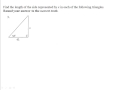
So say for example in this triangle we know these two sides we have to solve for that third side. So you can see in a
right triangle you can use the pagorean theorem a^2 + b ^2= c^2. So what we have here to solve for this missing side is
5^2 + 12^2 = c^2. This is c and this comes out to 25 + 144 = c ^2 c^2 = 169. We take the square root of both sides
and you can see that C is going to come out to 13. Okay. Now, we want to solve for one of
these angles. Let's just say we want to solve for this angle here first. I'll call it angle X. So, what trig ratio
ties together this angle, this side, and say this side. Well, this one here is the opposite, and this one is the
adjacent. So, we're going to use the tangent inverse. Whenever you want to solve for the missing angle, you use the
inverse trig function. and we're going to use tangent since we have opposite and adjacent because we
have all three sides. We could actually use any three of the trig ratios. But let's just go ahead and use the original
values that they gave us. So let's do uh tangent inverse of 52. So opposite over adjacent equals
x. Okay. So I'm going to go to the calculator now and let's calculate what that is. So we've got tangent inverse
5 / 12 22.6. So this is uh 22.6° this whole angle here. And then what you
can do now is these two angles the two acute angles in a right triangle they add up to 90°. So by taking 90 minus
22.6 we can find the missing angle. So how much is that? Uh 67.4
right? Okay, good. All right, so now let's try this next example. So here they give us the angle in one of the
sides. So let's start maybe by finding this missing angle. So we know that the three angles add up to 180. That's the
triangle sum theorem. Or we can just realize that these two angles are complimentary and they add up to 90. So
if this is 25, this must be 65, right? Okay, good. Okay. Now, let's let's say we want to solve for maybe
this side right here. So, let's use this angle, the opposite side, and the adjacent
side. We'll call this side X. Okay. So, opposite adjacent. That's tangent again. So, tangent's opposite over adjacent.
And we know the angle now. So, when you know the angle and you're using the angle, you just use a regular s cosine
tangent. When you're solving for the missing angle, that's when you use the inverse trig functions. Okay? So, that's
important to remember. So tangent of 25°. So s cosine or tangent of the angle equals the ratio of the two sides in
this case opposite over adjacent. You can cross multiply or you can switch these on the diagonal. Okay. So I'm just
going to interchange these. And I've got x = 4 / the tangent of 25 degrees. So let's go to the calculator on that one.
We've got 4 / the tangent of 25 8.6 approximately. So this is 8.6. Okay. Now we're just missing this third
side, which you can see it's the hypotenuse. You've got a couple options. You can either do the Pythagorean
theorem. A square + b²= c^2. The only downside to that is because we rounded this answer and we get to the this side
and we round again, we may be a little bit off. So, what I tend to do on these problems, and what you might want to do,
too, is see if you can go back to the original numbers. The other benefit of this is if you made a mistake on one of
these, uh, you won't carry that mistake forward in your problem and get the rest of the questions wrong. So, let's go
back to this one. Uh, we've got 25, we've got four, and we want to find this side. Let's call it y. So, that's going
to be opposite over hypotenuse, which you can see that's opposite over hypotenuse. That's the sign ratio. And
so, let's go ahead and do that. So s of 25°. So s of the angle equals the ratio of the opposite side over the
hypotenuse. Anything divided by 1 is itself. You can cross multiply. So that's going to give you y * the s of 25
= 4 * 1 which is 4. Divide both sides by s of 25. Okay, those are going to cancel out. And y = 4
/ the s of 25. So, we'll just go to the calculator real quick and see what that comes out to.
9.5 approximately. Okay, I'm just rounding to the nearest 10th. 9.5. So, you solve the triangle. You found
all the angles, all the sides. That's what they mean when they say solving the right triangle. Just remember, if you're
solving for the angle, use the inverse trig functions. If you know the angle, take the s cosine tangent of that angle
and it equals the ratio of the two sides. If you're enjoying these videos and you're getting something out of
them, as I hope you are, uh, go ahead and subscribe to the channel, check out some of my past videos, and I'll see you
in the next
To find a missing side in a right triangle when you know the other two sides, use the Pythagorean theorem formula: a² + b² = c², where c is the hypotenuse. For example, if the legs are 5 and 12, calculate 5² + 12² = 25 + 144 = 169, then take the square root to find c = 13.
Identify the sides relative to the unknown angle (opposite and adjacent) and use inverse trigonometric functions such as arctangent: angle = tan⁻¹(opposite/adjacent). For instance, if opposite side is 5 and adjacent is 12, angle = tan⁻¹(5/12) ≈ 22.6°. Use complementary angles to find the other acute angle by subtracting from 90°.
Use the triangle angle sum theorem to find the missing angle (since the two acute angles add up to 90°). Then apply trigonometric ratios like tangent: tan(angle) = opposite/adjacent. Rearrange to solve for unknown sides. For example, if the angle is 25° and adjacent side is 4, the opposite side is 4 × tan(25°) ≈ 1.86.
Use the sine ratio when an acute angle and the length of the opposite side are known for higher accuracy. Calculate sin(angle) = opposite/hypotenuse and solve for the hypotenuse: hypotenuse = opposite / sin(angle). For example, if the opposite side is 4 and angle is 25°, hypotenuse = 4 / sin(25°) ≈ 9.5.
After calculating sides using the Pythagorean theorem, verify or refine your results using trigonometric ratios such as sine, cosine, or tangent. Since trig functions handle angled measurements directly, they can improve accuracy. Additionally, always keep intermediate values precise and round only at the final step.
In a right triangle, the two acute angles always add up to 90°. Knowing one acute angle means you can find the other by subtraction: 90° minus the known angle. This property helps complete angle measures when one angle is calculated via inverse trig functions.
Yes, tangent relates the opposite and adjacent sides of an angle: tan(angle) = opposite/adjacent. If you know one side and angle, rearrange to solve for the other side. For example, with a 25° angle and adjacent side of 4, opposite side = 4 × tan(25°) ≈ 1.86.
Keep this summary
Save it to LunaNotes and it becomes a real note in your library — editable, searchable, and ready to turn into flashcards or a diagram. Free to start.
Save to LunaNotesOr summarise for another video.
This summary and transcript were automatically generated using AI with the Free YouTube transcript summary tool by LunaNotes.
Related summaries
How to Find Triangle Side Lengths Using Trigonometry
Learn how to determine the length of a triangle's side using trigonometric ratios such as tangent, cosine, and sine. This guide walks through key examples and step-by-step methods to apply these ratios effectively, perfect for students mastering triangle problems.

How to Use SOHCAHTOA to Find Missing Angles in Triangles
Learn how to apply SOHCAHTOA principles combined with inverse trigonometric functions to calculate missing angles in right-angled triangles. This guide breaks down step-by-step labeling of sides and using inverse sine, cosine, and tangent on your calculator for accurate angle results.
How to Use the Cosine Law for Solving Triangle Dimensions
This video tutorial explains when and how to apply the cosine law to solve triangles, especially in cases where the sine law is not applicable. Learn step-by-step methods to find unknown side lengths and angles using the cosine law with practical examples.

Understanding the Sine Law for Solving Acute Triangle Problems
This video explains the sine law specifically for acute triangles, demonstrating how to relate angles and their opposite sides to solve for unknown sides or angles. Through clear examples, it illustrates applying the sine law formulas and highlights key considerations such as angle-side pairs and rounding effects.

Understanding the Ambiguous Case in Triangles Using Law of Sines
This lesson explains the ambiguous case in triangle problems, where given information can produce two distinct triangles. It guides how to identify and solve these scenarios using the Law of Sines, with clear examples demonstrating step-by-step calculations.
Most viewed summaries

A Comprehensive Guide to Using Stable Diffusion Forge UI
Explore the Stable Diffusion Forge UI, customizable settings, models, and more to enhance your image generation experience.

Kolonyalismo at Imperyalismo: Ang Kasaysayan ng Pagsakop sa Pilipinas
Tuklasin ang kasaysayan ng kolonyalismo at imperyalismo sa Pilipinas sa pamamagitan ni Ferdinand Magellan.

Mastering Inpainting with Stable Diffusion: Fix Mistakes and Enhance Your Images
Learn to fix mistakes and enhance images with Stable Diffusion's inpainting features effectively.

Pamamaraan at Patakarang Kolonyal ng mga Espanyol sa Pilipinas
Tuklasin ang mga pamamaraan at patakaran ng mga Espanyol sa Pilipinas, at ang epekto nito sa mga Pilipino.

How to Install and Configure Forge: A New Stable Diffusion Web UI
Learn to install and configure the new Forge web UI for Stable Diffusion, with tips on models and settings.
Found this summary useful?
Take it with you. One click puts it in your own LunaNotes library.
Save to LunaNotes