Download Subtitles for Why Does 2 + 2 = 4? Video
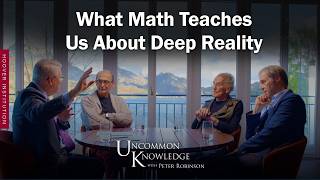
Why Does 2 + 2 = 4? What Math Teaches Us About Deep Reality
Hoover Institution
SRT - Most compatible format for video players (VLC, media players, video editors)
VTT - Web Video Text Tracks for HTML5 video and browsers
TXT - Plain text with timestamps for easy reading and editing
Scroll to view all subtitles
2 + 2 = 4. In all places and for all
time, 2 + 2 equals 4. But why? What does
math tell us about the nature of
reality?
David Berinsky, Sarah Juan, and Steven
Meyer on Uncommon Knowledge. Now,
[music]
welcome to Uncommon Knowledge recording
today in Saltzburg, Austria. I'm Peter
Robinson. David Berlinsky has taught
math, philosophy, and English at
universities including Stanford, Ruters,
the City University of New York, and the
Universary.
I hope you like that pronunciation,
David.
>> Perfect.
>> He is the author of books including one,
two, three, absolutely elementary
mathematics and his fourthcoming volume,
the perpetual rose. A native of Romania,
Sergio Clanerman is a professor of
mathematics at Princeton. In his own
words, his current interests include the
mathematical theory of black holes, more
precisely, their rigidity and stability.
I'm reading these words without having
any idea what they mean. and the dynamic
formation of trapped surfaces and
singularities. Close quote.
I'll ask you to explain a little bit of
that maybe. Sergio, the director of the
discoveries institute center for science
and culture, Steven Meyer, started his
professional life as a geoysicist. He
returned to school earning a doctorate
from Cambridge in the history and
philosophy of science. Uh he has
established himself as one of America's
leading thinkers in intelligent design.
his most recent book, The Return of the
God Hypothesis.
David, Sergio, Steve, welcome.
Um,
in the return of the God Hypothesis,
Steve's latest book, he argues that
three relatively recent developments
suggests that science needs to return to
some notion of the transcendent. And
these three developments are the big
bang, the finetuning of the universe,
and the discovery of DNA.
After reading Steve's book, a certain
very accomplished, well-known
mathematician took Steve aside and said,
"You only named three developments that
suggest a transcendent mind. There's a
fourth." Sergio, what did you mean by
that?
>> Well, first I I should say uh Steve
talked about about developments and uh
mathematics
is forever. I mean has been around for
thousands of years. So it's not quite
fair to compare but uh uh mathematics
has
by definition deals with its own sense
of it's its own reality which is uh I
claim as objective as physical reality
and uh so for example black holes are
like that right a black hole by
definition
>> it it we have a a mathematical theory of
general relativity that predicts black
holes
>> but uh by definition a black hole cannot
be seen. So nevertheless we we can
assert its existence. Why? Because the
general relativity is a consistent
theory.
>> So so could to take this to black holes
scare the daylights out of me. We'll
come back to black holes I'm sure. But
my mind already hurts is just when
hearing about your work on the rigidity.
All right.
In layman's terms, which is to say for
me 2 + 2 equals 4 is real. That's not a
figment. It's not an artifact of our
mind of mental processes of the
accidental processes that might be going
on in our neurons. Whether I think it's
2 plus two equals three or five, I'm
wrong. 2 plus 2 does equal four and that
is objectively real.
>> Correct?
>> Therefore, there is a conceptual
objective reality that exists in outside
us.
>> It's not material.
>> That's not material. And this is
actually a big deal.
>> David shrugs.
>> Um, yeah, of course it's a big I mean 2
plus 2 equals 4 is an interesting
example but you can derive that
biological inference from still more
fundamental ideas which is an exciting
and interesting fact all its own. You
don't have to begin by affirming 2 plus
2 equals 4. There I stand I can do no
other. You can say I've derived that
from still more primitive conceptual
items. But when you go back and back and
back and back and you ask about the
initial assumptions
the axioms of a system about arithmetic
there is no additional defense that you
can offer beyond the consistency of the
whole which is a very interesting
position to find oneself. So I'm going
to quote to you from your book
>> nothing
>> one one two three I think this is the
I'm hoping this is the same point
because that will indicate that I have
actually understood you quote neither
the numbers nor the operations they make
possible permit an analysis in which
they disappear in favor of something
more fundamental. It is the numbers that
are fundamental. They may be better
understood. They may be better
described, but they cannot be bettered.
>> I I still think that's true. Bear in
mind when you say 2 + 2 equals 4, that's
an assertion.
>> Yes.
>> What I'm arguing for in that particular
passage is that when you go back to the
foundations of arithmetic in the
expectation or the hope that you can get
rid of the numbers, you're going to be
very disappointed because they reappear.
All right, I'm going to quote David once
again, but I put this to to the two of
you for judgment. I'm assuming he will
agree with himself. Although in David's
case, this is always a question. Again,
from his book 123, quote, across the
vast range of arguments offered,
assessed, embraced, deferred, delayed,
or defeated, it is only within
mathematics that arguments achieve the
power to compel
>> allegiance. No philosophical theory has
ever shown why this should be so. It is
a part of the mystery of mathematics.
So you argue from some
philosophical point that derived from
Aristotle and has seemed
straight and but I can still say you
know I'm not persuaded but when you say
to me 2 plus 2 equals 4 I have to of
course you're right about that. Is is
that the point? I can speak to this from
the standpoint of someone who's worked
in the natural sciences and as a
philosopher of science. The natural
sciences provide empirical or
observational evidence in support of
conclusions and scientists will evaluate
particular theories or hypotheses by
comparing their explanatory power or
their predictive power. But the logical
form of those arguments is does not
render a deductively certain conclusion.
You in the best of cases will make an
inference to a a hypothesis which
provides the best explanation.
>> Hang on one second. Right. Just
distinguish deduction from inference for
us.
>> So a deductive a deductive uh argument
will start with a major premise. All men
are mortal. A minor premise some fact
about the world. Uh
>> Socrates the man
>> Socrates is a man. And then a
conclusion. Therefore
>> Socrates is immortal. Okay. And if the
premises are true and the reasoning is
valid, then the conclusion can be
affirmed with some kind of with with
certainty. But the uh in in the natural
sciences, you start with facts that
you've observed about the world. And you
want to infer from those facts to either
some kind of generalization that would
be an inductive argument or to some sort
of causal uh process that might explain
what you're seeing around you. Those
arguments are typically u characterized
as abductive. the kind of detective
reasoning that we we enjoy when we watch
detective shows where the yeah Columbbo
or someone's trying to figure out who
done it.
>> Um and so those abductive and inductive
inferences when you examine the logical
forums turn out not to give you
certainty. They may give you
plausibility. They may give you
comparative plausibility where one
theory is very much better than another.
But they don't give you the kind of
certainty that mathematics alone and
mathematical logic can give. A good
scientist will never say any more than
the theory is XYZ and on the best
evidence it holds up for now. Whereas a
mathematician is feels perfectly
confident in saying I've proven I've
proven we've proven it. We have a proof.
>> When you say proof in science the
mathematicians however are better than
we
>> when you say you've proved something you
mean it.
>> Yes.
>> All right. Okay. So this go ahead.
>> It could be wrong but somebody will show
it to me that it's okay. So if this
brings us to Sergio's article in
inference, a magazine that you edit,
David, the
article is entitled reflections on an
essay by Vner.
Now Eugene Vner, I have to set this up,
was a 20th century mathematician and
physicist. In 1960, he wrote a famous
essay, the unreasonable effectiveness of
mathematics in the natural sciences.
Vner noted his surprise that
mathematics, which after all goes on in
our minds, should prove so useful in
describing and even predicting aspects
of the physical world. Okay, can you
give me a couple of examples of this? I
mean, when I when I think to myself,
wait a minute, so I have a dream in the
middle of the night. I wake up and it
turns out it was untrue. But if I do a
mathematical equation and I wake up,
it's still true. is well Sergeu wrote a
brilliant essay and what he showed was
that you can start with very simple
mathematics and build up to more and
more and more complex forms of math
essentially deductively and then those
complex forms of math take the calculus
take differential equations they map
beautifully onto the physical world to
describe actual processes that are
taking place in nature so that they
provide very precise descriptions of
things that are going on in nature and
what Vner is alluding to is mystery that
this or the the puzzle this induces for
a lot of physicists. Why should the math
that we have developed through a series
of deductive steps effectively from our
own reasoning map so beautifully to
processes that we sometimes haven't even
observed yet. And David has a number of
great examples in one 123 of
mathematical structures that were
developed well before they had any
application to to to physics but then
later were were crucial and maybe he
should speak to that.
>> Yes. Well, I mean it's not I mean Eugene
Bner raised a very interesting point and
people have been discussing it. If you
look at theoretical physics, the great
structures, Newtonian mechanics, general
relativity, quantum mechanics, you can't
do it without a lot of mathematics. You
just need a whole lot of mathematics.
And Vignaris, the question is, you know,
we need mathematics to do quantum
mechanics, but we don't need entomology.
How come the bugs don't figure in
quantum mechanics, but the numbers and
the complex numbers do? And that is a a
rewarding and a provocative question.
But we don't have to turn to quantum
mechanics. There's a glass here. There's
a glass here, one glass, one glass. How
many glasses are in front of you? Two.
From where do you derive that assurance
>> that there are two glasses in front of
you? It's not a physical observation
because nothing in the physics of the
situation reveals the fact that one and
one are two. That is something someone
would think that's additional. Now, we
can break that all down into smaller
steps. And that's what logicians have
done in the 20th century. They've shown
us that the method of proof can be
decomposed into very small steps. In
fact, so small a computer can execute
them. And the initial assumptions can be
made so general, in fact so general that
they encompass all of mathematics as in
set theory or categories theory for that
matter. But we are in all this in a
rather an awkward position. I happen to
be looking out at a beautiful alpine
lake now. And just imagine we see
somebody on the other shore who begins
walking across the water without any
assistance whatsoever. He's just
crossing walking one step in front of
the other and he's crossing the light
toward us and he comes completely dry.
He appears in front of the television
camera and we say, "How did you do
that?" And he says, "Well, I took very
small steps.
I took very small steps." Now, our
natural reaction would be that's
commendable and you got across. But
somehow or other, it's not the answer to
the question. And we are all in the
position of watching someone cross a
large bottle body of water and
explaining his success by saying, "Look
at my feet. Small steps." That's where
we are.
>> Okay. So, so Sergio, well, wait, let me
go back to your essay. I'm quoting you
once again. The mystery Vner points out
arises in part from the perennial
question of whether mathematics is a
science advanced by exploration and
discovery like the main physical
theories or whether it is an an
invention a creation of the human mind.
I argue that mathematics developed
through exploration and discovery. That
is to say it is like a nugget in the
ground. You find it
>> correct.
>> It has its own. Okay.
>> Yeah. No, absolutely. I mean, uh,
one image that you could make is that of
an alpineist that is is going trying to
go on the top of the mountain. He has
>> everybody's doing alpine metaphors
today, but
>> he has an idea where he wants to go,
right? So, that's very important. That's
part of doing mathematics. It's not just
>> it's not just deduction. There's sort of
a vision of where you want to go which
is very important.
>> Inspiration,
right? Has something to do with
inspiration. But then then you know you
have something very objective in front
of you, right? The stone is of the
alpinist that you have to take into
account that you you're not going to
fall. You you you
have to touch the stone to know exactly
where you are going and if you don't you
get into trouble. Uh so is very similar.
um people have the feeling that
everything is deductive. It's not. I
mean
it it is uh very similar in that respect
to physical sciences. You physical
sciences also you have some idea of you
you have let's say an expectation uh you
make a hypothesis.
>> Right.
>> Right. The choice of a hypothesis is is
is not a deductive thing. is just a it's
an insight and then uh you try to show
that that it fits everything else all
the other experiences. So uh
>> and that that's the process of proving
something right. So you have the the the
process right you have the process of
discovery but then the process of
justification
>> the process of justification. So
mathematics at the end of the day it
looks like a a chain of logical
sequences that the computer can also I
mean once you you have the chain the
computer can
>> go very fast through it and maybe even
check uh so there are no yet no
computers that can check large
>> I mean they can check small small proofs
but not large in in in any case uh it's
sort of a very good example I think that
illustrates very well relations between
mass and theory take geometry so The
geometry was the first really theory of
the physical world right I mean it's
what it describes
>> going all the way back to Uklid is that
what you
>> it goes back right so Uklid tried
obviously tried to make sort of
mathematical statements out of
>> but it's a physical theory without doubt
including geometry is a physical theory
and then uh it it developed so here it
comes up something specific to
mathematics different from physics
mathematicians can take a theory and
then develop based on
very different criteria than a physicist
will do. So you know they are interested
in in problems because they are
beautiful or because because they uh
they feel that it will lead to certain
understanding of something else and uh
this freedom really in the case of
geometry went for I don't know 2,000
years without essentially no connection
back to the physical world. I mean
geometry was there
>> to start with but then by the 19th
century you have you know have Gaus you
have Robacheski you have Gaus you have
reman uh you have Minkovski at the
beginning of of the 20th century and
then all of a sudden all that stuff
becomes an essential ingredient I mean
it's not just you know it's not just a
technical it's an essential ingredient
of of special and generativity
right so uh
>> comes directly applicable to fundamental
physical theory
>> and I think this has happened many many
times in and maybe it's not very well
it's not very well acknowledged. So can
I ask when you Serguit needless to say I
cannot evaluate your work on my own
because you have done a 2,000page proof
2,000 pages of close mathematical
reasoning. I could have I could live to
2000 and not I could read a page a day
or a page a year and it still would
escape me I'm sure. And this was on the
stability of some aspect of Ein that
Einstein. So may I ask
>> did you think you were doing a work of
art creating something beautiful or did
you think you were interrogating
reality? Do you see that? I'm trying to
understand what you thought what it felt
like to you as a working mathematician
engaged on a
>> it's a very deep very difficult problem
>> and the answer is both. I mean I I I
would take the problem in the first
place. I'm a mathematician. I'm not a
physicist, right? I'm interested in I I
believe that the best mathematics is
connected somehow with physics in in
complicated ways. So uh but there are
many problems in physics and I will pick
the one that satisfies my
aesthetical feeling as a mathematician.
Uh so that's that's a saying
>> your aesthetical feeling. So so so
explain that you want something
>> something that I feel something that I
feel is very beautiful. It's it it it's
very profound. It gives lots of very
interesting questions. Uh okay. So
that's that's one aspect. But then then
it has to be the sec for me at least
there has to be a second aspect which is
that it should say something about the
physical world and in this case it does
right I mean the the care solutions. So
here here how it goes right you have
general relativity which was well
formulated by Einstein in uh at the end
of 2015
>> uh 1915 excuse me
>> and this was at the time a new theory of
gravity the massive bodies curve
>> spa what's called spacetime
>> and then then uh certain solutions were
found was the first to found in 2016 a
year immediately a year after found a
so-cal solution which is a stationary
solution
with a lot of symmetries that you can
actually extract from from the theory of
relativity from the angel equations as
exact formula uh and uh uh that had led
to lots of issues because it has a
singularity.
This is connected later on with the
Pendro singularity theorem for which he
actually got a Nobel Prize. He's the
only mathematician to have gotten a
Nobel Prize in physics which is quite
there's nobody else uh in part because
the the the math applied so beautifully
to to
>> right or to a question to a question
that was very important yeah
>> that was very important and and then
there was a second uh second major
development by K this was 1963
uh where the care solutions was okay so
now you have the a care family which
includes Schwarfield it's a it's a large
family depending on two parameters uh so
these are exact solutions of the
equations right I You know from
mathematical
from a mathematical point of view they
are real because for me reality
mathematical reality has to do with
objectic fact that these are solutions
of an equation which you can write down
it's it's
conceptually
>> and may I interrupt for just a moment so
as if I understand one of the remarkable
things about Einstein by the way of
course correct me jump in I'm doing baby
talk here because that is the top of my
form when it comes to this material
Einstein comes up with general
relativity in 1915 and here we are in
2025 and there's still experiment there
have been experiments that have been
done over the course of the succeeding
century as new satellite it new
technology makes new experiments
>> and every single time
>> it's the theory of general relativity is
is proven proven out that is to say
>> this theory that Einstein came up with
on a chalkboard
for a century of experiments now it
turns out to correspond with and predict
reality and and your work if we could
somehow devise experiments on black
holes your work would would prove out
>> well it's it's real to that extent
>> so I I like to call it a test of reality
so the the the fact that the care
solution is stable right it's a
mathematical statement but with a lot of
physical content because let's say if it
was not stable so it's a it's a solution
a correct solution of the equation which
starts with specific initial conditions
right so the the issue of stability is
now you make small pertubations of the
initial conditions and all of a sudden
we get something entirely different
which has nothing to do with the
solution the care solution that would be
called instability right so if if the
care solution would be unstable It means
it doesn't have any physical meaning
right because you you you know it
doesn't correspond to anything that you
can recognize in nature as corresponding
to that right so the stability uh of the
issue of stability is a fundamental
issue in
>> it's a test it's a marker for reality
>> you can say so it's I call it a
mathematical test of reality
>> but that is what's going on here Peter
so interesting
>> explicate for us
>> well from I'm just as from a
philosophical point of view here is that
there's a deep assumption that that
which is mathematically cons consistent,
coherent, stable is going to give us a
guide to physical reality as if there's
a rationality built into the physics
that somehow matches the rationality
that's at work when we're doing this
this type of advanced mathematics. And
so that that's that's the Vner mystery.
Why why does the reason within match the
rationality of nature external to us,
the reason without? All right. So now
now we move into territory.
I'm already in over my head, but I
continue swimming. It gets deeper.
>> May I offer a simple thing that might
help just with because we got into the
the field equations of general
relativity and the the solutions and but
uh uh Sergio started initially talking
about geometry.
>> Yes.
>> And just the idea that mathematical
objects have stable properties. This is
why mathematicians regard them as real.
You know, a circle has certain basic
properties. We it's got a circumference
and area and we can calculate these
things and those properties are true for
all people who think about circles. It's
it's there there are stable properties
that that geometric object has that we
can describe mathematically that's
independent of our minds. Right? And yet
it h and yet the stability of those
properties is a token as as Sue has
explained in our recent conference. It's
a token of of reality of a mind
objective reality, a mind independent
objective reality. And that's why
mathematicians don't think that they're
inventing new mathematical formulas.
They think almost almost universally
feel that they're they're discovering
something, not inventing.
>> Well, there are some who who don't. But
but what's interesting is that
physicists always refer to mathematics
as being an invention of the human mind.
That's what Vner says.
>> Sorry, Einstein says an invention of the
human mind. But Vickness says something
very similar.
>> So I I'm always surprised to see that
>> Einstein felt he invented the general.
>> No, no, no. I Einstein feels that ma
mathematicians invent things,
>> right? So
>> he actually called it a free creation of
the human mind.
>> Right.
>> So
>> by which he meant what?
>> It's not really clear because if it's a
free creation of the human mind, why are
mathematical propositions so dreadfully
necessary?
>> Mhm. I didn't have much choice about 2 +
2 = 4 and I presume you didn't either.
>> But these are
>> kind of at odds with the notion of
spontaneous
spontaneously reaching an invention like
addition doesn't seem to be an invention
at all.
>> But I have a reason why physicists do
that because and I doubt that Newton
would have said that.
>> No,
>> it's a modern it's a modern uh
physicists who are materialists. They do
believe that there is just matter and
everything the mind including has to be
uh determined somehow.
>> You can't be right about Okay. So,
notice what what's in the in the
dialectic here. The mathematicians who
are doing the the math that are
developing the math typically believe
that they are discovering something that
is real and independent of their minds
not not inventing something like an
internal combustion engine or
>> Exactly. I mean any invention has to
have a starting point, right? So it
means that before that starting point
that that mathematical fact did not
exist. Right? Pagora theorem was not
true before Pagora discovered it. It's
kind of ridiculous.
>> But how can anybody who who can
there must be complexities here. I'm
sure there are complexities. I'm not
grasping. But 2 plus 2 equals 4 is true
for me. It's true for you. It's true for
David. No matter how perverse David may
be feeling at any given moment is still
true. It's true and it has been true for
all time. Therefore, there is something
immater. Isn't that doesn't that just
put us a a stake in the heart of
materialism right there? Something ex
exists outside us.
Something we can call it reason or we
could call it platon. Okay. So, let's go
to Plato. If I understand this much
in the republic, Plato draws a
distinction between the intelligible
world.
The sensible world is what we can see
and touch and the intelligible world is
that which we can
is intelligible to us but
>> access we can access through the
intellect. Okay. And so that's where he
places his ideal forms. There is a
circle out there. There is a triangle
out there.
>> Plato says it does have an independent
existence but he seems to suggest that
there's a there's a realm of ideal forms
someplace out there. Aquinus comes along
1500 years later and says ideas exist
in minds
and something that is true for all of us
and for all time that is intelligible
but immaterial exists in the mind of
God.
David.
Yeah. Maybe [laughter]
David was never more David than in that
very moment.
Um I can't make any sense of the
discussion so far. That's my problem. Uh
there is a problem to which Vner was
calling attention which is a real
philosophical problem. That is if
mathematics
is essential
for every physical theory. It cannot be
the case
unless it's a trivial explanation that
there is a physical theory that
physically explains mathematics. I mean,
if a man proposes to catch a carp by
baiting his hook with a carp, he's
engaged in a trivial pursuit. He has the
carp. If we need a physical theory that
includes mathematics to explain
mathematics, we no longer have a
physical theory. We have a physical and
a mathematical theory. And that's the
dilemma. I think the deep dilemma to
which Vner is calling attention. There
are certain principles we'd like to hold
on to. It's part of the cultural
imperative. We'd like to hold on to this
fundamental idea. The world is physical.
We live in a physical world. I'm not
saying this is a commendable idea. I'm
saying it's a cultural imperative
because it seems so reassuring. Look,
we're faced with imponderables. The
basic fact the thing is a material or a
physical object.
It is very inconvenient culturally and
intellectually
to come to the conclusion that in order
to understand that physical object, we
need a whole lot of non-physical facts
about mathematics.
>> And in order to explain a whole lot of
non-physical facts about mathematics,
there is no conception of a physical
theory without mathematics that can do
the explaining. So we're left in the
position that if mathematics is as
useful as Sergey and Steve says and
they're absolutely right about that.
It's useful in daily life. There is
something fundamental wrong
fundamentally wrong with our idea of the
world as a physical system.
>> Exactly.
>> It's something cannot be right.
Something has to give. Either we develop
physics physical theories with no
mathematics. Fineman conjectures
something of this sort. or we agree that
materialism simply cannot be right. One
of the two, but something has to go.
>> But physicists would until now at least
have not given up on the idea of
physicality or realism. So that's that's
that's the issue.
>> But they're not reckoning with the
dilemma that David just described. I
think
>> not me. I mean that dilemma has been in
the literature for at least 50 years or
60 even.
>> Don't understand all of you bright
people. If something's been in the
literature for half a century which
essentially is a stop sign saying wait a
moment wait a moment wait a moment you
have a basic decision to make here about
the nature of reality either it it is
well then how can the academy how can
you academics just ignore it
>> well so okay so I I don't know why and
and like like David
>> but I hold you responsible
>> I I don't want to talk about exist
issues of existence ideas platonic ideas
maybe it's it's a step too far and that
maybe we agree uh but but I I have a
operational definition of reality so
reality is consistency of
representations of a particular object I
mean that that's true in physics and
that's true in mathematics mathematical
objects are real a mathematician who
works on on on a mathematical problem
calculates in this way calculates in
that other way always get the same
result I mean there's something so
obviously objective about what we do,
right? That somehow to claim that these
are just inventions of the human mind is
ridiculous to me. I mean, um, there is a
way to defend any position in
philosophy. I mean, we could argue that
there are inventions of the human mind
because the human mind is the only thing
that really exists. After all, there's a
very noble tradition going right back to
Barkley which makes exactly that case.
To be is to be perceived. But there is
something that uh inhibits a return to
Barclayian idealism
in that it sounds vaguely preposterous
to say the only thing that exists is a
mind. It doesn't comport with the
magnificence of the physical theories
we've just that's not an argument. It's
an observation. But having said that, we
we are really in danger of being reduced
to an ever narrowing ice flow. The ice
flow, as Sergi just mentioned, is the
consistency of representations. Well,
representations is kind of an obscure
term. Why don't we get down to basics?
It's the consistency of our theories.
Well, what is a theory? Well, we can
provide an answer to that. A theory is
kind of a large group of sentences. And
what are sentences? There are things
that make certain kinds of assertions
that can be true or false. And if
they're consistent,
that is about as good as we can get in
terms of the credibility and
commendability of a theory. So we're
reduced now on our ice fold to saying,
well, we have a representation or a
theory about the physical world and it's
consistent, but when we examine it, we
find out it is not a physical object. It
invokes non-physical substances like
mathematical objects. We don't have to
say we we we need not make a decision.
Do they exist in the mind or they exist
in the external world? They exist.
That's all we need. The number two
exists. I don't have to tell you well it
exists in your mind exists in my mind.
That's an irrelevant. It exists. That's
the determinative statement. And as long
as it exists and we acknowledge it's not
physical, then we're left with a
position of saying, how come our best
view of the physical world incorporates
things that are not physical? Why is
that?
>> Existence is an autological question. I
I I I prefer reality uh
is something that I can work with. While
existence, I don't know. When when it
comes to issue existence, I feel lost,
right? I don't exist.
>> You feel exist? I mean I don't know what
exists and what does not exist.
>> What intrigues me in all this is the
idea that those mathematical objects whe
it's the quadratic equation or a circle
or more advanced forms of mathematics
have stable properties. They're when we
when
>> this is the consistency you're talking
>> I talk about reality. Yeah. I prefer to
call reality being objectivity
consistency.
>> Yeah. What Seru is saying is that these
these mathematical structures or objects
have an a reality that's independent of
whether or not I affirm those properties
myself. They're mind independent and yet
they're conceptual essentially. They're
not material, they're conceptual. So it
does raise the question
where do they reside in what if there
are concepts and this is where I think
you were moving in this direction by by
bringing Plato in. Plato had the idea
that there are conceptual realities that
exist in some sort of of heavenly realm.
But Aquinas's critique of that was that
doesn't make any that's not that's not
consistent with our experience. Ideas
exist in minds. And so if the there
there are these objective properties of
material of of mathematical structures
that are independent of our minds. And
if these mathematical structures are
themselves conceptual, it it implies not
that they're floating around someplace,
but they they fund they originate or
reside fundamentally in some
transcendent mind. That's that's the
theistic take on the mathematical
realism.
>> Steve says math exists in the mind of
God. And Sergio says, "No, don't bother
me with that. I'm a working
mathematician. All I need is a piece of
chalk and and a and a blackboard." Well,
an operational definition of reality,
right? And I I the notion that somehow
everything that's real, it's physical
doesn't make sense to me because
mathematical objects are also real.
>> And I think we're all saying whichever,
you know, where you slice this whether
you're a political
>> Yeah, I think that's absolutely right. I
mean, even if we adopt Barklay's
position that to be is to be perceived,
we write we wind up at the same position
that a thoroughly consistent and
coherent coherent view of the universe
simply can't be physical.
>> Yeah.
>> It simply can't be.
>> Agreed. Okay. That actually that
actually strikes even my little mind as
a really quite profound
I'm not going to call it an insight.
It's a discovery. It's something it's a
some a real aspect of reality itself.
Can I revert back to something earlier
in the conversation? It's just something
that from David's book. He gave a he
gave a talk in in the US on this one
time and it just it just was so
intriguing to me. It was I think it was
from your book 123 when you were talking
about it on the road and it was he he he
showed how I think it was the complex
variables, the complex numbers. Remember
the square root of negative one from
math. There's this whole mathematical
apparatus that's been developed around
complex numbers and it seems like it has
absolutely nothing to do with anything
but there's a whole body of mathematics
on this. I I took a course in grad
school on on complex variables and David
showed that this was invented something
like what was 140 developed
140 years before
>> 200 maybe 200
>> and then lo and behold it's absolutely
crucial for doing quantum mechanics
which is our most fundamental physical
theory or one of them. No, but but if I
can Yeah, please correct me. What what
what is fascinating about the history of
the invention of the number I is that uh
well it it came up in it in Italy uh in
around you know 14th century 14
>> 16th century
>> no earlier I think 1450 yeah okay 1450 a
bit earlier maybe but in any case it was
based on their desire to solve equations
so they wanted to solve first the
quadratic equation there was a formula
already uh the Arabs apparently also
knew it already. In any case, they they
they went to the third order equation
and they found that uh it it pays to
introduce this symbol square root of
minus one which makes no sense. You
cannot take the square root of minus
one, right? But they just put it there
>> and they made this incredible
observation that you can use this number
and at the end you are getting a
solution of of a cubic equations which
are all reals. nothing to do with those
complex numbers but they enter into the
formula for for so this was quite an
amazing thing right so then little by
little they got used to this using
square root of minus one and uh at some
point in the 19th century uh it was even
made more formal geomet it it was given
a geometric rep geometric definition of
scores of minus one and have complex
numbers and complex functions and and
then the enormous amount of applications
came out of it. So it's square root of
minus one is is obviously real. It
existed before it was discovered by
>> there's a very interesting I mean I made
a basic mistake in ninth grade when they
introduced negative numbers I stopped
paying attention negative numbers
nothing to do with reality but I was
wrong then
>> Peter it's not negative these are
complex numbers the square root of
minus1 negative numbers are minus1
minus2 think of debts
>> we're not talking about debts now we're
talking about a complex number but
here's the extraordinarily interesting
point you got this
>> weirdo Italian mathematician of 15th
century who figures out that if I
introduce the symbol I equals the square
root of minus1 I can solidify a chain of
inference and come out with the right
answer. Just absolutely amazing.
However, when mathematicians start to
think about it, it's entirely possible
to get rid of the square root of minus1
in favor of two real numbers and a set
of rules for manipulating them. All of a
sudden the square root of minus1 is
gone. You're left with what you began
with the real numbers 3 and 7 in a
certain order and obeying certain rules.
>> A multiplication rule which is
essential. So that's the complex number.
>> The complex number. Exactly.
>> It's a multip it's a new multiplication
rule which was not did not exist in the
realm of of of
real what is called real natural
numbers. But that that introduces a very
interesting analytical point that
ontology can be reduced in favor of a
system of rules and regulations.
You can reduce the ontological burden of
mathematics. You can say I'm going to
get rid of the numbers in favor of the
sets. I'm going to get rid of the
complex numbers in favor of ordered
pairs of real numbers. I'm going to get
rid of the real numbers in favor of
convergent sequences. I'm going to get
rid of so much. But as you reduce the
burden of ontology, you increase the
burden of your regulations. So you
actually never get to the point where
mathematics appears from nothing. You
never get to that point. Like biology
just being the affirmation of what's
really true, something substantially
real.
>> I mean, biologists love to say life
comes only from life. 19th century, it's
obviously true. Life comes only from
life. and how it might not come from
life is an utter mystery. But it's also
true that language comes only from
language and it's additionally true that
mathematics only comes from mathematics.
These seem to be processes with which we
have a good deal of experience which
have no point of origin. There is no
place in which mathematics originates.
There's no place in which language
originates and there is no place in
which life originates. They may well be
fundamental features of the universe
itself.
>> But nevertheless, mathematics has a
history. So, and in this article,
>> but it it's infinite in the past,
>> right? I mean, it's a human. So, there
is something human about mathematics.
>> There's a history of our discovery, but
not a a history to the realities.
>> Exactly. That we are discovering. The
way we discover
>> right
>> okay
David this is you in a recent um this is
a conversation you had I think with
Steve in Cambridge
>> I'm going to quote a passage
hold up a finger could this finger be a
different color yes could it be slightly
longer yes could it be crooked yes but
it could it ever be anything other than
one finger
no the number is obligatory the number
the The number is something the finger
essentially has. Close quote.
All right. So now we're in the realm of
Aristotle and the difference between
essence,
>> essential properties and non-essential
properties
>> and accidents. Essential properties and
accidents. Explain this.
>> Well,
>> I feel as though I'm tiptoeing around.
Wow, Robinson.
>> All right. All right. So numbers
represent an essential aspect of
reality. That's a big deal. Well, it's
it's a very general statement. I I much
prefer, God forbid me, forgive me for
introducing Haidiger, I much prefer his
formulation. Haidiger and they're very
interesting passages in his work. I
admit it. And he says, "Look, when we
look at objects,
we cannot separate the oneness of this
glass from the object itself. But we can
change the color. We can change the
shape and still be the same object, but
we can say this one object could have
been two. That just doesn't go. So when
we talk about physical objects, we're
only talking now about physically
realizable objects, their mathematical
aspects are essential to them.
What holds for numbers also holds for
shape.
uh we don't have to do what Eugene Vner
did and say look at quantum mechanics
and the remarkable fact that Hilbert
spaces require introduction complex
numbers. No, just look at the glass. The
glass requires the introduction of a
natural number. Two glasses require the
introduction of two natural numbers.
That is every bit as mysterious as the
invocation of complex numbers and
quantum field theory. every bit is
mysterious and we don't know quite why.
>> Okay. So, all three of you are willing
to agree in all three of you are willing
to insist
that mathematics,
the existence of mathematics, the weird
way in which mathematics seems to
correspond with and help us to
investigate reality in a way that is
real. I'm using reality over and over
again. proves that reality is not purely
not limited to what we can access by our
five senses.
>> It's a hint. It doesn't prove. It's a
hint.
>> Oh, now I've lost ground even from that.
Oh, so all we have is a hint. So why
aren't you I think Steve is willing to
go. Now here I am putting words into
Steve's mouth. Steve is willing to say
we're dealing here with the mind of I
think what David's getting
>> and David is David won't do that no
matter how much pin you down and you
would I'll give I'll give you sort of an
example of something like this so uh you
know immediately after Newton there was
Newtonian mechanics the idea was that
Newtonian mechanics has to explain
everything then came Maxwell the Maxwell
equations and in order to uh adjust the
maxwell equations to Newtonian
mechanics. they need they needed this
notion of ether right so uh you know
ether here is that there
at some point I mean Einstein's great
insight was we don't need it right so
it's the same thing I believe we don't
need this materialistic representation
of the world just forget about it
reality means something broader than
that
>> it's inconsistent with the most obvious
presentation of of mathematics itself
it's it's obvious that mathematical
properties are not material you and
invent a metaphysical system that
explains that away. That's why it's not
a proof. But
>> so nobody proved the ether is not does
not exist. But we just get rid of it.
Yeah.
>> And I think that's what we should do
about
>> I think I could agree with that. But
going back to your last remark, Peter, I
think it's just much simpler to say that
the mystery is just the existence of
mathematics.
It's just that because it's fundamental.
We could well say and of course
philosophers have well said we can get
rid of the physical world.
Metaphysically that's not a problem.
Barkley showed how everything is a
perception or an idea. External world
just disappears. But we can't get rid of
the mathematical world. That's
ineliminable
and its existence is a profound mystery.
What is it doing there? Why do we see
things in mathematical terms? Now, I'm
not asking this question because I have
a secret answer. I I'm prepared to
vouch. Say
>> I was hoping you would wrap up the
conversation with the answer.
>> I I find it a great mystery. The sheer
existence of mathematics is deeply
puzzling.
>> You will agree with every word of that.
>> Yeah, absolutely.
>> And and you'll agree, but can you take
it farther? Well, I just am intrigued
with this kind of argument that I
recapitulated earlier in the
conversation that that mathematical
objects have stable properties.
Therefore, they have an objectivity that
is independent of our minds. And yet,
they are conceptual, which suggests
suggests by our experience that they
must not be floating around somewhere in
the Platonic heavens, but rather it
makes more sense to me to think that
they ultimately issue from the mind of
God. And that that is the deep reason
for the mysterious applicability of
mathematics to the physical world.
>> Bear in mind, Steve, that you're
reaching a position very close to
Barkley's position.
>> To who? To Barkley. Bishop Bar. I mean
if you say that to be is to be perceived
>> Bishop Barkley 17th century British 18th
century English churchman and
philosopher uh who appears possibly most
famously in Boswell's life of Johnson
when Boswell
>> I refute Barkley thus thus Johnson
kicking a rock
>> but the point faced the obvious question
if you're not looking at the moon
Einstein discusses this too does the
moon continue to exist and Barklay's
response was yes it exists as a thought
in the mind of God, which is very close
to what Steve was just all although he's
certainly not
>> I'm not Yeah, I don't I don't think the
physical world is has a I think it has a
mind an independence of our mind and of
the mind of God who created it. But I
think the ultimate source of
mathematical reality may well be the
mind of God. But it's interesting that
you are prepared to go further than I
think many contemporary analytic
philosophers are prepared to go in the
direction of a Barclayian kind of
analysis which I think is in this case
the only analysis that makes sense
>> at least for math at least for math
because it is so mysterious.
>> Boys I'm going to attempt for last
question here. I'm going to attempt to
introduce one new concept and that is
the concept of beauty. I have no idea
how this will go, but here's an excerpt
from the forthcoming documentary, The
Story of Everything.
There's something in science called the
beauty principle that says true theories
often convey a mathematical beauty or
structural harmony.
Upon looking at their model of the DNA
molecule, Francis Crick was quoted as
saying,
"It's so beautiful. It's got to be
right."
>> Explain that.
>> Why should beauty enter into this?
>> It we don't really know, but it tends to
be what's called a heristic guide in
science, a guide to discovery. And in
the in the section of the film that
follows, uh there were maybe perhaps
even more trenchant comments from a
couple of the physicists who were saying
how often their perception of
mathematical beauty had been a guide to
discovery. I think it was Paul Dak who
first said that it's more important for
the theories are beautiful than than to
to have them consistent with the data
because eventually u well because we can
be mistaken about how we're perceiving
the data. But there there is assumption
that there's something mathematically
beautiful about about reality itself.
intelligibility.
>> Draco was mesmerized by
>> Sorry, who was Dra?
>> Did I say I said Dra? Yeah, Draco was
mesmerized by by
>> and you said a moment ago when you were
choosing projects on which to work, you
I think you used the word is it elegant?
Is it beautiful
>> of course why the care solution is an
incredible
incredible object. I mean very really
beautiful. I mean yeah.
>> Are we on another mystery here? An
aesthetic mystery. Beauty
plays a a fundamental role of course in
the way we choose problems but also in
the way we are guiding ourselves towards
the truth. I mean it towards a solution
of a problem. Uh somehow we reject
reject arguments which are contrived
which are not beautiful. We don't call
them beautiful. Uh yeah I mean it's
mysteriously true. Uh and physics of
course is full of such examples.
uh Maxwell you know the the Maxwell the
way the Maxwell equations were
discovered it was first Faraday who had
uh the three laws of electron mine that
is already discovered experimentally
>> that's right
>> and then uh but he was not a mathemat
mathematician at all so he he just he
just uh left it there and just stated
the laws and it was Maxwell who realized
that if you put those statements within
mathematics
there's a lack of symmetry in sort of
guided him towards a force one uh which
led to electromagnetism.
So, uh, and all of the technology of the
of the modern world,
>> beauty,
>> Maxwell with Maxwell. Yeah.
>> Your your comment upon beauty.
>> Yeah. I'd like to hear from these guys
cuz Yeah.
>> I kind of reserve that for my tailor.
[laughter]
>> Well, you know, I can tell you that as a
working mathematician, it plays
absolutely a fundamental role in
everything people do. really
>> there are very few mathematicians who
would say I work on this because it's
it's it's just ugly right I mean you
know they they choose the the problems
or directions based on
>> party line Sergey there are all sorts of
mathematical drabs that we keep hidden
>> nobody's going to tell me turbulence is
a beautiful subject
>> oh it's a it's a fantastic subject
>> fantastic but not beautiful clumsy
lumbering Well, but but the expectation
is that we'll find we find the beauty in
in turbulence by
>> expectations are easily purchased.
Beauty comes at famine prices.
>> All right, kick him because he's being
perverse now. He's he's being he's being
mischievous. Last question. Isaac
Newton, the man who gave us mathematics
that on astronomy, fluid dynamics, and
>> calculus, and Newton explains a lot.
Here's a quotation from Newton. A
heavenly master governs all the world as
sovereign of the universe. Close quote.
A recognition of the divine or a mind
that transcends our own is taken for
granted for thousands of years
new as recently as Newton and then it
gets kicked out of intellectual life and
kicked out of the academy.
Does the mystery of mathematics
suggest
that the materialist error was an
aberration
that ought to and may be may be ending
now. Are you willing to go that far,
Steve?
>> Yeah, of course. I think that's exactly
right. And what Newton illustrates so
beautifully is that this princip this
principle of intelligibility that we've
been talking about that the mathematical
rationality that can be developed by
mathematicians without necessarily
observing nature does then apply to
understanding the rationality that's
built into nature. And this was so
crucial to the the period of the
scientific revolution when these the
these systematic methods for
interrogating nature, for studying
nature were developed and culminating in
figures that that maybe is no figure
like Newton who was so profound in his
his insight and who advanced what was
called natural philosophy that or
science so much in one generation. Even
even in one year his famed Annis
Morabilus where he went home uh during
the plague to remediate his own
deficiencies in mathematics and came
back having invented the calculus you
know. So
>> a heavenly master David.
>> All right.
>> What can I say? That insight has not
been vouch safe to me.
>> Fair enough. Sergio.
>> Well, okay. So, uh, first of all, I
think materialism should I mean
materialism is just the only explanation
of of the world should be put in the ash
bin of history. So, that with that that
we both agree.
>> Yeah.
>> Uh, bringing God in. Sure, why not? I
mean, that's another way of looking at
the world whether if there is something
else. Well, let's find out. Maybe there
is another explanation. But at this
point I don't see any reason why you
should not look at that possibility.
>> So
God exists me and why not
>> Serge Clanerman, David Berinsky and
Steve Meyer. Gentlemen, thank you.
>> It's been our privilege. Peter
>> for Uncommon Knowledge, the Hoover
Institution and Fox Nation. I'm Peter
Robinson.
>> [music]
Full transcript without timestamps
2 + 2 = 4. In all places and for all time, 2 + 2 equals 4. But why? What does math tell us about the nature of reality? David Berinsky, Sarah Juan, and Steven Meyer on Uncommon Knowledge. Now, [music] welcome to Uncommon Knowledge recording today in Saltzburg, Austria. I'm Peter Robinson. David Berlinsky has taught math, philosophy, and English at universities including Stanford, Ruters, the City University of New York, and the Universary. I hope you like that pronunciation, David. >> Perfect. >> He is the author of books including one, two, three, absolutely elementary mathematics and his fourthcoming volume, the perpetual rose. A native of Romania, Sergio Clanerman is a professor of mathematics at Princeton. In his own words, his current interests include the mathematical theory of black holes, more precisely, their rigidity and stability. I'm reading these words without having any idea what they mean. and the dynamic formation of trapped surfaces and singularities. Close quote. I'll ask you to explain a little bit of that maybe. Sergio, the director of the discoveries institute center for science and culture, Steven Meyer, started his professional life as a geoysicist. He returned to school earning a doctorate from Cambridge in the history and philosophy of science. Uh he has established himself as one of America's leading thinkers in intelligent design. his most recent book, The Return of the God Hypothesis. David, Sergio, Steve, welcome. Um, in the return of the God Hypothesis, Steve's latest book, he argues that three relatively recent developments suggests that science needs to return to some notion of the transcendent. And these three developments are the big bang, the finetuning of the universe, and the discovery of DNA. After reading Steve's book, a certain very accomplished, well-known mathematician took Steve aside and said, "You only named three developments that suggest a transcendent mind. There's a fourth." Sergio, what did you mean by that? >> Well, first I I should say uh Steve talked about about developments and uh mathematics is forever. I mean has been around for thousands of years. So it's not quite fair to compare but uh uh mathematics has by definition deals with its own sense of it's its own reality which is uh I claim as objective as physical reality and uh so for example black holes are like that right a black hole by definition >> it it we have a a mathematical theory of general relativity that predicts black holes >> but uh by definition a black hole cannot be seen. So nevertheless we we can assert its existence. Why? Because the general relativity is a consistent theory. >> So so could to take this to black holes scare the daylights out of me. We'll come back to black holes I'm sure. But my mind already hurts is just when hearing about your work on the rigidity. All right. In layman's terms, which is to say for me 2 + 2 equals 4 is real. That's not a figment. It's not an artifact of our mind of mental processes of the accidental processes that might be going on in our neurons. Whether I think it's 2 plus two equals three or five, I'm wrong. 2 plus 2 does equal four and that is objectively real. >> Correct? >> Therefore, there is a conceptual objective reality that exists in outside us. >> It's not material. >> That's not material. And this is actually a big deal. >> David shrugs. >> Um, yeah, of course it's a big I mean 2 plus 2 equals 4 is an interesting example but you can derive that biological inference from still more fundamental ideas which is an exciting and interesting fact all its own. You don't have to begin by affirming 2 plus 2 equals 4. There I stand I can do no other. You can say I've derived that from still more primitive conceptual items. But when you go back and back and back and back and you ask about the initial assumptions the axioms of a system about arithmetic there is no additional defense that you can offer beyond the consistency of the whole which is a very interesting position to find oneself. So I'm going to quote to you from your book >> nothing >> one one two three I think this is the I'm hoping this is the same point because that will indicate that I have actually understood you quote neither the numbers nor the operations they make possible permit an analysis in which they disappear in favor of something more fundamental. It is the numbers that are fundamental. They may be better understood. They may be better described, but they cannot be bettered. >> I I still think that's true. Bear in mind when you say 2 + 2 equals 4, that's an assertion. >> Yes. >> What I'm arguing for in that particular passage is that when you go back to the foundations of arithmetic in the expectation or the hope that you can get rid of the numbers, you're going to be very disappointed because they reappear. All right, I'm going to quote David once again, but I put this to to the two of you for judgment. I'm assuming he will agree with himself. Although in David's case, this is always a question. Again, from his book 123, quote, across the vast range of arguments offered, assessed, embraced, deferred, delayed, or defeated, it is only within mathematics that arguments achieve the power to compel >> allegiance. No philosophical theory has ever shown why this should be so. It is a part of the mystery of mathematics. So you argue from some philosophical point that derived from Aristotle and has seemed straight and but I can still say you know I'm not persuaded but when you say to me 2 plus 2 equals 4 I have to of course you're right about that. Is is that the point? I can speak to this from the standpoint of someone who's worked in the natural sciences and as a philosopher of science. The natural sciences provide empirical or observational evidence in support of conclusions and scientists will evaluate particular theories or hypotheses by comparing their explanatory power or their predictive power. But the logical form of those arguments is does not render a deductively certain conclusion. You in the best of cases will make an inference to a a hypothesis which provides the best explanation. >> Hang on one second. Right. Just distinguish deduction from inference for us. >> So a deductive a deductive uh argument will start with a major premise. All men are mortal. A minor premise some fact about the world. Uh >> Socrates the man >> Socrates is a man. And then a conclusion. Therefore >> Socrates is immortal. Okay. And if the premises are true and the reasoning is valid, then the conclusion can be affirmed with some kind of with with certainty. But the uh in in the natural sciences, you start with facts that you've observed about the world. And you want to infer from those facts to either some kind of generalization that would be an inductive argument or to some sort of causal uh process that might explain what you're seeing around you. Those arguments are typically u characterized as abductive. the kind of detective reasoning that we we enjoy when we watch detective shows where the yeah Columbbo or someone's trying to figure out who done it. >> Um and so those abductive and inductive inferences when you examine the logical forums turn out not to give you certainty. They may give you plausibility. They may give you comparative plausibility where one theory is very much better than another. But they don't give you the kind of certainty that mathematics alone and mathematical logic can give. A good scientist will never say any more than the theory is XYZ and on the best evidence it holds up for now. Whereas a mathematician is feels perfectly confident in saying I've proven I've proven we've proven it. We have a proof. >> When you say proof in science the mathematicians however are better than we >> when you say you've proved something you mean it. >> Yes. >> All right. Okay. So this go ahead. >> It could be wrong but somebody will show it to me that it's okay. So if this brings us to Sergio's article in inference, a magazine that you edit, David, the article is entitled reflections on an essay by Vner. Now Eugene Vner, I have to set this up, was a 20th century mathematician and physicist. In 1960, he wrote a famous essay, the unreasonable effectiveness of mathematics in the natural sciences. Vner noted his surprise that mathematics, which after all goes on in our minds, should prove so useful in describing and even predicting aspects of the physical world. Okay, can you give me a couple of examples of this? I mean, when I when I think to myself, wait a minute, so I have a dream in the middle of the night. I wake up and it turns out it was untrue. But if I do a mathematical equation and I wake up, it's still true. is well Sergeu wrote a brilliant essay and what he showed was that you can start with very simple mathematics and build up to more and more and more complex forms of math essentially deductively and then those complex forms of math take the calculus take differential equations they map beautifully onto the physical world to describe actual processes that are taking place in nature so that they provide very precise descriptions of things that are going on in nature and what Vner is alluding to is mystery that this or the the puzzle this induces for a lot of physicists. Why should the math that we have developed through a series of deductive steps effectively from our own reasoning map so beautifully to processes that we sometimes haven't even observed yet. And David has a number of great examples in one 123 of mathematical structures that were developed well before they had any application to to to physics but then later were were crucial and maybe he should speak to that. >> Yes. Well, I mean it's not I mean Eugene Bner raised a very interesting point and people have been discussing it. If you look at theoretical physics, the great structures, Newtonian mechanics, general relativity, quantum mechanics, you can't do it without a lot of mathematics. You just need a whole lot of mathematics. And Vignaris, the question is, you know, we need mathematics to do quantum mechanics, but we don't need entomology. How come the bugs don't figure in quantum mechanics, but the numbers and the complex numbers do? And that is a a rewarding and a provocative question. But we don't have to turn to quantum mechanics. There's a glass here. There's a glass here, one glass, one glass. How many glasses are in front of you? Two. From where do you derive that assurance >> that there are two glasses in front of you? It's not a physical observation because nothing in the physics of the situation reveals the fact that one and one are two. That is something someone would think that's additional. Now, we can break that all down into smaller steps. And that's what logicians have done in the 20th century. They've shown us that the method of proof can be decomposed into very small steps. In fact, so small a computer can execute them. And the initial assumptions can be made so general, in fact so general that they encompass all of mathematics as in set theory or categories theory for that matter. But we are in all this in a rather an awkward position. I happen to be looking out at a beautiful alpine lake now. And just imagine we see somebody on the other shore who begins walking across the water without any assistance whatsoever. He's just crossing walking one step in front of the other and he's crossing the light toward us and he comes completely dry. He appears in front of the television camera and we say, "How did you do that?" And he says, "Well, I took very small steps. I took very small steps." Now, our natural reaction would be that's commendable and you got across. But somehow or other, it's not the answer to the question. And we are all in the position of watching someone cross a large bottle body of water and explaining his success by saying, "Look at my feet. Small steps." That's where we are. >> Okay. So, so Sergio, well, wait, let me go back to your essay. I'm quoting you once again. The mystery Vner points out arises in part from the perennial question of whether mathematics is a science advanced by exploration and discovery like the main physical theories or whether it is an an invention a creation of the human mind. I argue that mathematics developed through exploration and discovery. That is to say it is like a nugget in the ground. You find it >> correct. >> It has its own. Okay. >> Yeah. No, absolutely. I mean, uh, one image that you could make is that of an alpineist that is is going trying to go on the top of the mountain. He has >> everybody's doing alpine metaphors today, but >> he has an idea where he wants to go, right? So, that's very important. That's part of doing mathematics. It's not just >> it's not just deduction. There's sort of a vision of where you want to go which is very important. >> Inspiration, right? Has something to do with inspiration. But then then you know you have something very objective in front of you, right? The stone is of the alpinist that you have to take into account that you you're not going to fall. You you you have to touch the stone to know exactly where you are going and if you don't you get into trouble. Uh so is very similar. um people have the feeling that everything is deductive. It's not. I mean it it is uh very similar in that respect to physical sciences. You physical sciences also you have some idea of you you have let's say an expectation uh you make a hypothesis. >> Right. >> Right. The choice of a hypothesis is is is not a deductive thing. is just a it's an insight and then uh you try to show that that it fits everything else all the other experiences. So uh >> and that that's the process of proving something right. So you have the the the process right you have the process of discovery but then the process of justification >> the process of justification. So mathematics at the end of the day it looks like a a chain of logical sequences that the computer can also I mean once you you have the chain the computer can >> go very fast through it and maybe even check uh so there are no yet no computers that can check large >> I mean they can check small small proofs but not large in in in any case uh it's sort of a very good example I think that illustrates very well relations between mass and theory take geometry so The geometry was the first really theory of the physical world right I mean it's what it describes >> going all the way back to Uklid is that what you >> it goes back right so Uklid tried obviously tried to make sort of mathematical statements out of >> but it's a physical theory without doubt including geometry is a physical theory and then uh it it developed so here it comes up something specific to mathematics different from physics mathematicians can take a theory and then develop based on very different criteria than a physicist will do. So you know they are interested in in problems because they are beautiful or because because they uh they feel that it will lead to certain understanding of something else and uh this freedom really in the case of geometry went for I don't know 2,000 years without essentially no connection back to the physical world. I mean geometry was there >> to start with but then by the 19th century you have you know have Gaus you have Robacheski you have Gaus you have reman uh you have Minkovski at the beginning of of the 20th century and then all of a sudden all that stuff becomes an essential ingredient I mean it's not just you know it's not just a technical it's an essential ingredient of of special and generativity right so uh >> comes directly applicable to fundamental physical theory >> and I think this has happened many many times in and maybe it's not very well it's not very well acknowledged. So can I ask when you Serguit needless to say I cannot evaluate your work on my own because you have done a 2,000page proof 2,000 pages of close mathematical reasoning. I could have I could live to 2000 and not I could read a page a day or a page a year and it still would escape me I'm sure. And this was on the stability of some aspect of Ein that Einstein. So may I ask >> did you think you were doing a work of art creating something beautiful or did you think you were interrogating reality? Do you see that? I'm trying to understand what you thought what it felt like to you as a working mathematician engaged on a >> it's a very deep very difficult problem >> and the answer is both. I mean I I I would take the problem in the first place. I'm a mathematician. I'm not a physicist, right? I'm interested in I I believe that the best mathematics is connected somehow with physics in in complicated ways. So uh but there are many problems in physics and I will pick the one that satisfies my aesthetical feeling as a mathematician. Uh so that's that's a saying >> your aesthetical feeling. So so so explain that you want something >> something that I feel something that I feel is very beautiful. It's it it it's very profound. It gives lots of very interesting questions. Uh okay. So that's that's one aspect. But then then it has to be the sec for me at least there has to be a second aspect which is that it should say something about the physical world and in this case it does right I mean the the care solutions. So here here how it goes right you have general relativity which was well formulated by Einstein in uh at the end of 2015 >> uh 1915 excuse me >> and this was at the time a new theory of gravity the massive bodies curve >> spa what's called spacetime >> and then then uh certain solutions were found was the first to found in 2016 a year immediately a year after found a so-cal solution which is a stationary solution with a lot of symmetries that you can actually extract from from the theory of relativity from the angel equations as exact formula uh and uh uh that had led to lots of issues because it has a singularity. This is connected later on with the Pendro singularity theorem for which he actually got a Nobel Prize. He's the only mathematician to have gotten a Nobel Prize in physics which is quite there's nobody else uh in part because the the the math applied so beautifully to to >> right or to a question to a question that was very important yeah >> that was very important and and then there was a second uh second major development by K this was 1963 uh where the care solutions was okay so now you have the a care family which includes Schwarfield it's a it's a large family depending on two parameters uh so these are exact solutions of the equations right I You know from mathematical from a mathematical point of view they are real because for me reality mathematical reality has to do with objectic fact that these are solutions of an equation which you can write down it's it's conceptually >> and may I interrupt for just a moment so as if I understand one of the remarkable things about Einstein by the way of course correct me jump in I'm doing baby talk here because that is the top of my form when it comes to this material Einstein comes up with general relativity in 1915 and here we are in 2025 and there's still experiment there have been experiments that have been done over the course of the succeeding century as new satellite it new technology makes new experiments >> and every single time >> it's the theory of general relativity is is proven proven out that is to say >> this theory that Einstein came up with on a chalkboard for a century of experiments now it turns out to correspond with and predict reality and and your work if we could somehow devise experiments on black holes your work would would prove out >> well it's it's real to that extent >> so I I like to call it a test of reality so the the the fact that the care solution is stable right it's a mathematical statement but with a lot of physical content because let's say if it was not stable so it's a it's a solution a correct solution of the equation which starts with specific initial conditions right so the the issue of stability is now you make small pertubations of the initial conditions and all of a sudden we get something entirely different which has nothing to do with the solution the care solution that would be called instability right so if if the care solution would be unstable It means it doesn't have any physical meaning right because you you you know it doesn't correspond to anything that you can recognize in nature as corresponding to that right so the stability uh of the issue of stability is a fundamental issue in >> it's a test it's a marker for reality >> you can say so it's I call it a mathematical test of reality >> but that is what's going on here Peter so interesting >> explicate for us >> well from I'm just as from a philosophical point of view here is that there's a deep assumption that that which is mathematically cons consistent, coherent, stable is going to give us a guide to physical reality as if there's a rationality built into the physics that somehow matches the rationality that's at work when we're doing this this type of advanced mathematics. And so that that's that's the Vner mystery. Why why does the reason within match the rationality of nature external to us, the reason without? All right. So now now we move into territory. I'm already in over my head, but I continue swimming. It gets deeper. >> May I offer a simple thing that might help just with because we got into the the field equations of general relativity and the the solutions and but uh uh Sergio started initially talking about geometry. >> Yes. >> And just the idea that mathematical objects have stable properties. This is why mathematicians regard them as real. You know, a circle has certain basic properties. We it's got a circumference and area and we can calculate these things and those properties are true for all people who think about circles. It's it's there there are stable properties that that geometric object has that we can describe mathematically that's independent of our minds. Right? And yet it h and yet the stability of those properties is a token as as Sue has explained in our recent conference. It's a token of of reality of a mind objective reality, a mind independent objective reality. And that's why mathematicians don't think that they're inventing new mathematical formulas. They think almost almost universally feel that they're they're discovering something, not inventing. >> Well, there are some who who don't. But but what's interesting is that physicists always refer to mathematics as being an invention of the human mind. That's what Vner says. >> Sorry, Einstein says an invention of the human mind. But Vickness says something very similar. >> So I I'm always surprised to see that >> Einstein felt he invented the general. >> No, no, no. I Einstein feels that ma mathematicians invent things, >> right? So >> he actually called it a free creation of the human mind. >> Right. >> So >> by which he meant what? >> It's not really clear because if it's a free creation of the human mind, why are mathematical propositions so dreadfully necessary? >> Mhm. I didn't have much choice about 2 + 2 = 4 and I presume you didn't either. >> But these are >> kind of at odds with the notion of spontaneous spontaneously reaching an invention like addition doesn't seem to be an invention at all. >> But I have a reason why physicists do that because and I doubt that Newton would have said that. >> No, >> it's a modern it's a modern uh physicists who are materialists. They do believe that there is just matter and everything the mind including has to be uh determined somehow. >> You can't be right about Okay. So, notice what what's in the in the dialectic here. The mathematicians who are doing the the math that are developing the math typically believe that they are discovering something that is real and independent of their minds not not inventing something like an internal combustion engine or >> Exactly. I mean any invention has to have a starting point, right? So it means that before that starting point that that mathematical fact did not exist. Right? Pagora theorem was not true before Pagora discovered it. It's kind of ridiculous. >> But how can anybody who who can there must be complexities here. I'm sure there are complexities. I'm not grasping. But 2 plus 2 equals 4 is true for me. It's true for you. It's true for David. No matter how perverse David may be feeling at any given moment is still true. It's true and it has been true for all time. Therefore, there is something immater. Isn't that doesn't that just put us a a stake in the heart of materialism right there? Something ex exists outside us. Something we can call it reason or we could call it platon. Okay. So, let's go to Plato. If I understand this much in the republic, Plato draws a distinction between the intelligible world. The sensible world is what we can see and touch and the intelligible world is that which we can is intelligible to us but >> access we can access through the intellect. Okay. And so that's where he places his ideal forms. There is a circle out there. There is a triangle out there. >> Plato says it does have an independent existence but he seems to suggest that there's a there's a realm of ideal forms someplace out there. Aquinus comes along 1500 years later and says ideas exist in minds and something that is true for all of us and for all time that is intelligible but immaterial exists in the mind of God. David. Yeah. Maybe [laughter] David was never more David than in that very moment. Um I can't make any sense of the discussion so far. That's my problem. Uh there is a problem to which Vner was calling attention which is a real philosophical problem. That is if mathematics is essential for every physical theory. It cannot be the case unless it's a trivial explanation that there is a physical theory that physically explains mathematics. I mean, if a man proposes to catch a carp by baiting his hook with a carp, he's engaged in a trivial pursuit. He has the carp. If we need a physical theory that includes mathematics to explain mathematics, we no longer have a physical theory. We have a physical and a mathematical theory. And that's the dilemma. I think the deep dilemma to which Vner is calling attention. There are certain principles we'd like to hold on to. It's part of the cultural imperative. We'd like to hold on to this fundamental idea. The world is physical. We live in a physical world. I'm not saying this is a commendable idea. I'm saying it's a cultural imperative because it seems so reassuring. Look, we're faced with imponderables. The basic fact the thing is a material or a physical object. It is very inconvenient culturally and intellectually to come to the conclusion that in order to understand that physical object, we need a whole lot of non-physical facts about mathematics. >> And in order to explain a whole lot of non-physical facts about mathematics, there is no conception of a physical theory without mathematics that can do the explaining. So we're left in the position that if mathematics is as useful as Sergey and Steve says and they're absolutely right about that. It's useful in daily life. There is something fundamental wrong fundamentally wrong with our idea of the world as a physical system. >> Exactly. >> It's something cannot be right. Something has to give. Either we develop physics physical theories with no mathematics. Fineman conjectures something of this sort. or we agree that materialism simply cannot be right. One of the two, but something has to go. >> But physicists would until now at least have not given up on the idea of physicality or realism. So that's that's that's the issue. >> But they're not reckoning with the dilemma that David just described. I think >> not me. I mean that dilemma has been in the literature for at least 50 years or 60 even. >> Don't understand all of you bright people. If something's been in the literature for half a century which essentially is a stop sign saying wait a moment wait a moment wait a moment you have a basic decision to make here about the nature of reality either it it is well then how can the academy how can you academics just ignore it >> well so okay so I I don't know why and and like like David >> but I hold you responsible >> I I don't want to talk about exist issues of existence ideas platonic ideas maybe it's it's a step too far and that maybe we agree uh but but I I have a operational definition of reality so reality is consistency of representations of a particular object I mean that that's true in physics and that's true in mathematics mathematical objects are real a mathematician who works on on on a mathematical problem calculates in this way calculates in that other way always get the same result I mean there's something so obviously objective about what we do, right? That somehow to claim that these are just inventions of the human mind is ridiculous to me. I mean, um, there is a way to defend any position in philosophy. I mean, we could argue that there are inventions of the human mind because the human mind is the only thing that really exists. After all, there's a very noble tradition going right back to Barkley which makes exactly that case. To be is to be perceived. But there is something that uh inhibits a return to Barclayian idealism in that it sounds vaguely preposterous to say the only thing that exists is a mind. It doesn't comport with the magnificence of the physical theories we've just that's not an argument. It's an observation. But having said that, we we are really in danger of being reduced to an ever narrowing ice flow. The ice flow, as Sergi just mentioned, is the consistency of representations. Well, representations is kind of an obscure term. Why don't we get down to basics? It's the consistency of our theories. Well, what is a theory? Well, we can provide an answer to that. A theory is kind of a large group of sentences. And what are sentences? There are things that make certain kinds of assertions that can be true or false. And if they're consistent, that is about as good as we can get in terms of the credibility and commendability of a theory. So we're reduced now on our ice fold to saying, well, we have a representation or a theory about the physical world and it's consistent, but when we examine it, we find out it is not a physical object. It invokes non-physical substances like mathematical objects. We don't have to say we we we need not make a decision. Do they exist in the mind or they exist in the external world? They exist. That's all we need. The number two exists. I don't have to tell you well it exists in your mind exists in my mind. That's an irrelevant. It exists. That's the determinative statement. And as long as it exists and we acknowledge it's not physical, then we're left with a position of saying, how come our best view of the physical world incorporates things that are not physical? Why is that? >> Existence is an autological question. I I I I prefer reality uh is something that I can work with. While existence, I don't know. When when it comes to issue existence, I feel lost, right? I don't exist. >> You feel exist? I mean I don't know what exists and what does not exist. >> What intrigues me in all this is the idea that those mathematical objects whe it's the quadratic equation or a circle or more advanced forms of mathematics have stable properties. They're when we when >> this is the consistency you're talking >> I talk about reality. Yeah. I prefer to call reality being objectivity consistency. >> Yeah. What Seru is saying is that these these mathematical structures or objects have an a reality that's independent of whether or not I affirm those properties myself. They're mind independent and yet they're conceptual essentially. They're not material, they're conceptual. So it does raise the question where do they reside in what if there are concepts and this is where I think you were moving in this direction by by bringing Plato in. Plato had the idea that there are conceptual realities that exist in some sort of of heavenly realm. But Aquinas's critique of that was that doesn't make any that's not that's not consistent with our experience. Ideas exist in minds. And so if the there there are these objective properties of material of of mathematical structures that are independent of our minds. And if these mathematical structures are themselves conceptual, it it implies not that they're floating around someplace, but they they fund they originate or reside fundamentally in some transcendent mind. That's that's the theistic take on the mathematical realism. >> Steve says math exists in the mind of God. And Sergio says, "No, don't bother me with that. I'm a working mathematician. All I need is a piece of chalk and and a and a blackboard." Well, an operational definition of reality, right? And I I the notion that somehow everything that's real, it's physical doesn't make sense to me because mathematical objects are also real. >> And I think we're all saying whichever, you know, where you slice this whether you're a political >> Yeah, I think that's absolutely right. I mean, even if we adopt Barklay's position that to be is to be perceived, we write we wind up at the same position that a thoroughly consistent and coherent coherent view of the universe simply can't be physical. >> Yeah. >> It simply can't be. >> Agreed. Okay. That actually that actually strikes even my little mind as a really quite profound I'm not going to call it an insight. It's a discovery. It's something it's a some a real aspect of reality itself. Can I revert back to something earlier in the conversation? It's just something that from David's book. He gave a he gave a talk in in the US on this one time and it just it just was so intriguing to me. It was I think it was from your book 123 when you were talking about it on the road and it was he he he showed how I think it was the complex variables, the complex numbers. Remember the square root of negative one from math. There's this whole mathematical apparatus that's been developed around complex numbers and it seems like it has absolutely nothing to do with anything but there's a whole body of mathematics on this. I I took a course in grad school on on complex variables and David showed that this was invented something like what was 140 developed 140 years before >> 200 maybe 200 >> and then lo and behold it's absolutely crucial for doing quantum mechanics which is our most fundamental physical theory or one of them. No, but but if I can Yeah, please correct me. What what what is fascinating about the history of the invention of the number I is that uh well it it came up in it in Italy uh in around you know 14th century 14 >> 16th century >> no earlier I think 1450 yeah okay 1450 a bit earlier maybe but in any case it was based on their desire to solve equations so they wanted to solve first the quadratic equation there was a formula already uh the Arabs apparently also knew it already. In any case, they they they went to the third order equation and they found that uh it it pays to introduce this symbol square root of minus one which makes no sense. You cannot take the square root of minus one, right? But they just put it there >> and they made this incredible observation that you can use this number and at the end you are getting a solution of of a cubic equations which are all reals. nothing to do with those complex numbers but they enter into the formula for for so this was quite an amazing thing right so then little by little they got used to this using square root of minus one and uh at some point in the 19th century uh it was even made more formal geomet it it was given a geometric rep geometric definition of scores of minus one and have complex numbers and complex functions and and then the enormous amount of applications came out of it. So it's square root of minus one is is obviously real. It existed before it was discovered by >> there's a very interesting I mean I made a basic mistake in ninth grade when they introduced negative numbers I stopped paying attention negative numbers nothing to do with reality but I was wrong then >> Peter it's not negative these are complex numbers the square root of minus1 negative numbers are minus1 minus2 think of debts >> we're not talking about debts now we're talking about a complex number but here's the extraordinarily interesting point you got this >> weirdo Italian mathematician of 15th century who figures out that if I introduce the symbol I equals the square root of minus1 I can solidify a chain of inference and come out with the right answer. Just absolutely amazing. However, when mathematicians start to think about it, it's entirely possible to get rid of the square root of minus1 in favor of two real numbers and a set of rules for manipulating them. All of a sudden the square root of minus1 is gone. You're left with what you began with the real numbers 3 and 7 in a certain order and obeying certain rules. >> A multiplication rule which is essential. So that's the complex number. >> The complex number. Exactly. >> It's a multip it's a new multiplication rule which was not did not exist in the realm of of of real what is called real natural numbers. But that that introduces a very interesting analytical point that ontology can be reduced in favor of a system of rules and regulations. You can reduce the ontological burden of mathematics. You can say I'm going to get rid of the numbers in favor of the sets. I'm going to get rid of the complex numbers in favor of ordered pairs of real numbers. I'm going to get rid of the real numbers in favor of convergent sequences. I'm going to get rid of so much. But as you reduce the burden of ontology, you increase the burden of your regulations. So you actually never get to the point where mathematics appears from nothing. You never get to that point. Like biology just being the affirmation of what's really true, something substantially real. >> I mean, biologists love to say life comes only from life. 19th century, it's obviously true. Life comes only from life. and how it might not come from life is an utter mystery. But it's also true that language comes only from language and it's additionally true that mathematics only comes from mathematics. These seem to be processes with which we have a good deal of experience which have no point of origin. There is no place in which mathematics originates. There's no place in which language originates and there is no place in which life originates. They may well be fundamental features of the universe itself. >> But nevertheless, mathematics has a history. So, and in this article, >> but it it's infinite in the past, >> right? I mean, it's a human. So, there is something human about mathematics. >> There's a history of our discovery, but not a a history to the realities. >> Exactly. That we are discovering. The way we discover >> right >> okay David this is you in a recent um this is a conversation you had I think with Steve in Cambridge >> I'm going to quote a passage hold up a finger could this finger be a different color yes could it be slightly longer yes could it be crooked yes but it could it ever be anything other than one finger no the number is obligatory the number the The number is something the finger essentially has. Close quote. All right. So now we're in the realm of Aristotle and the difference between essence, >> essential properties and non-essential properties >> and accidents. Essential properties and accidents. Explain this. >> Well, >> I feel as though I'm tiptoeing around. Wow, Robinson. >> All right. All right. So numbers represent an essential aspect of reality. That's a big deal. Well, it's it's a very general statement. I I much prefer, God forbid me, forgive me for introducing Haidiger, I much prefer his formulation. Haidiger and they're very interesting passages in his work. I admit it. And he says, "Look, when we look at objects, we cannot separate the oneness of this glass from the object itself. But we can change the color. We can change the shape and still be the same object, but we can say this one object could have been two. That just doesn't go. So when we talk about physical objects, we're only talking now about physically realizable objects, their mathematical aspects are essential to them. What holds for numbers also holds for shape. uh we don't have to do what Eugene Vner did and say look at quantum mechanics and the remarkable fact that Hilbert spaces require introduction complex numbers. No, just look at the glass. The glass requires the introduction of a natural number. Two glasses require the introduction of two natural numbers. That is every bit as mysterious as the invocation of complex numbers and quantum field theory. every bit is mysterious and we don't know quite why. >> Okay. So, all three of you are willing to agree in all three of you are willing to insist that mathematics, the existence of mathematics, the weird way in which mathematics seems to correspond with and help us to investigate reality in a way that is real. I'm using reality over and over again. proves that reality is not purely not limited to what we can access by our five senses. >> It's a hint. It doesn't prove. It's a hint. >> Oh, now I've lost ground even from that. Oh, so all we have is a hint. So why aren't you I think Steve is willing to go. Now here I am putting words into Steve's mouth. Steve is willing to say we're dealing here with the mind of I think what David's getting >> and David is David won't do that no matter how much pin you down and you would I'll give I'll give you sort of an example of something like this so uh you know immediately after Newton there was Newtonian mechanics the idea was that Newtonian mechanics has to explain everything then came Maxwell the Maxwell equations and in order to uh adjust the maxwell equations to Newtonian mechanics. they need they needed this notion of ether right so uh you know ether here is that there at some point I mean Einstein's great insight was we don't need it right so it's the same thing I believe we don't need this materialistic representation of the world just forget about it reality means something broader than that >> it's inconsistent with the most obvious presentation of of mathematics itself it's it's obvious that mathematical properties are not material you and invent a metaphysical system that explains that away. That's why it's not a proof. But >> so nobody proved the ether is not does not exist. But we just get rid of it. Yeah. >> And I think that's what we should do about >> I think I could agree with that. But going back to your last remark, Peter, I think it's just much simpler to say that the mystery is just the existence of mathematics. It's just that because it's fundamental. We could well say and of course philosophers have well said we can get rid of the physical world. Metaphysically that's not a problem. Barkley showed how everything is a perception or an idea. External world just disappears. But we can't get rid of the mathematical world. That's ineliminable and its existence is a profound mystery. What is it doing there? Why do we see things in mathematical terms? Now, I'm not asking this question because I have a secret answer. I I'm prepared to vouch. Say >> I was hoping you would wrap up the conversation with the answer. >> I I find it a great mystery. The sheer existence of mathematics is deeply puzzling. >> You will agree with every word of that. >> Yeah, absolutely. >> And and you'll agree, but can you take it farther? Well, I just am intrigued with this kind of argument that I recapitulated earlier in the conversation that that mathematical objects have stable properties. Therefore, they have an objectivity that is independent of our minds. And yet, they are conceptual, which suggests suggests by our experience that they must not be floating around somewhere in the Platonic heavens, but rather it makes more sense to me to think that they ultimately issue from the mind of God. And that that is the deep reason for the mysterious applicability of mathematics to the physical world. >> Bear in mind, Steve, that you're reaching a position very close to Barkley's position. >> To who? To Barkley. Bishop Bar. I mean if you say that to be is to be perceived >> Bishop Barkley 17th century British 18th century English churchman and philosopher uh who appears possibly most famously in Boswell's life of Johnson when Boswell >> I refute Barkley thus thus Johnson kicking a rock >> but the point faced the obvious question if you're not looking at the moon Einstein discusses this too does the moon continue to exist and Barklay's response was yes it exists as a thought in the mind of God, which is very close to what Steve was just all although he's certainly not >> I'm not Yeah, I don't I don't think the physical world is has a I think it has a mind an independence of our mind and of the mind of God who created it. But I think the ultimate source of mathematical reality may well be the mind of God. But it's interesting that you are prepared to go further than I think many contemporary analytic philosophers are prepared to go in the direction of a Barclayian kind of analysis which I think is in this case the only analysis that makes sense >> at least for math at least for math because it is so mysterious. >> Boys I'm going to attempt for last question here. I'm going to attempt to introduce one new concept and that is the concept of beauty. I have no idea how this will go, but here's an excerpt from the forthcoming documentary, The Story of Everything. There's something in science called the beauty principle that says true theories often convey a mathematical beauty or structural harmony. Upon looking at their model of the DNA molecule, Francis Crick was quoted as saying, "It's so beautiful. It's got to be right." >> Explain that. >> Why should beauty enter into this? >> It we don't really know, but it tends to be what's called a heristic guide in science, a guide to discovery. And in the in the section of the film that follows, uh there were maybe perhaps even more trenchant comments from a couple of the physicists who were saying how often their perception of mathematical beauty had been a guide to discovery. I think it was Paul Dak who first said that it's more important for the theories are beautiful than than to to have them consistent with the data because eventually u well because we can be mistaken about how we're perceiving the data. But there there is assumption that there's something mathematically beautiful about about reality itself. intelligibility. >> Draco was mesmerized by >> Sorry, who was Dra? >> Did I say I said Dra? Yeah, Draco was mesmerized by by >> and you said a moment ago when you were choosing projects on which to work, you I think you used the word is it elegant? Is it beautiful >> of course why the care solution is an incredible incredible object. I mean very really beautiful. I mean yeah. >> Are we on another mystery here? An aesthetic mystery. Beauty plays a a fundamental role of course in the way we choose problems but also in the way we are guiding ourselves towards the truth. I mean it towards a solution of a problem. Uh somehow we reject reject arguments which are contrived which are not beautiful. We don't call them beautiful. Uh yeah I mean it's mysteriously true. Uh and physics of course is full of such examples. uh Maxwell you know the the Maxwell the way the Maxwell equations were discovered it was first Faraday who had uh the three laws of electron mine that is already discovered experimentally >> that's right >> and then uh but he was not a mathemat mathematician at all so he he just he just uh left it there and just stated the laws and it was Maxwell who realized that if you put those statements within mathematics there's a lack of symmetry in sort of guided him towards a force one uh which led to electromagnetism. So, uh, and all of the technology of the of the modern world, >> beauty, >> Maxwell with Maxwell. Yeah. >> Your your comment upon beauty. >> Yeah. I'd like to hear from these guys cuz Yeah. >> I kind of reserve that for my tailor. [laughter] >> Well, you know, I can tell you that as a working mathematician, it plays absolutely a fundamental role in everything people do. really >> there are very few mathematicians who would say I work on this because it's it's it's just ugly right I mean you know they they choose the the problems or directions based on >> party line Sergey there are all sorts of mathematical drabs that we keep hidden >> nobody's going to tell me turbulence is a beautiful subject >> oh it's a it's a fantastic subject >> fantastic but not beautiful clumsy lumbering Well, but but the expectation is that we'll find we find the beauty in in turbulence by >> expectations are easily purchased. Beauty comes at famine prices. >> All right, kick him because he's being perverse now. He's he's being he's being mischievous. Last question. Isaac Newton, the man who gave us mathematics that on astronomy, fluid dynamics, and >> calculus, and Newton explains a lot. Here's a quotation from Newton. A heavenly master governs all the world as sovereign of the universe. Close quote. A recognition of the divine or a mind that transcends our own is taken for granted for thousands of years new as recently as Newton and then it gets kicked out of intellectual life and kicked out of the academy. Does the mystery of mathematics suggest that the materialist error was an aberration that ought to and may be may be ending now. Are you willing to go that far, Steve? >> Yeah, of course. I think that's exactly right. And what Newton illustrates so beautifully is that this princip this principle of intelligibility that we've been talking about that the mathematical rationality that can be developed by mathematicians without necessarily observing nature does then apply to understanding the rationality that's built into nature. And this was so crucial to the the period of the scientific revolution when these the these systematic methods for interrogating nature, for studying nature were developed and culminating in figures that that maybe is no figure like Newton who was so profound in his his insight and who advanced what was called natural philosophy that or science so much in one generation. Even even in one year his famed Annis Morabilus where he went home uh during the plague to remediate his own deficiencies in mathematics and came back having invented the calculus you know. So >> a heavenly master David. >> All right. >> What can I say? That insight has not been vouch safe to me. >> Fair enough. Sergio. >> Well, okay. So, uh, first of all, I think materialism should I mean materialism is just the only explanation of of the world should be put in the ash bin of history. So, that with that that we both agree. >> Yeah. >> Uh, bringing God in. Sure, why not? I mean, that's another way of looking at the world whether if there is something else. Well, let's find out. Maybe there is another explanation. But at this point I don't see any reason why you should not look at that possibility. >> So God exists me and why not >> Serge Clanerman, David Berinsky and Steve Meyer. Gentlemen, thank you. >> It's been our privilege. Peter >> for Uncommon Knowledge, the Hoover Institution and Fox Nation. I'm Peter Robinson. >> [music]
Keep this transcript
Save it to LunaNotes and it becomes a real note in your library — editable, searchable, and ready to turn into flashcards or a diagram. Free to start.
Save to LunaNotesOr download subtitles for another video.
These subtitles were extracted using the Free YouTube subtitle downloader by LunaNotes.
Related videos
Download Subtitles for Geometry Class 2 Video Lessons
Enhance your learning experience by downloading accurate subtitles for Geometry Class 2 videos. Subtitles help you follow along easily, improve understanding, and make revising key concepts more effective.
Download Subtitles for Geometry Class 4 Video Lessons
Enhance your learning experience by downloading accurate subtitles for the Geometry Class 4 video. Subtitles help improve comprehension, support language learners, and make the content accessible to everyone. Get the captions now to study effectively at your own pace.

Download Subtitles for SMCCC2 Video and Enhance Understanding
Download accurate subtitles for the SMCCC2 video to improve comprehension and accessibility. Enjoy clear captions that help you follow along easily and grasp key content effortlessly.
Download Subtitles for All Dimensions in Physics Explained Video
Get accurate subtitles for the 'All Dimensions in Physics Explained Simply' video to enhance your understanding and enjoy the content at your own pace. Perfect for students and physics enthusiasts who want clear and accessible explanations during their learning journey.
Download Subtitles for All Machine Learning Concepts Video
Enhance your understanding by downloading accurate subtitles for the 'All Machine Learning Concepts Explained in 22 Minutes' video. Access clear captions to follow complex topics with ease and improve your learning experience.
Most viewed

Untertitel für 'Nicos Weg' Deutsch lernen A1 Film herunterladen
Laden Sie die Untertitel für den gesamten Film 'Nicos Weg' herunter, um Ihr Deutschlernen auf A1 Niveau zu unterstützen. Untertitel helfen Ihnen, Wortschatz und Aussprache besser zu verstehen und verbessern das Hörverständnis effektiv.

ดาวน์โหลดซับไตเติ้ล DMD LAND 3 The Final Land Day 1
ดาวน์โหลดซับไตเติ้ลสำหรับวิดีโอ DMD LAND 3 The Final Land Day 1 เพื่อช่วยให้เข้าใจเนื้อหาได้ง่ายขึ้น และเพิ่มความสะดวกในการติดตามทุกช่วงเวลา เหมาะสำหรับผู้ชมที่ต้องการความชัดเจนและเข้าถึงข้อมูลอย่างครบถ้วน

Subtítulos para TIPOS DE APEGO | 6 DE COPAS Episodio 56
Descarga los subtítulos para el episodio 56 de la tercera temporada de 6 DE COPAS, centrado en los tipos de apego. Mejora tu comprensión y disfruta del contenido en detalle con nuestros subtítulos precisos y accesibles.
Download Subtitles for Harvard CS50 2026 Computer Science Course
Enhance your learning experience with downloadable subtitles for the Harvard CS50 2026 full computer science course. Easily follow along with lectures, improve comprehension, and access the content offline anytime. Perfect for students and enthusiasts aiming to master computer science concepts.
Descarga Subtítulos para NARCISISMO | 6 DE COPAS - Episodio 63
Accede fácilmente a los subtítulos del episodio 63 de '6 DE COPAS', centrado en el narcisismo. Descargar estos subtítulos te ayudará a entender mejor el contenido y mejorar la experiencia de visualización.
Found this transcript useful?
Take it with you. One click puts it in your own LunaNotes library.
Save to LunaNotes