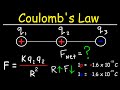
Introduction to Coulomb's Law in Atomic Context This video breaks down Coulomb's law and its application to atoms, focusing on how charge interactions govern electron behavior, shielding, and effective nuclear charge. For a foundational review, see Understanding Electric Charges and Forces: A Comprehensive Guide . ## Core Equation: E = k(Q1 × Q2) / r - k = constant (1/4πε0) - Q1 and Q2 = charges of particles - r = distance between charges The key takeaway: potential energy depends on charge magnitudes and the distance between charged particles. For more examples and calculations, check the Comprehensive Guide to Coulomb's Law with Practical Problem Solutions. ## Like vs. Opposite Charges: Potential Energy Effects ## Like Charges (Positive-Positive or Negative-Negative) - Potential energy is positive - Bringing like charges closer → increases potential energy (unfavorable) - Result: Repulsion – particles move apart to lower potential energy - Think of gravitational potential energy: higher altitude = higher energy; natural state is low ## Opposite Charges (Positive-Negative) - Potential energy is negative - Bringing opposites closer → more negative (lower) potential energy (favorable) - Result: Attraction – particles come together to reach lowest energy state - Separating opposites increases potential energy (less negative) ## Applying Coulomb's Law to Atoms ## Hydrogen (1 proton, 1 electron) - Opposite charges create attraction - Electron wants to be as close as possible to nucleus - Explains the Aufbau principle: electrons fill lowest energy (closest) orbitals first ## Helium (2 protons, 2 electrons) - Two electrons in same orbital are like charges → repel each other - This repulsion counteracts the attractive force of the 2+ nucleus - Shielding effect: electrons partially block each other from the full nuclear pull - Larger nucleus (2+ vs 1+) creates stronger attraction, but repulsion balances it ## Lithium (3 protons, 3 electrons) - Two electrons fill n=1, third electron goes to n=2 (higher energy, farther from nucleus) - Inner two electrons shield outer electron from full 3+ nuclear charge - Outer electron experiences effective nuclear charge less than 3+ - Attraction (to nucleus) and repulsion (from inner electrons) reach a balance ## Why This Matters: Link to Periodic Trends Coulomb's law is the foundation for understanding: - Effective nuclear charge changes across periods - Ionization energy trends (why it increases left to right) - Atomic radius trends (why size decreases across a period) - All periodic properties trace back to charge-distance interactions. For a deeper dive, explore Understanding Electric Fields and Gauss's Law in Physics. ## Key Principles to Remember - Electrons seek lowest potential energy state - Distance (r) and charge magnitude (Q) are equally important - Shielding reduces the effective pull of the nucleus on outer electrons - The balance of attraction and repulsion determines atomic behavior
hello everyone and welcome back my name is Mr kovalt and in this video I'm going to go over Coulomb's law and how it
applies to the atom so let's get into this so here we have Coulomb's law and basically what you have here is you have
energy is equal to some constant one over five four uh pi and then this is some some constant that we don't really
need to get into but it's important that this is just a constant whatever that number is
uh but the really important part of this equation is right here so here you have two charges Q is for some charge so you
have charge number one multiplied by charge number two divided by the distance between those
two charges Okay so this equation really does explain a lot
about what's going on in the atom with regard to electrons and uh shielding effect and stuff like that and effective
nuclear charge and things things of that nature and so we have to understand what's going on and so in the atom we
have charges so we have the nucleus so I have three atoms here and this is the nucleus with one proton this one has
two protons this one has three protons and so when we're thinking about this this uh law here basically what it's
saying is that the energy in the system of these charged particles is going to depend on the charges of the
charged particles and the distance between those charged particles so there's a few things to note here
uh first uh when we have like charges uh the potential energy is going to be
positive and when we're thinking about potential energy in the atom it's very much like potential energy gravitational
potential potential energy when we're thinking about gravitational fields right so I standing on the ground right
now I have a low gravitational potential energy because I am close to the ground I'm uh closer to the Center of the Earth
as compared to like if I was flying in an airplane right so the farther I get away from the
earth the higher my gravitational potential energy so as the distance between me and the Earth increases so
does my potential energy and so the default position or the natural position for me to be in is low potential energy
so if I jump out of the airplane I'm going to be falling to the ground lowering my potential energy increasing
my kinetic energy and uh so on so it's very similar to what we uh see in the atom so when the particles are
absolutely charged they like to be close together but if they are negatively charged or I'm sorry if they are if they
have the same charge then they're not really going to be liking to be close together so what does that mean how does
it how does this law like apply to that so here let's assume we have like charges okay so if we have I'm going to
use different color so if we have two plus charges two positive charges it could be two negative charges too but
if we have two of the same charge then we know that like charges repel they don't really want to be close to
each other so let's assume let's imagine for a moment that we're trying to bring them closer together
so first we notice that these two multiply together if I have a positive charge multiplied by a positive charge
then that's going to make the potential energy positive the uh nature wants to have low
potential energy and that goes the same for anything in the atom so the atom itself is trying to reach the lowest
potential energy possible and so when you have two like charges that are close to each other
um if you lower the distance here if R being the distance between the charges gets smaller right what happens to this
whole thing right if R gets smaller then this whole thing gets larger and therefore the potential energy becomes
more positive so higher potential energy that is not a good system it's not a good uh
um position to be in they don't want we don't want high potential energy so you can understand that when we bring the
two like charges closer together that's raising the potential energy right that is not what uh the system wants the
system wants to go to low potential energy so what are the charges charged particles going to want to do they're
going to want to repel and get away from each other right so getting away from each other lowers the possible the
potential energy so if we make the distance between the light charges lar larger then this gets larger the
denominator gets larger that means this whole thing gets smaller and potential energy goes down so like charges want to
repel they want to remove away from each other in order to lower the potential energy because potential energy is
positive and we want that less and less positive okay same thing for negative charges okay okay well what about
opposite charges right so if I have one of these let me use a different color let's use blue
so what happens when I have a negative charge with a positive charge so we're
multiplying those charges together if I have a negative multiplied by a positive that's going to make the potential
energy negative so now the potential energy is negative so now
what happens with regard to distance so if I decrease the distance between the two
charges if I make them come closer together what happens now same thing happens
right so this gets smaller that means that this whole thing gets larger but now instead of being a larger positive
value It's a larger negative value which means more negative potential energy means lower potential energy so they
want to get closer together that if they if if opposites get closer together that's going to lower the
potential energy and it's going to be uh more they're going to be more happy a more happy system if you want to put it
that way all right so this explains why Opposites Attract they're tracting in order to lower the potential energy so
if we bring those charges apart if we try to separate them and increase the distance
R here gets larger right so when R being a denominator the distance between the the charge particles gets larger then
this whole number here this ratio gets smaller and we end up with a smaller negative number so in this case it's
becoming less negative so another way you could put it is larger potential energy less negative potential energy is
a larger potential energy that is not a favorable system that's not a favorable situation to be in so separating those
absolutely charged particles increases potential energy so they want to be charged they want to be attracted to
each other they want to become closer together and that's going to lower potential energy and again
we want to lower the potential energy or the system or the atom is looking to lower potential energy
okay so with that out of the way if we now fully understand the equation we can now apply it to atoms with various
amounts of electrons so here we have a basic atom this is your hydrogen because we only have one
proton so we have a hydrogen atom in here with the one electron so here the electron and the proton we have one the
nucleus is positive so we the nucleus is one charge right we can think of that as q1
or in this case we could say Q2 is the positive nucleus and q1 is the negative electron and so here we would expect an
attractive Force so an attraction or uh between those two and so being as close as the electron can to the nucleus would
be the lowest possible energy so this explains the outbound principle in the electronic configurations like electrons
want to be in the lowest energy states possible they that means they want to be as close to the nucleus as possible so
lower energy states are closer to the nucleus than farther away as you get farther away energy the potential energy
increases um so that why because the electrons and the protons the nucleus is positive so
they want to be attracted to each other they want to decrease that distance so again negative times positive gives you
negative uh uh uh potential energy um so electrons want to be close to the
positive nucleus so what happens when we put another electron into into the orbit here so
here we have two protons right um so here we have helium
with two protons so the other thing we want to look at is now we have like charges here so we have
two electrons they're in the same orbital they're at the same energy level and so once these two electrons going to
want to do they're going to want to repel each other and so having those two light charges in the same orbital that's
going to if we if we keep them together that's going to raise potential energy so what are these electrons going to
want to do they're going to want to repel each other and move farther farther apart right
so this uh repelling force between the two electrons is going to counteract to some degree the attractive force of the
protons in the nucleus that are attracted to the electrons so not only are the two electrons attracted to the
positive nucleus therefore that they're going to want to come closer to the nucleus in order to lower the potential
energy but the two light charges are going to want to repel in order to also lower that potential energy so there's
some give and take here that there so the repelling force it has to counteract in some degree the positive attractive
force in the nucleus and in that we call that shielding or um
uh the affected nuclear charge so there's some shielding going on here with the repelling Force here
and so these two electrons because they are repelling each other that's going to counteract some of the attractive force
of the nucleus and so these two electrons are not going to quite feel the exact uh strength or the total uh
pulling force of the uh of the nucleus because of the repelling force of the electrons so there is some shielding
going on here so these electrons are kind of shielding each other from from the the attractive force of the nucleus
and so here I also want to point out the fact that we have two protons in this nucleus so
this nucleus has a total of a two plus charge so not only does the uh signs of the charges matter
but the size of the charge itself so larger charges are going to either have a stronger repelling force or a stronger
attractive Force if they're opposite so if they're the same they're going to have a stronger repellent Force if
they're opposite charged they're going to have a stronger attractive Force so here we have a larger nucleus so that
larger nucleus with more protons and it is going to have a stronger attractive force and therefore the potential energy
is going to be greater or less depending on the charges so here we have two protons versus one
so if they're oppositely a Charged then having a larger charge is going to affect and make a larger negative
potential energy okay so this is going to have a greater effect on the uh the pulling of the
electrons so and so we can see here also in this one so this would be lithium with three protons so
we have lithium here and so here you can see uh we have this energy level number one n equals one and now we're adding a
second energy level so energy level number two and now we have electrons in the energy level here and so if we're
looking at this electron here this electron is farther from the nucleus so it's not going to feel have
as much of a pull so because these two electrons are occupying the lower energy this electron has nowhere else to go
except for just to go to the next Higher One which would be your 2s orbital okay and so here this electron is farther
away so it's going to have a higher potential energy but it's as low as it can get so higher potential energy
because it's farther away increasing R okay um
but at the same time you can see that these two electrons are on the inside both of these electrons are going to
have a repelling force on this so you can see this as a two negative so our negative charge will be two
right and then we have a negative charge here right so we have two negative one negative so you can see that these
charges in this in the middle here on the inside are going to have a stronger effect on this electron here on the
outside so that these two electrons have a repelling force on this one therefore it these two are counteracting the
pulling force of the three protons and this nucleus on that electron so there's some counteracting there and so because
of this we call this shielding right these two electrons are shielding the the positive effect of the three protons
on this one if these two electrons were taken away and only that electron was there then the three protons would be
able to have a full effect on that electron without any repulsion or repelling force due to these but because
you have these two electrons there you've got those charges so since there are like charges those
like charges do not want to be close together they are repelling the uh the lower to lower the potential energy they
want to be farther apart but in order to be farther apart um you got to increase the distance but
at the same time you have that attractive force in the nucleus that attractive force is wanting to
attract so this electron also wants to be attracted to the proton and being close together lowers potential energy
so there's that sorry about that so there's that counteracting force and
so because of that counteracting force and all these different attractive and uh repelling forces there's there's got
to be an ultimate balance between these and that's what referred to shielding so increasing the protons in the nucleus
increases the attractive force between the two charges the oppositely charged particles
in this case the nucleus and the electron therefore that's going to decrease the uh or I decrease the
potential energy make it more negative so uh so that's going to allow the
electrons to become closer uh be attracted more strongly but again adding electrons to it will also add a
repulsive force and so in order to lower potential energy they're going to want to get farther apart so understanding
what's going on in the atom with regard to Coulomb's law helps us in the end to understand what's going on with the
periodic trends and so um this is really the background and
understanding of of periodic trends as far as why does the uh the effective nuclear charge change when you go in a
certain way when you go across why does it uh across the periodic table left to right why does
um why does the ionization energy change the way it does why does the size of the atom change the way it does it all comes
back to Coulomb's law so understanding what's going on here will actually explain everything with regard to
periodic trends which I will be talking about in future videos thanks for joining me if you liked this video If
you learned a lot from this video if this was informative please smash that like button
subscribe to my channel hit that notification Bell so you can be notified of other videos I put out and put a
comment in the comment section let me know what you think let me know if you have any questions I can answer thanks
for joining me have a great day
While the 2+ nucleus strongly attracts both electrons (opposite charges), the electrons themselves are like charges that repel each other. Coulomb's law shows this repulsion increases as they get closer. The atom reaches equilibrium when the attractive force from the nucleus balances the repulsive force between the electrons, preventing collapse.
In hydrogen, the single electron and proton are opposite charges, making the potential energy negative. According to Coulomb's law, bringing opposite charges closer (reducing 'r') makes the potential energy more negative (lower), which is energetically favorable. Thus, the electron naturally seeks the proximity that minimizes potential energy, filling the lowest orbital first.
Shielding occurs when inner electrons partially block outer electrons from experiencing the full positive charge of the nucleus. From Coulomb's law, the inner electrons (like charges) repel the outer electron, reducing the net attraction (effective nuclear charge). This balance of attraction to the nucleus and repulsion from inner electrons is defined by charge (Q) and distance (r) interactions.
Lithium has two electrons in the n=1 orbital that shield the third electron from the full 3+ nuclear charge. Coulomb's law shows the net attraction is reduced by the repulsive force from the inner electrons. As a result, the third electron experiences a lower effective nuclear charge and occupies the next shell (n=2) at a greater distance, minimizing repulsive energy.
For opposite charges (e.g., electron + proton), the potential energy is negative. Bringing them closer makes it more negative (lower energy, favorable attraction). For like charges (e.g., two electrons), the energy is positive; pushing them together increases energy (unfavorable repulsion). This explains why electrons avoid each other while being drawn to the nucleus.
Coulomb's law underpins effective nuclear charge: as you move left to right across a period, protons increase, boosting nuclear attraction (higher Q). This pulls electrons in tighter, decreasing atomic radius. The stronger attraction also makes it harder to remove an electron (higher ionization energy). Distance (r) and charge (Q) changes drive all these trends.
The formula is E = k(Q1 × Q2)/r, where k is a constant, Q are charges, and r is distance. Both charge magnitude (Q) and distance (r) are equally crucial. For example, doubling the nuclear charge or halving the distance between charges can dramatically change potential energy, governing how electrons behave—from attraction to repulsion.
Keep this summary
Save it to LunaNotes and it becomes a real note in your library — editable, searchable, and ready to turn into flashcards or a diagram. Free to start.
Save to LunaNotesOr summarise for another video.


32K+ people have turned 65K+ videos into notes
“Very useful tool. I'm using it for the last couple weeks and I'm loving it so far. Makes learning on YouTube a great experience.”
 Bhai Chrome Web Store review
This summary and transcript were automatically generated using AI with the Free YouTube transcript summary tool by LunaNotes.
Related summaries
Comprehensive Guide to Coulomb's Law with Practical Problem Solutions
Explore the fundamentals of Coulomb's Law, including the nature of electric charges, force calculations between point charges, and real-world application problems. Understand how charge magnitude and distance affect force interactions with step-by-step examples and detailed explanations.

Understanding Electric Charges and Forces: A Comprehensive Guide
Explore atomic structure, electric forces, and the principles of electrostatics in this detailed overview.

Ionization Energy: Periodic Table Trend Explained Clearly
In this video, Mr. Covald explains the periodic trend for ionization energy, the energy required to remove an electron from a neutral atom. He covers the key factors of effective nuclear charge and distance from the nucleus, and breaks down how ionization energy increases across a period and decreases down a group.

Orbitals, Energy States, and Electron Configuration Explained
This video clarifies the key difference between Bohr model orbits and quantum mechanical orbitals, explaining how electrons exist as probability clouds rather than fixed paths. You'll learn how energy states dictate electron placement in shells and subshells, and see the electron configurations for hydrogen, helium, and lithium.

Understanding Electromagnetism: The Basics of Forces, Mass, and Charge
Explore the fundamentals of electromagnetism, forces, mass, and charge with in-depth explanations.
Most viewed summaries

A Comprehensive Guide to Using Stable Diffusion Forge UI
Explore the Stable Diffusion Forge UI, customizable settings, models, and more to enhance your image generation experience.

Kolonyalismo at Imperyalismo: Ang Kasaysayan ng Pagsakop sa Pilipinas
Tuklasin ang kasaysayan ng kolonyalismo at imperyalismo sa Pilipinas sa pamamagitan ni Ferdinand Magellan.

Mastering Inpainting with Stable Diffusion: Fix Mistakes and Enhance Your Images
Learn to fix mistakes and enhance images with Stable Diffusion's inpainting features effectively.

Pamamaraan at Patakarang Kolonyal ng mga Espanyol sa Pilipinas
Tuklasin ang mga pamamaraan at patakaran ng mga Espanyol sa Pilipinas, at ang epekto nito sa mga Pilipino.

How to Install and Configure Forge: A New Stable Diffusion Web UI
Learn to install and configure the new Forge web UI for Stable Diffusion, with tips on models and settings.
Found this summary useful?
Take it with you. One click puts it in your own LunaNotes library.
Save to LunaNotes