Introduction to Public Land Management Challenges
As human populations grow, the rapid consumption of natural resources and conversion of forests pose significant environmental issues. Effective management of public lands is crucial to address these challenges and ensure sustainability.
Conservation: Responsible Use and Management
- Definition: Conservation focuses on the sustainable use and responsible management of natural resources.
- Key Principle: Utilize resources to meet present needs without compromising future availability.
- Value Perspective: Environment valued for goods and services it provides to humans.
- Historical Advocate: Gifford Pinchot (1865–1946), founder of the US Forest Service, promoted conservation to enable both human development and resource sustainability.
- Methodology: Avoid destructive practices like clearcutting to maintain timber and other resources. See also Understanding Clear Cutting and Sustainable Forestry Practices for deeper insight.
- Goal: Prevent depletion or permanent destruction, allowing long-term human use.
Preservation: Protecting Natural Integrity
- Definition: Preservation emphasizes maintaining lands in their pristine, untouched state.
- Key Principle: Protect land from exploitation, allowing only non-consumptive human access.
- Value Perspective: Land has intrinsic worth simply by existing, beyond its utility to humans.
- Historical Advocate: John Muir (1838–1914), founder of the Sierra Club, championed preservation of areas like California’s Yosemite Valley.
- Methodology: Restrict human activity to enjoyment and inspiration without resource extraction.
- Goal: Safeguard natural beauty and ecological integrity uninterrupted.
Comparing Conservation and Preservation
| Aspect | Conservation | Preservation | |----------------------|-----------------------------------|------------------------------------| | Resource Use | Sustainable utilization | No resource consumption | | Human Interaction | Managed development | Limited to appreciation and recreation | | Value Focus | Economic and ecological benefits | Intrinsic, inherent value | | Prominent Figures | Gifford Pinchot | John Muir |
Conclusion
Effective public land management balances human needs with environmental stewardship. Understanding the distinct approaches of conservation and preservation helps policymakers, environmentalists, and the public make informed decisions to protect natural resources for current and future generations. For broader context on environmental impacts, see Understanding Deforestation: Causes, Effects, and Solutions.
As the human population grows and grows, natural resources are being used at a rapid rate and large areas of forest are
being converted for human use. How do you think public land should be managed to deal with these types of
environmental issues? Over the years, there have been many opinions on how to manage public lands. Two of the major
points of view include conservation and preservation of the environment. People often use these two terms
interchangeably when in fact they are two very different views and methods for managing land. Let's explore these two
terms and how they vary from one another. Some people believe that public land should be managed by the method of
conservation. Meaning that the environment and its resources should be used by humans and managed in a
responsible manner. These types of people see the value of the environment as the goods and
services that it can provide to people. This viewpoint requires that the environment be used in a way that is
sustainable and ensures that the natural resources will be used in a manner that will meet the present-day needs for the
resource without jeopardizing the supply of the resource for future generations. By using the environment sustainably,
the environment and the natural resources it provides will not be depleted or destroyed permanently and
will be available for human use for a very long time. If people do not manage the land
properly and the resources are not being used sustainably, then the environment can be destroyed and the conservation
method will have failed. Gford Pincho who lived from 1865 to 1946 was a leader in the conservation
movement. As the United States expanded and more land was being converted for human use,
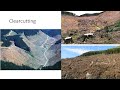
Pincho was bothered by the method used in transforming the land. At the time, most forests were being clearcut, which
is when all of the trees are removed at the same time. Pincho did not like this method because he saw the forest as a
valuable resource of timber and thought that it should be managed in a way that enabled human development of the land
but also ensured use of the natural resources. He later founded the organization that would become the US
forest service and served as chief of the organization while Theodore Roosevelt was president. While Pincho
was in charge, the federal government adopted the conservationist method for managing land and drastically increased
the amount of land managed by the government. On the other side of the argument of how to effectively manage
public land are the preservationists. The method of preservation is much stricter than the conservationist
approach. Under preservation of the environment, lands and their natural resources should
not be consumed by humans and should instead be maintained in their pristine form.
Preservationists believe that humans can have access to the land but should only utilize it for its natural beauty and
inspiration. They think that the value of the land is not what you can use from it, but
instead that land has an intrinsic value, meaning that it is valuable in itself simply by existing.
One of the most famous preservationists in US history is John Muer. John Mure was a Scottish immigrant who lived from
1838 to 1914 and had a large admiration for California's Yusede Valley. Similarly to Gford Pincho, Mure was
motivated by the deforestation and destruction of land as the human population moved west across the
country. Mure was a strong advocate for the complete protection of land and believed
that people should only use the environment for enjoyment and not as a resource for goods.
Mir was involved in the creation of the Sierra Club in 1892, which is an environmental organization
that advocates for the preservation and protection of public lands. The
Conservation involves the responsible and sustainable use of natural resources to meet human needs without compromising future availability, while preservation focuses on protecting land in its untouched, natural state with minimal human interference beyond enjoyment and inspiration.
Gifford Pinchot, founder of the US Forest Service, championed conservation by promoting sustainable resource use to support both human development and environmental health. John Muir, founder of the Sierra Club, advocated for preservation, emphasizing protecting natural areas like Yosemite Valley in their pristine condition.
Conservation employs sustainable management practices that use resources like timber without destroying ecosystems—such as avoiding clearcutting—to maintain continuous availability and ecological balance, ensuring resources remain for future generations.
Preservation values land for its intrinsic worth, safeguarding natural beauty and ecological integrity from human exploitation. By limiting activities to non-consumptive uses like recreation and inspiration, preservation helps maintain biodiversity and ecosystem functions undisturbed.
Recognizing the distinct goals and methods of conservation and preservation enables policymakers and environmentalists to balance human needs with environmental protection, crafting strategies that either sustainably utilize resources or protect natural areas wholly, depending on conservation priorities.
In conservation, human interaction includes managed development and sustainable resource use, while preservation restricts human activity primarily to appreciation and recreation without resource extraction or development to maintain natural conditions.
For deeper insight into sustainable forestry and methods to avoid harmful practices like clearcutting, you can explore resources such as 'Understanding Clear Cutting and Sustainable Forestry Practices' available online, which elaborates on techniques to balance timber use with environmental sustainability.
Keep this summary
Save it to LunaNotes and it becomes a real note in your library — editable, searchable, and ready to turn into flashcards or a diagram. Free to start.
Save to LunaNotesOr summarise for another video.
This summary and transcript were automatically generated using AI with the Free YouTube transcript summary tool by LunaNotes.
Related summaries
Understanding Clear Cutting and Sustainable Forestry Practices
Explore the contrasts between clear cutting and sustainable forestry, focusing on their effects on ecosystems and resource management.
Montana Forest Management: Protecting Ecosystems and Communities
Explore how Montana's state forestry programs actively manage private and public forests to reduce wildfire risks, support wildlife habitats, and protect clean water. Learn from landowner experiences and see how collaborative strategies and cost-sharing contribute to healthier, safer forests across diverse ownerships.
Understanding Peatlands: The Vital Ecosystem
Explore the importance of peatlands as a unique ecosystem and their role in environmental conservation.

Understanding Minerals and Energy Resources: Comprehensive Guide
Explore the significance, types, and conservation methods for minerals and energy resources in this informative guide.
Understanding Deforestation: Causes, Effects, and Solutions
Explore the causes and impacts of deforestation on ecosystems and climate change, and discover solutions to combat this global issue.
Most viewed summaries

A Comprehensive Guide to Using Stable Diffusion Forge UI
Explore the Stable Diffusion Forge UI, customizable settings, models, and more to enhance your image generation experience.

Kolonyalismo at Imperyalismo: Ang Kasaysayan ng Pagsakop sa Pilipinas
Tuklasin ang kasaysayan ng kolonyalismo at imperyalismo sa Pilipinas sa pamamagitan ni Ferdinand Magellan.

Mastering Inpainting with Stable Diffusion: Fix Mistakes and Enhance Your Images
Learn to fix mistakes and enhance images with Stable Diffusion's inpainting features effectively.

Pamamaraan at Patakarang Kolonyal ng mga Espanyol sa Pilipinas
Tuklasin ang mga pamamaraan at patakaran ng mga Espanyol sa Pilipinas, at ang epekto nito sa mga Pilipino.

How to Install and Configure Forge: A New Stable Diffusion Web UI
Learn to install and configure the new Forge web UI for Stable Diffusion, with tips on models and settings.
Found this summary useful?
Take it with you. One click puts it in your own LunaNotes library.
Save to LunaNotes